
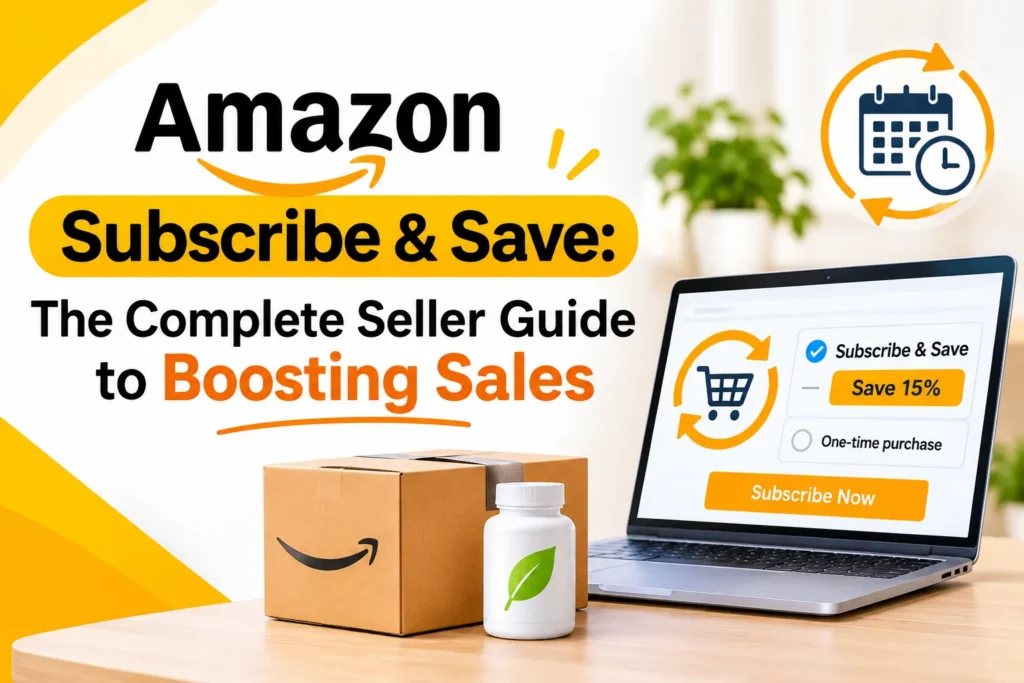
Most Amazon sellers spend their budget chasing the next new customer. The smartest sellers spend it making sure the customer they already won buys again, and again, without having to be asked. That is exactly what Amazon Subscribe and Save is built to do.
If you sell anything people use up, wear out or run out of (supplements, pet food, skincare, cleaning products, coffee, baby care, vitamins, stationery, grooming products), Subscribe and Save can quietly become one of the most profitable levers in your account. It turns a one-off purchase into a recurring order, gives you demand you can forecast instead of guess, lifts your sales velocity, and lowers the cost of every sale after the first.
At EcomRanker, we are a full-service Amazon agency working with brands across the UK, USA, UAE and India, and we see the same pattern again and again: brands that treat Subscribe and Save as a strategy outperform brands that treat it as a checkbox. This guide shows you how to be the first kind of brand.
By the end of this guide you will know:
- What the Amazon Subscribe and Save program is and how it works for both shoppers and sellers
- How it increases sales, visibility and customer lifetime value
- Which products qualify and how enrolment works now that the program is largely automatic
- How discounts and Subscribe and Save coupons work, and how to model your margins
- How to combine Subscribe and Save with PPC, listing optimisation, promotions and inventory planning
- Which reports and KPIs to track in Seller Central
- The most common mistakes that quietly kill subscription growth
- A practical 30-day action plan you can start this week
Key Takeaways
- Subscribe and Save converts one-time buyers into recurring revenue. Shoppers choose a delivery schedule and Amazon ships automatically, usually at a discount.
- Enrolment is mostly automatic. Amazon decides eligibility using signals such as category, average selling price, sales performance, fulfilment history and in-stock rate, so your operations directly affect your access.
- Amazon funds a base discount on qualifying orders and you can add more. Sellers can fund extra discount tiers or run Subscribe and Save coupons to attract new subscribers.
- Subscriptions make demand predictable. That means smarter inventory planning, fewer stockouts and steadier cash flow.
- It supports organic ranking. Higher, steadier sales velocity helps your listing stay competitive in search.
- It works best when the whole account is healthy. Listing quality, reviews, advertising and inventory all feed the subscription flywheel.
What Is Amazon Subscribe and Save?
Amazon Subscribe and Save is a program that lets customers set up recurring deliveries of eligible products on a schedule they choose, for example every month, every two months or every six months. In return for committing to the repeat order, the customer receives a discount, and Amazon handles the reordering automatically. The shopper can skip, pause, change frequency or cancel at any time, which keeps the commitment feel light.
For sellers, Amazon describes the program as a way to secure repeat sales and build brand loyalty. Instead of paying for ads again and again to win the same customer, you win them once and Amazon brings them back on a schedule.
Think of it this way:
- Without Subscribe and Save, a customer buys your product, uses it, and then has to remember to come back. Many forget, or buy a competitor’s product that happens to appear first in search.
- With Subscribe and Save, the reorder is already scheduled. The customer has to take action to leave, not to stay. Inertia works in your favour.
That single behavioural shift is why subscription-style selling is so powerful. It turns a fragile, ad-dependent purchase cycle into a more stable, compounding one.
Where Subscribe and Save sits inside the Amazon ecosystem
Subscribe and Save is not a separate marketplace or a separate account. It is a feature layered onto your existing listings. Your product detail page shows a Subscribe and Save option beside the one-time purchase option when your ASIN is eligible. The subscription order flows through the same fulfilment, inventory and customer-service systems you already use. That is good news, because you do not need to build anything new. It is also a warning: a weak listing, poor stock availability or slow fulfilment will limit how much value you extract from it.
How Does Subscribe and Save Work for Customers?
Understanding the shopper journey helps you optimise for it. The experience is simple:
- The shopper finds your product through search, ads, a brand page or a recommendation.
- They see two options on the listing: a one-time purchase or Subscribe and Save with a discount shown.
- They pick a delivery frequency, such as monthly, and place the first order.
- Amazon ships the first order immediately and then schedules the next ones automatically.
- Before each shipment, Amazon sends a reminder so the customer can edit, skip or cancel.
- The cycle repeats until the customer changes or ends the subscription.
From the customer’s point of view, the value is convenience plus savings. From your point of view, every active subscription is a small, recurring revenue stream that you do not need to pay to re-acquire.
The psychology behind subscriptions
Three behavioural principles explain why Subscribe and Save works so well for the right products:
- Default bias. People tend to stick with the option that requires no new decision. A scheduled delivery is a default.
- Loss aversion. Customers feel the discount as something they would lose by cancelling.
- Reduced friction. Running out of a product is annoying. Automatic replenishment removes the problem.
When your offer lines up with these three forces, subscription share tends to rise naturally.
How Does Subscribe and Save Work for Sellers?
On the seller side, the program has four moving parts: eligibility, discounts, fulfilment and reporting.
1. Eligibility
Amazon decides which ASINs can offer Subscribe and Save. According to Amazon’s own seller information, products become eligible based on factors including their category, average selling price, sales performance, fulfilment history and in-stock rate. Many products are enrolled automatically once they meet the criteria, so you generally cannot manually upload products to the program the way sellers once could.
2. Discounts
Amazon funds a standard discount on Subscribe and Save orders that meet its conditions (for example, a discount applied when a customer receives five or more items in one delivery). Sellers can also fund an additional discount of 5% or 10% to make the subscription offer more attractive and win more subscribers. We cover the maths in detail further down.
3. Fulfilment
Historically, Subscribe and Save was closely tied to Fulfilled by Amazon (FBA). More recently, Amazon has extended Subscribe and Save to Fulfilled by Merchant (FBM) sellers, which opens the program to brands that ship their own stock. If you are an FBM seller, check your Seller Central account and Amazon’s current program rules to confirm whether your ASINs qualify in your marketplace.
4. Reporting
Seller Central includes Subscribe and Save reporting, including a performance report and a forecast report that estimates upcoming subscription orders for the next several weeks. These are your planning tools, and we will show you how to use them.
How Subscribe and Save Boosts Your Amazon Sales
The program lifts results in several connected ways. Let’s go through each one, because each has a different implication for how you run your account.
1. Recurring revenue and higher customer lifetime value
The most obvious benefit is repeat revenue. A customer who buys once at a given price is worth that price minus costs. A customer on a monthly subscription for eight months is worth roughly eight times the revenue, with a single acquisition cost.
Here is a simple illustration. Suppose your product sells for £25 and you spend £8 in advertising to win each new customer.
- One-time buyer: £25 revenue, £8 acquisition cost.
- Subscriber who stays six deliveries: £150 revenue (before discount), still £8 acquisition cost.
Even after a subscription discount, the lifetime value gap is enormous. This is why brands that understand LTV can afford to bid more aggressively on advertising than competitors who only measure first-order profit. If you want help building that kind of model, our Amazon PPC management team does it for clients every week.
2. Predictable, forecastable demand
At 1,000 units a month, moving even 15% of volume onto subscriptions gives you 150 units of demand you can plan around rather than guess. Multiply that across a catalogue and the effect on operations is large:
- Fewer emergency air shipments
- Better purchase-order timing with manufacturers
- Lower risk of both stockouts and overstock
- More confident cash-flow planning
Predictability is an underrated competitive advantage. Many sellers lose rank because they run out of stock at the wrong moment. Subscription demand helps you avoid that.
3. Stronger sales velocity and organic ranking
Amazon’s search algorithm rewards products that sell consistently. Subscribe and Save orders add steady, repeat sales to your velocity, which can help support your organic position over time. Amazon’s own seller materials highlight improved search visibility and organic reach as benefits of increased subscription sales.
Be realistic here: Subscribe and Save is not a ranking hack. Nobody outside Amazon publishes the exact weighting. But steady repeat sales, strong conversion and good availability are all positive signals, and subscriptions help with all three.
4. Lower customer acquisition cost over time
Every reorder from a subscriber is a sale you did not need to pay advertising to win. As the share of subscription revenue grows, your blended advertising cost of sale (ACOS) and total advertising cost of sale (TACoS) tend to fall. That frees budget to invest in new customer acquisition, new products or new marketplaces.
5. More visibility on the listing
A visible Subscribe and Save discount can make your offer look better than a rival’s on the same results page. Where your listing displays the savings, it can improve click-through and conversion, particularly in price-sensitive consumable categories. Industry sources also report that eligible products may receive additional visibility within Amazon, although Amazon does not guarantee placement.
6. Retention and brand loyalty
Subscribers see your brand every time a delivery arrives. That repeated exposure builds familiarity and trust, which supports reviews, referrals and cross-sell. It is also a quiet defence against competitors: a subscriber is much less likely to switch to a rival when a new advertisement appears.
7. Better cross-sell and bundle opportunities
Subscribers are your most engaged audience. Use Amazon Posts, Brand Stores and Sponsored Brands campaigns to introduce them to related products, such as refills, larger pack sizes or complementary items.
8. A practical proof point
Amazon’s seller programme page features a brand that reported Subscribe and Save customers making up more than 20% of its Amazon sales. Another case study published by a third party describes a Health and Household brand whose Subscribe and Save share grew to around 20% of its Amazon sales in a year, with lower acquisition costs and more predictable revenue. Results vary widely by category, price and execution, but the direction of the effect is consistent.
Which Products Are Eligible for Subscribe and Save?
Eligibility is the question we hear most. The honest answer is that Amazon decides, and Amazon does not publish an exact formula. What it does publish are the broad factors:
- Product category. Some categories suit subscriptions better than others.
- Average selling price. Very high-priced items are less likely to be subscription candidates.
- Sales performance. Proven demand matters.
- Fulfilment history. Reliable, on-time shipping supports eligibility.
- In-stock rate. Frequent stockouts hurt.
Third-party analyses also point to a strong ASIN sales history as an important factor, which fits with the sales performance signal Amazon names.
Categories where Subscribe and Save tends to perform best
These categories are widely associated with replenishment behaviour:
- Health and Household
- Beauty and Personal Care
- Grocery and Gourmet Food
- Baby
- Pet Supplies
- Vitamins, Minerals and Supplements
- Office Supplies
- Cleaning and laundry products
- Some Toys, Musical Instruments and hobby consumables
Category availability can change, and rules differ across Amazon UK, Amazon US, Amazon UAE and Amazon India, so always check your marketplace.
What makes a product a good subscription candidate?
Ask yourself five questions:
- Is it consumed or replaced regularly? Think days, weeks or a few months.
- Is it low-consideration after the first purchase? The shopper already trusts it.
- Is the price point comfortable for repeat buying? Mid-range and lower prices work best.
- Can you reliably keep it in stock? Subscribers expect it to arrive.
- Does the unit economics allow a discount? If margin is razor-thin, subscriptions can hurt.
If you answer yes to most of these, your product is a strong candidate. If not, focus your effort on other growth levers instead.
How to Get Your Products Into Subscribe and Save
Because the program is now largely an auto-enrolment system, your job is less about filling in a form and more about earning and protecting eligibility. Here is the practical process.
Step 1: Check your account health
Before anything else, confirm your account is in good standing. Fix open policy warnings, address late shipment issues and resolve any listing suppressions. Amazon is far more willing to promote sellers it trusts.
Step 2: Review the Subscribe and Save section in Seller Central
Log in to Seller Central and open the Subscribe and Save area. Here you can see which ASINs are eligible or enrolled, the discount settings that apply and the reports available. Menu names change from time to time, so search for Subscribe and Save inside Seller Central if the path has moved.
Step 3: Make sure inventory is available
Stockouts are the most common reason strong products lose subscription momentum. Keep enough inventory to cover both normal sales and the subscription forecast. If you use FBA, send stock in well ahead of seasonal peaks. If you use FBM, make sure your handling times are realistic and consistent.
Step 4: Strengthen the sales signals
Amazon looks at performance. Build sales history through strong listings, targeted advertising and solid reviews so that your ASIN looks like a good subscription candidate.
Step 5: Decide your discount strategy
Once eligible, choose whether to rely on Amazon’s standard funding or add your own extra discount or coupon. We unpack that decision in the next section.
Step 6: Monitor and iterate
Track subscriber growth, churn and revenue share monthly. Adjust your pricing, promotions and advertising based on what the data shows.
A note for FBM sellers
If you fulfil orders yourself, the extension of Subscribe and Save to FBM sellers is a real opportunity, but it raises the bar on your own operations. Subscribers expect predictable delivery. Late or missed shipments lead to cancellations and can damage your seller metrics. Make sure your logistics can handle recurring schedules before leaning into the program. If you need help evaluating whether FBA or FBM is better for your catalogue, our Amazon account management team can walk you through it.
Subscribe and Save Discounts and Coupons Explained
Discounts are where margin and growth meet, so it is worth understanding them clearly.
Amazon-funded discount
Amazon funds a standard discount on eligible Subscribe and Save orders. Amazon’s seller programme page states that it funds a 5% discount on orders of five or more items, and lets sellers fund an additional discount to help grow sales. Because discount rules can change, always confirm the current structure in Seller Central for your marketplace.
Seller-funded additional discount
Sellers can choose to fund an extra 5% or 10% on top of the standard discount. This makes your listing more attractive and can increase the subscription conversion rate. It also reduces your margin on every subscription order, so use it deliberately.
Subscribe and Save coupons
Subscribe and Save coupons let you offer a targeted incentive specifically to customers who subscribe. They are typically used to win new subscribers rather than to discount every future shipment. Amazon has highlighted these coupons as an accelerator for subscriber growth in its seller materials. Coupons carry their own setup and fee structures that vary by marketplace, so review the current terms before launching.
Promotions that can stack with Subscribe and Save
Seller promotions can apply to products in the program, which makes them useful for acquiring new subscribers during high-demand periods. Industry guidance suggests pairing time-limited events such as Lightning Deals or seasonal promotions with subscription offers to capture new subscribers when traffic is high. Check each promotion’s eligibility rules, as not every offer combines with every other.
The Margin Maths: Can You Afford Subscribe and Save?
Before you add any seller-funded discount, run the numbers. A subscription is only a good deal if lifetime profit beats what you would have earned from one-off sales.
Here is a simple worked example. All figures are illustrative, so replace them with your own.
- Selling price: £20.00
- Cost of goods, fulfilment and Amazon fees: £12.50 (so profit before ads and discount is £7.50)
- Total subscription discount to the customer: 10% (£2.00)
- Profit per subscription order after discount: £5.50
- Advertising cost to acquire the customer: £6.00
Now compare two customers:
- One-time buyer: £7.50 profit minus £6.00 ad cost = £1.50 profit in total.
- Subscriber who completes five deliveries: 5 x £5.50 = £27.50 profit minus £6.00 ad cost = £21.50 profit in total.
The subscriber is worth over fourteen times more, even after giving away a 10% discount. That is the logic behind Subscribe and Save: you trade a little margin per order for a lot more orders per customer.
The break-even rule of thumb
A useful check is the break-even retention number: how many deliveries does a subscriber need to complete for the discount to pay for itself? Divide your first-order acquisition cost by the profit lost to the discount on each order. If you lose £2.00 per order to the discount and the same customer would not otherwise reorder, any subscriber who stays two or more deliveries is already ahead of a one-time buyer. The real risk is not the discount. It is churn and stockouts.
Factors that change the maths
- Fees. Referral and fulfilment fees can change by marketplace and category. Always model with your current fee schedule.
- Cannibalisation. Some customers would have bought again at full price. Track your repeat-purchase rate before and after you push subscriptions so you understand how much of the subscription volume is genuinely incremental.
- Returns and cancellations. Include them in your model.
- Coupon costs. Coupons may carry per-redemption fees depending on the marketplace, so include them in acquisition cost.
If you want a second pair of eyes on your numbers, our team can build a profitability model for your catalogue as part of our Amazon advertising management services.
Optimise Your Listing to Win More Subscribers
Even the best discount will not convert if the listing does not sell. Treat your product detail page as the engine of your subscription growth.
Titles and bullets that signal replenishment
Shoppers who subscribe are thinking about ongoing use. Make that easy to imagine:
- State the pack size and how long it lasts, for example a 60-day supply.
- Highlight daily-use benefits, not just one-off outcomes.
- Mention refill or multipack options where relevant.
- Use language shoppers actually search, such as monthly supply, refill and bulk.
Images that explain the value
Add an image that shows how long one pack lasts, how it fits into a routine, or the saving on the larger pack. Use lifestyle images that show repeated use. Strong visuals raise conversion across the board and are especially helpful for consumables, where shoppers want proof of results. Our Amazon creative and listing optimisation specialists build image stacks designed around exactly this logic.
A+ Content and Brand Story
Use A+ Content to reinforce trust and explain the long-term benefit of consistent use. Comparison charts, usage timelines and routine guides all help customers see why a recurring order makes sense. Brand Story builds familiarity that supports loyalty.
Reviews and ratings
Customers rarely subscribe to a product they do not trust. Build social proof steadily, respond to negative feedback quickly, and use Amazon’s compliant review-request tools. If you are comparing tools to help, see our guide to the best Amazon review management software.
Price and pack architecture
Subscriptions favour packs that match real usage cycles. A 30-day pack suits a monthly schedule, and a 90-day pack suits quarterly buyers. Test pack sizes so that the subscription price per unit looks clearly better than the one-time price without destroying margin.
Keep Buy Box ownership
Subscribe and Save is tied to the offer that wins the Buy Box. Monitor unauthorised resellers, pricing conflicts and stock gaps that could shift the Buy Box away from you. Brand Registry and good account management make this much easier.
Pair Subscribe and Save With Amazon PPC
Advertising and subscriptions work best together. Ads win the first order. Subscribe and Save turns it into many.
Bid with lifetime value in mind
Traditional ACOS targets only look at first-order profit. A brand with a healthy subscription rate can justify a higher ACOS on new-customer campaigns, because the long-term payback is better. Calculate a blended target that reflects expected repeat orders. Our Amazon PPC management guide explains how to set those targets step by step.
Campaign tactics that support subscriptions
- Sponsored Products on core replenishment keywords. Capture people already searching for the product type.
- Sponsored Brands with a Store spotlight. Introduce the full range and subscription-friendly multipacks.
- Sponsored Display for retargeting. Remind past viewers and buyers about refills.
- Defensive campaigns on your own brand terms. Protect subscribers from competitor conquesting.
- Amazon DSP for upper-funnel and remarketing. Retarget buyers who are due for a reorder. Learn more in our guide to Amazon DSP for sellers.
Use Brand Analytics and customer data
Look at repeat-purchase behaviour in Brand Analytics, where available to you. Identify the products with the shortest repurchase cycle and focus your subscription push there first.
Measure the right metrics
Track TACoS, new-to-brand orders, repeat-purchase rate and subscription share alongside ACOS. A rising subscription share with a stable TACoS is a sign the strategy is working.
Promotions and Coupons That Grow Your Subscriber Base
Promotions are how you create the first subscription. Plan them as part of the calendar, not as one-off experiments.
Subscribe and Save coupons for new subscribers
Use coupons to nudge hesitant shoppers into their first subscription. Because the incentive is aimed at subscription sign-ups, it avoids permanently discounting your one-time price.
Lightning Deals and seasonal events
High-traffic moments such as Prime Day, Black Friday, Cyber Monday and January wellness peaks are ideal times to build your subscriber base, because traffic is high and shoppers are in a buying mindset. Pair an event with a visible subscription discount to capture subscribers while attention is at its peak. Remember to build stock in advance.
Bundles and multipacks
A well-designed bundle can lift average order value and make the subscription more attractive. Make sure the bundle’s economics still work after the discount.
Social and off-Amazon traffic
Direct email, social, influencer and content traffic to your listing with Amazon Attribution tags. Customers who arrive from your own audience are often more likely to subscribe because they already know your brand.
Do not over-discount
Deep, permanent discounts train customers to wait for deals and erode brand value. Test one level at a time, measure retention and keep the lowest discount that achieves your subscription goals.
Inventory and Forecasting: Where Subscriptions Are Won or Lost
Subscribers expect the product to arrive on time, every time. A stockout can cause a skipped or cancelled subscription, and a lost subscriber is costly to replace.
Use the forecast report
Amazon’s Subscribe and Save forecast report shows expected upcoming subscription orders for roughly the next eight weeks. Treat it as a floor for demand, then add your normal non-subscription sales, promotions and seasonality on top.
Build a safety buffer
Add a safety stock margin for subscription ASINs. The right buffer depends on your supplier lead time and how volatile your demand is. For most sellers, a larger buffer on high-subscription SKUs is cheaper than the cost of lost subscribers and recovery advertising.
Align shipments with the demand curve
Because subscription demand is more predictable, you can often move from emergency shipments to scheduled replenishment. That reduces freight costs and improves cash-flow planning.
Watch storage limits and fees
Holding extra stock has a cost. Balance your safety buffer against storage limits and long-term storage fees so you do not trade one problem for another.
Packaging and prep compliance
Poor packaging or incorrect prep creates damages and delays that frustrate subscribers. Review our guide to Amazon packaging requirements to avoid avoidable problems.
The Subscribe and Save KPIs and Reports to Track
What you measure shapes what you improve. Build a simple monthly dashboard with these metrics.
| Metric | Why it matters | What to watch for |
| Subscription share of sales | Shows how much revenue is recurring | Steady growth month on month |
| Active subscribers / recurring orders | Measures the size of your base | Net adds after cancellations |
| Churn / cancellation rate | Reveals satisfaction and stock issues | Spikes after stockouts or price changes |
| Average subscription length | Drives lifetime value | Longer is better |
| Repeat-purchase rate | Shows loyalty beyond subscriptions | Compare subscribers vs one-time buyers |
| Subscription conversion rate | How many shoppers choose to subscribe | Test discounts and listing changes |
| TACoS | Total ad cost vs total sales | Should fall as subscriptions grow |
| In-stock rate | Protects eligibility and retention | Keep consistently high |
| Forecast vs actual | Improves planning accuracy | Large gaps signal planning issues |
Where to find the data in Seller Central
Look in the reports area of Seller Central for the Subscribe and Save Performance report and the forecast report. Some data also appears in Sales Diagnostics and Business Reports. Menu locations change from time to time, so search for Subscribe and Save inside Seller Central if you cannot find them.
Build a feedback loop
Review your numbers monthly. If subscription share is flat, test the listing, the discount or the pack size. If churn is high, look for stockouts, product quality issues or delivery problems. If the forecast is rising, adjust your purchase orders early.
Category Playbooks: How to Use Subscribe and Save by Product Type
Supplements and vitamins
Predictable daily use makes this a natural fit. Emphasise the number of days per pack, show clear results and keep compliance claims careful. Subscription share can be high when the product works and the pack lasts a month.
Pet supplies
Food, treats, litter and flea products are consumed on a schedule. Highlight pet-size guidance and monthly supply calculations.
Beauty and personal care
Skincare, haircare and grooming products work well when the routine is built into the listing. Use A+ Content to show the regimen and its timeline.
Baby products
Nappies, wipes and baby care items are need-based and often brand-loyal. Reliability matters most, so protect your stock.
Household and cleaning
Low-consideration, frequently repurchased items convert well. Value packs and refills shine here.
Grocery and gourmet
Coffee, tea, snacks and pantry staples all suit subscriptions. Watch shelf life and storage rules.
Office and hobby consumables
Ink, paper, art supplies and similar items suit scheduled deliveries, particularly for business buyers.
Common Subscribe and Save Mistakes (and How to Avoid Them)
- Treating it as set-and-forget. Eligibility, discounts and rules change. Review the program monthly.
- Running out of stock. Stockouts damage eligibility, lose subscribers and hurt rank.
- Over-discounting. Cutting margin deeper than needed gives away profit for no extra retention.
- Ignoring listing quality. A weak page will not convert shoppers into subscribers.
- Measuring only first-order ACOS. You miss the long-term value and under-invest in growth.
- Choosing the wrong products. Not every product suits a subscription. Focus on replenishable items.
- Forgetting FBM readiness. If you self-fulfil, unreliable shipping will drive cancellations.
- Skipping the reports. Without data you cannot improve retention or plan inventory.
- Neglecting reviews and quality. Subscribers who are disappointed cancel.
- Not testing. Test one variable at a time (discount level, pack size, image, price) so you know what worked.
Subscribe and Save Across Marketplaces: UK, USA, UAE and India
Program availability, discount tiers, eligible categories and coupon rules differ by marketplace. Here is how to approach each region.
- Amazon UK. Consumables and household categories are strong. Pay close attention to delivery promises and VAT-inclusive pricing when modelling margins.
- Amazon USA. The most mature market, with the broadest category coverage and the most advanced seller tools. Competition is also intense, so execution matters.
- Amazon UAE. A growing market where reliable fulfilment and clear localisation (including Arabic where helpful) can set you apart.
- Amazon India. Price sensitivity is high and programs differ from other regions, so confirm what is available and model margins carefully. Our Amazon India profit calculator can help.
Because rules change, always confirm the current terms inside Seller Central for each marketplace. If you sell across several regions, our marketplace management services keep your strategy consistent while adapting to local rules.
Your 30-Day Subscribe and Save Action Plan
Week 1: Audit
- Check account health and resolve any warnings.
- Identify your replenishable ASINs and their repeat-purchase potential.
- Confirm which ASINs are eligible or enrolled in each marketplace.
- Build a margin model including discount and coupon scenarios.
Week 2: Fix the foundations
- Improve titles, bullets, images and A+ Content on target ASINs.
- Align pack sizes with usage cycles.
- Fix stock gaps and set safety buffers.
Week 3: Launch and promote
- Choose a discount level and test it on a small group of ASINs.
- Launch a Subscribe and Save coupon for new subscribers.
- Update PPC campaigns with a lifetime-value target.
Week 4: Measure and refine
- Review subscription share, conversion and early churn.
- Compare forecast and actual orders.
- Scale what works and pause what does not.
Repeat the cycle every month. Subscription growth compounds, so small gains early become big gains later.
How EcomRanker Helps You Grow With Subscribe and Save
EcomRanker is a full-service Amazon agency, founded in 2017 and operating across the UK, USA, UAE and India marketplaces. We help brands turn programs like Subscribe and Save into measurable, compounding growth by combining:
- Account and program strategy. Eligibility audits, discount modelling and promotion calendars.
- Advertising. PPC and DSP campaigns built around lifetime value, not just first-order ACOS.
- Listing and creative. Titles, images and A+ Content designed to convert shoppers into subscribers.
- Inventory and operations support. Forecast-driven planning to protect availability.
- Reporting. Clear dashboards that show subscription share, churn and profit.
Ready to find out how much recurring revenue is hiding in your catalogue? Talk to the EcomRanker team for a free account review.
Frequently Asked Questions About Amazon Subscribe and Save
What is Amazon Subscribe and Save for sellers?
How do I enrol my products in Subscribe and Save?
Which products qualify for Subscribe and Save?
How much does Subscribe and Save cost sellers?
Can FBM sellers use Subscribe and Save?
What are Subscribe and Save coupons?
Does Subscribe and Save improve organic ranking?
How do I track Subscribe and Save performance?
What happens if I run out of stock?
Is Subscribe and Save worth it for every product?
Can I run Subscribe and Save alongside PPC?
How long does it take to see results?
Conclusion
Amazon Subscribe and Save rewards brands that think beyond the first sale. It lifts lifetime value, steadies demand, supports organic visibility and lowers the cost of every reorder. But it does not work in isolation. Strong listings, healthy inventory, smart advertising and careful margin management all decide how much you gain.
Start with the basics: audit eligibility, model your margins, protect your stock and improve your listings. Then layer on promotions, coupons and lifetime-value-based advertising. Measure monthly and keep refining.
If you would like an expert team to build this for you, EcomRanker is ready to help.
Next step: Book a free Amazon account review with EcomRanker