
Funnel-Based Advertising Strategy

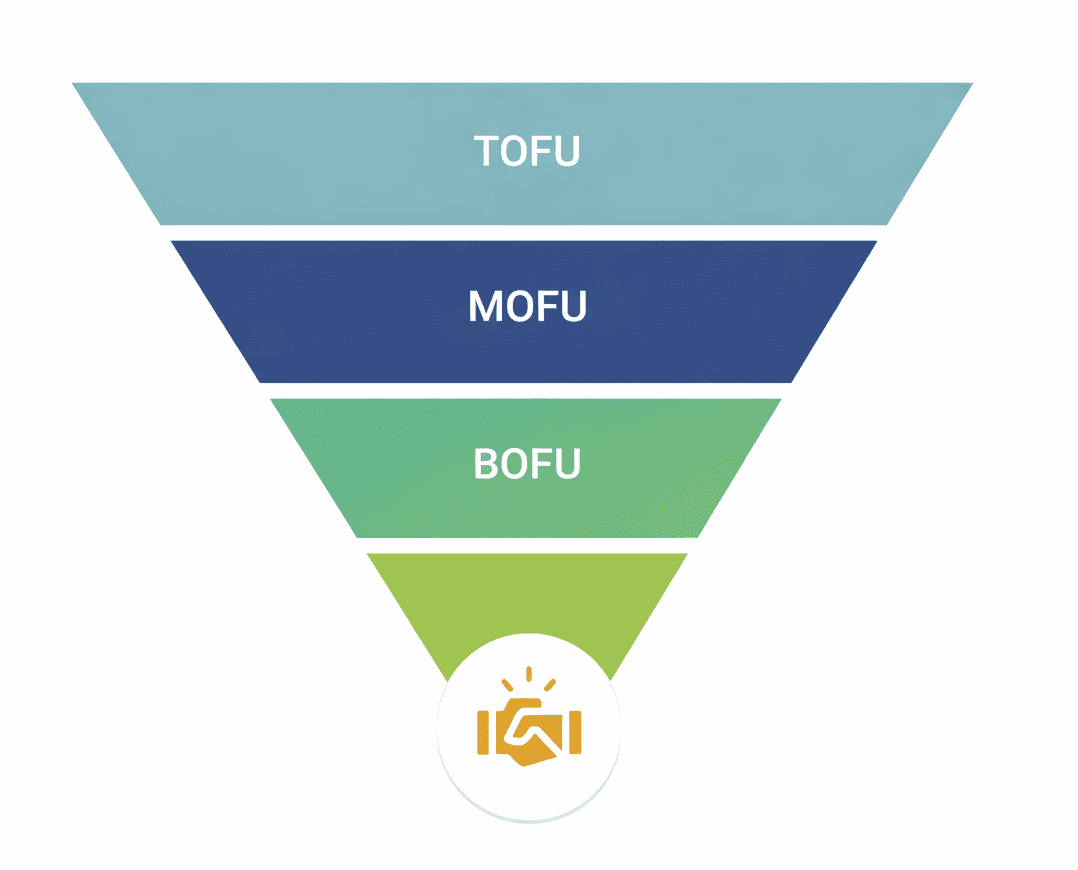
Minimal funnel-based marketing illustration on a white background showing three stacked stages—TOFU at the top, MOFU in the middle, and BOFU at the bottom—each in distinct colors, narrowing downward to a circular handshake icon representing conversion and trust

Funnel-Based Advertising Strategy for Amazon Sellers

A Full-Funnel Amazon Ads Framework Built for Scalable, Profitable Growth

Introduction: Why Amazon Ads Without a Funnel Fail

Most Amazon sellers approach advertising the wrong way. They launch Sponsored Products, increase bids, burn budget, and hope sales improve.

Sometimes they do.
Most of the time, TACoS increases, ACOS becomes unstable, and growth plateaus.

That’s because Amazon advertising is not a single campaign problem — it’s a funnel problem.

At EcomRanker, we don’t “run ads.”
We build funnel-based Amazon advertising strategies that align visibility, consideration, and conversion across every stage of the buyer journey.

This page explains:

  • What a funnel-based Amazon ads strategy actually is
  • How TOFU, MOFU, and BOFU campaigns work together
  • How to structure Amazon PPC for ranking + profitability
  • How to build a scalable performance marketing engine on Amazon
  • Why this approach consistently outperforms traditional Amazon PPC management

If you’re searching for the best Amazon ads strategy, this is the blueprint.

What Is a Funnel-Based Amazon Advertising Strategy?

A funnel-based advertising strategy for Amazon sellers is a structured PPC framework that targets shoppers differently based on where they are in the buying journey.

Instead of pushing everyone to buy immediately, we:

  1. Introduce your brand and product to new shoppers
  2. Re-engage interested shoppers who compared or clicked
  3. Aggressively convert high-intent buyers who are ready to purchase

This mirrors how customers actually shop on Amazon — and how the Amazon algorithm rewards listings with consistent velocity and relevance.

Traditional Amazon Ads vs Funnel-Based Ads
Traditional PPC vs Funnel-Based Amazon PPC
Traditional PPC Funnel-Based Amazon PPC
One-layer keyword targeting Multi-stage buyer targeting
Focused only on conversions Focused on discovery, ranking & profit
High ACOS volatility Controlled ACOS with scalable growth
Limited brand visibility Full Amazon ecosystem coverage
Short-term wins Long-term performance growth

Why Funnel-Based Advertising Is the Best Amazon Ads Strategy in 2026

Amazon has evolved. Sponsored Products alone are no longer enough.

To win today, sellers need:

A funnel-based Amazon ads strategy ties all of these ad types together into a single performance system.

Benefits of Funnel-Based Amazon Advertising

  • Lower blended ACOS over time
  • Faster keyword ranking
  • Stronger brand recall
  • Better ad attribution
  • Improved conversion rates
  • Predictable scaling

This is why top Amazon brands and aggregators use funnel-based PPC models instead of isolated campaigns.

Understanding the Amazon Buyer Funnel

Before building campaigns, you must understand how shoppers move through Amazon.

Stage 1: Awareness (TOFU)

Shoppers are:

  • Browsing categories
  • Searching broad keywords
  • Comparing alternatives
  • Discovering brands

Stage 2: Consideration (MOFU)

Shoppers are:

  • Reading listings
  • Watching videos
  • Comparing prices and reviews
  • Visiting Brand Stores

Stage 3: Conversion (BOFU)

Shoppers are:

  • Searching exact keywords
  • Comparing 1–2 options
  • Ready to purchase

Your Amazon ads strategy must match each stage precisely.

TOFU: Top-of-Funnel Amazon Advertising Strategy

Goal: Visibility, Discovery & Keyword Data

TOFU campaigns introduce your product to new-to-brand shoppers.

These campaigns:

  • Drive impressions
  • Collect search term data
  • Support keyword indexing
  • Feed the Amazon algorithm

Key TOFU Amazon Ad Types

  • Sponsored Products (Auto & Broad)
  • Sponsored Brands (Headline + Video)
  • Category targeting campaigns

Competitor ASIN targeting

TOFU Campaign Structure (Best Practices)

Sponsored Products – Auto Campaigns

Purpose:

  • Discover converting search terms
  • Identify ASIN placement opportunities

Targeting:

  • Close match
  • Loose match
  • Substitutes
  • Complements

Budget Strategy:

  • Medium budget
  • Controlled bids

Data-first approach

Sponsored Products – Broad Match Campaigns

Purpose:

  • Capture high-volume search traffic
  • Expand keyword footprint

Targeting:

  • Broad match keywords
  • Category-level intent keywords

Examples:

  • “protein water”
  • “organic face serum”
  • “kids educational toys”

Sponsored Brands – Awareness Campaigns

Purpose:

  • Brand discovery
  • Store traffic
  • Multi-product visibility

Formats:

  • Headline ads
  • Sponsored Brand Video

Landing:

  • Brand Store (not PDP)

This is critical for brand building on Amazon, which directly improves conversion efficiency later in the funnel.

TOFU KPIs to Track

  • Impressions – Measures how widely your ads are shown, indicating top-of-funnel visibility and reach.

  • CTR (Click-Through Rate) – Shows how effectively your ads attract interest from relevant shoppers.

  • New-to-brand orders – Tracks how well TOFU campaigns acquire first-time customers for your brand.

  • Search term discovery – Identifies new, high-intent search terms uncovered through broad exposure.

  • Keyword indexing improvements – Reflects stronger organic keyword recognition driven by ad-driven relevance.

TOFU is not about ROAS — it’s about data, demand creation, and scalable reach.

MOFU: Middle-of-Funnel Amazon Advertising Strategy

Goal: Consideration, Engagement & Retargeting

MOFU campaigns focus on shoppers who:

  • Clicked but didn’t buy
  • Viewed similar products
  • Visited your Brand Store
  • Compared competitors

This is where Sponsored Display and brand signals become powerful.

MOFU Campaign Types

Sponsored Display – Views Remarketing

Purpose:

  • Re-engage shoppers who viewed your product
  • Reinforce product benefits
  • Increase conversion probability

Targeting:

  • 7-day
  • 14-day
  • 30-day view audiences

Sponsored Display – Product Targeting

Purpose:

  • Appear on competitor listings
  • Capture comparison shoppers

Strategy:

  • Target ASINs with:
    • Higher price
    • Lower reviews

Weaker listings

Sponsored Brands – Video (MOFU Layer)

Video ads work exceptionally well in MOFU because:

  • They increase time on listing
  • They improve conversion rates
  • They differentiate your brand

This is one of the highest-ROI Amazon ad formats when used correctly.

MOFU KPIs to Track

  • CTR improvement – Indicates growing ad relevance as shoppers move closer to purchase intent.

  • Conversion rate – Measures how effectively product pages turn interested traffic into buyers.

  • Assisted conversions – Tracks sales influenced by MOFU ads that may convert later through other touchpoints.

  • Brand Store engagement – Shows how well shoppers interact with your Brand Store after ad exposure.

  • Cost per view – Evaluates efficiency of video and awareness formats in nurturing consideration-stage audiences.

BOFU: Bottom-of-Funnel Amazon Advertising Strategy

Goal: Maximum Conversions & Profitability

BOFU campaigns target shoppers who are ready to buy.

These campaigns should receive:

  • The highest intent traffic
  • The strongest budgets
  • The most aggressive optimization

BOFU Campaign Structure

Sponsored Products – Exact Match

Purpose:

  • Win high-intent searches
  • Defend top keywords
  • Drive consistent sales

Targeting:

  • Exact match converting keywords
  • Branded keywords
  • High-intent long-tail keywords

Sponsored Products – Product Targeting (BOFU)

Purpose:

  • Appear on:
    • Own ASINs
    • Variations
    • Bundles

This increases AOV and cross-selling

Branded Keyword Defense Campaigns

Purpose:

  • Protect your brand from competitors
  • Lower CPC
  • Maximize conversion rates

These campaigns typically deliver:

  • Lowest ACOS
  • Highest ROAS

BOFU KPIs to Track

  • ACOS (Advertising Cost of Sales) – Measures ad spend efficiency by showing how much revenue is consumed by advertising.

  • ROAS (Return on Ad Spend) – Indicates how much revenue is generated for every unit of ad spend invested.

  • Conversion rate – Reflects how effectively high-intent traffic is converted into actual purchases.

  • Order volume – Tracks the total number of sales driven by bottom-of-funnel campaigns.

  • Profit contribution – Evaluates the true business impact by measuring net profit after ad costs.

Budget Allocation Across the Funnel

A common mistake is overfunding BOFU and starving TOFU.

Recommended Funnel Budget Split

Funnel Stage

Budget %

TOFU

35–40%

MOFU

25–30%

BOFU

30–35%

This ensures:

  • Continuous keyword discovery
  • Stable ranking growth
  • Long-term profitability

Keyword Strategy in Funnel-Based Amazon Advertising

High-Volume Keyword Clusters We Target

Core Commercial Keywords

  • Amazon ads strategy
  • Amazon advertising strategy
  • Amazon PPC management
  • Amazon performance marketing
  • Best Amazon ads strategy

Informational Keywords (TOFU Intent)

Transactional Keywords (BOFU Intent)

  • Amazon PPC agency
  • Amazon ads management services
  • Amazon performance marketing agency
  • Full service Amazon agency

These clusters form a content + ads ecosystem that reinforces ranking and authority.

How Funnel-Based Ads Improve Amazon SEO & Organic Ranking

Amazon rewards:

  • Consistent sales velocity
  • High CTR
  • Strong conversion rates
  • Keyword relevance

A funnel-based ads strategy:

  • Improves keyword indexing
  • Increases organic rank stability
  • Reduces dependence on paid traffic over time

Paid and organic growth must work together — not separately.

Our Funnel-Based Amazon Advertising Process at EcomRanker

Step 1: Account & Funnel Audit

  • Campaign structure review
  • Search term analysis
  • Budget efficiency check

Step 2: Funnel Mapping

  • Product-level funnel creation
  • Keyword intent segmentation
  • Audience targeting plan

Step 3: Campaign Rebuild

  • TOFU, MOFU, BOFU campaign architecture
  • Clean naming conventions
  • Scalable structures

Step 4: Creative & Conversion Optimization

  • Listing optimization alignment
  • A+ content & Brand Store synergy
  • Video ad deployment

Step 5: Ongoing Optimization

  • Weekly search term mining
  • Bid & placement optimization
  • Funnel rebalancing

Why EcomRanker for Amazon Performance Marketing?

We are a full-service Amazon agency specializing in:

We don’t chase vanity metrics.
We build profitable systems.

Who Needs a Funnel-Based Amazon Ads Strategy?

This approach is ideal for:

  • Brand-registered sellers
  • Private label brands
  • Amazon aggregators
  • DTC brands entering Amazon
  • Sellers stuck at revenue plateaus

If you want predictable scale, this is the only sustainable way forward.

Final Thought: Amazon Ads Are a System, Not a Switch

The best Amazon ads strategy is not:

  • Higher bids
  • More keywords
  • Bigger budgets

It’s structure, intent, and funnel alignment.

A funnel-based advertising strategy turns Amazon PPC from an expense into a scalable growth engine.

If you want Amazon ads that actually compound over time — this is where it starts.