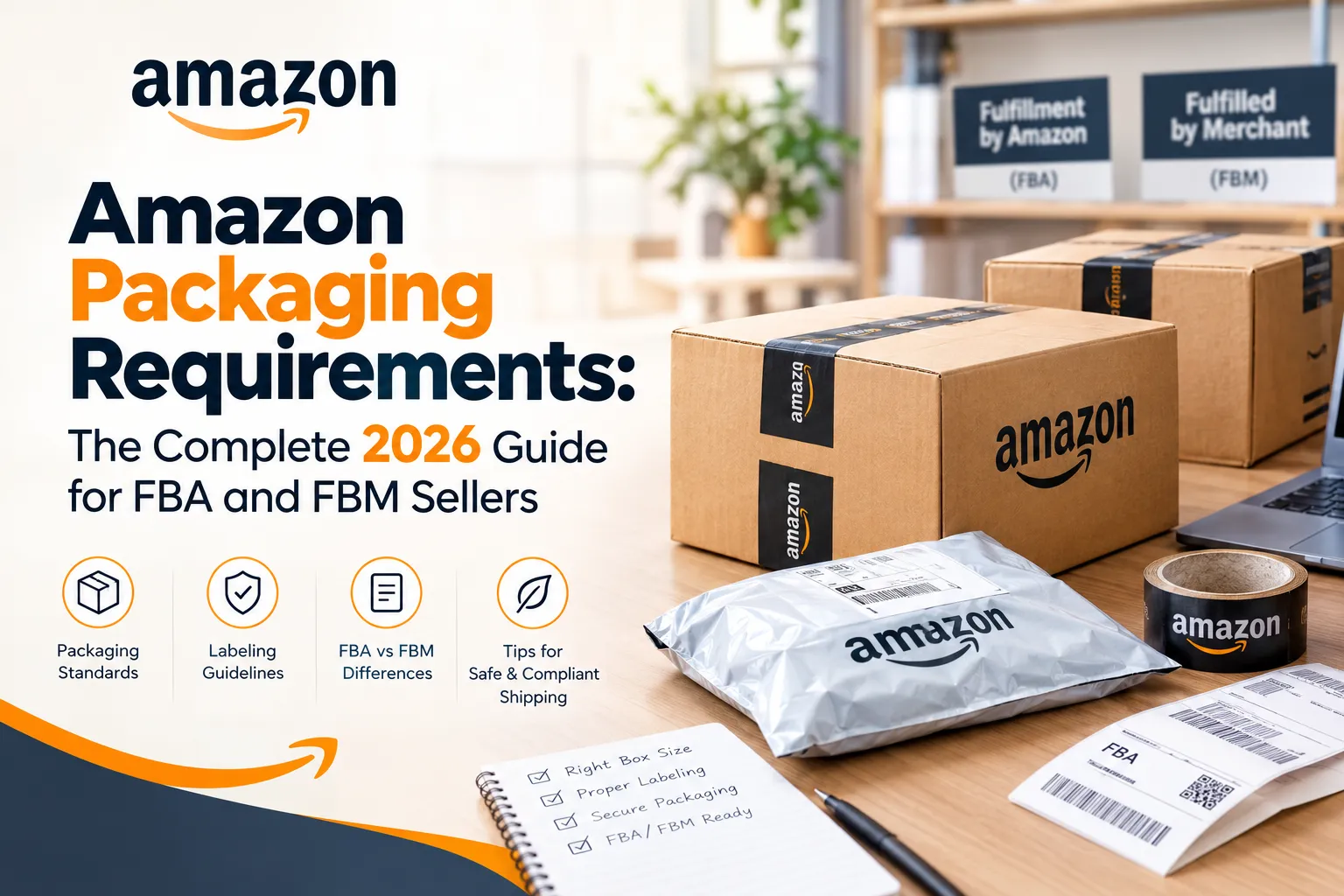

Amazon packaging requirements are the rules that decide whether your inventory is accepted, stored and shipped, or rejected at the dock, delayed for weeks or quietly downgraded into stranded stock. They cover three things: how each individual unit is packed and labelled, how your cartons and pallets are packed and labelled for inbound shipping, and what you owe under packaging waste law once the product reaches a customer.
If you want the short answer, here it is. Every unit needs a scannable barcode. Every box must be sealed, six-sided and strong enough to survive handling. Every poly bag with an opening over five inches needs a suffocation warning. Every set must be marked so it is never split. Every carton needs the right shipment label. And since 2026, the old safety net of letting Amazon fix your prep mistakes has shrunk or vanished depending on your marketplace, so the work now sits with you, your supplier or a prep centre.
This guide is written by people who have spent more than a decade inside Amazon accounts, fixing the shipments that went wrong. It covers FBA, FBM and Seller Fulfilled Prime, barcodes and the FNSKU change that landed on 31 March 2026, the FBA prep service and what replaced it, Amazon preferred packaging, imported goods that go straight to a fulfilment centre, UK packaging waste rules, costs, mistakes and a step-by-step compliance workflow you can hand to your team.
Why Amazon packaging requirements matter more than most sellers think
Amazon is the largest online marketplace most brands will ever sell on, so being visible there is rarely optional. What catches new sellers out is that visibility alone does not pay the bills. Your product has to physically arrive at a customer in the condition they expect, and before that it has to move through a fulfilment network built on scanners, conveyors and automation that cannot interpret a creative workaround.
Packaging problems show up in your account in four ways.
Rejected or delayed inbound shipments. A carton that cannot be matched to its shipment plan, or a unit with no scannable barcode, can be refused, held for manual handling or received into the wrong inventory. Receiving can already take days or weeks at busy times, so a rejection pushes you straight into a stockout.
Fees and chargebacks. Where Amazon prepares or relabels a unit for you, you pay for it. Where it cannot, it may dispose of the unit or send it back at your cost.
Damage, returns and bad reviews. A product that rattles, leaks or arrives scuffed generates returns and one-star reviews that no amount of advertising will outrun. If you want to understand how those returns are processed, read our guide to Amazon returnless refunds.
Account health. Repeated packaging and labelling defects feed into inbound performance and can restrict your ability to send inventory at all.
The frustrating part is that the guidance is long. Amazon’s packaging and prep documentation inside Seller Central covers every product type from garments to glass bottles to batteries, and it is easy to feel overwhelmed. The good news is that you do not need to read all of it. Once the basics are covered, you only need the section that applies to your product type. That single idea will save you hours.
The three order fulfilment models: FBM, SFP and FBA
Before you decide how to pack anything, decide who is shipping it. Each fulfilment model has different packaging requirements, so this choice shapes everything that follows.
| Model | Who picks, packs and ships | Packaging strictness | Typical fit |
| FBM (Fulfilled by Merchant) | You | Lowest from Amazon, but customer expectations still apply | Bulky, low-volume, made-to-order or high-margin items |
| SFP (Seller Fulfilled Prime) | You pack, Amazon-approved carriers deliver on Prime promises | Similar to FBM, with strict delivery performance targets | Sellers with strong warehouse operations |
| FBA (Fulfilled by Amazon) | Amazon, from its fulfilment centres | Highest: unit, carton and pallet rules all apply | Most brands that want Prime reach and scale |
For packaging purposes, these fall into two camps. FBM and SFP are close cousins because you still process the order and put the product in a parcel. FBA is its own world because you are sending stock in bulk to a warehouse that you do not control.
FBM (Fulfilled by Merchant)
With FBM you receive the order, you pack it and you post it. Amazon is not handling the goods at all, so the packaging rules are much lighter. That does not mean you can ignore them. Amazon customers have been trained by next-day delivery to expect secure packaging, the right item, no mess and no damage. A product that arrives crushed in an oversized or under-protective package will cost you a return, a refund and probably a review.
The sensible approach is to follow Amazon’s own packaging and labelling standards even for FBM orders. It keeps your options open: the day you decide to move a bestseller into FBA, the packaging is already compliant.
SFP (Seller Fulfilled Prime)
SFP means you process and pack the order yourself, and Amazon-approved carriers collect and deliver it on Prime timelines. Packaging expectations mirror FBM, but the delivery performance bar is high. A damaged parcel or a late collection hurts your Prime eligibility, so packaging quality directly protects your programme status.
FBA (Fulfilled by Amazon)
With FBA you send inventory in bulk to Amazon, which then stores it and handles picking, packing, delivery, customer service for delivery issues, returns and refunds. The benefits are well known:
- Speed. Amazon delivers faster than almost any individual seller can.
- Prime eligibility. Prime customers filter for it and trust it.
- Convenience. Order processing, picking, packing and shipping are done for you, which is especially useful for many small items.
- Customer service. Delivery, return and refund queries are handled by Amazon.
- Multi-channel reach. You can use Multi-Channel Fulfilment to ship orders from other sales channels out of the same stock.
- Supplier-direct shipping. Your manufacturer can send stock straight to a fulfilment centre so you never touch it.
The trade-off is rules. There are two distinct layers of packaging work in FBA, and confusing them is behind a large share of inbound problems:
- Unit-level packaging and labelling: the individually packed items that will ultimately be handed to your customer.
- Shipment-level packaging and labelling: the cartons and pallets in which those units travel to Amazon.
Get both layers right and your stock goes live quickly. If you are weighing up whether FBA suits your catalogue at all, our Amazon agency team can model the margin impact of each fulfilment route before you commit stock.
What changed in 2026: the updates most guides still miss
Many articles ranking for this topic were written years ago. They quote fees and policies that no longer apply. Three changes matter most.
Amazon ended FBA prep and item labelling in the US
On 28 July 2025 Amazon announced that from 1 January 2026 it would stop offering FBA prep and item labelling services for US shipments, including inbound routes such as AWD and the Supply Chain Portal. Units that arrive without proper prep and labelling are not protected in the way they once were. Amazon’s stated reason was that most sellers already prepare their own inventory.
What this means for you: if you sell in the US, polybagging, bubble wrapping, FNSKU labelling and kitting are fully your responsibility. If you sell in the UK, Europe or other marketplaces, do not assume the same rule applies, and do not assume it does not. Prep and label service availability and fees differ by marketplace and can change, so check the FBA Prep Service and FBA Label Service pages in your own Seller Central account before you budget. Many sellers now treat the old Amazon service as unavailable and plan around supplier or third-party prep.
FNSKU labels on every unit for non-Brand Registry sellers
From 31 March 2026, sellers who are not enrolled in Brand Registry are required to apply an Amazon-issued FNSKU barcode to every unit sent to an FBA fulfilment centre, even when the product already carries a valid GS1 barcode such as a UPC, EAN or GTIN. Amazon is discontinuing pooled, or commingled, inventory for these sellers. Brand owners enrolled in Brand Registry can continue using their GTIN-based manufacturer barcodes.
What this means for you: resellers and wholesalers need an FNSKU label on every unit and must cover or avoid conflicting barcodes. Brand owners gain a real operational advantage by being registered. We unpack that in section 4.
UK packaging EPR is live
The UK’s Extended Producer Responsibility (EPR) for packaging regulations, which replaced the old packaging waste regime from 1 January 2026, put reporting and fee obligations on qualifying UK businesses. This is the modern version of what older guides call the packaging waste register. Section 10 covers who is affected.
Amazon labelling requirements: barcodes, FNSKU and commingled inventory
Before a single box is packed, every unit needs an identity. Amazon labelling requirements start with the barcode, because a barcode is how a human-free warehouse knows what a thing is and whose it is.
The three types of barcode
- Manufacturer barcodes. These are the identifiers already printed on many products: GCID, UPC, EAN, JAN or ISBN. If your product carries one, and it matches the ASIN, Amazon may be able to scan it directly.
- Amazon barcodes (FNSKU). An FNSKU, or Fulfilment Network Stock Keeping Unit, is an Amazon-generated barcode that ties a physical unit to your seller account and a specific listing. It typically starts with X00.
- Brand owner only. Some products, especially in categories prone to counterfeiting, need extra identification so only the brand owner or authorised sellers can supply them.
An easy way to remember the difference: the ASIN tells Amazon what the product is, and the FNSKU tells Amazon whose unit it is. For a deeper look at identifiers, see our guides on FNSKU barcodes and the difference between an ASIN and a SKU.
Manufacturer barcode versus Amazon barcode
For years, accounts defaulted to manufacturer barcodes. That meant the barcode already printed on a product could be used, and no Amazon label needed to be added. That is no longer the story for everyone:
- Expiry-dated products always need an Amazon barcode label, because Amazon has to track batches and expiry.
- Resellers outside Brand Registry now need FNSKU on every unit from 31 March 2026.
- Brand owners inside Brand Registry can keep using GS1 GTIN barcodes.
- Products with a barcode that maps to more than one ASIN require an Amazon barcode because a scan would be ambiguous.
You set your preference in Seller Central under your FBA settings and can change it before you create a shipment. Review it every time you create a new shipment plan, because a wrong default is one of the most common ways stock ends up unsellable.
Commingled inventory explained
When a manufacturer barcode is used, the item is eligible for commingled inventory. That means identical products from different sellers are stored together, and Amazon may fulfil an order with whichever unit is closest to the customer, even if it came from another seller. It speeds up delivery and cuts storage complexity, but it creates risks:
- Counterfeit or poor-quality units from another seller may be shipped under your listing.
- Returns and defects get attributed to you even when the unit was not yours.
- Brand owners lose control of quality.
Amazon can also decide that an item is no longer eligible for commingling and demand an Amazon barcode even where one was not needed before. If you are a private label brand, the safest long-term strategy is simple: enrol in Brand Registry and use FNSKU labelling to keep your inventory separate and traceable.
The FBA Label Service
Historically, Amazon would label your products for a per-unit fee after receiving a bulk delivery. This is where older articles quote a fee of £0.15 per unit in the UK. Do not budget from numbers like that. In the US, the service has ended. In other marketplaces, confirm the current status and fee in Seller Central before relying on it. For low-margin products, any per-unit fee eats your profit quickly, so labelling at source (by your supplier, or at your own site) is usually cheaper.
The standard information on packaging
Once you have your barcode, make sure each unit also carries the standard packaging information:
- The relevant barcode (and no conflicting barcode visible)
- Official business or brand address
- Contact information, such as a phone number or email address
- A CE certificate or LFGB certificate where applicable
- The expiration date where applicable
If your product is a toy, electrical item, cosmetic, food contact material or a similar regulated product, the regulatory markings are a legal requirement, not an Amazon preference. A missing CE mark can lead to listing removal.
How to label units properly
- Create or confirm the listing and set the barcode preference to Amazon barcode where required.
- Print FNSKU labels from Seller Central, from the Send to Amazon workflow or from your inventory tools, at the correct label size.
- Place one label on each unit, on a flat surface, where a scanner can reach it without opening the package.
- Cover any old, conflicting barcodes so a scanner cannot read the wrong one.
- Never place a label across a seam, fold, curve or perforation, because it can tear or fail to scan.
- Keep a test scan routine. If a label does not scan on your own handheld scanner, it will not scan at Amazon.
If you use a 3PL or a prep centre, send them the exact FNSKU files and a one-page label placement standard. Ambiguity at the labelling step is how stock gets the wrong FNSKU.
Unit-level packaging rules and product-specific prep
Once the labels are organised, packaging comes next. The core principle behind every rule is that Amazon’s warehouses are largely automated and every unit must be ready to ship to a customer without further preparation.
The universal rules for FBA units
- Loose products sold together must be in the same package. If a customer buys a set, it cannot arrive as separate loose parts.
- Sets with several pieces in one box must be marked ‘Sold as set’ or ‘Do not separate’ so a picker never splits them into separate orders.
- Boxed units must be six-sided and fully closed, difficult to reopen, and able to withstand light pressure.
- Poly bags must be fully sealed, carry a barcode, and display a suffocation warning on the bag or on a label when the opening is larger than five inches.
- Expiration dates must be visible on the individual unit and, where appropriate, on the carton.
- Case-packed products must contain equal quantities of the same item with matching SKUs in every box in the case.
- Items must be able to survive handling. Retail packaging that looks great on a shelf is often not strong enough for a conveyor, a tote and a courier.
Packaging requirements by product type
You do not need to master all of these. Read the one that applies to you.
Fragile and glass items. Wrap each unit with enough cushioning that it withstands a drop test, and protect against corners and edges. Glass bottles, candles in jars and ceramics typically need bubble wrap or a custom insert plus a closed carton.
Liquids. Containers must be leak-proof and sealed, with caps secured and, for many categories, bagged in a sealed poly bag with an absorbent layer. Overfilled or loose-lid bottles are a top reason for rejected inbound.
Baby and children’s products. Poly bagging with a suffocation warning, plus any safety or age-grading marks required by law.
Adult products. Opaque bagging so contents are not visible, and compliance with Amazon’s category rules.
Sharp items. Edges, points and blades must be covered or protected so they cannot cut packaging or people.
Textiles and clothing. Often need to be bagged to stay clean and dry, with the label visible through or on the bag.
Small items. Very small products can get lost in the system, so they are bagged or boxed with a barcode large enough to be handled.
Granular or powder products. Sealed to prevent spillage, then double-protected.
Hanging garments and perforated packaging. Special handling rules apply, and the barcode must be on a continuous surface.
Hazmat and dangerous goods. Batteries, aerosols, flammables and similar items need classification, safety data and compliant packaging before they are allowed into the network. Do not ship them without completing the dangerous goods review.
Expiry-dated goods. Needs an Amazon barcode, a visible expiry date, and a clear date format.
Because Amazon updates these rules frequently, treat the live Seller Central page for your product type as the source of truth and re-check it every quarter.
FBA carton and pallet requirements
Unit prep gets your product ready for the customer. Carton and pallet prep gets it ready for Amazon’s dock. The rules exist so Amazon knows exactly what is inside every box or pallet it receives, because a warehouse that cannot identify a carton cannot receive it.
Use the shipment workflow. Create your shipment plan through the Send to Amazon workflow in Seller Central. It produces the shipment and box labels you must attach. Do not reuse labels from an earlier shipment and do not hand-write them.
Pack to the carton rules.
- Use sturdy, six-sided cartons that are fully sealed with proper tape, not string, staples or loose flaps.
- Do not mix different products in one carton unless Amazon’s workflow explicitly allows it and the contents are listed in the box content information.
- Keep case-packed cartons uniform: the same SKU and the same quantity in every box.
- Respect weight limits. As a rule, cartons holding multiple items should stay at 15 kg in the UK and Europe and 50 lb in the US, unless the carton holds a single item that cannot be split. Heavier cartons need the correct heavy-package or team-lift labelling. Always confirm the current figure for your marketplace.
- Leave no empty space. Fill voids with paper or air pillows so units do not shift and burst bags.
- Do not use packaging materials Amazon discourages, such as loose polystyrene beads that spill when the box is opened.
Label both sides of the story. Each carton needs its shipment label on a flat surface, clear of seams and tape, and old labels from previous shipments removed or covered. Where you use pallets, follow Amazon’s pallet requirements for height, stability, wrapping and pallet labels on each side. Mixed or damaged pallets are a frequent cause of dock delays.
Tell Amazon exactly what is inside. Box content information (provided in the workflow or via a file) is what lets Amazon check in a carton without opening it. Errors in quantities or SKUs are why units go missing in receiving and why reimbursement claims drag on.
Choose your carrier carefully. You can use Amazon’s partnered carrier programme or your own carrier. Partnered carriers often offer discounted rates and automatic label printing, but you remain responsible for packing correctly.
For teams handling many shipments a week, packing and labelling errors multiply fast. This is one of the reasons we help clients design repeatable inbound workflows and automate the surrounding admin, as described in our Amazon order processing automation guide.
Sending imported goods straight to an Amazon fulfilment centre
Did you know imported goods can go directly from your overseas manufacturer to an Amazon fulfilment centre, so you never touch the stock? It is a popular route for private label brands because it removes double handling, reduces cost and speeds up launches.
The catch is that direct imports follow exactly the same packaging and labelling rules as anything else. Amazon will not relax them because stock came from a factory. If the units are not prepped and labelled, they will not be accepted properly, or will arrive damaged.
Here is how to make it work:
- Brief the supplier in writing. Send a packaging and labelling specification that covers barcode type, label size and position, bag requirements, suffocation warnings, carton size, carton weight, unit counts and carton label format.
- Send the actual label files. Provide the FNSKU labels generated in Seller Central, or the supplier’s printed samples for approval, so they are exactly right.
- Insist on photos before shipping. Ask for pictures of a packed unit, a bagged unit, an open carton and a labelled carton before the goods leave the factory.
- Check carton labels against the shipment plan. The destination and box ID must match your plan.
- Handle customs and duties. Make sure the importer of record, commodity codes, VAT or duty arrangements and Incoterms are clear, because Amazon will not clear goods for you in most cases.
- Have a rescue plan. Know which prep centre or 3PL can receive and fix a shipment if something goes wrong. Fixing at origin is cheap. Fixing at a fulfilment centre is costly or impossible.
An increasing number of suppliers are now familiar with Amazon packaging standards, which makes direct shipping far less risky than it was a few years ago. Still, treat every first order from a new supplier as a trial and inspect it.
One warning is worth repeating. Items going to a fulfilment centre must be ready to go to the buyer in the packaging they arrive in, or you must have a prep route in place. In many categories, such as kitchen and home, Amazon may ship the product in its own retail box with a shipping label stuck on it and no outer carton. Standard retail packaging that looks fine on a shelf may arrive scuffed or crushed. Test your box with a real drop and a real courier trip before you scale.
FBA prep options: DIY, supplier, 3PL or Amazon
“FBA prep” means everything that turns a product into a compliant unit: labelling, bagging, wrapping, bundling, adding warnings and sealing. In 2026 you have four routes. Here is how they compare.
| Route | Best for | Main advantage | Main risk |
| Do it yourself | Low volume, hands-on sellers, handmade products | Full control and no outsourcing fees | Time, labour, errors as you scale |
| Supplier prep at the factory | Private label brands importing in volume | Lowest cost per unit, no extra handling | Mistakes are costly to fix once shipped |
| Third-party prep centre or 3PL | Resellers, mixed catalogues, direct-from-supplier flows | Scalable, flexible, can inspect and fix | Added fees, extra transit days, quality varies |
| Amazon FBA Prep Service | Only where it is still offered in your marketplace | Convenience | Ended in the US from 1 January 2026, so confirm availability and fees elsewhere |
The Amazon FBA Prep Service: should you still rely on it?
The Amazon FBA Prep Service was always an optional paid service where Amazon polybagged, bubble wrapped, taped, bundled or labelled your goods for per-unit fees. It was useful for sellers with supplier-direct shipments, tight budgets for labour or no warehouse at all. Amazon’s scale sometimes made it cheaper than doing the work yourself.
The situation now depends on where you sell. In the US the service has ended. In the UK and EU marketplaces, check Seller Central for the live status and the live fee table, and do not plan a launch around a price you read in an old article. If you must specify prep on a shipment, and you do not, Amazon may send products out with insufficient packaging, so never assume.
How to choose a prep centre
A good prep partner is more than a pair of hands. Look for:
- Written standards for each prep type and a sample approval process
- Photo reports on receiving, with discrepancy handling
- Experience with your category, for example fragile, hazmat or textiles
- Fast turnaround and inbound slots that match your launch calendar
- Transparent per-unit fees and clear pricing for storage, kitting and returns
- Insurance and a clear liability policy for lost or damaged stock
- Compatibility with your FNSKU and shipment plan workflow
Expect to pay a per-unit fee for labelling, bagging and similar tasks, plus fees for receiving, storage and forwarding. Prices vary widely by country and service, so get at least three quotes, run a small pilot batch and measure the defect rate before you commit your whole range.
Amazon preferred packaging, Frustration-Free Packaging and FBM packaging
If you want to keep control of packaging, or you can pack more cheaply than a prep centre can, you should still buy supplies that match Amazon’s expectations.
Amazon preferred packaging
Amazon preferred packaging refers to boxes, poly bags, stretch wrap, bubble packs and other supplies that are designed to meet FBA standards. Sellers can buy them through Amazon’s packaging supplies programme, and carriers often offer free or discounted supplies when you ship your inbound stock using their service. Buying matched packaging means fewer arguments about whether a bag is thick enough or a box is strong enough.
Frustration-Free Packaging and ISTA testing
Frustration-Free Packaging (FFP) is Amazon’s programme for products that ship safely in their own packaging, with no additional overbox. Products can be certified through Amazon’s testing programme, which uses ISTA-based protocols, and certified products can ship in their own container, cutting packaging waste and sometimes handling cost. FFP is worth exploring if you have a hero product that ships frequently, because a leaner pack is cheaper, lighter and kinder to the environment. It will not suit every product, and the testing standards are demanding, so treat it as a project, not a tick-box.
Packaging when you fulfil yourself
For FBM and SFP orders, Amazon does not inspect your box, but your customer does. Build a packing standard that covers:
- The right box size to avoid crushed corners and wasted void fill
- Protective materials appropriate to your product’s fragility
- A packing slip or invoice as required
- Compliance with Amazon’s rules on inserts: no inserts that ask for reviews, push customers off Amazon or break Amazon’s communication policies
- Carrier labelling that is readable and well placed
Sellers who fulfil themselves often choose to run a parallel compliance check using FBA standards. If the pack passes an FBA-grade test, it will almost certainly delight a customer.
UK packaging waste register and EPR: what you owe even when Amazon ships
Here is something many guides skip. Even if you use FBA, you remain responsible for the packaging you place on the market and the waste it generates. In the UK, this used to be called the packaging waste register. Under the Producer Responsibility Obligations (Packaging and Packaging Waste) Regulations 2024, it is now known as extended producer responsibility, or EPR, for packaging, and it applies from 2026.
Who is a producer? Under GOV.UK guidance, you are an obligated producer if you are a UK-established business, subsidiary or group, you supplied or imported more than 25 tonnes of packaging in the UK in the previous calendar year, and your annual turnover is £1 million or more.
Small or large? A small producer has turnover between £1 million and £2 million and supplies more than 25 tonnes, or supplies between 25 and 50 tonnes. A large producer has turnover above £2 million and supplies more than 50 tonnes. Large producers have more obligations, including more frequent reporting and disposal fees. Small producers have lighter duties, but still have to register and report. Older articles that quote only a 50-tonne, £2 million threshold are out of date.
What counts as a packaging activity? You may be treated as handling packaging if your business:
- Manufactures or converts raw materials into packaging
- Fills packaging with products
- Sells packaged goods to customers
- Hires out packaging, such as pallets
- Operates a franchise or licensed business
- Imports packaging or packaged goods
- Brings transit packaging into the UK that will end up as waste in the UK
What about overseas sellers on Amazon? The rules treat the marketplace operator as the supplier of packaging for sales by non-UK sellers who do not have a UK presence, so the obligation usually sits with the marketplace for those sales. A non-UK seller with a UK company, branch or importer may still have its own duties. UK-based sellers should assume they are in scope until they have checked the thresholds.
The aims of the regime are to reduce packaging at source, reduce landfill and raise recycling and recovery rates. Fees are modulated, which means packaging that is harder to recycle can cost more. That is a commercial reason to simplify your materials, not just an environmental one.
This section is general information, not legal advice. Check the live GOV.UK guidance, and speak to a compliance specialist if you are near a threshold. Sellers in the EU and the US face their own packaging and extended producer responsibility rules, which vary by country and state.
Sustainability, branding and the unboxing experience
Packaging is the only physical touchpoint most Amazon customers will ever have with your brand. It is worth treating as part of your marketing, within Amazon’s rules.
- Right-size everything. Oversized boxes waste money, add dimensional weight and look careless.
- Reduce plastic where you can. Paper void fill, recyclable mailers and mono-material packaging are easier to recycle and may lower EPR fees.
- Keep brand consistency. Your product box, inserts and colours should match your listing images and A+ Content, so the customer recognises what they ordered.
- Make opening easy. Packaging that frustrates customers drives returns and complaints. Packaging that protects and delights drives repeat purchases.
- Print instructions clearly. For products that need assembly or care, put QR codes or short instructions inside the box.
- Stay inside the rules. Branded inserts are fine when they follow Amazon’s policy. Never use them to solicit reviews or move buyers to another channel.
Brand-led packaging also supports other parts of your growth plan. If you are building a loyalty loop or running promotions, see how Amazon coupons for sellers work alongside a premium pack, and how Amazon advertising performs better when the product experience backs up the promise.
What Amazon packaging really costs you
Packaging is a cost centre that quietly eats margin. Build it into your unit economics from the start.
- Materials: boxes, poly bags, bubble wrap, tape, void fill, labels and warning stickers.
- Labour: time to label, bag, bundle and carton, either yours or a third party’s.
- Prep centre fees: per-unit labelling and bagging, receiving, storage, kitting and forwarding.
- Weight and size: extra packaging increases weight and dimensions. Because FBA fees are driven by size tier and weight, a larger pack can push a product into a more expensive tier.
- Inbound shipping: a smarter carton design can fit more units per box and per pallet.
- Compliance costs: regulatory markings, testing and EPR obligations where they apply.
- Failure costs: rejected inbound, relabelling, returns, replacements, removals and disposals.
A simple discipline helps. For every SKU, calculate landed cost, packaging cost, prep cost, FBA fees and the margin left after returns. Run the numbers again every time Amazon updates its fee schedule or you change a supplier. Products with thin margins can turn unprofitable when a labelling fee is added, so labelling at source is often the cheapest compliance decision you can make.
The most common Amazon packaging mistakes
After years of fixing accounts, the same errors keep coming back.
- Wrong barcode setting. A product set to manufacturer barcode when it needed FNSKU, or the reverse, leads to commingling or unreadable units.
- Conflicting barcodes. An FNSKU label placed next to an uncovered UPC confuses scanners.
- Missing suffocation warnings. Any large-opening poly bag needs one.
- Unsealed or weak bags. Bags that open in transit cause loose units and lost sales.
- Sets that can be split. Without a ‘Sold as set’ marking, pickers may separate pieces.
- Mixed cartons. Different SKUs in one carton without correct box content information.
- Reusing old carton labels. Shipment labels are single-use.
- Ignoring expiry dates. Missing or illegible dates can block an entire carton.
- Underestimating fragility. A pack that survives a desk test fails a conveyor test.
- Assuming the supplier knows. Ambiguity in the brief creates costly mistakes.
- Ignoring regulatory marks. CE, LFGB and other required certifications are not optional.
- Not budgeting for EPR. UK sellers who cross the thresholds without registering face enforcement.
A step-by-step Amazon packaging compliance workflow
Use this as a repeatable process for every new product and every restock.
- Choose your fulfilment model per SKU: FBM, SFP or FBA.
- Confirm your brand status. Are you in Brand Registry? This decides whether you can use manufacturer barcodes or need FNSKU on every unit.
- Set the barcode preference at listing and shipment level and check it again before sending.
- Identify your product type’s prep category in Seller Central (for example fragile, liquid, baby, textile, hazmat) and read only that guidance.
- Write a one-page packaging specification covering unit pack, labels, warnings, carton size, weight and photos.
- Order a sample batch and run a handling test: drop, shake, squeeze and scan.
- Choose a prep route: supplier, in-house or third-party centre.
- Create the shipment plan in Send to Amazon and print fresh labels.
- Inspect before dispatch with photos of units, cartons and pallets.
- Track check-in and investigate any discrepancy within days, not weeks.
- Review compliance quarterly, including packaging rules, fee changes, EPR thresholds and category restrictions.
- Log defects and fix them at source. Every returned or damaged unit is data about your pack.
When to bring in an Amazon agency
Packaging and labelling look like warehouse tasks, but they are tied to listing health, inventory planning, advertising and profitability. The best time to get help is before you ship, not after a rejected shipment.
EcomRanker is a full-service Amazon agency founded in 2017, working across the UK, USA, UAE and India marketplaces. Our senior-only team handles account management, listing optimisation, advertising, catalogue and inventory operations, so packaging decisions are made alongside margin, ad strategy and growth plans rather than in isolation. If you would like a compliance review of your current packaging, labelling and FBA setup, speak to our Amazon agency team.
Key takeaways
- Amazon packaging requirements apply at two levels: individual units and inbound cartons or pallets.
- Read only the guidance for your product type, once the basics are covered.
- Every unit needs a scannable barcode. From 31 March 2026, sellers outside Brand Registry need FNSKU labels on every FBA unit.
- Amazon ended FBA prep and item labelling in the US from 1 January 2026. Check live availability in other marketplaces and never rely on old fee tables.
- Boxes must be sealed and six-sided, poly bags must be sealed with warnings where required, and sets must be marked so they are never split.
- Imported goods can go directly to a fulfilment centre, but they must follow identical rules, so brief and inspect your supplier.
- Use Amazon preferred packaging or equivalent supplies, and consider Frustration-Free Packaging for hero products.
- UK sellers must check packaging EPR obligations, even when Amazon fulfils orders.
- Build packaging and prep costs into every SKU’s margin model.