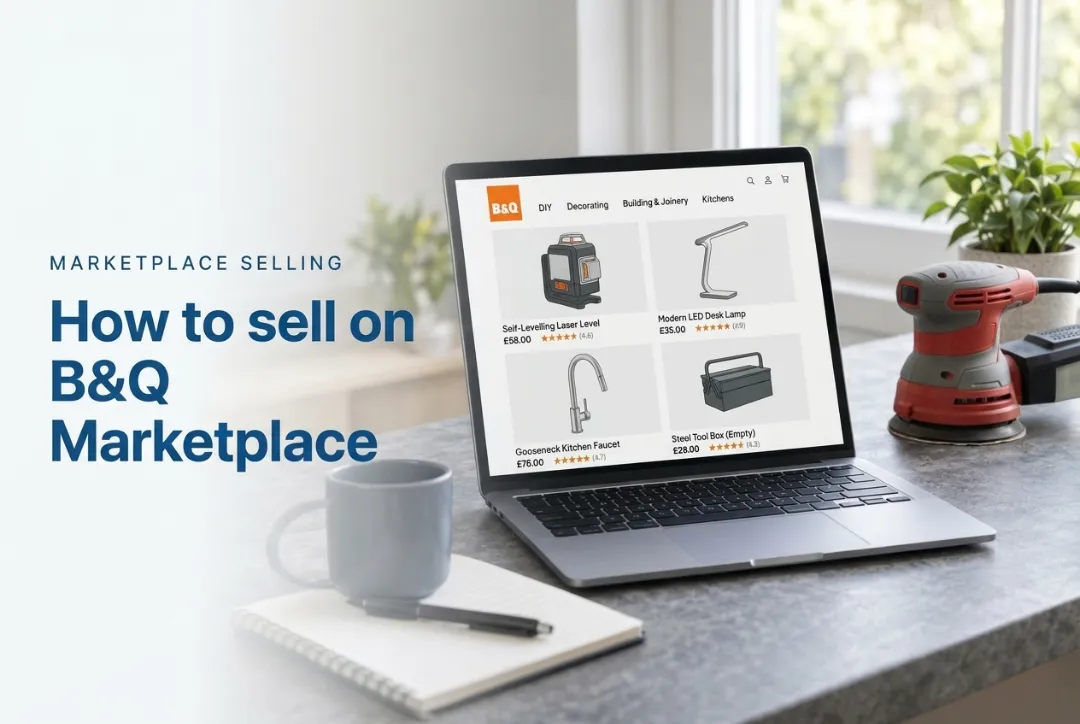

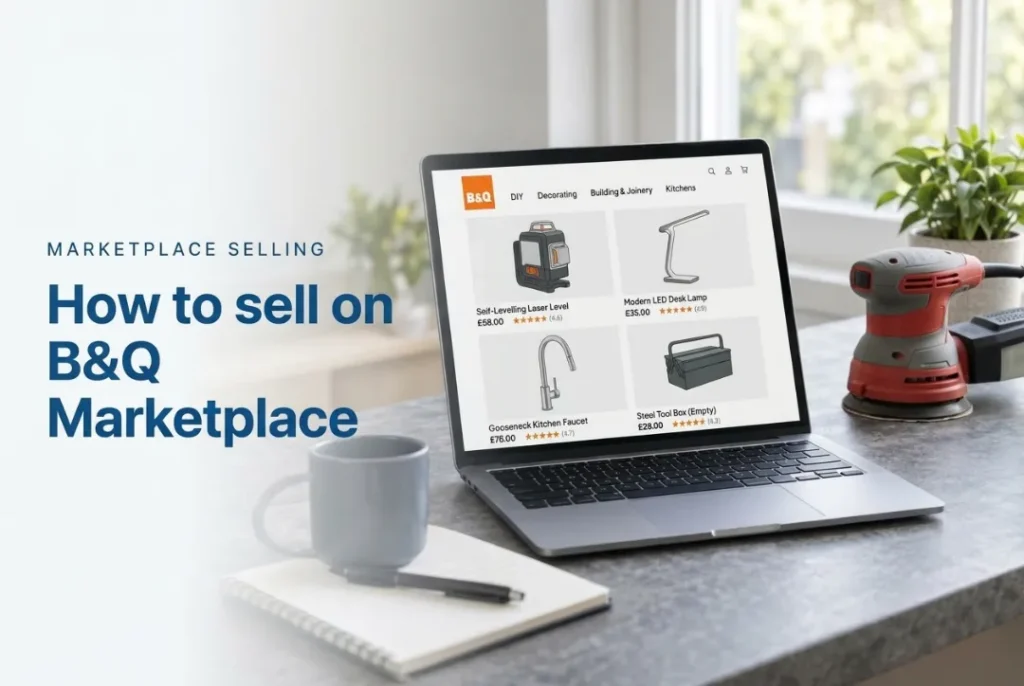
For years, UK home and garden sellers had a short list of places to go: Amazon, eBay, and a handful of niche sites. Then B&Q opened its doors to third-party sellers. Since its launch in March 2022, B&Q Marketplace on diy.com has become one of the most talked-about retail marketplaces in the country, giving sellers a way to put products in front of shoppers who are already planning a bathroom refit, a garden makeover or a weekend of DIY.
If you are searching for how to sell on B&Q Marketplace, you probably have three questions. Can I get in? What will it cost? And is it actually worth the effort? This guide answers all three, then walks you through the application, onboarding, product listing, payment, promotion and returns process in the order you will meet it.
We are EcomRanker, an Amazon-first marketplace agency working across the UK, USA, UAE and India. We have no commercial stake in whether you choose B&Q, so we will be candid about the parts that are easy, the parts that are not, and the numbers that are not publicly available. Where figures come from sellers, partners or published reports rather than from B&Q itself, we say so.
How do you sell on B&Q Marketplace?
To sell on B&Q Marketplace, you apply to become a B&Q verified seller on diy.com, pass B&Q’s review and onboarding checks, set up your merchant account on the Mirakl platform, upload your product catalogue and stock, publish your offers, ship orders yourself and get paid in scheduled payment runs.
Here is the process in seven lines:
- Apply through the “Become a B&Q verified seller” route on diy.com.
- B&Q reviews your business and products against its quality criteria.
- If approved, you accept the terms and complete onboarding and verification (KYC).
- You prepare product data, images and compliance documents.
- You upload or integrate your catalogue and stock via CSV or API.
- Your products go live, labelled as sold and shipped by you, alongside B&Q’s own range.
- You fulfil orders, handle returns and customer messages, and receive payment on a set schedule.
| Question | Short answer |
| Is it invitation-only? | No, but every application is reviewed and approval is not guaranteed. |
| What does it cost? | A reported £39 monthly subscription plus a commission on each sale. |
| Who ships orders? | You do. Sellers arrange their own delivery. |
| Who pays customer returns? | Returns are free for shoppers, so build the cost into your plan. |
| Do I need an agency? | No. You can apply directly. An agency helps with speed and optimisation. |
| Is it good for every product? | No. It suits home improvement, garden, furniture, tools and related categories. |
What B&Q Marketplace is and how it works
B&Q is part of Kingfisher plc and has been a household name in UK home improvement since 1969. Its website, diy.com, is one of the biggest retail sites in the country. B&Q Marketplace is the part of diy.com where approved third-party sellers list products alongside B&Q’s own range. The marketplace is powered by Mirakl, the enterprise marketplace software that many European retailers use.
For shoppers, the experience feels seamless. A customer searches for a product, sees a mix of B&Q-stocked and third-party items, and checks out through B&Q. Marketplace products are clearly labelled as sold and shipped by the merchant, and the basket separates items fulfilled by B&Q from items fulfilled by verified sellers.
For sellers, the model is a classic retail marketplace:
- You hold the stock. You store and ship your own inventory.
- B&Q provides the audience and the checkout. You benefit from its traffic and brand trust.
- You pay for the privilege. A monthly subscription plus a commission on each sale.
- B&Q sets the standards. Content quality, delivery performance, customer service and compliance are all monitored.
It is a curated marketplace. Unlike open marketplaces where almost anyone can list almost anything, B&Q reviews sellers and products, and that curation is part of what shoppers trust.
Why sell on B&Q Marketplace?
A high-intent, project-driven audience
People visit diy.com because they are planning to buy. A shopper looking for a bathroom vanity, a cordless drill, a garden storage unit or a set of patio lights is usually mid-project, with a budget and a deadline. That intent usually converts better than casual browsing.
Significant traffic
Published figures vary by source and by year. Optimizon cites over 290 million visits to diy.com a year, other industry guides quote 320 million, and earlier B&Q interviews referred to around 24 million visitors a month. The exact number matters less than the pattern: diy.com is one of the busiest retail sites in the UK, and marketplace sellers can tap into that audience without building it themselves.
New customers, not just B&Q’s existing ones
Industry research reported by marketplace tooling providers suggests that roughly half of marketplace buyers had never shopped with B&Q before. That is a useful signal that the marketplace is attracting fresh demand rather than only reshuffling existing customers.
Rapid growth stories
Marketplace leadership has publicly said that some sellers saw B&Q revenue overtake channels they had traded on for years. One furniture seller reported month-on-month revenue growth of over 360 percent in the early weeks after launch. Treat these as best-case examples rather than promises, because results depend on product, price, content and stock availability, but they show what a well-prepared seller can achieve.
Growing range and scale
B&Q Marketplace has expanded from tens of thousands of products to more than a million listings, with over a thousand third-party sellers reported across roughly 25 categories, including areas B&Q is not traditionally known for, such as cookware and tableware. A larger, more varied range draws more shoppers, and more shoppers help every seller.
Control over inventory and fulfilment
Because you store and ship your own stock, you decide your couriers, your packaging and your stock allocation. That lets you manage fulfilment costs rather than being locked into a fixed fee structure.
One onboarding, many marketplaces
B&Q Marketplace runs on Mirakl Connect. Sellers who complete onboarding can reportedly access over 400 other Mirakl-powered marketplaces without repeating the whole process each time, which makes B&Q a useful stepping stone for European expansion.
Diversification
If Amazon is your only channel, a single policy change or listing suspension can hit your whole business. B&Q gives you a second, retailer-branded channel with a different audience. At EcomRanker, we think diversification is one of the most valuable reasons to add a marketplace, even before the sales numbers justify it.
Who can sell on B&Q Marketplace, and who should think twice
B&Q does not publish a simple pass-or-fail checklist, and applications are assessed individually. In practice, these factors tend to matter:
- A legitimate UK-facing business that can pass identity and business verification.
- Products that fit B&Q’s categories and appeal to home improvement shoppers.
- Good product data and imagery, because B&Q expects a retail-quality shopping experience.
- Reliable fulfilment with realistic lead times and a plan for bulky or heavy items.
- Compliance, including product safety, energy labelling where relevant and any required certification.
- A customer service capability that can respond quickly and handle returns professionally.
You are likely a good fit if you are a brand, manufacturer, distributor or established retailer in home improvement, garden, furniture, lighting, tools, heating, bathrooms, kitchens, flooring, pet or related categories, with stock on hand and decent product content.
You may struggle if your product range is outside B&Q’s categories, you rely on very long supplier lead times, your content is thin or copied from a manufacturer feed, your margins cannot absorb commission and free returns, or you cannot support bulky-item logistics.
If you are not sure, a small, well-prepared application is usually better than a large, messy one.
Categories you can sell in
B&Q has opened its marketplace in stages. Earlier descriptions listed around 21 categories, and more recent seller guides refer to about 25. Categories reported across B&Q’s public marketplace communications include:
- Tools and power tools
- Electrical and lighting
- Paint and decorating
- Heating and cooling
- Outdoor, garden and plants
- Furniture and home décor
- Kitchens and bathrooms
- Flooring and tiling
- Ironmongery, access and storage
- Building and timber
- Automotive
- Pet care
- Cleaning
- Small domestic appliances, cookware and tableware
- Workwear
- Camping and outdoor games and toys
B&Q has said it plans to keep opening existing categories and adding new ones where consumers are looking to improve their home. Because the list changes, confirm what is currently open in your seller application before you invest in content.
How much does it cost to sell on B&Q Marketplace?
This is the section sellers read twice. Here is what is publicly reported, plus the costs that sit outside any rate card.
1. Monthly subscription. Marketplace partners and integration providers consistently report a standard subscription of £39 per month. Optimizon describes it as charged after your first sale. Confirm current terms in your seller agreement.
2. Sales commission. B&Q charges a commission on each sale. It does not publish a rate card, and public guides disagree. One agency guide suggests DIY marketplace fees often fall between 12 and 20 percent, while another suggests an average range of 7 to 15 percent depending on category. We cannot verify either. The honest approach is to treat the commission as a category-specific figure you will receive in your agreement, and to model your profit at several rates before you apply.
3. Shipping. You are responsible for arranging delivery. Courier costs, especially for bulky goods, can be your single biggest variable cost.
4. Returns. Returns are free for shoppers, with up to 90 days from purchase reported by Optimizon. Free returns for customers are not free for you: return postage or collection, repackaging and write-offs all come out of your margin.
5. Advertising and promotions. In-platform advertising and promotional participation are optional but affect your cost per sale.
6. Operational costs. Content creation, product photography, compliance testing, listing or integration software, customer service tools and stock holding all cost money.
7. VAT. If you are VAT-registered, understand how VAT applies to your prices, commission and shipping. Speak to an accountant.

A worked profit example
Here is an illustrative example, so you can see how the numbers interact. We have used an assumed 12 percent commission, which is not an official B&Q figure. Replace it with your agreed rate.
Product: a 6-tier garden storage rack Selling price (inc. VAT): £89.99 Price excluding VAT at 20 percent: £74.99 Cost of goods: £28.00 Courier cost to the customer: £9.50 Packaging: £1.50
Illustrative costs:
- Commission at an assumed 12 percent of £74.99 = £9.00
- Allocated subscription (£39 spread across, say, 60 orders a month) = £0.65
- Returns provision at 6 percent of orders, averaging £12 loss per return = £0.72
- Customer service and admin allowance = £0.60
Profit:
| Line | Amount |
| Net selling price (ex VAT) | £74.99 |
| Cost of goods | £28.00 |
| Courier and packaging | £11.00 |
| Commission (assumed) | £9.00 |
| Subscription allocation | £0.65 |
| Returns provision | £0.72 |
| Customer service allowance | £0.60 |
| Estimated profit per order | £25.02 |
That is a healthy margin of about a third. Now change two assumptions. If commission is 18 percent (£13.50) and your courier cost rises to £18 for a heavier item, profit per order drops to roughly £13.50 before ads. Add a sponsored listing at 8 percent (£6.00) and you are down to about £7.50.
The lesson: model your five best-selling products at low, mid and high commission, with realistic courier prices and returns. If the numbers only work at the cheapest commission and the cheapest courier, the channel will be a strain. We apply the same discipline to Amazon accounts through profit-first PPC management, and it carries over to any marketplace.
Step 1: Apply to become a B&Q verified seller
The entry point is simple: go to diy.com and use the “Become a B&Q verified seller” route. You complete an application form with details about your business and the products you want to sell.
What B&Q’s team is looking at: whether your business is credible, whether your products suit the marketplace, and whether you can deliver the customer experience B&Q expects. Applications are reviewed carefully, because every marketplace seller reflects on the B&Q brand.
How to improve your chances:
- Be specific about your range. Name your categories, your top products and your brand positioning. Vague applications look unprepared.
- Show you hold stock. B&Q’s model relies on sellers who store and ship their own inventory. Mention your warehouse, courier relationships and typical dispatch times.
- Highlight content readiness. If you already have professional images, detailed specifications and compliance documents, say so.
- Be honest about volume. Overpromising stock availability is worse than a modest, reliable range.
- Apply with products B&Q needs. The marketplace aims to deepen existing categories and fill gaps. Products that complement the range rather than duplicate it with a weaker offer have an advantage.
You can apply directly. Agencies that are official B&Q partners can help with onboarding and optimisation, but you do not need one to apply.
Step 2: Complete onboarding and KYC
Once your application is approved, you move to onboarding. This is where you accept the marketplace terms and conditions and complete the checks B&Q needs for both your business and your products.
KYC (Know Your Customer) verifies who you are and that your business is real. Optimizon’s guide describes the typical requirements as follows.
Personal verification:
- Photo ID, such as a passport or driving licence
- Proof of address, such as a utility bill or government document
Business verification:
- Company registration or articles of incorporation
- Details about your company structure and ownership
Requirements can vary by business type and change over time, so use the checklist in your own seller portal as the final word. To avoid delays, prepare these before you start:
- Clear, recent, correctly named documents (scans, not phone photos at an angle)
- Names that match across ID, company records and bank details
- Your VAT number, if registered
- Bank account details for payouts
- A named contact for customer service and compliance questions
Because B&Q Marketplace runs on Mirakl Connect, completing onboarding once is reported to open the door to selling on other Mirakl-powered marketplaces too. We cover that in section 23.
Step 3: Prepare your product data and compliance documents
The single biggest difference between sellers who launch smoothly and sellers who struggle is catalogue quality. Do this work before you upload anything.
Product data essentials
For each product, gather:
- Unique identifiers: GTIN or EAN barcodes, manufacturer part numbers and your own SKUs.
- Brand and model information.
- Titles written for shoppers, not for a supplier database.
- Detailed descriptions that explain what the product is, who it suits and what is included.
- Technical attributes: dimensions, weight, materials, power rating, voltage, compatibility, colour, finish, pack size and so on. Home improvement shoppers filter heavily by these attributes.
- Pricing and stock levels.
- Dispatch and delivery information, including lead times and any bulky-item considerations.
- Category mapping matched to B&Q’s taxonomy.
Imagery and media
Shoppers cannot touch a product, so images carry the sale. Plan a set that includes a clean main image, multiple angles, close-ups of finish and materials, scale and in-situ shots that show how the product looks in a room or garden, and infographic-style call-outs for key features. Optional video can demonstrate assembly, use or key benefits.
Compliance documents
Home improvement products are more regulated than many categories. Depending on what you sell, you may need:
- Product safety and conformity marking appropriate for Great Britain (UKCA) or recognised equivalents where applicable
- Energy ratings and labels for appliances, heating, cooling and some lighting
- Safety data sheets for paints, chemicals and certain consumables
- Instruction manuals and warnings
- Test reports and certificates for electrical, fire-safety and structural items
- Warranty information
B&Q wants shoppers to feel confident, so listings that include clear compliance information tend to perform better and avoid delays. Rules change, so check with a compliance specialist or trading standards guidance for your specific products.
Pricing and margin check
Decide your pricing before you list. Work out your minimum viable price at the highest commission you might face, include courier cost by weight band, and set a floor price you will not go below, even during promotions.
Step 4: Connect your catalogue and stock
B&Q Marketplace is built on Mirakl, so sellers manage their offers through a Mirakl-based seller portal. There are two broad ways to get your catalogue in.
Option A: CSV or spreadsheet upload. Suitable for smaller catalogues. You map your product data to the required template, upload it and fix any errors the system flags. It is manual but transparent, and it is a good way to learn how the marketplace thinks about data.
Option B: API or integration software. Suitable for larger catalogues, frequent price changes and fast-moving stock. Many sellers connect their ecommerce platform, ERP or inventory system through an integration partner, so that stock levels, prices and orders sync automatically. This prevents overselling, which is the most common and most damaging operational error on any marketplace.
Stock sync is not optional. If a customer orders something you do not have, you face cancellations, poor performance scores and unhappy shoppers. If you sell on Amazon, eBay or your own site as well, consider a central inventory system or a multichannel tool. Treat B&Q as one more channel that draws from the same stock pool, not a separate warehouse.
Start small. Launch with 20 to 50 of your best products, with excellent content and reliable stock. Prove the process, then expand.
Step 5: Publish your products
Once your data is approved, your offers go live on diy.com. B&Q displays marketplace products alongside its own range in search results and category pages, and labels them as sold and shipped by the merchant. At checkout, items are grouped according to who fulfils them.
After publishing, check these things within the first 48 hours:
- Search your own products on diy.com using the words a customer would use. Do your listings appear?
- Check every listing page for missing images, wrong attributes, incorrect prices or broken descriptions.
- Place a test order if possible, or follow your first real order closely, to confirm that notifications, dispatch and tracking updates work.
- Confirm delivery information shown to shoppers matches what you can actually deliver.
- Watch stock levels, especially if you share inventory with other channels.
Payment cycles: how and when you get paid
Getting paid is straightforward, but cash flow planning matters, especially if you are buying stock in bulk.
According to Optimizon’s guide, B&Q runs payments on a fixed schedule. Payment runs happen twice a month, on the 1st and the 15th, through the Hyperwallet payment service, using Mirakl’s statements module to calculate what you are owed. Your payment depends on orders being completed through the order journey, from customer order to shipment to delivery.
What this means in practice:
- There is a lag between sale and payout. Orders placed just after a payment run wait for the next one, so your cash conversion cycle is longer than on marketplaces that pay on a faster rolling basis.
- Commission and refunds are netted off. Statements show what B&Q has deducted, so reconcile them against your own records.
- Plan for working capital. If you restock weekly, make sure you can fund purchases while earlier sales wait to be paid.
- Check current terms. Payment schedules can change, so confirm the timetable in your seller agreement rather than relying on any third-party guide, including this one.
As a rule of thumb, keep a statement reconciliation process from day one: match orders, commissions, refunds and payout totals every cycle. It is much easier to spot an error in week two than in month six.
How to optimise your B&Q product detail pages (PDPs)
Your product detail page is your shop window. It needs to rank in diy.com search and convince a shopper who may be comparing five similar items. Here is what to focus on.
Product titles
Optimizon recommends titles of roughly 30 to 130 characters that include brand, product type, colour, material and key features, and that avoid all caps and special characters. We agree, and we would add a simple formula:
Brand + product type + key attribute + size or quantity + colour or finish + compatibility or use case
Example: “Garden Bay 6-Tier Outdoor Storage Rack, Galvanised Steel, Heavy Duty, 180cm, Green”
Put the information a shopper would search for first, and keep it readable. If a title reads like a list of keywords, shoppers will bounce.
Descriptions that sell and answer questions
Start with a one- or two-sentence summary of who the product is for and the main benefit. Follow with short paragraphs or bullets covering features, dimensions, materials, what is in the box, assembly requirements, care and maintenance, and warranty. Home improvement buyers read specifications closely. Missing dimensions or compatibility details are the quickest way to lose a sale or earn a return.
Attributes and filters
B&Q shoppers narrow results using filters such as colour, size, material, power and brand. Complete every attribute the category offers. If an attribute is blank, your product may not appear when a shopper filters by it.
Images and video
Optimizon cites 500 x 500 pixel images at 300 dpi as the baseline, but we recommend uploading larger, sharper images if the platform accepts them, because shoppers zoom in. Show:
- A clean main image on a plain background with realistic colour
- Multiple angles and close-ups
- Scale (a product next to a familiar object or person)
- Lifestyle shots in a realistic setting
- Call-out images highlighting the top three or four benefits
- Packaging or what’s included
Short videos for assembly or product demonstration help with complex items and can reduce returns.
For design ideas, our approach to Amazon creative design and listing optimisation applies equally well here: lead with the benefit, show the product in use, and answer the objection before the shopper has to ask.
Compliance content
Include energy ratings, safety information, manuals and certificates where relevant. They build trust and meet marketplace requirements.
Pricing and delivery messaging
Price competitively, state delivery lead times clearly and keep stock accurate. Price, delivery speed and availability influence both conversion and your ranking.
Reviews and ratings
As on any retail marketplace, reviews help conversion. Encourage genuine feedback with good packaging, accurate descriptions and quick resolution of problems. Never offer incentives that break the marketplace’s rules.
B&Q promotions and price establishment
Promotions are where marketplace sales spike. B&Q runs seasonal campaigns throughout the year, and sellers can opt in to them. Optimizon’s guide mentions a month-long Black Friday sale, a summer campaign and a large “You Can Do It” event. Always check the current calendar in your seller portal.
How to approach promotions without destroying margin:
- Check the calendar early. Plan stock and pricing weeks ahead of the campaign window.
- Pick the right products. Promote items where you can afford a discount and where you have stock depth.
- Enter offers via the platform. Discounts can be set through the Mirakl portal or by CSV, with start and end dates, so deals switch on and off automatically.
- Understand price establishment. To show a credible “was” price next to a “now” price, the platform needs a reference price, often based on the lowest price in the preceding 30 days. If you drop and raise your price casually, you may not be able to show the saving you expected.
- Protect your floor price. Never go below the price at which a sale still makes profit after commission, courier and returns.
- Avoid permanent discounting. Shoppers learn to wait for the next deal.
In the UK, pricing claims are also covered by consumer protection rules about misleading reference prices, so keep records of your pricing history.
Advertising on B&Q Marketplace
Organic visibility is not enough in competitive categories. B&Q’s retail media and in-platform advertising options include sponsored listings and featured placements, designed to help products show up higher in search and on category pages. Specific formats, bidding models and eligibility change, so confirm what is open to you in the seller portal or through B&Q’s marketplace team.
A sensible advertising approach:
- Advertise after you have good content and stock stability. Ads multiply a good listing and expose a bad one.
- Start with a handful of best sellers and clear margin.
- Set a target cost of sale from your profit model, not from a platform suggestion.
- Review profit per order, not just revenue. A campaign that doubles sales but halves profit is not working.
- Pause underperformers and fix titles, images or price before spending more.
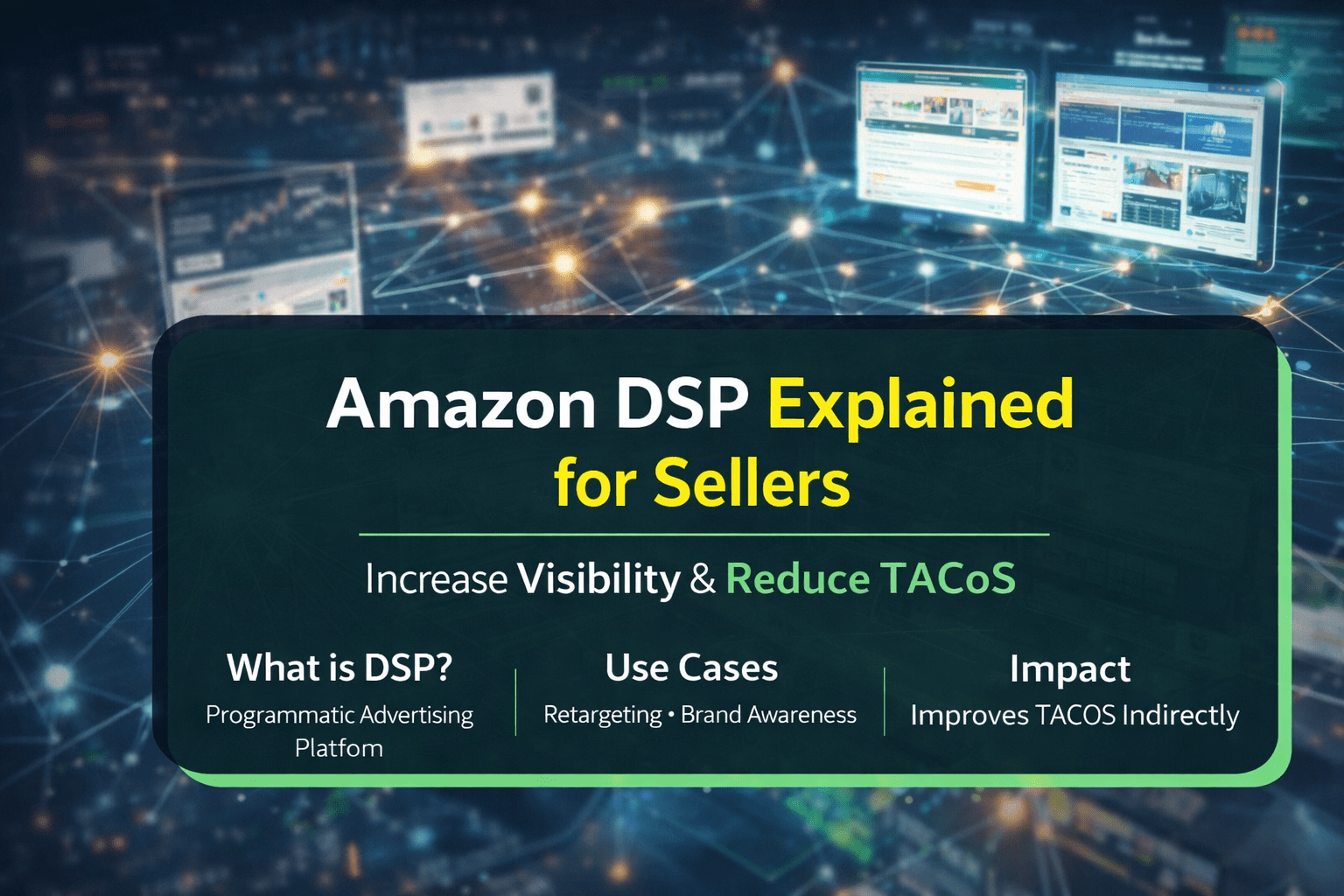
If you already run Amazon advertising, many skills transfer: keyword intent, bid discipline and profit-first reporting. See our overview of Amazon DSP for sellers for how retail media and audience advertising fit together.
Delivery and shipping
On B&Q Marketplace, the seller is responsible for arranging delivery. B&Q has described delivery as fully scheduled and arranged by the seller once an order is placed, with a lead time shown at checkout. That gives you control, but also responsibility.
Delivery decisions to make:
- Couriers: Choose carriers for each product type: parcel carriers for small items, pallet networks for bulky goods, specialist carriers for very large or fragile products.
- Weight bands and pricing: Calculate cost by weight and size, not by averages.
- Lead times: Promise only what you can keep. Late delivery damages performance scores.
- Packaging: Heavy, sharp or fragile products need packaging that survives transit. Damage claims are expensive.
- Tracking: Upload tracking promptly so customers and the marketplace see progress.
- Delivery charges: Initial communications from B&Q indicated that marketplace deliveries would not incur separate customer charges at launch, so price and delivery terms should be checked against current marketplace rules.
Bulky goods deserve their own plan. A garden table, a vanity unit or a bag of paving sand is nothing like a phone case. Check whether you can offer scheduled delivery windows, two-person delivery where needed, and clear instructions for access and unloading.
Returns: how to handle them well
B&Q’s returns promise is generous. Returns are free for customers regardless of reason, with up to 90 days from purchase, as described in Optimizon’s guide. That is excellent for conversion and expensive for sellers who are not prepared.
How to manage returns profitably:
- Offer prepaid return labels or collections upfront. It reduces friction and encourages repeat purchases.
- Handle returns promptly. Fast refunds protect your ratings.
- Know which items cannot go back to store. Large, heavy items and products containing materials such as lithium batteries or chemicals may have special return routes.
- Train your customer service team on the return rules so answers are consistent and accurate.
- Schedule collections quickly for bulky returns.
- Track return reasons by SKU. A high return rate on one product usually signals a content problem, such as unclear dimensions, or a quality issue.
- Build a returns provision into your pricing. Do not treat returns as a surprise cost.
Because returns are free for shoppers, listings that set clear expectations are especially valuable. Accurate dimensions, honest photos and clear compatibility information are your best defence.
Customer service and seller performance
B&Q expects marketplace sellers to deliver a retail-grade experience. That means:
- Fast responses to customer messages, usually within a working day
- Low cancellation rates, which depends on accurate stock
- On-time dispatch and delivery
- Accurate product information
- Quick, fair handling of returns and complaints
Metrics change over time, so check the service-level agreement in your seller portal. As a practical measure, aim for same-day replies on weekdays, a clear escalation route for damaged or missing items and a weekly review of messages, cancellations and returns.
As your volume grows, consider a helpdesk tool that consolidates marketplace messages with your other channels. A shared inbox, saved replies and clear ownership will protect your scores more than any promotion will improve them.
B&Q vs Amazon vs eBay vs ManoMano vs Wayfair
No marketplace is best for everyone. Here is how they compare for UK home and garden sellers. The comparison is qualitative, because fees and rules change and several platforms do not publish full rate cards.
| Dimension | B&Q Marketplace | Amazon UK | eBay UK | ManoMano | Wayfair |
| Best for | Home improvement, garden, tools, furniture, lighting | Almost everything, strongest for branded and repeat-purchase goods | Used, niche, spare parts, value-led products | DIY and gardening across several European countries | Furniture, homeware and décor |
| Audience intent | Project-driven, trusted-retailer shoppers | Convenience-led, very broad | Bargain and hard-to-find hunting | DIY-focused, Europe-wide | Home-styling shoppers |
| Access | Curated: application and review | Open, with category approvals | Open, easy start | Curated | Curated |
| Fees | Reported monthly subscription plus category commission (rates not published) | Referral fee, optional FBA fees, advertising | Category-based fees for business sellers | Commission-based | Commission-based |
| Fulfilment | Seller ships | Seller or FBA | Seller ships | Seller ships | Seller or platform programmes |
| Advertising | In-platform sponsored placements | Sponsored ads, DSP | Promoted Listings | Marketplace ads | Platform ads |
| Customer data and branding | Limited, retailer-led | Limited | Limited | Limited | Limited |
| Competition | Lower than Amazon in many niches, rising with growth | Very high | High on mainstream items | Moderate to high | Moderate to high |
| Scale potential | Strong in its categories | Highest | Moderate | Good for European expansion | Good in home and furniture |
How to read this table
B&Q is attractive when your product fits the home improvement journey. A shopper on diy.com is in a buying mindset for home projects, and the retailer’s brand adds trust. Curation means fewer low-quality competitors, but it also means you must earn your place.
Amazon is still the volume engine for many brands. Prime, logistics and a huge advertising ecosystem give it a scale advantage in most categories. That is why EcomRanker is Amazon-first, and why we spend so much time on account management and PPC.
eBay suits a different type of seller. If you resell, refurbish or sell niche items, see our guide on whether selling on eBay is worth it.
ManoMano and Wayfair are worth evaluating if you plan to sell across Europe or if your range is strongly furniture- and décor-led.
The smartest approach is sequencing. Make your best channel profitable first, then add B&Q when your stock, content and customer service are stable. Selling on several marketplaces with a weak foundation spreads your attention too thin.
Common mistakes that cost sellers money
- Applying with a thin, supplier-copied catalogue. B&Q expects retail-quality content. Duplicate manufacturer text and poor images hurt both approval and conversion.
- Ignoring the commission until the first statement. Model your margin before you apply, at several commission levels.
- Underestimating courier costs for bulky items. One badly priced pallet delivery can wipe out the profit from ten orders.
- No stock sync. Overselling causes cancellations, which damage performance.
- Weak attributes. Missing dimensions, materials or compatibility details remove you from filtered searches and increase returns.
- Lead times you cannot hit. Late deliveries erode customer trust and your seller standing.
- No returns plan. Free returns can quietly consume margin if you have no process, labels or provision.
- Discounting without a floor price. Promotions should create profitable volume, not volume that loses money.
- Skipping compliance documents. Missing energy labels, safety information or certification slows approval and creates risk.
- Launching too much too soon. A huge, messy catalogue is harder to fix than a small, polished one.
- Treating B&Q as set-and-forget. Marketplaces reward sellers who monitor search terms, price, stock, reviews and promotions every week.
- Reading only the competitor guides. Third-party guides, including this one, are useful but not official. Your seller agreement and portal are the source of truth.
A 90-day launch plan
Days 1 to 14: Prepare
- Choose 20 to 50 hero products with good margin and reliable stock.
- Model profit at low, mid and high commission, with realistic courier costs and returns.
- Gather KYC documents and compliance files.
- Write titles, descriptions and attributes. Shoot or finish product images.
- Decide how stock will sync with your other channels.
Days 15 to 30: Apply and onboard
- Submit your application with a clear, specific range.
- Complete terms, onboarding and verification as soon as approved.
- Set up couriers, returns labels and a customer service routine.
- Upload your first products by CSV or integration and check every listing.
Days 31 to 60: Launch and learn
- Monitor orders daily. Fix errors immediately.
- Check search visibility for your main terms and refine titles and attributes.
- Respond to every customer message within a working day.
- Review your first payment statement and reconcile it.
- Look at the promotions calendar and choose one or two campaigns to enter.
Days 61 to 90: Optimise and expand
- Analyse best sellers, returns and delivery issues by SKU.
- Improve content on products with high traffic but low conversion.
- Test a small advertising budget on your top products, with a profit-based target.
- Add a second batch of products and consider promotional pricing.
- Decide whether to scale B&Q, hold steady or expand to another Mirakl marketplace.
By day 90 you should know your real commission, real courier cost per product, real return rate and real profit per order. That is more valuable than any estimate in a guide.
Using Mirakl Connect to sell on other marketplaces
Because B&Q Marketplace is powered by Mirakl Connect, sellers who finish onboarding are reported to gain a streamlined route to over 400 other Mirakl-powered marketplaces, including European home improvement retailers such as Leroy Merlin. That does not mean automatic approval everywhere, and each marketplace sets its own rules, categories and fees. But it means your KYC and business verification can be reused, and your catalogue work carries over.
Think of B&Q as a training ground for European expansion. If you learn to maintain a clean product feed, sync stock accurately and meet service-level standards on diy.com, you are in a strong position to try other Mirakl marketplaces later. Before you expand, check VAT, shipping, returns and language requirements for each country.
How EcomRanker can help
EcomRanker is a full-service Amazon agency founded in 2017 by Chirag Bharihok. We operate across the UK, USA, UAE and India marketplaces, with services that cover account management, PPC and DSP advertising, listing optimisation and creative design.
We are an Amazon specialist, not an official B&Q partner, and we will not pretend otherwise. What we offer is an independent view of where your next pound of effort will earn the most. For many UK home and garden brands, that means getting Amazon profitable first, then adding B&Q as a second channel once the numbers and operations support it.
How we can help you:
- A marketplace profit review comparing your margins on Amazon, B&Q and other channels, including commission, courier and returns assumptions.
- Product content and creative built on the same principles that lift Amazon conversion: listing optimisation and creative design.
- Profit-first advertising through Amazon PPC management and DSP strategy.
- Day-to-day account support through Amazon account management.
Not sure whether B&Q, Amazon or both is the right next move? Book a free marketplace review with EcomRanker and we will walk through your numbers with you.
Frequently Asked Questions
How do I sell on B&Q Marketplace?
How much does it cost to sell on B&Q Marketplace?
Is B&Q Marketplace invitation-only?
Do I need an agency to sell on B&Q Marketplace?
What documents do I need to become a B&Q marketplace seller?
How do B&Q marketplace payments work?
Who handles delivery on B&Q Marketplace?
How do returns work on B&Q Marketplace?
What can I sell on B&Q Marketplace?
Can I advertise on B&Q Marketplace?
Can I sell on B&Q Marketplace from outside the UK?
Is B&Q Marketplace better than Amazon?
Final verdict: is selling on B&Q Marketplace worth it?
For UK sellers in home improvement, garden, furniture, tools, lighting and related categories, B&Q Marketplace is well worth serious consideration. It combines a trusted retailer brand, high-intent shoppers, a curated environment and, through Mirakl Connect, a route to wider European marketplaces.
It is not a shortcut. You need strong product data, reliable stock, a delivery plan that works for bulky goods, a returns process that protects margin and a customer service routine that meets retail standards. You also need to model profit carefully, because the commission is not published and free returns shift cost to you.
The practical next step is simple. Shortlist 20 to 50 products. Model profit at several commission levels. Prepare your documents and content. Apply with a clear, specific range. Launch small, learn fast and expand once the numbers prove the channel.
If you want a second opinion before you commit, contact EcomRanker for a free marketplace review.