
On 27 February 2026, Amazon quietly switched off one of the most talked-about A+ Content experiments of the last two years. Amazon Shoppable Collections, the interactive, carousel-style module that let shoppers browse and buy across a brand’s range without leaving a product page, was withdrawn from the product detail page (PDP). There was no press release, no webinar and no direct email to sellers. Brands simply logged into A+ Content Manager and found a banner telling them the beta was over.
If you had built Shoppable Collections for your catalogue, were waiting for access, or had been planning your Q4 content around it, this guide is for you. We will cover exactly what happened, what the PDP looks like now, why Amazon most likely pulled the plug, what the decision says about where Amazon is heading, and, most importantly, a practical playbook for recovering the cross-sell and storytelling value you were hoping to capture.
We manage Amazon content and advertising for brands across the UK, USA, UAE and India, so we have watched Amazon test, scale and retire dozens of features since 2017. The pattern is consistent, and Shoppable Collections fits it neatly. By the end of this article you will know how to turn the end of a beta into a content advantage.
Key takeaways
- Amazon ended the Shoppable Collections beta on 27 February 2026. The module no longer renders on product pages.
- The Brand Story module takes back the “From the Brand” placement wherever a brand has one. Listings without a Brand Story may show nothing in that space.
- Amazon said it plans to fold the most successful Shoppable Collections features into Brand Story. It has not published which features or when.
- The same notice introduced Content Quality Analysis, a beta that scores A+ Content on an ongoing basis. Content quality is now measurable and visible.
- Shoppable Collections is the second Amazon content format to be retired at short notice in under a year, after Amazon Posts in mid-2025.
- You can still cross-sell with comparison charts, Brand Story tiles, Brand Stores, Sponsored Brands and smart variation structure. The tools changed; the shopper behaviour did not.
- The winning response is not to mourn the beta. It is to rebuild Brand Story and A+ Content to a higher standard, measure the result and stay flexible for the next test.
What Was Amazon Shoppable Collections?
Amazon Shoppable Collections was a beta A+ Content format, introduced in September 2025 for brand-registered sellers and vendors. Instead of the familiar static Brand Story banner, it offered an interactive, tile-based experience. Shoppers could swipe through curated groups of products, view imagery and short copy, and click straight through to individual ASINs, all from within the product detail page.
The idea was straightforward: turn a single-ASIN page into a mini storefront. A shopper looking at one moisturiser could discover the matching serum, the travel-size set and the refill pouch without ever leaving the page or going back to search results. For brands with deeper catalogues, it promised higher average order value, better product discovery and a more content-led, multi-ASIN approach to commerce.
How Shoppable Collections worked
Based on what brands reported during the rollout, the format had several defining characteristics:
- It lived in A+ Content Manager. Brands created it by choosing the shoppable option next to Brand Story when starting a new A+ Content build.
- It replaced Brand Story. The two could not run together on the same listing. Adopting Shoppable Collections meant giving up your Brand Story for those ASINs.
- It offered a choice of content modules. Brands assembled a collection from a selection of four module types, mixing imagery, video and clickable product tags.
- It needed enough products to show. Amazon hid the section where a collection had fewer than five product cards, to protect the shopper experience.
- It appeared early on mobile. On phones, the module was reported to sit ahead of the standard A+ Content, taking over the space that traditionally introduced the product story.
That last point matters. Mobile now drives the majority of Amazon browsing in most markets, so a module that appeared early on the mobile detail page was a high-visibility asset. It is part of why brands took the beta seriously.
Who could use it?
Shoppable Collections was a Brand Registry feature. Like Brand Story, Premium A+ Content and Brand Stores, it was designed for brands that own their trademark and have enrolled in Amazon Brand Registry. It was most relevant for brands with several related products: skincare ranges, cookware families, accessory lines, supplements and anything sold in sizes, bundles or complementary sets.
The Timeline: From Launch to Shutdown
Timelines matter in SEO and in strategy, and some of the commentary around this change has muddled the dates. Here is the sequence as it is publicly documented.
| Date | Event |
| June to July 2025 | Amazon retires Amazon Posts. The Posts API is deprecated and fully switched off by the end of July 2025. |
| September 2025 | Shoppable Collections appears in A+ Content Manager as a beta, replacing Brand Story for adopting brands. |
| Autumn 2025 | Agencies promote Shoppable Collections as a way to boost cross-sell ahead of Prime Big Deal Days and the holiday season. |
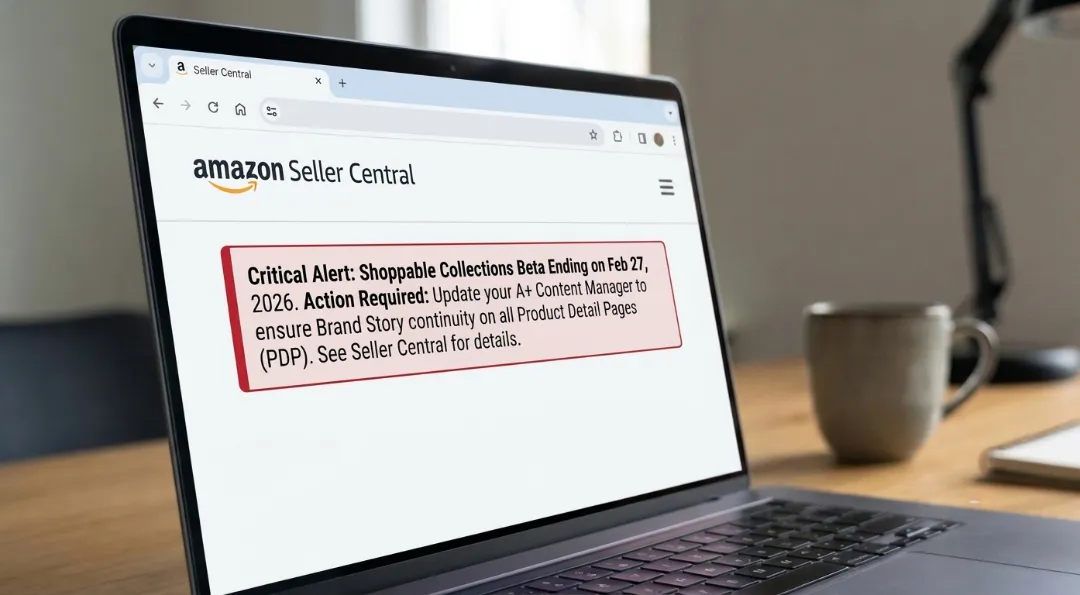
| Mid-to-late February 2026 | Amazon posts a dismissible banner in A+ Content Manager announcing the end of the beta. A second banner introduces Content Quality Analysis. |
| 27 February 2026 | Shoppable Collections stops rendering on product pages. Brand Story returns wherever it exists. |
Notice how short the product life was. From beta launch to withdrawal was roughly five to six months, hardly enough for most brands to build, test, learn and iterate. That is not unusual for Amazon betas, but it is a good reminder of how much risk sits with the seller when they build around an unproven format.
What Amazon Has Confirmed
Amazon communicated the change through notifications inside A+ Content Manager, not through a public announcement. The key confirmed points are these.
The beta is formally over
Amazon told brands that, after analysing user feedback and performance data, it decided to end the Shoppable Collections beta on 27 February 2026. That is the headline, and it is unambiguous. Shoppable Collections will not become a permanent part of the Amazon PDP experience in its beta form.
Brand Story is the replacement
The module disappears from product pages and from the A+ Content Manager interface. Where a brand has an active Brand Story, that Brand Story displays automatically in the “From the Brand” position that Shoppable Collections had occupied. If you kept your old Brand Story content saved, it comes back into play without any action.
Features may migrate
Amazon also stated that it intends to take the most successful features from Shoppable Collections and incorporate them into Brand Story, to improve both storytelling and the shoppability of products. It has not said which features, or on what timeline. That is the single most important forward-looking detail in the whole announcement, and we return to it later in this guide.
Your uploaded assets are not lost
Images that brands uploaded while building collections remain in the media library after the module is removed. That is useful: the creative you commissioned is reusable in Brand Story, in standard A+ modules, in your Brand Store and in Sponsored Brands creative.
What Amazon has not said
There has been no public performance commentary. We do not know adoption numbers, conversion data or the specific reasons behind the decision. Everything in the next section is therefore informed analysis, not confirmed fact, and we label it that way.
What Changes on Your Product Pages
If you want to check your own listings, here is what you should now see and what to do about it.
Listings that had an active Brand Story
The Brand Story module resumes its place in the “From the Brand” area. It typically presents a brand logo, a short brand narrative and a carousel of image and text tiles. For many brands this content was written years ago and has not been touched since. Treat its return as a prompt to review it, not simply as a restoration of the status quo.
Listings that never had a Brand Story
This is the group most likely to be surprised. If you moved straight to Shoppable Collections and never built a Brand Story for those ASINs, the space may now be empty or may not render at all. An empty above-the-fold brand area is a missed opportunity. Building a Brand Story for those ASINs should be one of your first actions.
Mobile versus desktop
Because Shoppable Collections was reported to appear early on the mobile detail page, the visual change on phones may be more noticeable than on desktop. Open your top ten ASINs on a phone and scroll the page from the top. Look at what a shopper sees between the buy box and the standard A+ Content. If it is thin, repetitive or empty, fix it.
Your analytics
If you tracked conversion rate, units per order or traffic to your Brand Store while Shoppable Collections was live, flag the end date in your reporting. A change in those metrics after 27 February may be a result of the module disappearing, not of changes you made. Annotate your dashboards so that future-you does not misread the data.
Why Amazon Ended Shoppable Collections (Our Analysis)
Amazon rarely explains its reasoning, so brands are left to read the signals. Based on how Amazon has handled earlier betas, and on what the notice and market commentary tell us, these are the most plausible factors. None is confirmed; together they form a coherent picture.
1. Adoption stayed limited
Shoppable Collections demanded work. Brands needed at least five products to make a collection eligible, a coherent creative concept, and fresh assets in the right formats. Many brands never prioritised it, and others could not access it early. A feature that few sellers use does not generate enough data to justify the engineering and support cost of keeping it alive.
2. Performance was probably uneven at scale
Cross-sell modules work brilliantly for some categories and poorly for others. A coherent skincare routine sells well as a collection; a single-purpose tool does not. When incremental conversion is strong in one vertical and flat in another, a platform that needs consistent results across millions of listings often decides not to scale the feature.
3. It added friction to content and catalogue management
Collections referenced multiple ASINs. That means every out-of-stock item, every suppressed listing and every price change in the range affected the quality of the module. Maintaining accurate multi-ASIN content across a living catalogue is hard for brands and hard for Amazon to police.
4. It overlapped with Brand Story
Because it replaced Brand Story rather than sitting alongside it, Shoppable Collections created a parallel path for the same placement. Running two competing formats in one slot complicates the PDP, the tooling and the guidance Amazon gives sellers. Folding the better ideas into one module is simpler.
5. The detail page is evolving
Amazon has talked publicly about redesigning search and detail pages and about AI-assisted shopping experiences such as Rufus. Retiring a format that did not fit a longer-term page architecture is consistent with that direction. We would treat this as a reasonable inference, not a confirmed motive.
The pattern behind the decision
Amazon has a well-worn playbook: launch a beta, invite early adopters, measure ruthlessly, scale what works and retire what does not. Amazon Posts, the social-style feed that sellers used for brand discovery, went through the same cycle and was retired in 2025, with Amazon citing declining impressions and a coming redesign of search and detail pages. Shoppable Collections ended for different reasons, but the outcome was identical.
Who Was Most Affected?
The end of the beta did not hit every brand equally.
Multi-SKU brands with curated ranges. Beauty, personal care, home and lifestyle brands that sell coordinated families of products had the most to gain from the module and therefore the most to lose. Categories driven by inspiration and context, where shoppers buy a look or a routine rather than a single item, benefited from the storefront feel.
Brands that rebuilt their Brand Story around the beta. Teams that retired their Brand Story to adopt collections now need to rebuild it.
Early adopters planning seasonal campaigns. Anyone who designed Q4 or Black Friday creative around Shoppable Collections needs a rapid fallback, particularly as Prime Big Deal Days and the peak trading period approach.
Single-SKU and education-led products. Brands selling one hero product, or items that require explanation rather than range discovery, were less likely to be affected and may barely have noticed the change.
What the End of Shoppable Collections Tells Us About Amazon’s Direction
It is tempting to read the shutdown as Amazon stepping back from content-led commerce. We think that is the wrong lesson. Three signals point the other way.
Signal 1: consolidation, not retreat
Amazon said it will carry successful Shoppable Collections features into Brand Story. That is a consolidation strategy: fewer formats, each with more capability. For brands, this means the modules that survive deserve more investment, because they are the ones Amazon will keep improving.
Signal 2: quality is becoming measurable
The second banner announced Content Quality Analysis, a beta tool that evaluates A+ Content pages on an ongoing basis. Amazon is simultaneously removing a flashy experimental format and introducing a scorecard for the fundamentals. The message is clear: execution quality matters more than novelty.
Signal 3: accountability for PDP content
A scoring system creates accountability. Once content quality has a number attached, brands will be compared against standards, and internal teams, agencies and Amazon account managers will start to reference those scores. Brands that treat A+ Content as a one-off creative project will fall behind those that treat it as an ongoing, measured asset.
Signal 4: the page is becoming more AI-readable
As shoppers increasingly use conversational and AI-assisted discovery, structured, accurate and complete content matters more than ever. Well-organised Brand Story and A+ Content, with clear product logic and consistent claims, is easier for Amazon’s systems to interpret and surface. That is an inference from where the platform is investing, but it is one we are already acting on with clients.
Content Quality Analysis: The Other Half of the Announcement
Because the two notices appeared together, it is easy to overlook the second. Content Quality Analysis deserves attention.
What it is
Content Quality Analysis is a beta feature inside A+ Content Manager that evaluates A+ Content pages and, according to early reporting, does so on an ongoing weekly basis. Instead of a one-time approval check, it provides a continuing view of how your content stacks up.
Why it matters
Historically, A+ Content was approved or rejected for compliance, not graded for quality. A quality score changes the dynamic in three ways. First, it gives brands a benchmark to improve against. Second, it signals what Amazon considers good, which tells you where to focus. Third, it creates a natural link between content quality and the tools Amazon makes available, including Premium A+ Content eligibility.
How to use it
Treat the score as a diagnostic, not a target to game. Use it to find your weakest pages, prioritise rewrites on your highest-revenue ASINs, and track improvement over time. Then validate with real shopper metrics. A page that scores well but converts poorly still needs work, and vice versa.
What Brands Should Do Now: The Recovery Playbook
For brands that were preparing for, testing or waiting on Shoppable Collections, the job now is to maximise impact inside the tools that remain. The good news is that those tools are powerful when used properly, and most accounts are using them poorly. Here is the order of work we recommend.
Step 1: Audit every ASIN’s “From the Brand” area
Start with facts. Export your top 50 ASINs by revenue and open each on desktop and mobile. Record whether it shows a Brand Story, an empty space or something else. Group ASINs into three buckets: Brand Story present and current, Brand Story present but outdated, and nothing there. This takes an afternoon and tells you exactly where the gaps are. If you want a second pair of eyes, our Amazon account audit service covers content, advertising and catalogue structure together.
Step 2: Rebuild or refresh Brand Story
Brand Story is once again your primary above-the-fold brand module, which makes it one of the highest-visibility pieces of content on the page. Our guidance, drawn from working on Amazon Brand Story for brands of all sizes:
- Keep the tile structure tight. Tight, focused tiles with clear product logic tend to outperform long, narrative-heavy layouts. Each tile should do one job.
- Lead with the shopper, not the founder. Your origin story matters, but a shopper deciding between three products wants to know what you stand for in one sentence, then see proof.
- Use the tiles as a mini catalogue map. One tile for the hero product, one for the range, one for the use case, one for the guarantee or credential. That reproduces some of the discovery value Shoppable Collections offered.
- Write short, scannable copy. Mobile screens punish paragraphs. Aim for a headline of a handful of words and a single supporting sentence per tile.
- Design for mobile first. Check legibility of text on images at phone size. If you cannot read it without zooming, rewrite it.
- Keep claims compliant. Avoid unverifiable superlatives, competitor references and time-sensitive promotions. Our Amazon brand guidelines page explains what tends to get content rejected.
Step 3: Reuse the assets you already paid for
Images uploaded for Shoppable Collections stay in your media library. Before commissioning new creative, check what you have. Lifestyle shots, range photography and group images can be dropped into Brand Story tiles, comparison charts and Brand Store pages. This is also a good moment to review your Amazon listing images, since listing images and A+ imagery should tell a consistent story.
Step 4: Fill gaps on every high-revenue ASIN
Prioritise by revenue and by traffic. An ASIN that earns well and has no Brand Story is the easiest quick win in your account. An ASIN with weak traffic needs its listing fixed first; content cannot convert shoppers who never arrive. For the discoverability side, see our Amazon SEO services and Amazon listing optimisation work.
Step 5: Annotate, measure, iterate
Log the date of every change, take a baseline of conversion rate, units per order and detail-page traffic, and measure again after two to four weeks. We cover measurement in detail later in this guide.
How to Cross-Sell Without Shoppable Collections
The real attraction of Shoppable Collections was cross-selling: increasing average order value by helping shoppers find the next product. Nothing about that goal has changed. What has changed is the toolkit. Here are the levers still available, and how to use each well.
Comparison charts inside A+ Content
A comparison chart is the closest standard A+ equivalent of a collection. It lets you show several of your ASINs side by side, with images, key attributes and links. Done well, it answers the question every shopper asks mentally: “Which one is right for me?”
- Compare three to six products, not twelve. More than that overwhelms mobile shoppers.
- Choose attributes that genuinely differ: size, strength, compatibility, material, use case.
- Order products logically, for example from entry level to premium.
- Highlight the current product so shoppers know where they are in the range.
Smart module sequencing
The order of modules on a page tells a story. A sequence that works for many ranges is: a hero banner that restates the core benefit, a feature grid, a lifestyle or use-case module, a comparison chart and a closing module that points to the wider range or the Brand Store. The comparison chart should sit after you have persuaded the shopper, not before.
Brand Story as a range map
Brand Story tiles can reference different product families. Even where tiles do not carry individual add-to-cart links, they can introduce the range and drive shoppers towards your Brand Store, where full multi-ASIN browsing exists.
Brand Store as the home for multi-ASIN browsing
If Shoppable Collections was a mini storefront on the detail page, the Amazon Brand Store is the full storefront. It supports curated collections, category pages and shoppable images, and it can be targeted directly by advertising. Brands that were excited about collections but had a thin Brand Store should invest there. Make sure the path from the detail page to the store is obvious.
Sponsored Brands and Sponsored Display
Advertising can do the cross-sell job that content cannot. Sponsored Brands can send shoppers to a curated Brand Store page or a custom landing page showing multiple products. Sponsored Display can show your own complementary products on your own detail pages and on competitors’ pages. We explain how to set these up profitably in our Amazon advertising services overview.
Bundles, variations and sets
If you want shoppers to buy three items together, sometimes the right answer is to sell them together. Multipacks, bundles and variation families reduce friction and raise order value directly. Review your catalogue for natural combinations, then use A+ Content to explain the bundle’s value.
| Cross-sell goal | Best tool now | Where it lives | Effort |
| Show the range at a glance | Comparison chart | A+ Content | Low |
| Introduce brand and range | Brand Story tiles | Detail page | Medium |
| Browse the full catalogue | Brand Store | Store pages | Medium to high |
| Reach shoppers on other listings | Sponsored Display | Advertising | Medium |
| Drive traffic to a curated page | Sponsored Brands | Advertising | Medium |
| Raise order value directly | Bundles and multipacks | Catalogue | Medium |
Catalogue-Level Thinking: Make Mental Comparison Easy
Amazon may not yet support full multi-ASIN shopping on the PDP, but shoppers still compare products in their heads. If your range is confusing, they will compare you against a competitor whose range is clearer. That is why catalogue-level thinking matters more now than it did before the beta.
Position variants clearly
Be explicit about how your products differ. If you sell a standard, a plus and a pro version, each listing should say, in the title, the bullets and the A+ Content, who it is for. Ambiguity does not just reduce conversion; it increases returns.
Use a good-better-best framework
Three-tier ranges are easy to understand. Even if you have more products, grouping them into three clear tiers helps shoppers decide.
| Tier | Shopper mindset | What to emphasise |
| Good (entry) | “I just need it to work” | Value, simplicity, reliability |
| Better (core) | “I want the sensible choice” | Best balance of features and price |
| Best (premium) | “I want the top option” | Performance, materials, extras, warranty |
Use the same tier names and visual language across every listing so shoppers recognise the system as they browse.
Signal compatibility and fit
For accessories, consumables and refills, compatibility is the most common reason for abandonment and returns. State clearly which models, sizes or systems each product works with, and repeat it in a comparison chart. Shoppers should never have to guess.
Keep your catalogue data clean
Cross-sell content is only as good as the listings it points to. Out-of-stock ASINs, suppressed listings and inconsistent naming undermine every comparison. Regular catalogue hygiene, including variation relationships, titles and attribute completeness, is part of content strategy. If you manage this across a Seller Central account, our Seller Central management team handles it as standard; vendors can rely on our Vendor Central management service.
Why Premium A+ Content and Brand Story Should Work Together
Amazon’s more advanced content tools tend to be reserved for accounts that demonstrate good content practice. Agencies have observed that aligning Brand Story with Premium A+ Content helps maintain eligibility for the most capable modules and tools. We cannot see Amazon’s internal eligibility rules, but the direction is consistent: brands that invest in complete, high-quality, well-structured content gain access to better formats.
If you are not already using Premium A+ Content, review whether your ASINs qualify. Our Premium A+ Content service and standard A+ Content creation pages explain the differences. The practical benefit is richer media, interactive hotspots and more layout freedom, which suits the kind of range storytelling brands were hoping to achieve through Shoppable Collections.
Use Advertising to Fill the Gap
Content and advertising are two halves of the same conversion system. If the PDP can no longer host a collection, your ads can carry more of the discovery load.
Sponsored Brands to a curated destination
Send Sponsored Brands traffic to a Brand Store page built around a theme, for example a routine, a use case or a gift set, rather than to a generic storefront. This recreates the curated feel of a collection with the added advantage that you can measure and bid on it.
Sponsored Display for complementary products
Use product targeting to place your complementary ASINs on your own best-selling detail pages. If a shopper is looking at your hero product, a relevant add-on is exactly what they should see. Keep an eye on ACoS and TACoS for these campaigns, because the aim is profitable basket growth, not just clicks.
Amazon DSP for range-level retargeting
For brands with larger ranges and budgets, Amazon DSP lets you retarget shoppers who viewed one product with messages about the rest of the range, on and off Amazon. It is a natural fit for brands that wanted the storefront experience Shoppable Collections hinted at.
Keep PPC and content in sync
Every ad creative promise must match the landing detail page. If your ad highlights the premium tier and the Brand Story talks about the entry model, conversion suffers. Our Amazon PPC management team works from the same content plan as our creative team for exactly this reason, and our funnel-based advertising strategy approach maps every campaign to a stage of the shopper journey.
How to Measure the Impact of Your Content Changes
One reason Amazon retires betas is that it measures them hard. Brands should do the same with their own content. Without measurement, you will not know whether a rebuilt Brand Story helped or hurt.
The metrics that matter
| Metric | Where to find it | What it tells you |
| Unit session percentage (conversion rate) | Business Reports | Whether the page turns visits into orders |
| Units per order | Business Reports and orders data | Whether cross-sell is working |
| Detail page sessions | Business Reports | Whether traffic is stable while you test |
| Brand Store visits and sales | Stores insights | Whether shoppers move from the PDP to your wider range |
| Return rate by ASIN | Returns reports | Whether positioning and compatibility are clear |
| Content quality score | A+ Content Manager | Whether content meets Amazon’s standard |
| TACoS | Advertising and sales data | Whether organic is growing relative to ad spend |
Test properly
Where your account is eligible, use Amazon’s experiment tools to run controlled tests of A+ Content, rather than comparing before and after periods that include different promotions and seasons. Our guide to Amazon A/B testing with Manage Your Experiments explains how to set up a clean test. Test one meaningful change at a time, run it long enough to reach significance, and record the result either way. If you want help building a structured testing programme, see our conversion rate optimisation services.
Watch for confounders
Price changes, coupons, stock-outs, Prime events and competitor actions all move conversion. When you review results, check for those first. The end of Shoppable Collections is itself a confounder in your 2026 data; keep it annotated.
A Practical Checklist: Your Post-Shoppable Collections Audit
Use this list on your top ASINs. Each “no” is a task.
Brand Story
- Does every high-revenue ASIN show a Brand Story on desktop and mobile?
- Is the content current, with accurate product names, ranges and claims?
- Does each tile do one clear job?
- Is every line of text readable on a phone?
- Does the story point shoppers to your Brand Store or wider range?
A+ Content
- Is there a comparison chart showing the right three to six products?
- Do modules follow a deliberate order from benefit to proof to range?
- Are alt text fields completed for every image?
- Is the content consistent with the listing’s bullets and images?
- Have you checked your content quality score for weak pages?
Catalogue
- Are variants clearly positioned and named?
- Are compatibility and sizing stated explicitly?
- Are variation relationships correct and all child ASINs live?
- Are bundles and multipacks available where shoppers want them?
Advertising and measurement
- Do Sponsored Brands campaigns land on a curated, relevant page?
- Is Sponsored Display used for complementary product targeting?
- Are baselines and change dates logged for every ASIN you edit?
- Is at least one A/B test running on your highest-revenue ASIN?
Common Mistakes Brands Make After a Beta Ends
Rebuilding the old experience in the wrong place. Some brands try to cram a collection into a Brand Story, with too many tiles and too much copy. Shoppers do not want a catalogue in a banner; they want clarity.
Ignoring mobile. A page that looks excellent on a 27-inch monitor and is unreadable on a phone is a page that is failing most shoppers.
Chasing the score rather than the shopper. Content Quality Analysis is a useful diagnostic. Optimising for it at the expense of persuasion, brand voice or clarity is a mistake.
Letting the creative sit for years. Brand Story that was last touched in 2022 does not reflect your current range. Put a review date on every content asset.
Putting all your eggs in one beta. The brands hurt most by the shutdown were those that retired solid content to commit fully to an unproven format. Keep the fundamentals in place and test new formats alongside them where you can.
Forgetting the brand-new listings. New ASINs often launch without a Brand Story. Build the content into your launch checklist.
Your 30-60-90-Day Plan
Days 1 to 30: Stabilise
- Audit your top 50 ASINs for Brand Story status on desktop and mobile.
- Rebuild or refresh Brand Story for your top 10 revenue ASINs.
- Pull reusable assets from your media library.
- Annotate your reporting with the 27 February 2026 change.
- Record baselines for conversion rate, units per order and Brand Store traffic.
Days 31 to 60: Improve
- Add or rework comparison charts on ASINs with strong sibling products.
- Review content quality scores and rewrite the weakest pages.
- Align Sponsored Brands destinations with your Brand Store themes.
- Launch Sponsored Display campaigns targeting complementary products.
Days 61 to 90: Optimise and scale
- Run A/B tests on your highest-revenue listings.
- Extend Brand Story and A+ improvements to the next 50 ASINs.
- Review bundles and multipacks for cross-sell opportunities.
- Build a content calendar with quarterly reviews and seasonal updates.
If you would rather not carry this alone, our full-service Amazon account management covers the whole plan under one account lead.
How to Treat the Next Amazon Beta
Shoppable Collections will not be the last beta Amazon retires. Here is the framework we use with clients to decide whether to commit.
- Test on a small, representative set of ASINs. Choose a few products across categories, not your entire catalogue.
- Keep your fallback intact. Never delete the content a beta replaces. Archive it, with notes on how it performed.
- Define success before you start. Decide what uplift in conversion or order value would justify the effort.
- Build reusable assets. Create imagery and copy that work in several modules and in your Brand Store, so the investment survives the format.
- Set a review date. If the beta has not delivered results by that date, stop and redirect effort.
- Listen for migration signals. Amazon said successful Shoppable Collections ideas will move into Brand Story. Watch release notes, seller forums and your account manager for the specifics, then test them early.
The brands that benefit most from Amazon’s experiments are not the ones that bet biggest. They are the ones that learn fastest and lose least.
Does This Apply to the UK, USA, UAE and India?
Feature availability on Amazon varies by marketplace and by account, and betas often reach some regions before others. We recommend checking A+ Content Manager in each marketplace where you sell to see which modules and notices appear. The strategic advice here applies everywhere: audit Brand Story, strengthen A+ Content, use comparison charts and Brand Stores for range discovery, and measure rigorously. If you sell across several marketplaces, our teams cover Amazon UK, Amazon USA, Amazon UAE and Amazon India with localised content and keyword work, so your Brand Story reads naturally in each market.
How EcomRanker Helps Brands After the Shoppable Collections Shutdown
EcomRanker is a full-service Amazon agency, founded in 2017, working across the UK, USA, UAE and India. When a feature like Shoppable Collections appears and disappears, the brands we work with do not scramble, because their content, advertising and catalogue are already managed as one system. Here is how we typically help:
- Content audit. We review Brand Story, A+ Content and listing images across your top ASINs and flag gaps by revenue impact.
- Brand Story and A+ rebuilds. Our creative and copy teams build mobile-first modules that tell your story and guide shoppers through the range.
- Cross-sell architecture. We design comparison charts, Brand Store journeys and advertising paths that lift units per order.
- Advertising alignment. Our Amazon advertising specialists make sure Sponsored Brands, Sponsored Display and DSP campaigns match the content shoppers land on.
- Testing and reporting. We run structured experiments and report on revenue, profitability and organic rank rather than vanity metrics.
If you are unsure where your listings stand, start with a free audit. Contact EcomRanker and we will show you exactly what to fix first. You can also read why brands call us the best Amazon agency in the UK.
Frequently Asked Questions About Amazon Shoppable Collections
What was Amazon Shoppable Collections?
When did Amazon end the Shoppable Collections beta?
What replaced Shoppable Collections on the product page?
Will Shoppable Collections come back?
Did I lose the images I uploaded for my collections?
Can I still cross-sell on Amazon product pages?
What is Content Quality Analysis?
Do I need Brand Registry to use Brand Story and A+ Content?
Are Amazon Shoppable Collections still available?
What replaced Amazon Shoppable Collections?
Is Brand Story the same as Shoppable Collections?
Are Amazon Store product collections the same as Shoppable Collections?
What happened to the uploaded Shoppable Collections images?
Can sellers still use shoppable comparison charts?
Should old Shoppable Collections screenshots be removed?
Final Thoughts: Build Foundations, Stay Adaptable
Shoppable Collections was an interesting experiment. For a few months it hinted at a more storefront-style future for the product detail page, and some brands used it well. Its removal is a reminder of how Amazon operates: test quickly, measure ruthlessly and scale only what works at platform level.
For brands, the lesson is practical. Sustainable growth on Amazon does not come from chasing every beta. It comes from strong foundations: a current, mobile-first Brand Story, well-sequenced A+ Content, a clear catalogue, advertising that matches the page and a measurement habit that tells you what is working. Do those things well and you will be ready for whatever Amazon launches next, including the features it carries over from this experiment.
Ready to rebuild your Brand Story and A+ strategy for the post-Shoppable Collections PDP? Talk to the EcomRanker team for a free audit and a clear plan.