The Amazon Great Indian Festival is India’s biggest annual Amazon sale event, timed around Navratri and Diwali, and it draws well over 100 crore customer visits in a matter of days. [Confirm 2026 exact dates on sell.amazon.in before publishing — sources conflict between late September and early October]. Sellers who start preparation 6-8 weeks out consistently outperform those who scramble the week before, since inventory, pricing, and advertising decisions all need lead time Amazon’s systems don’t grant on short notice.
Key Takeaways
- The Great Indian Festival typically runs in the late September to early October window, coinciding with Navratri and running through Diwali — [verify the confirmed 2026 dates directly before publishing, as sources reviewed conflict].
- Traffic during the event is genuinely massive — prior years have seen over 100 crore (1 billion+) customer visits, with a significant share of sales going to sellers based outside metro cities.
- Preparation should start 6-8 weeks before the event, not the week before — inventory forecasting, deal submissions, and PPC budget planning all have lead times that don’t compress well under pressure.
- Flipkart’s Big Billion Days typically runs concurrently, meaning sellers on both platforms need a coordinated cross-platform strategy, not two separate last-minute plans.
- What happens after the festival matters almost as much as the event itself — post-event returns, inventory drawdown, and repricing back to normal levels all need their own plan.
What the Great Indian Festival Is (and Why It Matters This Much)
The Amazon Great Indian Festival (often abbreviated AGIF) is Amazon India’s flagship annual sale event, timed to coincide with the country’s biggest festive shopping season — Navratri and Diwali. It functions similarly to Prime Day or Black Friday in Amazon’s other markets, but concentrated around India’s specific cultural calendar, with steep discounts (historically up to 75% on select items) across every major category. The scale is genuinely different from a typical promotional period: past events have drawn more than 100 crore customer visits, and Amazon has specifically highlighted that a meaningful share of sellers who saw a sale during the event were based outside major metro areas — this is as much a non-metro demand event as a big-city one, which has direct implications for logistics planning discussed below.
The Prep Timeline: What to Do and When
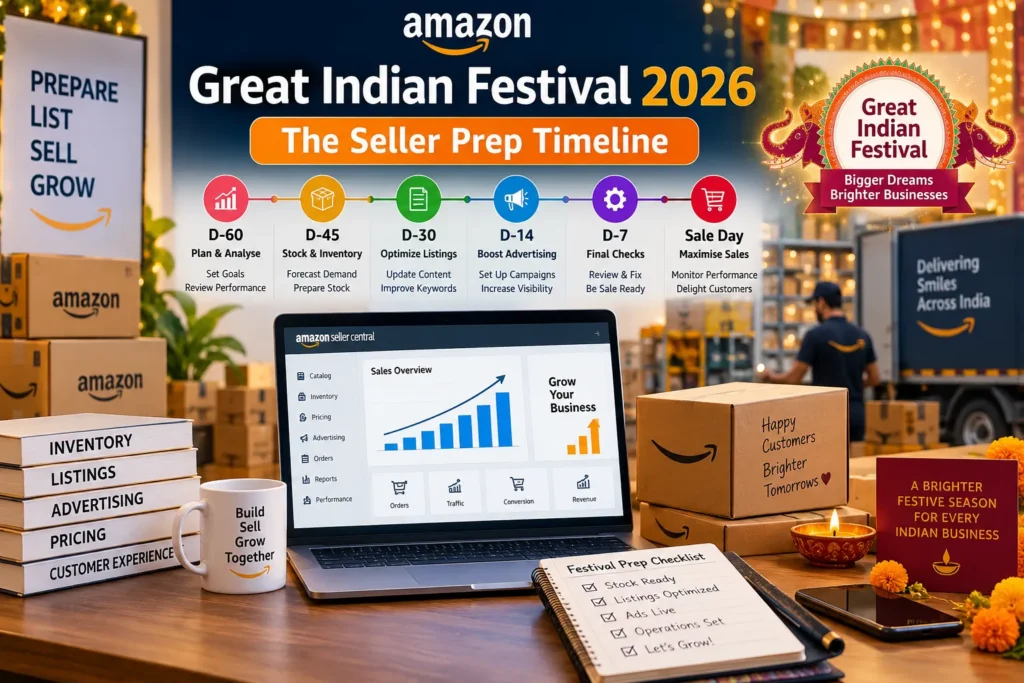
6-8 Weeks Out: Inventory and Forecasting
Pull last year’s sales data for the same event (or, for newer sellers, the closest comparable sale period) and forecast demand for your top SKUs specifically — don’t spread forecasting effort evenly across your full catalog when a small number of products will drive most of the volume. Begin the FBA inbound shipment process for high-demand items now, since fulfillment centers experience their own capacity crunch as the event approaches and later shipments risk missing the window entirely.
4-6 Weeks Out: Pricing and Deals
Submit Lightning Deal and other promotional applications during this window — Amazon’s deal submission process has lead times, and late submissions risk missing the event’s deal calendar entirely, similar to how Amazon’s global Lightning Deal system requires early submission for the best fee terms. Check your own price history now: a deal price must clear Amazon’s price-history requirements, and a pricing decision made too close to the event can disqualify a deal you’re counting on.
2-4 Weeks Out: PPC and Listing Readiness
Review and refresh underperforming listings — images, titles, and A+ Content — since paid traffic during the event will expose any existing conversion weakness at a much higher volume than normal. Plan PPC budget increases ahead of the surge rather than reacting to it mid-event, when bid competition and cost-per-click both rise sharply.
Final Week: Operational Checks
Confirm all inbound inventory has cleared into fulfillment centers, verify deal approvals are live and correctly priced, and set up daily monitoring for stock levels on your highest-velocity SKUs, since a stockout during peak traffic is one of the most preventable, most costly mistakes at this stage.
Inventory Planning for a Demand Spike
- Prioritize your top-selling SKUs for the deepest inventory buffer — a stockout on your best seller during peak traffic costs disproportionately more than a stockout on a slower-moving item
- Account for fulfillment center capacity constraints as the event approaches; inbound shipment processing can slow during high-demand periods, so earlier is better than “on time”
- Plan for non-metro demand specifically, given the documented pattern of significant non-metro sales share during this event — this may mean revisiting assumptions built purely from metro sales history
Pricing and Deal Strategy
Discounting for the sake of participating isn’t automatically the right move — the same margin discipline that applies to any promotional pricing decision applies here. Reserve the deepest discounts for products with genuine sell-through potential at scale, and be deliberate about which SKUs are priced to drive volume versus which are priced to protect margin. Submit deal applications with enough lead time to clear Amazon’s review process, and double-check your price history against Amazon’s deal eligibility requirements before submission.
Advertising During the Event
Expect cost-per-click to rise as competition for visibility intensifies during the event window — budget for this rather than being surprised by it. Increasing budgets ahead of the surge, rather than reactively once the event has already started, captures more of the available traffic while competitors are still adjusting. Sponsored Products and Sponsored Brands both see elevated competition during major sale events; prioritizing budget toward proven, already-converting listings tends to outperform spreading budget thin across the full catalog during this specific window.
Logistics: Why Non-Metro Fulfillment Matters More Than Ever
Amazon has publicly emphasized expanding warehouse capacity to serve customers closer to where they live ahead of this event specifically, reflecting the genuinely large non-metro demand share the festival generates. For sellers, this reinforces a planning implication: if your inventory strategy and past sales analysis are built primarily around metro-city demand patterns, this event is a reason to revisit that assumption specifically, since a meaningful share of festival-period demand originates outside the cities most seller analytics tend to focus on by default.
What Happens After the Festival Ends
Post-event planning deserves its own attention, not an afterthought:
- Expect a returns bump in the days following the event, similar in mechanism to the post-holiday returns pattern seen in other markets — plan customer service and returns processing capacity accordingly
- Reprice back to standard levels deliberately, rather than leaving promotional pricing live longer than intended
- Reassess inventory levels for products that sold through faster or slower than forecasted, and adjust restocking plans before the next demand cycle
- Analyze what actually drove performance — which keywords, which price points, which creative — while the data is fresh, since this directly informs next year’s prep
Competing With Flipkart’s Concurrent Sale Event
Flipkart’s Big Billion Days typically runs during a similar window, meaning Indian consumers are frequently comparing prices and deals across both platforms during this period rather than shopping exclusively on one. Sellers active on both platforms should plan pricing and promotional strategy across both simultaneously, rather than treating them as two separate, uncoordinated events — a customer comparing prices between platforms during this specific window is a live dynamic worth planning for directly. See our Amazon vs Flipkart comparison for the fuller platform-by-platform breakdown if you’re deciding how to weight effort between the two.
How EcomRanker Helps Sellers Prepare
We build festival-event prep timelines starting 6-8 weeks out as standard practice, not a rushed final-week scramble — inventory forecasting, deal submission timing, and PPC budget pacing are all planned against the actual event calendar rather than reacted to as it unfolds. This sits alongside our broader marketplace management services work covering Amazon and Flipkart together, since most Indian sellers navigating this event are managing both platforms simultaneously.
Want a festival-readiness review of your inventory, pricing, and ad budget before the event window opens? Get in touch for a prep audit.
Frequently Asked Questions
1 . When is the Amazon Great Indian Festival in 2026?
The event typically runs in the late September to early October window, aligned with Navratri and Diwali. [Confirm the exact 2026 dates directly on sell.amazon.in before relying on this — sources reviewed for this piece cited conflicting dates.]
2 . How far in advance should I prepare for the Great Indian Festival?
Start 6-8 weeks out for inventory forecasting and FBA inbound shipments, 4-6 weeks out for deal submissions and pricing checks, and 2-4 weeks out for listing refreshes and PPC budget planning.
3 . Does the Great Indian Festival favor sellers in specific regions?
The event has historically driven a significant share of sales to sellers based outside major metro cities, reflecting Amazon’s deliberate push into non-metro demand and logistics expansion ahead of the event.
4 . Should I discount every product during the festival?
No. Reserve the deepest discounts for products with genuine sell-through potential at scale, and price other SKUs to protect margin rather than discounting uniformly across the catalog.
5 . How much should I increase my PPC budget during the event?
There’s no universal figure, but expect cost-per-click to rise as competition intensifies, and plan a budget increase ahead of the surge rather than reacting mid-event once costs have already climbed.
6 . Does Flipkart run a competing sale at the same time?
Yes, Flipkart’s Big Billion Days typically runs during a similar window, and Indian shoppers frequently compare deals across both platforms during this period, making a coordinated cross-platform strategy worthwhile for sellers active on both.
7 . What should I expect after the festival ends?
A returns bump in the following days or weeks, a need to reprice back to standard levels deliberately, and a reassessment of inventory levels against actual sell-through versus forecast.
8 . How much traffic does the Great Indian Festival typically generate?
Past events have drawn well over 100 crore (1 billion+) customer visits, making it one of the highest-traffic periods of the year on Amazon.in.
9 . What’s the biggest mistake sellers make preparing for this event?
Starting preparation too late — inventory, deal submissions, and listing optimization all have lead times that don’t compress well under pressure, so a last-week scramble typically underperforms a plan started 6-8 weeks out.