
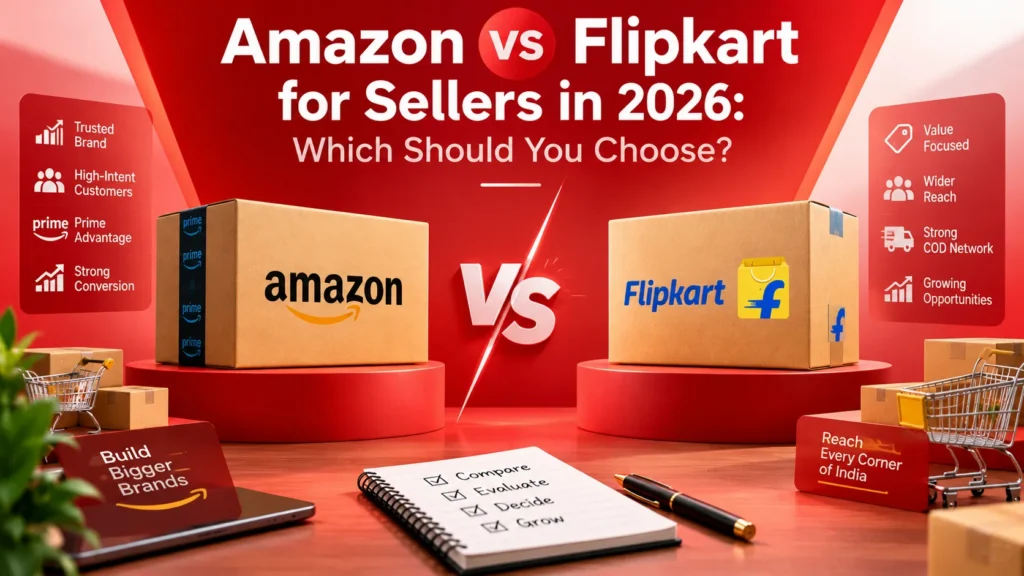
Flipkart now waives commission entirely on products under ₹1,000, while Amazon India waives it under ₹300 — a meaningful difference for sellers in that price band. Beyond fees, Flipkart holds roughly 48% of India’s e-commerce market to Amazon’s 31–35%, with deeper reach into tier 2/3 cities, while Amazon still leads on premium, branded, and electronics categories with lower return rates. Neither platform is universally better — the right choice depends on your category, price point, and target customer.
Key Takeaways
- Flipkart currently holds the larger overall market share (roughly 48% vs. Amazon’s 31–35%), with particularly strong reach into tier 2/3 cities and COD-preferring customers.
- Fee structures diverge most in the sub-₹1,000 price band — Flipkart waives commission entirely up to ₹1,000, while Amazon’s zero-fee threshold sits lower, around ₹300, meaning low-ticket sellers often see a real margin difference between platforms.
- Category fit matters more than platform prestige — Amazon tends to win for premium, branded, electronics, and beauty products with lower return rates; Flipkart tends to win for fashion, mobile phones, home decor, footwear, and high-volume tier 2/3 sales.
- Returns and RTO (return-to-origin) meaningfully affect real margin on both platforms, and COD-heavy categories on Flipkart can see notably higher return rates than Amazon’s more prepaid-skewed, stricter-policy customer base.
- Most established sellers don’t choose one platform exclusively — a hybrid approach (both platforms, weighted by category strength) is increasingly the default for sellers past the early-stage testing phase.
Market Share and Reach: The Basic Numbers
| Factor | Amazon India | Flipkart |
| Approx. market share | 31–35% | ~48% |
| Registered customers | Large, premium-skewing base | 500M+ registered, ~200M active annual users |
| Seller base | Large, established | 1.4M+ sellers |
| Strongest reach | Metro and tier 1 cities, Prime subscriber base | Tier 2/3 cities, deep vernacular and COD support |
| Ownership | Amazon.com | Walmart-owned |
Flipkart’s larger overall footprint comes substantially from its depth in tier 2/3 markets and its long-standing local positioning — it was founded in India in 2007, versus Amazon’s later market entry, and that head start still shows up in regional trust and reach. Amazon’s strength skews toward metro, tier 1, and Prime-subscriber demographics who tend to have higher average order values and lower return rates.
Fee Structure Compared
| Factor | Amazon India | Flipkart |
| Zero-commission threshold | Under ~₹300 | Under ~₹1,000 (rolled out across Shopsy, Nov 2025) |
| Typical referral/commission range | 6–25% depending on category, most products in the 8–15% band | 5–20% depending on category |
| Fixed/closing fees | Roughly ₹5–₹40 per unit | Roughly ₹14–₹60 per unit |
| Payment/collection fee | Bundled into referral structure | Typically 2–3% separately |
| FBA/fulfillment fees | Additional, weight- and category-based | Additional, weight- and distance-based (Flipkart FC) |
For products priced under ₹1,000, Flipkart’s broader zero-commission band can represent a meaningful margin advantage over Amazon, whose equivalent zero-fee threshold sits considerably lower. Above that price band, the comparison becomes far more category-dependent — fashion, for instance, commonly runs a higher commission rate on Amazon than on Flipkart, while some electronics subcategories run the other direction. Run the actual numbers for your specific category and price point in each platform’s current fee calculator rather than relying on the general ranges above, since both platforms revise category-level rates periodically.
Which Categories Perform Better Where
| Category | Tends to Favor | Why |
| Premium/branded goods | Amazon | Prime subscriber base skews toward brand trust and willingness to pay full price |
| Electronics and appliances | Both, category-dependent | Flipkart often has lower commission and stronger EMI integration; Amazon often has stronger Prime-driven conversion |
| Beauty and cosmetics | Amazon | Lower return rates, established trust for authenticity-sensitive categories |
| Fashion | Flipkart | Broader reach, strong tier 2/3 fashion demand, generally competitive commission |
| Home decor, footwear, books | Flipkart | Established category strength and reach |
| Regional/ethnic products | Flipkart | Deeper tier 2/3 penetration where local trust in an Indian-founded platform matters |
This table is directional, not absolute — category performance shifts with seasonality, specific sub-category competition, and your own brand positioning. Use it as a starting hypothesis to test, not a fixed rule.
Returns and RTO: The Margin Killer Most Sellers Underestimate
Commission rates get most of the attention, but returns and RTO (return-to-origin, where a COD order is never accepted at delivery) quietly erode margin more than most sellers initially model:
- Amazon generally maintains a stricter returns policy and skews toward prepaid, Prime-driven orders, which tends to keep return rates comparatively lower, particularly in electronics and beauty.
- Flipkart charges reverse shipping and, in some categories, a restocking fee on returns — and its deeper COD penetration in tier 2/3 markets, while a genuine reach advantage, also correlates with higher RTO rates in some categories, since COD orders are more prone to non-acceptance at the door than prepaid ones.
Before committing heavily to either platform for a given category, model the realistic return/RTO rate for that specific category and price point on each platform, not just the headline commission difference — a lower commission rate can be fully offset by a higher effective return rate.
Logistics and Fulfillment Compared
Both platforms offer a managed fulfillment option — Amazon FBA and Flipkart’s Fulfilment Centre (FC) network — plus self-shipping. Amazon FBA tends to carry slightly higher referral commissions and storage fees in some categories (fashion is a commonly cited example), offset in part by Amazon’s traffic and Prime-badge conversion lift. Flipkart’s Ekart logistics network is a genuine differentiator for reach into tier 2/3 pin codes specifically. A increasingly common approach among more established Indian sellers: use managed fulfillment (FBA or Flipkart FC) for the top 15–20% of SKUs — the high-velocity, low-return, strong-margin products where the badge and speed benefit is worth the fee — and self-ship the long tail through a third-party logistics partner to keep fee exposure down on slower-moving inventory.
Advertising on Each Platform
Both platforms run their own sponsored-placement advertising systems, structured similarly to Amazon’s global Sponsored Products model — keyword-targeted, cost-per-click placements within search results. Flipkart has recently introduced credit-based advertising options aimed at lowering the entry barrier for newer sellers. As with fees, advertising cost-efficiency varies by category and competition level on each platform rather than one platform being uniformly cheaper — the same category-by-category testing discipline that applies to fees applies here too.
Should You Choose One, or Sell on Both?
For most established sellers past the initial testing phase, the honest answer is both — but weighted deliberately rather than split evenly by default. Running both platforms diversifies demand (if one platform’s algorithm or policy shifts hurt visibility, the other can partially compensate) and maximizes total addressable reach, since a meaningful share of Flipkart’s customer base doesn’t overlap with Amazon’s. The operational cost is real, though: separate listing optimization, separate advertising management, separate inventory and pricing coordination, and separate account health monitoring. For a brand-new seller testing a single product for the first time, starting on one platform — chosen by category fit using the framework below — and expanding once initial traction is proven is often the more capital-efficient path than launching on both simultaneously.
A Simple Decision Framework
- Premium, branded, or high-AOV product with strong photography and reviews? → Lean Amazon first.
- Fashion, home goods, or a price point under ₹1,000 with volume potential? → Lean Flipkart first, given the more favorable zero-commission threshold.
- Targeting tier 2/3 cities or COD-preferring customers specifically? → Lean Flipkart, given its deeper reach and localization.
- Established with proven unit economics on one platform and looking to diversify? → Add the second platform deliberately, starting with your already-proven best sellers rather than your full catalog at once.
How EcomRanker Helps Sellers Choose and Scale
We help sellers make this decision with actual category and fee data specific to their product, not a generic platform preference — and once the decision is made, we manage the operational complexity of running both efficiently through our marketplace management services, covering Amazon, Flipkart, and other Indian marketplaces under one coordinated strategy. If you’re already selling across multiple channels and need the operational playbook for running them together, our multi-channel marketplace management guide covers that in depth.
Want a category-specific comparison for your own products before you commit? Get in touch for a marketplace fit assessment.
Frequently Asked Questions
1 . Is Amazon or Flipkart better for new sellers in India?
It depends on category and price point more than the platform itself. Premium, branded products with strong reviews tend to perform better on Amazon; fashion, home goods, and products under ₹1,000 with volume potential tend to perform better on Flipkart, given its broader zero-commission threshold.
2 . Which platform has lower seller fees?
Neither is universally cheaper — it depends on price band and category. Flipkart’s zero-commission threshold (under ₹1,000) is broader than Amazon’s (under ₹300), which favors Flipkart for lower-priced items, but commission rates above those thresholds vary by category on both platforms.
3 . Do I need a GST number to sell on Amazon or Flipkart?
Yes. A GST number is mandatory for selling on both platforms, unless you’re selling exclusively GST-exempt goods.
4 . Which platform has better reach in smaller Indian cities?
Flipkart generally has deeper penetration into tier 2/3 cities, supported by strong COD and vernacular-language support and its long-standing local market positioning.
5 . Does Amazon or Flipkart have higher return rates?
It varies by category, but Amazon’s more prepaid-skewed, Prime-driven customer base tends to see comparatively lower return rates in categories like electronics and beauty, while Flipkart’s deeper COD penetration in tier 2/3 markets correlates with higher RTO in some categories.
6 . Should I sell on both Amazon and Flipkart at the same time?
Many established sellers do, since it diversifies demand and maximizes reach, but it also roughly doubles the operational work of listing optimization, advertising, and inventory management. Testing on one platform first, chosen by category fit, is often more efficient for a brand-new seller.
7 . Which platform is better for electronics?
Both perform well, and the better choice is category- and price-point-specific — Flipkart often has lower commission rates and stronger EMI integration for electronics, while Amazon’s Prime-driven traffic and trust can offset a higher fee through better conversion.
8 . Is Flipkart or Amazon FBA cheaper for fulfillment?
It varies by category. Amazon FBA has been cited as running slightly higher referral commissions and storage fees in categories like fashion, though Amazon’s traffic and Prime badge can offset this through stronger conversion. Compare both directly for your specific category and weight tier.
9 . How do I decide which platform to prioritize for my specific product?
Compare the actual fee calculator output for your specific price point and category on both platforms, factor in realistic return/RTO rates for that category, and weigh reach against your target customer’s location and shopping behavior (metro/prepaid vs. tier 2/3/COD) before committing primary focus to one platform.