
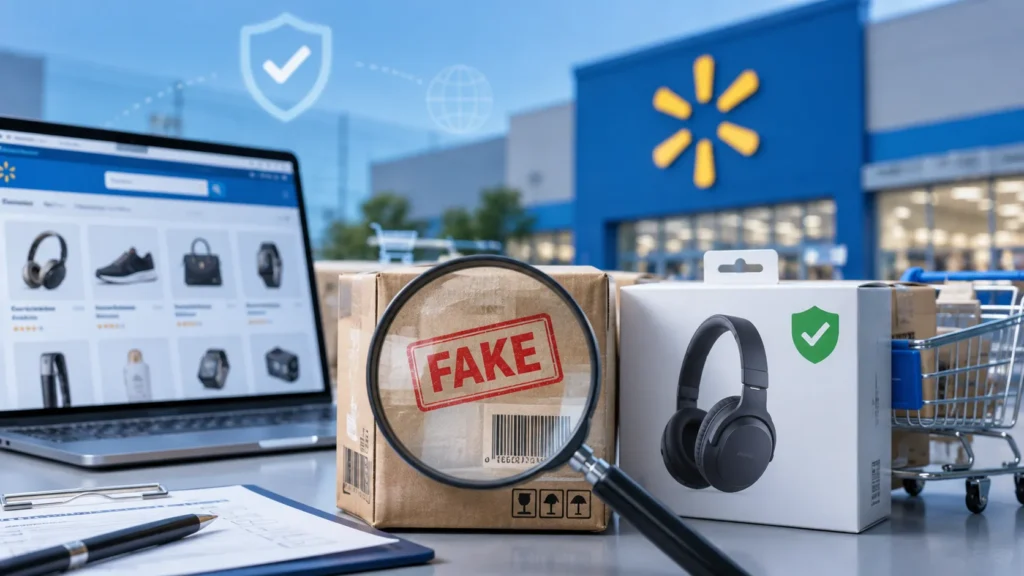
In September 2025, a CNBC investigation found at least 43 third-party sellers on Walmart Marketplace using stolen business identities, alongside counterfeit health and beauty products confirmed through lab testing. A year later, Walmart has rolled out enhanced seller vetting, sourcing-documentation requirements, and AI-driven listing monitoring. For brands selling on the platform, the practical question now isn’t whether the original findings were serious — they were — but what’s actually different today and what brand protection looks like going forward.
Key Takeaways
- CNBC’s September 2025 investigation identified at least 43 fraudulent seller accounts using stolen business credentials, and confirmed counterfeit health/beauty products through lab testing and brand verification.
- Walmart has since introduced an enhanced vetting program requiring documentation proving products are sourced from brand owners or manufacturers, alongside expanded AI-driven listing monitoring.
- The legal landscape is shifting but not settled — the proposed federal SHOP SAFE Act, which would push marketplaces toward stronger verification, has stalled in prior Congressional sessions despite ongoing brand-side support.
- A seller removed from Walmart can still re-register or relist elsewhere without triggering a cross-marketplace alert, meaning ongoing monitoring matters more than a one-time report.
- This is a legitimate reason for active brand protection, not a reason to avoid the marketplace — Walmart’s third-party marketplace remains a significant growth channel, and the counterfeit risk it carries is broadly consistent with the risk profile every major open marketplace has faced during rapid growth.
What CNBC’s Investigation Found
CNBC’s September 2025 investigation centered on Walmart Marketplace’s rapid seller growth and the vetting gaps that came with it. Reporters purchased and lab-tested multiple health and beauty products from third-party sellers and found the items were counterfeit, in some cases including supplements with misspelled labeling — a common tell of counterfeit manufacturing. Separately, the investigation identified dozens of seller accounts that had registered using stolen business credentials, affecting companies ranging from larger public firms to small independent businesses; some of the affected business owners learned about the impersonation only after receiving customer returns for products they’d never sold.
CNBC’s reporting also included on-the-record interviews with current and former Walmart employees who described internal pressure to approve seller applications quickly during a period of rapid marketplace expansion, even when documentation raised questions. Walmart’s own comment to CNBC, both in the original reporting and in a subsequent public statement, affirmed that trust and safety were a company priority and described its multi-layered enforcement approach — seller vetting, category restrictions, AI-assisted monitoring, and a dedicated trust and safety response team.
What Walmart Has Actually Changed Since
Following the reporting, Walmart introduced several specific changes rather than a general statement of intent:
- An enhanced vetting program for higher-risk vendor categories, notably health and beauty, requiring documentation that proves products are sourced from brand owners or authorized manufacturers — a meaningfully higher bar than the general onboarding requirements the original investigation described
- Pre-listing category restrictions limiting who can sell in certain higher-risk product categories to approved sellers specifically
- Expanded AI-driven monitoring of product listings intended to flag policy violations and intellectual property infringement in closer to real time
- Public engagement on federal policy, including participation in Congressional discussion around the proposed SHOP SAFE Act, which would push marketplaces toward stronger seller verification standards
Sellers in affected categories reported that a number of previously live listings were removed following the change — a signal the enhanced vetting had real enforcement teeth, not just updated policy language. Whether the same rigor has extended meaningfully beyond the initially targeted health and beauty categories is less independently verified in follow-up reporting, and is worth watching rather than assuming.
The Legal Landscape Brand Owners Should Know
Under current US law, marketplaces generally aren’t held strictly liable for counterfeit items sold by third-party sellers, provided they remove infringing listings after being notified — a framework that puts significant weight on brand owners actively monitoring and reporting, rather than assuming the platform will catch every issue proactively. Two developments are relevant to watch:
- The Inform Consumers Act, already in effect, requires online marketplaces to collect and, in some cases, disclose certain seller identity information for high-volume third-party sellers — intended to make anonymous bad-actor operations harder to sustain.
- The proposed federal SHOP SAFE Act would go further, pushing marketplaces toward stronger verification standards and potentially offering platforms a liability shield if they meet more rigorous anti-counterfeiting requirements. It has brand-industry support but has stalled in prior Congressional sessions, and its current status should be checked against the latest legislative tracking before citing it as pending or passed.
For brand owners, the practical implication is straightforward regardless of how the legislation ultimately resolves: proactive monitoring and documentation remain the primary tools available today, not a future regulatory guarantee.
How to Protect Your Brand on Walmart Marketplace
If You Discover a Counterfeit or Impersonator
- Document everything — screenshots of the listing, seller name, product images, and any customer communication or returns tied to the issue
- File through Walmart’s Brand Portal or IP Claim Form, providing listing URLs, your IP category, and supporting registration documentation
- Report identity theft or impersonation specifically if a seller is using your business name or credentials, since this is a distinct issue from a standard counterfeit listing and may need separate escalation
- Keep a record of resolution timelines — this matters both operationally and, if the issue recurs, as documentation for any further escalation
Ongoing Monitoring
- Enroll in Walmart’s Enhanced Brand Portal if you haven’t already, since it’s the primary channel for both reporting and receiving updates on enforcement action
- Monitor regularly, not just reactively — a seller removed from Walmart can re-register or relist on the same platform, or resurface on a different marketplace entirely, without automatically triggering an alert on your existing monitoring setup
- Treat cross-marketplace visibility as part of the strategy if you sell on Amazon, Walmart, and other channels simultaneously, since repeat offenders frequently operate across multiple platforms rather than just one
Should This Change Whether You Sell on Walmart?
No, and treating this as a reason to avoid the marketplace misreads what the investigation actually demonstrated. Every major open third-party marketplace — Amazon included, during its own earlier growth phase — has faced a similar pattern: rapid seller growth outpacing vetting rigor, followed by tightened controls once problems surface publicly. Counterfeit activity is a documented, ongoing risk across essentially all open marketplaces, not a Walmart-specific flaw, and Walmart’s scale of third-party sellers remains considerably smaller than Amazon’s, which some brand protection professionals note has meant fewer counterfeit issues in absolute terms even amid the vetting concerns CNBC’s reporting raised. The realistic takeaway is that active brand protection is now a standard cost of doing business on any open marketplace — Walmart included — not a reason to sit out a legitimate growth channel.
How EcomRanker Approaches Brand Protection
Brand protection isn’t a one-time report-and-forget task — it’s an ongoing monitoring discipline, particularly across a multi-marketplace footprint. As part of our marketplace management services, we help brands set up proactive listing monitoring, manage Brand Portal and IP claim submissions, and track repeat-offender patterns across the platforms they sell on, rather than treating each takedown as an isolated event.
If you’re setting up or optimizing a Walmart presence and want brand protection built in from the start rather than bolted on after an issue surfaces, our Walmart Seller Central guide covers setup fundamentals, and our team can walk through a brand protection plan specific to your catalog. Get in touch to discuss your account.
Frequently Asked Questions
1 . What did CNBC’s investigation into Walmart Marketplace actually find?
CNBC identified at least 43 third-party seller accounts using stolen business identities and confirmed, through lab testing and brand verification, that health and beauty products purchased from certain sellers were counterfeit.
2 . Has Walmart made changes since the investigation?
Yes. Walmart introduced an enhanced vetting program requiring sourcing documentation for higher-risk categories like health and beauty, expanded category restrictions, and increased AI-driven listing monitoring.
3 . Is Walmart Marketplace less safe than Amazon for brand owners?
The investigation found Walmart’s vetting requirements were less stringent than Amazon’s at the time of reporting. However, Walmart’s overall third-party seller base remains considerably smaller than Amazon’s, and some brand protection professionals note this has meant fewer absolute counterfeit incidents on Walmart historically, even amid the vetting concerns raised.
4 . What should I do if I find a counterfeit of my product on Walmart?
Document the listing and any related customer complaints or returns, then file a report through Walmart’s Brand Portal or IP Claim Form with supporting registration documentation.
5 . What is the SHOP SAFE Act, and has it passed?
It’s a proposed federal law that would push marketplaces toward stronger seller verification and could offer liability protections to platforms meeting stricter anti-counterfeiting standards. As of the most recent reporting reviewed, it has stalled in prior Congressional sessions and has not been enacted; check current legislative tracking for its latest status.
6 . Does removing a counterfeit listing stop the seller from selling again?
Not necessarily. A seller removed from one marketplace can potentially re-register under different credentials or resurface on another platform, which is why ongoing monitoring matters more than a single takedown.
7 . Should new sellers avoid launching on Walmart Marketplace because of this?
No. The underlying counterfeit and identity-theft risk is a feature of open third-party marketplaces generally, not unique to Walmart, and Walmart has demonstrably tightened controls since the investigation. Active brand protection is the appropriate response, not platform avoidance.
8 . Does Walmart’s Brand Portal cover both counterfeit reports and seller impersonation? Y
es, though they can require different documentation. A standard counterfeit report focuses on the product itself, while a seller impersonating your business identity may need to be reported and escalated as identity theft specifically.