
In today’s highly competitive ecommerce landscape, running PPC campaigns is no longer optional. Whether you sell on Amazon, Google Shopping, or other ecommerce marketplaces, Pay-Per-Click advertising plays a major role in product visibility, traffic generation, and sales growth. However, many brands waste thousands in ad spend because their PPC strategy lacks structure, optimization, and long-term planning.
A successful PPC strategy is not simply about increasing bids or launching more campaigns. It requires keyword intelligence, conversion optimization, audience targeting, campaign segmentation, data analysis, and continuous refinement. Brands that understand how to rank and optimize their PPC advertising consistently achieve better ROAS, lower ACoS, improved conversion rates, and stronger organic rankings.
As a full-service Amazon and ecommerce growth agency, EcomRanker helps brands scale through advanced PPC management, Amazon SEO, listing optimization, and marketplace growth strategies. Their approach focuses on combining advertising with conversion optimization and organic ranking improvements to maximize profitability.
What Is PPC Advertising?
PPC, or Pay-Per-Click advertising, is a digital advertising model where businesses pay only when users click on their ads. In ecommerce, PPC campaigns allow products to appear prominently within search results, category pages, and competitor listings. This advertising model is highly effective because it targets shoppers who are already searching for related products, making it easier to generate highly relevant traffic and increase conversion rates.
Amazon PPC advertising, in particular, has become essential for sellers who want to remain competitive within crowded marketplaces. Sponsored Product Ads, Sponsored Brand Ads, and Sponsored Display campaigns help brands improve product visibility and increase sales velocity. Since Amazon’s ranking algorithm rewards products with strong sales history and engagement metrics, PPC campaigns also play a critical role in improving organic keyword rankings over time.
For ecommerce businesses, PPC advertising offers measurable and scalable growth opportunities. Every click, impression, and conversion can be tracked, analyzed, and optimized to improve overall advertising profitability. This data-driven approach makes PPC one of the most powerful marketing channels for ecommerce brands seeking long-term growth.. In ecommerce, PPC is commonly used across:
- Amazon Sponsored Ads
- Google Shopping Ads
- Search Engine Ads
- Display Advertising
- Retargeting Campaigns
- Video Advertising
- Social Commerce Advertising
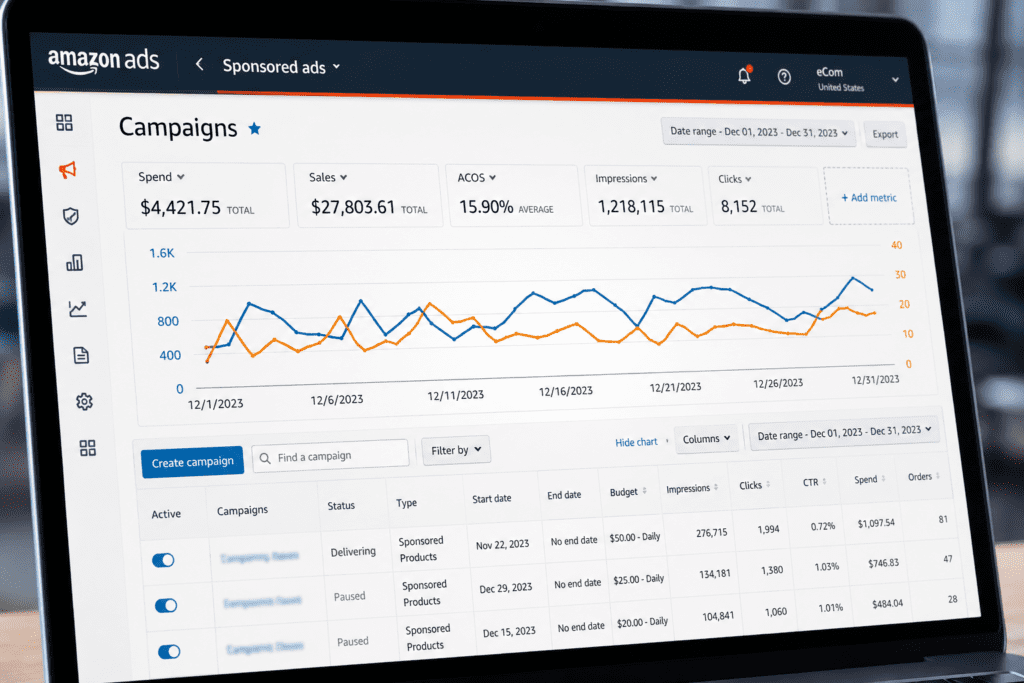
On Amazon specifically, PPC campaigns help sellers increase product visibility, accelerate sales velocity, improve keyword rankings, and launch new products effectively. Amazon Ads operates through an auction-based bidding system where advertisers compete for placements using keywords, ASIN targeting, and audience targeting.
Why PPC Strategy Matters More Than Ever
The ecommerce industry has become increasingly competitive, making it difficult for products to rank organically without advertising support. Millions of products compete for visibility on Amazon and other marketplaces every day. Without a strategic PPC advertising plan, even high-quality products may struggle to gain exposure and generate sales.
A well-structured PPC strategy helps businesses target the right audience while controlling advertising costs. Instead of wasting budget on irrelevant traffic, optimized campaigns focus on high-converting keywords and buyer-intent searches. This not only improves conversion rates but also increases the efficiency of advertising spend.
Modern marketplace algorithms evaluate multiple performance factors such as click-through rates, conversion rates, customer engagement, and sales velocity. Strong PPC campaigns improve these performance signals, which can positively impact organic rankings as well. This is why PPC advertising is no longer just a short-term traffic solution—it is a critical component of long-term ecommerce growth.
Professional agencies like EcomRanker use data-driven advertising strategies to help businesses improve campaign profitability while simultaneously strengthening organic visibility.
Poorly managed campaigns often lead to:
- High ACoS
- Wasted clicks
- Low conversion rates
- Irrelevant traffic
- Poor keyword targeting
- Low ROAS
- Reduced profitability
A strong PPC strategy, on the other hand, creates a system where paid traffic improves both immediate sales and long-term organic visibility.
Modern Amazon and ecommerce algorithms evaluate multiple performance signals, including:
- Click-through rate (CTR)
- Conversion rate
- Sales velocity
- Customer engagement
- Product relevance
- Listing quality
- Keyword relevance
This means PPC campaigns directly influence organic growth as well.
Core Elements of a High-Ranking PPC Strategy
1. Keyword Research and Intent Mapping
Keyword research forms the foundation of every successful PPC campaign. Without proper keyword targeting, ads may appear for irrelevant searches that generate clicks but fail to convert into sales. Effective keyword research focuses not only on search volume but also on buyer intent, competition levels, and conversion potential.
High-performing PPC campaigns usually include a combination of broad keywords, long-tail keywords, competitor keywords, and branded keywords. Broad keywords help increase visibility and discover new opportunities, while long-tail keywords target shoppers with stronger purchase intent. Competitor keywords allow sellers to capture traffic from rival brands, while branded keywords protect brand visibility within search results.
Advanced keyword research tools such as Helium 10, Jungle Scout, DataDive, and Amazon Brand Analytics provide valuable insights into search trends and customer behavior. By continuously analyzing keyword performance, advertisers can identify profitable opportunities and refine campaigns for maximum ROI.
Businesses looking to improve Amazon rankings often combine keyword research with advanced Amazon SEO strategies. Helpful insights can also be found through Amazon SEO Strategy Guide.Every successful PPC campaign starts with advanced keyword research.
Many sellers make the mistake of targeting only high-volume keywords. While traffic matters, buyer intent matters even more.
Effective keyword research includes:
Primary Keywords
Broad high-volume search terms related to your product.
Example:
- “wireless earbuds”
- “protein shaker bottle”
Long-Tail Keywords
Highly specific phrases with stronger purchase intent.
Example:
- “noise cancelling wireless earbuds for gym”
- “BPA free protein shaker bottle”
Competitor Keywords
Keywords competitors already rank for organically or through ads.
Branded Keywords
Terms related to your own brand name for brand protection campaigns.
Professional PPC agencies often use tools such as:
- Helium 10
- Jungle Scout
- DataDive
- Amazon Brand Analytics
- SellerSprite
Advanced keyword segmentation allows advertisers to separate high-converting keywords from research-based traffic.
2. Campaign Structure Optimization
Campaign structure plays a major role in determining PPC success. A poorly organized account can lead to budget waste, keyword overlap, inaccurate data tracking, and inefficient optimization. Proper campaign segmentation allows advertisers to monitor performance more accurately and make better strategic decisions.
Successful PPC accounts often separate campaigns by product category, keyword match type, advertising objective, and profitability goals. Exact match campaigns typically target high-converting keywords, while broad match campaigns are used for keyword discovery and traffic expansion. Segmenting campaigns by performance also helps advertisers allocate budgets more effectively.
Structured campaigns provide greater control over bidding strategies, search term analysis, and optimization processes. This allows businesses to scale campaigns efficiently while maintaining profitability. Proper campaign organization becomes even more important when managing large catalogs or multiple product categories.
An organized advertising structure also supports better reporting and performance forecasting, which are essential for long-term ecommerce growth.Campaign structure is one of the most overlooked aspects of PPC management.
A poorly organized account creates:
- Budget leakage
- Data confusion
- Keyword overlap
- Inefficient bidding
- Poor scalability
A strong PPC structure usually separates campaigns by:
Match Types
- Broad Match
- Phrase Match
- Exact Match
Product Categories
- Best sellers
- High-margin products
- Seasonal products
- Launch products
Campaign Goals
- Keyword discovery
- Conversion campaigns
- Brand defense
- Competitor conquesting
- Retargeting
According to ecommerce PPC specialists, separating campaigns by search intent significantly improves optimization control and reporting accuracy.
3. Sponsored Products Strategy
Sponsored Products are among the most effective Amazon advertising formats because they appear directly within search results and product pages. These ads are highly conversion-focused since they target customers actively searching for related products.
A strong Sponsored Products strategy includes keyword targeting, bid optimization, negative keyword management, and placement adjustments. Advertisers must continuously monitor search term reports to identify profitable keywords and remove irrelevant traffic sources. This helps improve conversion rates while reducing wasted ad spend.
Sponsored Product campaigns are especially important for new product launches. Since new listings often lack reviews and sales history, PPC advertising helps generate early visibility and sales momentum. Increased sales velocity can improve organic keyword rankings and help products gain long-term traction within Amazon’s search algorithm.
Combining Sponsored Product campaigns with optimized product listings creates a powerful growth strategy that improves both paid and organic performance.Sponsored Products are the foundation of most Amazon PPC campaigns.
These ads appear directly within search results and product pages, making them critical for visibility and conversions.
A successful Sponsored Products strategy includes:
- High-converting keyword targeting
- Bid optimization
- Negative keyword filtering
- Search term harvesting
- Placement adjustments
- ASIN targeting
For new product launches, aggressive Sponsored Product campaigns often help accelerate indexing and organic ranking growth.
4. Sponsored Brands and Brand Building
Sponsored Brands campaigns help businesses increase brand visibility while promoting multiple products simultaneously. These ads appear prominently within search results and often include custom headlines, logos, and featured products.
Unlike Sponsored Products, Sponsored Brands focus heavily on brand awareness and customer trust. They allow sellers to showcase their brand identity while directing traffic to Amazon Brand Stores or curated product collections. This creates a more professional shopping experience that encourages repeat purchases and long-term customer loyalty.
Video-based Sponsored Brand campaigns have become increasingly popular because they attract higher engagement rates and improve click-through performance. High-quality visuals and compelling messaging can significantly increase advertising effectiveness.
Strong branding not only improves advertising performance but also helps businesses stand out within competitive product categories. Ecommerce brands that invest in professional brand positioning often achieve better customer retention and stronger long-term profitability.Sponsored Brands ads allow sellers to promote:
- Brand Stores
- Multiple products
- Brand identity
- Video content
These campaigns improve both visibility and customer trust.
Strong Sponsored Brand campaigns typically include:
- Custom headlines
- Brand-focused creatives
- Product collections
- Lifestyle imagery
- Video assets
Brand-focused PPC campaigns often generate stronger long-term customer retention compared to purely conversion-driven ads.
5. Sponsored Display and Retargeting
Most online shoppers do not purchase products during their first visit. Sponsored Display advertising allows businesses to reconnect with shoppers who previously viewed their products but did not complete a purchase.
Retargeting campaigns are extremely valuable because they target warm audiences that have already shown interest in the product. These campaigns often achieve higher conversion rates compared to cold traffic campaigns. Sponsored Display ads can also be used for cross-selling and upselling related products.
Advanced retargeting strategies help businesses improve customer lifetime value by encouraging repeat purchases and increasing overall account revenue. Display advertising also expands brand reach beyond traditional keyword-based search campaigns.
When integrated with Sponsored Products and Sponsored Brands campaigns, Sponsored Display advertising creates a comprehensive PPC ecosystem that supports both customer acquisition and long-term retention.Many shoppers do not purchase during their first visit.
This is where Sponsored Display campaigns become valuable.
Retargeting campaigns help brands:
- Re-engage previous visitors
- Recover abandoned traffic
- Cross-sell related products
- Upsell existing customers
- Improve repeat purchases
Advanced display strategies can significantly improve total advertising efficiency when combined with Sponsored Products campaigns.
6. Listing Optimization and PPC Performance
Driving traffic through PPC advertising is only effective if the product listing converts visitors into customers. Many advertisers spend heavily on ads while ignoring listing quality, resulting in low conversion rates and wasted advertising budget.
An optimized listing includes SEO-focused product titles, persuasive bullet points, high-quality product images, engaging A+ Content, and well-structured backend keywords. These elements improve customer trust and increase purchase confidence.
Amazon’s algorithm also considers listing quality when determining ad relevance and organic rankings. Products with better engagement and conversion metrics often receive stronger visibility within search results.
Professional listing optimization services from Ecom Ranker help sellers improve both PPC performance and organic growth by aligning product listings with marketplace ranking factors and customer behavior.One of the biggest mistakes advertisers make is focusing only on ads while ignoring listing quality.
Traffic alone does not generate sales.
If your listing has:
- weak images,
- poor copy,
- bad reviews,
- unclear benefits,
- low trust,
then PPC performance will suffer regardless of budget.
According to Ecom Ranker, optimized listings improve both organic visibility and PPC conversion rates by aligning with Amazon’s ranking expectations and customer behavior.
Key listing optimization factors include:
- SEO-focused product titles
- Conversion-driven bullet points
- High-quality images
- A+ Content
- Backend keywords
- Brand Story modules
- Mobile optimization
PPC and SEO should always work together rather than operate independently.
7. Bid Optimization Strategy
Bid optimization is one of the most important aspects of PPC management because it directly impacts campaign profitability. Setting bids too high can increase advertising costs without improving conversions, while bids that are too low may reduce visibility and traffic.
Successful advertisers continuously adjust keyword bids based on conversion data, competition levels, and campaign objectives. Dynamic bidding strategies allow campaigns to respond to changing market conditions and maximize efficiency.
Different products require different bidding approaches depending on profitability, competition, and lifecycle stage. For example, aggressive bidding may be necessary during product launches, while mature products often benefit from efficiency-focused bidding strategies.
Continuous bid optimization helps businesses improve ROAS while maintaining strong visibility within competitive marketplaces.Bid management determines how efficiently your campaigns spend money.
Successful PPC advertisers continuously optimize:
- Keyword bids
- Placement multipliers
- Budget allocation
- Device targeting
- Audience targeting
Different campaign types require different bidding strategies.
Examples include:
| Campaign Goal | Suggested Bid Strategy |
|---|---|
| Product Launch | Aggressive bidding |
| Brand Defense | Moderate stable bidding |
| Competitor Targeting | Dynamic aggressive bidding |
| Profit Optimization | Conservative efficiency bidding |
| Keyword Discovery | Broad exploratory bidding |
Experienced agencies often use both AI-powered automation and manual optimization together for better decision-making.
8. Negative Keywords and Waste Reduction
Negative keywords are essential for controlling advertising costs and improving campaign relevance. Without proper negative keyword management, campaigns may receive clicks from unrelated searches that do not convert into sales.
Adding negative keywords prevents ads from appearing for irrelevant search terms. This helps improve click-through rates, increase conversion rates, and reduce wasted ad spend. For example, premium products may exclude searches containing terms like “cheap” or “budget” to avoid attracting low-intent shoppers.
Regular search term analysis is critical for identifying irrelevant traffic and optimizing campaign performance. Over time, effective negative keyword management can significantly improve advertising profitability.
Advertisers who actively refine their campaigns through search term optimization typically achieve better long-term PPC performance.Negative keywords are critical for improving PPC profitability.
Without negatives, campaigns often spend budget on irrelevant traffic.
For example:
A premium product may not want clicks from searches containing:
- cheap
- budget
- free
- replacement parts
Adding negative keywords improves:
- CTR
- conversion rates
- ROAS
- campaign efficiency
This is one of the fastest ways to reduce wasted ad spend.
9. PPC Metrics That Actually Matter
Many advertisers focus too heavily on vanity metrics such as impressions or clicks without understanding profitability metrics. While traffic volume is important, successful PPC management depends on analyzing performance indicators that directly impact revenue and profitability.
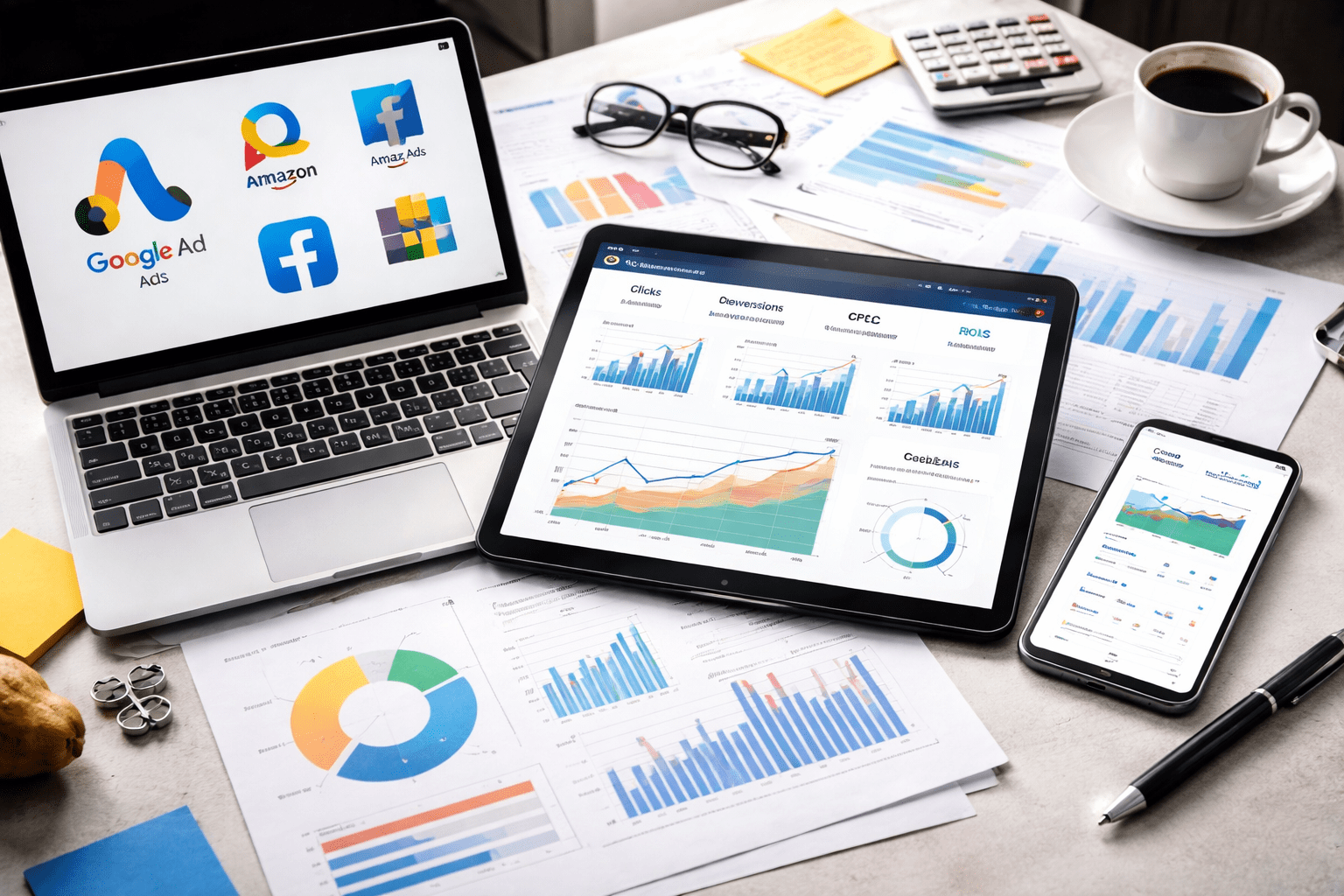
Important PPC metrics include ACoS, TACoS, ROAS, CTR, CPC, and conversion rates. These metrics help advertisers understand campaign efficiency and identify optimization opportunities.
Monitoring keyword-level data also provides insights into customer behavior and product relevance. Campaigns with strong click-through rates but poor conversions may indicate listing issues, while campaigns with low CTR may require better keyword targeting or creative optimization.
Data-driven decision-making is essential for scaling PPC campaigns successfully while maintaining healthy profit margins.Many advertisers focus on vanity metrics instead of profitability metrics.
The most important PPC KPIs include:
ACoS (Advertising Cost of Sale)
Measures advertising spend relative to sales.
TACoS (Total Advertising Cost of Sale)
Measures ad spend against total account revenue.
ROAS (Return on Ad Spend)
Revenue generated per advertising dollar spent.
CTR (Click Through Rate)
Indicates ad relevance and creative performance.
Conversion Rate
Measures how effectively traffic converts into buyers.
CPC (Cost Per Click)
Tracks click efficiency and competition levels.
Organic Rank Improvement
Shows how PPC contributes to long-term visibility.
Top-performing ecommerce brands monitor PPC data daily and continuously refine campaigns based on performance trends.
10. How PPC Supports Organic Ranking
One of the most valuable benefits of PPC advertising is its ability to improve organic keyword rankings. Amazon’s ranking algorithm rewards products that generate strong sales velocity, high conversion rates, and positive customer engagement.
When PPC campaigns generate consistent sales, products often begin ranking higher organically for targeted keywords. This creates a compounding growth effect where increased visibility leads to more sales, which further improves rankings.
Over time, strong organic rankings can reduce dependency on paid advertising and improve overall profitability. Businesses that integrate PPC advertising with SEO and listing optimization typically achieve stronger long-term marketplace performance.
This combined growth strategy is a core focus of EcomRanker’s Amazon Growth Services. One of the most powerful aspects of ecommerce PPC is its impact on organic growth.
Amazon’s algorithm heavily evaluates:
- sales velocity,
- keyword relevance,
- conversion rate,
- click-through behavior.
Effective PPC campaigns increase these signals, which often improves organic rankings over time.
This creates a flywheel effect:
- PPC drives traffic
- Traffic generates sales
- Sales improve ranking
- Higher ranking increases organic sales
- Organic sales reduce dependency on ads
This integrated growth strategy is a major focus of advanced Amazon agencies like EcomRanker.
Common PPC Mistakes That Hurt Rankings
Ignoring Conversion Optimization
Driving traffic to weak listings wastes budget.
Overbidding Too Early
Aggressive bids without conversion data can destroy profitability.
Using Only Broad Match Keywords
This often results in irrelevant clicks.
Not Monitoring Search Terms
Search term reports reveal wasted spend opportunities.
No Negative Keywords
Lack of filtering increases inefficient traffic.
Poor Campaign Segmentation
Mixed campaign structures reduce optimization control.
Scaling Too Fast
Sudden budget spikes can destabilize campaign performance.
Advanced PPC Scaling Strategies
Once campaigns become profitable, businesses can begin scaling strategically to increase market share and revenue. Advanced scaling strategies often include expanding keyword targeting, launching Sponsored Brand Video campaigns, increasing ASIN targeting, and exploring international marketplaces.
Many large ecommerce brands also combine Amazon PPC with external traffic sources such as Google Ads, TikTok Ads, Meta Ads, influencer marketing, and email campaigns. This multi-channel approach increases brand visibility while diversifying traffic sources.
Audience segmentation, retargeting strategies, and seasonal campaign planning further improve scalability and profitability. Businesses that scale gradually while maintaining strong performance metrics are more likely to achieve sustainable long-term growth. Once campaigns become profitable, scaling should happen strategically.
Advanced scaling tactics include:
- Expanding long-tail keywords
- Increasing ASIN targeting
- International marketplace expansion
- Sponsored Brand Video campaigns
- DSP advertising
- Audience segmentation
- Dayparting strategies
- Seasonal campaign scaling
- External traffic integration
Large-scale brands often combine Amazon PPC with:
- Google Ads
- TikTok Ads
- Meta Ads
- Influencer marketing
- Email retargeting
This multi-channel approach improves customer acquisition and brand growth.
Why Professional PPC Management Matters
Managing ecommerce PPC campaigns has become increasingly complex due to rising competition, evolving algorithms, and changing consumer behavior. Successful campaign management now requires expertise in keyword research, bid optimization, conversion analysis, audience targeting, and data interpretation.
Professional PPC agencies bring advanced tools, optimization frameworks, and industry expertise that help businesses scale more efficiently. Agencies also save businesses time by handling daily campaign management, reporting, and strategic adjustments.
Working with experienced ecommerce specialists allows brands to focus on product development and customer experience while ensuring advertising campaigns remain optimized for growth and profitability. Amazon advertising has become increasingly complex.
Modern campaign management now involves:
- keyword engineering,
- conversion optimization,
- data analysis,
- bid automation,
- creative testing,
- audience targeting,
- profitability forecasting.
Professional agencies bring:
- marketplace expertise,
- advanced tools,
- reporting systems,
- scaling frameworks,
- optimization experience.
According to industry specialists, combining PPC management with SEO and listing optimization generates stronger long-term performance than isolated advertising efforts.
How EcomRanker Helps Brands Scale PPC Profitably
Ecom Ranker provides a complete Amazon growth ecosystem that combines:
- Amazon PPC Management
- Amazon SEO
- Listing Optimization
- A+ Content
- Brand Store Development
- Account Management
- Multi-marketplace scaling
Their integrated approach focuses on:
- improving rankings,
- lowering ACoS,
- increasing conversions,
- maximizing profitability,
- and building sustainable long-term growth.
Helpful internal resources from EcomRanker include:
Final Thoughts
Ranking your PPC ad strategy requires far more than increasing ad spend. Success comes from building a complete advertising system that combines keyword research, campaign structure, listing optimization, conversion strategy, and continuous performance analysis.
The most profitable ecommerce brands understand that PPC is not just a traffic source — it is a growth engine that supports both paid and organic visibility.
When executed correctly, PPC advertising can:
- increase sales velocity,
- improve organic rankings,
- strengthen brand authority,
- reduce wasted spend,
- and create scalable long-term growth.
Businesses looking to scale efficiently should focus on integrated advertising strategies where SEO, listing optimization, and PPC management work together toward profitability and sustainable marketplace growth.
Frequently Asked Questions About Ranking Your PPC Ad Strategy
1 . What is PPC advertising in ecommerce?
PPC advertising, or Pay-Per-Click advertising, is a digital marketing model where businesses pay only when a user clicks on their advertisement. In ecommerce platforms like Amazon and Google Shopping, PPC ads help products appear in front of shoppers who are actively searching for related items. This makes PPC one of the most effective methods for driving targeted traffic and increasing product sales.
For Amazon sellers, PPC campaigns are especially important because they improve product visibility within competitive marketplaces. Sponsored Product Ads, Sponsored Brand Ads, and Sponsored Display campaigns allow brands to attract potential buyers at different stages of the customer journey. When optimized correctly, PPC advertising can improve sales velocity, boost organic keyword rankings, and increase long-term profitability.
Professional PPC management services from Ecom Ranker help businesses create highly optimized campaigns designed to improve both advertising performance and organic marketplace growth.
2 . Why is PPC important for Amazon sellers?
PPC advertising is essential for Amazon sellers because it helps products gain visibility in highly competitive search results. Since millions of products compete for customer attention on Amazon, relying solely on organic traffic can make it difficult for new or growing brands to generate consistent sales.
Amazon’s ranking algorithm heavily considers factors such as sales velocity, click-through rates, and conversion rates. PPC campaigns help improve these performance metrics by driving highly targeted traffic to product listings. Increased sales activity can then improve organic rankings, creating long-term visibility benefits.
PPC is also valuable for launching new products, promoting seasonal offers, increasing brand awareness, and defending branded keywords from competitors. Businesses that combine PPC advertising with optimized product listings and strong SEO strategies usually achieve better long-term marketplace performance.
3 . How does PPC help improve organic rankings?
PPC advertising can indirectly improve organic rankings by increasing sales velocity and customer engagement. Amazon’s algorithm rewards products that generate strong conversion activity and positive shopping experiences. When PPC campaigns drive more sales, products often gain higher organic visibility for targeted keywords.
This creates a growth cycle where increased visibility generates more clicks and conversions, which further strengthens organic rankings. Over time, successful PPC campaigns can reduce dependence on paid traffic as products begin ranking organically for important search terms.
To maximize these benefits, businesses should combine PPC advertising with listing optimization and keyword-focused SEO strategies. Helpful guidance can also be found through Amazon SEO Strategy Guide.
4 . What are the most important PPC metrics to track?
Tracking the right PPC metrics is critical for understanding campaign performance and profitability. While impressions and clicks provide visibility insights, profitability-focused metrics are far more important for long-term success.
Some of the most important PPC metrics include:
- ACoS (Advertising Cost of Sale)
- TACoS (Total Advertising Cost of Sale)
- ROAS (Return on Ad Spend)
- CTR (Click Through Rate)
- CPC (Cost Per Click)
- Conversion Rate
- Sales Velocity
- Organic Keyword Ranking
These metrics help businesses identify profitable keywords, optimize bidding strategies, and reduce wasted ad spend. Regular performance analysis allows advertisers to refine campaigns and improve overall advertising efficiency.
5 . What is a good ACoS for Amazon PPC?
A good ACoS (Advertising Cost of Sale) depends on several factors, including product margins, competition levels, and business goals. In general, lower ACoS values indicate better advertising efficiency because less money is being spent to generate sales.
However, ideal ACoS targets vary depending on campaign objectives. For example, businesses launching new products may accept higher ACoS levels temporarily to increase visibility and improve organic rankings. Established products with strong sales history often focus on maintaining lower ACoS levels to maximize profitability.
Rather than focusing only on ACoS, businesses should also monitor TACoS and total account growth to understand the broader impact of advertising on overall revenue.
6 . How often should PPC campaigns be optimized?
PPC campaigns should be monitored and optimized regularly to maintain strong performance. Ecommerce marketplaces are highly dynamic, with keyword trends, competition levels, and customer behavior constantly changing.
Most successful advertisers review campaigns weekly or even daily depending on advertising volume. Important optimization activities include:
- Adjusting keyword bids
- Reviewing search term reports
- Adding negative keywords
- Monitoring conversion rates
- Scaling profitable campaigns
- Reducing wasted spend
- Testing new keyword opportunities
Continuous optimization helps businesses maintain efficiency while adapting to changing marketplace conditions.
7 . What are negative keywords in PPC advertising?
Negative keywords are search terms that prevent ads from appearing for irrelevant or low-converting searches. They play a major role in reducing wasted ad spend and improving overall campaign efficiency.
For example, a premium product brand may want to exclude keywords such as “cheap,” “free,” or “budget” to avoid attracting low-intent shoppers. Adding these terms as negative keywords ensures that ads appear only for more relevant customer searches.
Effective negative keyword management improves click-through rates, increases conversion rates, and lowers advertising costs over time. Regular search term analysis is essential for identifying irrelevant traffic opportunities and refining campaign targeting.
8 . Why is listing optimization important for PPC success?
Even the best PPC campaigns will struggle if the product listing fails to convert visitors into customers. Listing optimization directly impacts conversion rates, customer trust, and overall advertising profitability.
An optimized listing should include:
- SEO-focused product titles
- Persuasive bullet points
- High-quality images
- A+ Content
- Clear product descriptions
- Relevant backend keywords
Strong listings improve both organic rankings and PPC performance because Amazon’s algorithm rewards products with higher engagement and conversion rates.
Businesses looking to improve listing quality can benefit from professional optimization services available through EcomRanker Listing Optimization Services.
9 . What is the difference between Sponsored Products and Sponsored Brands?
Sponsored Products ads promote individual product listings directly within Amazon search results and product pages. These campaigns are highly conversion-focused and are commonly used for increasing product visibility and generating direct sales.
Sponsored Brands campaigns, on the other hand, focus more on brand awareness and customer engagement. These ads typically feature a custom headline, brand logo, and multiple products. Sponsored Brands can direct traffic to Amazon Brand Stores or curated product collections.
Both campaign types play important roles within a complete PPC strategy. Sponsored Products help drive immediate conversions, while Sponsored Brands strengthen brand identity and improve long-term customer loyalty.
10 . Can small businesses succeed with PPC advertising?
Yes, small businesses can achieve excellent results with PPC advertising when campaigns are properly structured and optimized. In fact, PPC advertising often provides smaller brands with opportunities to compete against larger competitors by targeting highly specific customer searches.
Success depends on strategic keyword targeting, conversion-focused listings, proper bid management, and continuous optimization. Small businesses that focus on long-tail keywords and niche audiences can often achieve strong profitability even with smaller advertising budgets.
Professional PPC management can also help smaller businesses avoid costly mistakes and improve campaign performance more quickly.
11 . How long does it take to see results from PPC advertising?
PPC campaigns can begin generating traffic and sales almost immediately after launch. However, achieving profitable and optimized long-term performance usually requires ongoing testing and optimization.
Most businesses start seeing meaningful campaign data within a few days or weeks. During this period, advertisers analyze keyword performance, conversion rates, and customer behavior to refine targeting and bidding strategies.
Long-term organic ranking improvements typically take more time because marketplace algorithms evaluate sales consistency, engagement metrics, and keyword relevance over extended periods.
12 . Why should businesses hire a professional PPC agency?
Managing ecommerce PPC campaigns requires advanced knowledge of keyword research, campaign structure, bid optimization, conversion analysis, and marketplace algorithms. Many businesses struggle to maintain profitability because they lack the time or expertise needed for effective campaign management.
Professional agencies provide:
- Advanced optimization strategies
- Keyword research expertise
- Data analysis and reporting
- Campaign scaling support
- Listing optimization guidance
- Long-term growth planning
Experienced agencies like Ecom Ranker help businesses improve advertising performance while reducing wasted spend and maximizing ROI.
13 . What services does EcomRanker provide for ecommerce businesses?
Ecom Ranker offers comprehensive ecommerce growth services designed to help brands improve marketplace visibility, increase conversions, and scale profitably.
Their services include:
- Amazon PPC Management
- Amazon SEO Services
- Listing Optimization
- A+ Content Creation
- Amazon Brand Store Development
- Marketplace Growth Strategy
- Account Management Services
By combining paid advertising with organic optimization strategies, EcomRanker helps businesses build scalable ecommerce growth systems focused on long-term profitability and marketplace success.