
Amazon SEO in 2026 is no longer just about keyword placement — it’s about satisfying a ranking system that now weighs conversion rate, seller account health, external traffic, return rate, and an AI assistant that reads your listing like a knowledge graph, not a string of search terms. This guide walks through the full strategy in 10 clear steps, from foundational keyword research through the newest ranking factors most sellers haven’t caught up to yet.
Key Takeaways
- Amazon’s ranking system has evolved from A9 into A10, and is now integrating a knowledge-graph model called COSMO — meaning your listing needs to satisfy keyword relevance, seller account health, and semantic/entity-level understanding all at once.
- Conversion rate (Amazon calls it Unit Session Percentage) functions as close to the single most important ranking factor — a listing converting at a higher rate can outrank a competitor with stronger keyword coverage.
- External traffic isn’t just a ranking signal — it can pay you directly. The Brand Referral Bonus program credits Brand Registry-enrolled sellers roughly 10% of the referral fee on sales driven by properly-attributed external traffic.
- Amazon’s AI shopping assistant (formerly Rufus, now Alexa for Shopping) saw roughly 250 million users in 2025, with usage up triple digits year-over-year — a listing not built for entity-based, conversational discovery is missing a large and fast-growing share of shoppers.
- Your return rate is a ranking factor, not just an operations metric. A listing running meaningfully above its category’s average return rate can see its visibility actively suppressed.
How Amazon Search Actually Works: A9, A10, and COSMO
Before optimizing anything, it’s worth understanding what you’re actually optimizing for — because the system has changed twice in ways that meaningfully affect strategy.
| System | Core Logic | What It Rewards |
|---|---|---|
| A9 (original) | Keyword string-matching plus sales history | Exact keyword relevance, conversion rate, sales velocity |
| A10 (current baseline) | A9’s logic, expanded | Everything A9 rewarded, plus external traffic, seller account health, and a recalibrated relationship between ad spend and organic rank |
| COSMO (actively rolling out) | Knowledge-graph / entity-based understanding | Semantic and contextual relevance — understanding what a search term implies, not just matching its literal words |
Under A9, a search for “camping shoes” looked for the words “camping” and “shoes.” Under the COSMO model Amazon is rolling out, “camping” is treated as an entity — a well-defined concept carrying an entire cloud of associated context (waterproofing, durability, terrain, grip) — and the system reasons about what a shopper searching that entity actually needs, even when they never typed those associated words. Amazon’s Rufus assistant, now rebranded Alexa for Shopping (as of May 13, 2026), increasingly functions as the conversational interface sitting on top of this same knowledge-graph logic, meaning the assistant and the underlying ranking system are converging rather than staying separate.
The practical upshot: a modern Amazon SEO strategy has to satisfy three layers simultaneously — literal keyword relevance (still real, still necessary), account-level and behavioral signals (A10’s contribution), and semantic/entity-level understanding (COSMO’s contribution). The 10 steps below are organized to build all three.
The 10-Step Amazon SEO Strategy
Step 1: Do Real Keyword Research (Not Guesswork)
Keyword research is the foundation everything else sits on — if you don’t know which search terms you’re actually trying to rank for, no amount of copywriting or imagery fixes that.
Start broad, then narrow. Use Amazon’s own search bar autocomplete to surface real, popular queries related to your product’s core terms. For deeper research, keyword tools built specifically for Amazon (rather than general SEO tools built for Google) give you search volume estimates, competition density, and the number of competing ASINs for a given term.
Reverse ASIN lookup is the single most efficient technique here: identify a handful of top-ranking competitor products in your category, then use a keyword tool’s reverse-lookup feature to see exactly which search terms those ASINs already rank for. This reverse-engineers years of a competitor’s SEO work into a usable keyword list in minutes.
Balance short-tail and long-tail terms deliberately. A short, broad term like “backpack” carries high search volume but low buyer specificity. A long-tail term like “hiking backpack with water bladder” has far less volume, but the searcher is much further along in their buying decision and much more likely to convert. Since the first three organic results on most Amazon search pages capture roughly 60-70% of all clicks, a realistic strategy prioritizes long-tail terms you can genuinely rank in the top few positions for, rather than chasing high-volume terms you’ll only ever rank on page two for.
Step 2: Optimize Your Title for Both Humans and the Algorithm
Your title is the highest-value keyword real estate you have. Reserve it for your two or three most important, highest-relevance keywords rather than trying to cram in every term you’ve researched.
A practical length target: 150-180 characters for desktop, with your most critical keywords and your core value proposition placed within the first 70-80 characters, since that’s what displays on mobile search results and within the Amazon app. Using the full available character allowance every time often backfires through keyword dilution, where cramming in more terms weakens the signal strength of the ones that actually matter.
Step 3: Write Bullet Points Around Use Cases, Not Just Features
A feature tells a shopper what a product is — “high-abrasion rubber sole.” A benefit tells them what that feature means for them — “engineered specifically for concrete and asphalt durability, so it won’t wear down on daily pavement runs.”
Bullet points are also where you have room to include long-tail keyword variations naturally, especially usage-scenario phrases (“running shoes for flat feet,” “charcoal BBQ for camping”) that carry genuine search intent. Be aware that Amazon only indexes the first 1,000 bytes (characters plus spaces) of your bullet point content — anything beyond that is invisible to the ranking system, so front-load your most important terms.
Step 4: Fill Out Backend Search Terms Properly
Backend search terms are hidden fields invisible to shoppers but fully visible to Amazon’s ranking system — a place to include keyword variations, synonyms, and alternate spellings that wouldn’t read naturally in your visible copy. Use this space for genuinely relevant terms you couldn’t otherwise fit, not to repeat terms already covered in your title and bullets.
One firm rule worth stating directly: never include a competitor’s brand name in your backend search terms. This is an explicit Amazon Terms of Service violation and a fast, common route to listing suppression or account-level consequences. Stick to generic, descriptive synonyms.
A smaller, frequently-asked point: “Platinum Keywords” is a legacy field relevant only to a small number of specific merchant account types. For the overwhelming majority of sellers, filling it out does nothing — put that effort into your standard Search Terms and Subject Matter fields instead.
Step 5: Get Your Images and A+ Content Working Together
Images are easy to underweight in an SEO conversation because they don’t carry keywords directly — but they’re doing enormous conversion work, and conversion rate is a genuine ranking factor (see below).
Technical baseline: high-resolution images (at least 1000×1000 pixels), a pure white background on your main image per Amazon’s compliance requirements, and a full gallery that includes lifestyle shots showing the product in actual use, plus infographic-style images calling out key features and dimensions. Video, increasingly common in the image carousel, adds another layer of conversion support.
A+ Content, available to Brand Registry-enrolled sellers, extends this further with richer visual storytelling. Beyond the direct conversion lift, A+ Content sends a secondary signal: higher engagement and lower bounce rates feed back into the same conversion and satisfaction metrics Amazon’s ranking system already rewards.
Step 6: Price to Convert, Not Just to Compete
Pricing doesn’t touch your SEO directly the way a keyword does — but it shapes your conversion rate more than almost any other single variable, and conversion rate is arguably the single most important ranking factor on this list. Price meaningfully above your competitive set and you’ll see fewer conversions per visitor even with a flawless listing; price too low and you erode margin without necessarily gaining enough incremental conversion to offset it.
Step 7: Use PPC to Break the Cold-Start Loop
New listings face a genuine chicken-and-egg problem: Amazon wants to see sales history and conversion data before ranking a product well organically, but you can’t generate that sales history without visibility in the first place. Amazon Advertising — Sponsored Products specifically — is the standard way to break this loop, buying visibility for your target keywords while your listing builds the organic sales and conversion history it needs.
Once a listing establishes genuine organic momentum, ad spend on well-performing keywords can typically be scaled back, with organic ranking sustaining a growing share of visibility on its own.
Step 8: Drive External Traffic — and Claim the Brand Referral Bonus
This is one of the more underused levers in this guide, and it has two distinct layers worth understanding separately.
The ranking layer: Amazon rewards sellers who bring their own demand into the ecosystem rather than relying solely on internal search traffic. A sale generated by external traffic — from Google Ads, Meta, TikTok, or email — sends essentially the same “this product sells” signal to Amazon’s ranking system that an internally-generated sale does.
The financial layer — the Brand Referral Bonus (BRB): For Brand Registry-enrolled sellers, Amazon doesn’t just reward external traffic with better ranking — it directly subsidizes it. Through the BRB program, Amazon credits back roughly 10% of the referral fee on any sale generated from properly-attributed external traffic. The mechanism that unlocks this: send external ad traffic directly to the specific product listing, tagged with an Amazon Attribution link, rather than to your general storefront.
Putting it together: a well-run external campaign pointed at a specific listing, properly tagged, is simultaneously feeding your organic ranking signal and directly reducing your effective referral fee on the resulting sales. For the deeper mechanics, see our SEO marketing for Amazon sellers guide.
One refinement worth knowing: sending high-intent external traffic outperforms simply sending more external traffic. Inserting a landing page between your ad and your Amazon listing, one that pre-qualifies interest before the shopper reaches Amazon, is a common fix that meaningfully lifts the resulting conversion rate.
Step 9: Optimize for Alexa for Shopping and Entity-Based Search
Amazon’s AI shopping assistant — now called Alexa for Shopping, built on the COSMO knowledge-graph framework — represents a genuinely large and fast-growing share of how shoppers discover products. Amazon has reported roughly 250 million shoppers used the assistant (then still called Rufus) in 2025, with monthly users up around 140% year-over-year and interactions up around 210% — and shoppers engaging with it during a shopping journey are reported to be about 60% more likely to complete a purchase.
A practical way to identify your product’s core “entity”: search your product’s broad category term and check whether a dedicated knowledge-base or encyclopedia-style entry exists for it. If one does, you’ve found a recognized entity with an established web of associated context Amazon’s system already understands — build your listing content to explicitly cover that surrounding context, not just the literal product category term.
Two concrete techniques:
- Mine your own (and competitors’) Q&A sections for the specific, real questions shoppers actually ask (“Is this suitable for flat feet?”). Answering these directly gives the AI system exact, ready-to-surface answers.
- Write explicit usage scenarios, not just specs. A “Charcoal BBQ” and a “Charcoal BBQ for camping” imply different customer needs even though they share a core product.
On voice search specifically: Alexa-driven voice queries tend to recommend the single listing carrying the “Amazon’s Choice” badge for a given search term almost by default. Since that badge is earned largely through sustained conversion velocity on a specific keyword, the practical path to voice-search visibility runs directly back through pricing and conversion fundamentals, not a separate tactic.
Step 10: Protect Your Ranking From Returns and Negative Experience
This is the step most Amazon SEO content skips entirely: your product’s return rate is itself a ranking factor, operating through what Amazon refers to internally as Negative Customer Experience (NCX).
Amazon’s core incentive is protecting its own customer relationship, not any individual seller’s revenue — a product generating an elevated volume of returns fails that test regardless of how well-optimized its keywords are. Reported behavior suggests that once a listing’s return rate runs meaningfully above its category average — even a gap as small as roughly 2 percentage points — visibility can be actively suppressed.
The specific failure mode worth naming directly: chasing a high-volume search term your product doesn’t genuinely match. A “Compact Travel Umbrella” ranking for “Large Golf Umbrella” purely because that term has higher search volume might produce a short-term sales bump, but the resulting mismatched-expectation returns actively suppress ranking for both the term you were chasing and the term your product genuinely belongs to.
The practical fix: review your Voice of the Customer / NCX dashboard on a weekly cadence, and treat recurring complaint patterns as SEO work, not just a customer service queue. For a full framework on diagnosing which specific SKUs and return reasons are actually costing you the most, see our Amazon Return Rate Analytics guide.
The Ranking Factor Most Sellers Underweight: Unit Session Percentage
Worth calling out on its own: Unit Session Percentage — Amazon’s internal name for conversion rate — functions as close to the single most important ranking factor on this entire list. If 100 visitors land on your listing and 15 buy, your conversion rate is 15%. If a competing listing pulls the same traffic volume but converts only 10%, Amazon will tend to rank your listing higher — even if the competitor’s keyword coverage is technically stronger.
The practical implication: if you’re stuck choosing where to focus limited time between more keyword research and fixing a mediocre-converting listing, fix conversion first.
A Quick Reference: Ranking Factors at a Glance
| Factor | What It Measures | Where It’s Covered |
|---|---|---|
| Keyword relevance | Title, bullet, and backend term match to search queries | Steps 1-4 |
| Conversion rate (Unit Session %) | Percentage of visitors who purchase | Steps 2, 3, 5, 6 |
| Sales velocity | Consistent, sustained sales over time | Steps 7, 8 |
| Seller/account health | Consistency and reliability as a seller | A10 overview |
| External traffic | Demand generated outside Amazon’s own search | Step 8 |
| Entity/semantic relevance | How well content matches COSMO’s contextual understanding | Step 9 |
| Return rate / NCX | Whether the product satisfies the customers it reaches | Step 10 |
Common Amazon SEO Mistakes
- Keyword stuffing at the expense of readability — both human shoppers and Amazon’s increasingly context-aware system penalize this
- Ignoring backend search terms, or filling them with duplicates already covered in visible copy
- Treating PPC and organic SEO as unrelated rather than using PPC deliberately to break the cold-start visibility loop
- Sending external traffic to a general storefront instead of a specific, Attribution-tagged listing, missing the Brand Referral Bonus entirely
- Chasing high-volume keywords your product doesn’t genuinely match, generating return-driven ranking suppression
- Treating images as a design task disconnected from SEO, rather than recognizing their direct role in conversion rate
- Never reviewing NCX or return-reason data, missing a genuine, ongoing ranking risk hiding in plain sight
How EcomRanker Builds Amazon SEO Strategy
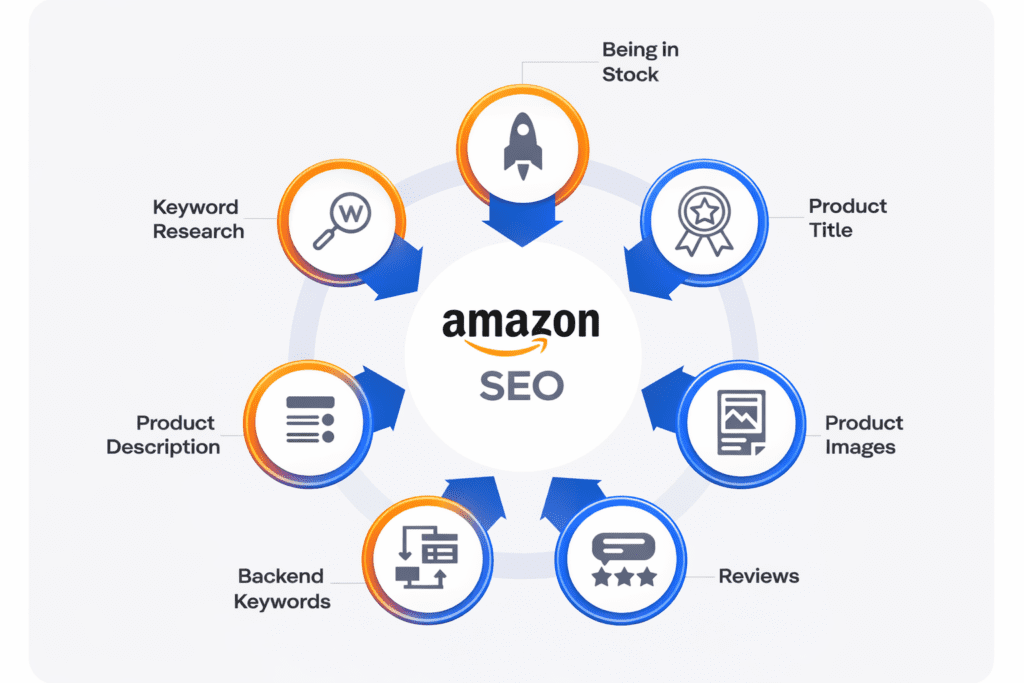
We treat Amazon SEO as a system with several interacting layers — keyword and content fundamentals, conversion optimization, external traffic and Brand Referral Bonus capture, entity-based content for Alexa for Shopping, and return-rate monitoring — rather than a single checklist item.
Want your current Amazon SEO strategy audited against all 10 steps above? Get in touch for a full listing and ranking review.
Frequently Asked Questions
What is Amazon SEO strategy?
The process of optimizing product listings, titles, bullet points, backend keywords, images, and performance metrics, to rank higher in Amazon’s search results.
How does Amazon’s ranking algorithm actually work?
Amazon’s system evolved from A9 into A10, and is now incorporating a knowledge-graph model called COSMO, weighing keyword relevance, conversion rate, sales velocity, external traffic, and account health together.
What is the difference between A9 and A10?
A9 weighed keyword relevance and sales history most heavily. A10 adds meaningful weight to external traffic and seller account health.
What is COSMO?
Amazon’s move toward a knowledge-graph-based search model, treating search terms as entities with associated context.
What are backend search terms and how should I use them?
Hidden fields for keyword variations not natural to include in visible copy. Never include a competitor’s brand name.
Is keyword stuffing still effective in 2026?
No, Amazon’s evolving context-aware systems can flag unnaturally keyword-dense copy as low quality.
What is the ideal Amazon product title length?
Roughly 150 to 180 characters for desktop, with critical keywords within the first 70 to 80 characters for mobile visibility.
Does A+ Content actually impact SEO?
Indirectly, yes — A+ Content increases engagement and conversion, both of which feed into ranking signals.
What is Unit Session Percentage?
Amazon’s internal name for conversion rate, functioning as close to the single most important ranking factor on Amazon.
Can external traffic actually improve my Amazon ranking?
Yes, sales from external traffic feed the same sales-velocity signals as internal sales, and can also qualify for the Brand Referral Bonus.
What is the Amazon Brand Referral Bonus program?
A program crediting Brand Registry sellers roughly 10 percent of the referral fee on sales from properly Attribution-tagged external traffic.
What is Alexa for Shopping?
Amazon’s AI shopping assistant, previously known as Rufus, rebranded May 13, 2026, built on the COSMO knowledge-graph framework.
How do I optimize my listing for Alexa for Shopping?
Write clear, factual, specific content covering real usage scenarios and directly answering common shopper questions.
Does my return rate actually affect my Amazon ranking?
Yes, once return rate runs meaningfully above category average, Amazon’s systems can suppress that listing’s visibility.
What’s the “Honeymoon Period” for new Amazon listings?
A temporary ranking boost for new ASINs, commonly lasting 30-45 days, used to build genuine sales velocity before it ends.
Should I target high-volume keywords even if my product isn’t a perfect match?
No, chasing a mismatched high-volume term can drive short-term sales followed by return-driven ranking suppression.
How often should I update my Amazon SEO strategy?
At minimum a quarterly audit, with immediate review after any major algorithm change or unexplained ranking shift.
Does pricing affect my Amazon SEO?
Not directly, but it strongly influences conversion rate, one of the most important ranking factors.
What’s the biggest mistake sellers make with PPC and organic SEO?
Treating them as unrelated, rather than using PPC deliberately to break the cold-start loop.
What should I check first if my listing is indexed but not ranking?
Usually a velocity problem, not a content problem — driving deliberate sales velocity through PPC or external traffic is the typical fix.
Do I need Brand Registry to use A+ Content or the Brand Referral Bonus?
Yes, both require active Brand Registry enrollment.
How do I know if my product qualifies as an “entity” for AI search optimization?
Search your product’s broad category term and check whether a dedicated knowledge-base entry exists for it — if so, build content around its associated context, not just the literal term.