
Selling on Amazon today is more competitive than ever.
Millions of products compete for visibility, and even well-optimized listings often struggle to rank.
Many sellers focus only on visible elements such as:
• product titles
• bullet points
• product descriptions
• A+ content
• images
But experienced Amazon sellers know that one of the most powerful ranking factors is hidden from customers.
These are Amazon backend keywords.
After working with Amazon brands for more than 10 years, I’ve seen countless cases where simply optimizing backend search terms dramatically improved product visibility and sales.
Yet many sellers ignore this opportunity.
In this guide we’ll explain:
• what backend keywords are
• how Amazon’s algorithm uses them
• how AI search is changing keyword strategy
• how to find high-performing backend keywords
• how to structure backend keywords for maximum indexing
• common mistakes sellers make
• advanced strategies used by top Amazon brands
We’ll also show how agencies like EcomRanker help brands optimize Amazon SEO for long-term growth.
What Are Amazon Backend Keywords?
Amazon backend keywords are hidden search terms stored in the Seller Central backend of a product listing.
These keywords are invisible to customers but help Amazon’s algorithm understand what searches your product should appear for.
Backend keywords allow sellers to target additional search terms that cannot fit naturally into visible listing content.
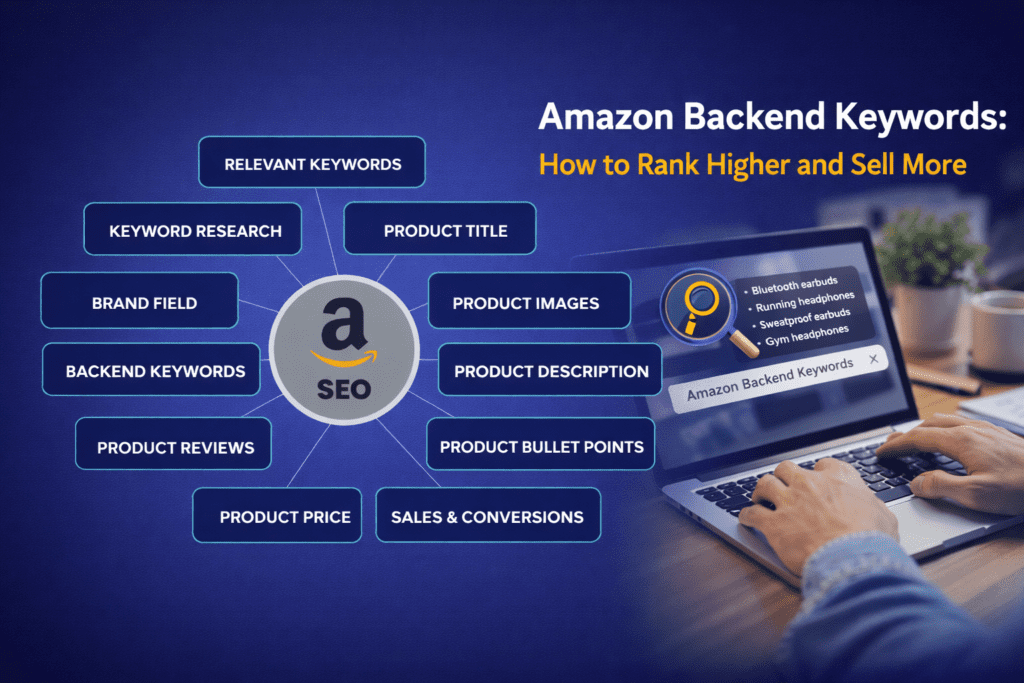
For example, a listing selling wireless headphones might include backend keywords such as:
• bluetooth earbuds
• workout headphones
• sweatproof earbuds
• running headphones
• gym earbuds
These keywords expand the search coverage of the listing.
Instead of relying only on visible text, Amazon’s algorithm also analyzes backend keywords when deciding whether a product should appear in search results.
Why Backend Keywords Matter More in 2026
Amazon’s search algorithm has evolved dramatically.
Earlier versions relied heavily on keyword matching.
But modern Amazon search uses:
• machine learning
• customer behavior data
• conversion signals
• contextual intent analysis
Amazon’s AI systems such as Rufus and Cosmo are changing how product discovery works.
Instead of simply matching words typed by users, the algorithm now interprets search intent.
For example, a customer searching:
“comfortable running headphones”
Amazon AI understands the shopper likely wants:
• lightweight headphones
• secure fit
• sweat resistance
• long battery life
Backend keywords help the algorithm connect your product to these types of intent-based searches.
This is why backend keyword optimization has become even more important.
How Amazon’s AI Search Is Changing Keyword Strategy
Amazon recently introduced Rufus, an AI shopping assistant now used by hundreds of millions of customers.
Instead of typing traditional keyword searches, customers can now ask conversational questions like:
• “What are the best headphones for working out?”
• “Which earbuds are best for small ears?”
• “What headphones are good for long flights?”
These types of queries require Amazon’s algorithm to interpret meaning rather than simply match keywords.
Because of this shift, backend keyword strategies must evolve.
Instead of focusing only on exact match keywords, sellers must include:
• semantic keyword variations
• problem-solution keywords
• customer use cases
• demographic descriptors
At EcomRanker, we help brands restructure backend keyword strategies to align with Amazon’s AI search environment.
How to Find High-Performing Backend Keywords
The biggest challenge for sellers is discovering the right keywords.
The goal is to identify search terms that:
• have meaningful search volume
• match customer intent
• have manageable competition
Below are proven keyword research strategies.
Strategy 1: AI-Powered Keyword Research Tools
Professional Amazon sellers rely on advanced keyword research tools.
Popular tools include:
• Helium 10
• Jungle Scout
• MerchantWords
• DataHawk
• Keyword Tool Dominator
These platforms provide insights into:
• search volume
• keyword competition
• seasonal demand
• customer search patterns
However tools alone are not enough.
Sellers must interpret the data strategically.
This is why many brands work with Amazon SEO specialists.
At EcomRanker, our Amazon SEO services combine keyword research with conversion optimization to improve rankings.
Strategy 2: Competitor Keyword Analysis
Competitor analysis remains one of the best keyword discovery methods.
Using reverse ASIN tools you can discover:
• keywords competitors rank for
• missing keyword opportunities
• emerging keyword trends
The goal is not to copy competitors but to identify keyword gaps.
For example:
If competitors rank for “gym earbuds” but your listing does not include that keyword, adding it to backend search terms may improve ranking potential.
Strategy 3: Amazon Auto Suggest
Amazon’s search bar provides valuable keyword insights.
When typing a keyword, Amazon suggests popular related searches.
These suggestions come directly from real customer searches.
Example:
Typing “wireless headphones” may generate suggestions like:
• wireless headphones for running
• wireless headphones for gym
• wireless headphones noise cancelling
These suggestions represent strong keyword opportunities.
Strategy 4: Amazon PPC Keyword Data
Amazon advertising campaigns generate valuable keyword data.
Running automatic PPC campaigns allows Amazon’s algorithm to test keywords and identify those that convert.
After collecting data for several weeks, sellers can analyze search term reports to identify:
• high-converting keywords
• relevant long-tail search phrases
• niche customer queries
These keywords often perform well as backend keywords.
Our Amazon PPC Management Service helps brands leverage advertising data to improve organic SEO.
The 3-Tier Backend Keyword Framework
Traditional keyword stuffing no longer works.
Instead, modern backend strategies use a structured framework.
Tier 1: Semantic Keyword Variations
These include synonyms and alternate phrases.
Example:
wireless earbuds
bluetooth headphones
sport headphones
gym earbuds
Tier 2: Problem-Solution Keywords
These keywords describe the problems the product solves.
Example:
tangle free headphones
sweatproof earbuds
noise cancelling headphones
Tier 3: Customer Intent Keywords
These keywords describe how customers use the product.
Example:
headphones for running
headphones for travel
headphones for office calls
Combining these three tiers creates a powerful keyword ecosystem.
Backend Keyword Best Practices
To maximize indexing and ranking potential, follow these rules.
Best Practices
• stay within Amazon’s byte limits
• avoid repeating keywords
• include synonyms and alternate spellings
• include plural variations
• target long-tail search terms
Common Mistakes
Avoid these common errors:
• repeating keywords already in title
• using competitor brand names
• including irrelevant keywords
• exceeding character limits
How to Check Keyword Indexing
Sellers must verify whether keywords are indexed.
One simple method:
Search on Amazon using:
ASIN + keyword
Example:
B08XYZ1234 wireless earbuds
If your listing appears, the keyword is indexed.
Professional tools like Helium 10 can also check indexing automatically.
Advanced Backend Keyword Optimization
Advanced sellers continuously improve backend keywords.
A typical optimization cycle includes:
Monthly keyword reviews
Quarterly keyword research updates
Seasonal keyword adjustments
Competitor keyword monitoring
How EcomRanker Helps Brands Rank Higher
At EcomRanker, we help brands optimize Amazon listings using advanced SEO strategies.
Our approach combines:
• keyword research
• listing optimization
• PPC campaign intelligence
• conversion rate optimization
Our team works with brands to build sustainable marketplace growth systems.
Learn more about our services:
Amazon Listing Optimization Service
Frequently Asked Questions
What are backend keywords on Amazon?
Backend keywords are hidden search terms in Seller Central that help Amazon’s algorithm understand what searches your product should appear for.
Do backend keywords improve ranking?
Yes. Backend keywords help Amazon index your product for additional search terms.
This increases the chances of appearing in relevant searches.
Should backend keywords include full phrases?
Individual keywords generally work better because Amazon’s algorithm combines words automatically.
How often should backend keywords be updated?
Sellers should review backend keywords every three to six months to adapt to changes in search trends and customer behavior.
Final Thoughts
Amazon SEO continues evolving as AI and machine learning reshape search behavior.
Backend keywords remain one of the most powerful yet overlooked ranking opportunities.
By understanding customer intent, using advanced keyword research methods, and continuously optimizing backend search terms, sellers can significantly improve product visibility.
Brands that treat backend keywords as part of an ongoing SEO strategy will gain a major competitive advantage.
If you want help optimizing your Amazon listings and keyword strategies, EcomRanker provides data-driven solutions designed to increase rankings and sales.