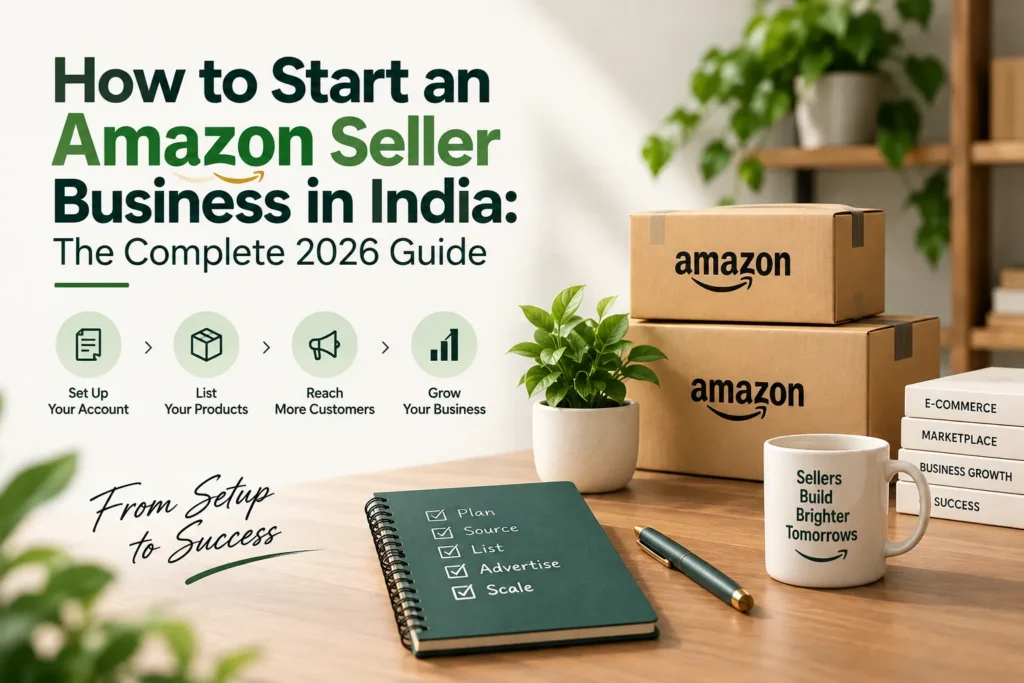
Starting an Amazon seller business in India means registering a Seller Central account, choosing between an Individual or Professional plan, getting GST in place for most product categories, and picking a sourcing model before you list your first product. Most beginners fail not because Amazon’s process is hard, but because they skip planning (sourcing, pricing, listing quality) and treat registration as the finish line rather than the starting point.
Key Takeaways
- Registration itself is simple and largely free — the real work is everything that comes after: sourcing, pricing, GST compliance, and listing quality.
- GST is required for most product categories, though a specific list of exempt goods (books, some handicrafts, certain edible goods) doesn’t require it.
- Choosing between Individual and Professional selling plans depends on expected volume, not just cost — Professional makes sense once you’re consistently selling more than a handful of units monthly.
- Your sourcing model shapes everything downstream — private label, wholesale, retail arbitrage, and artisanal/handmade routes each have different margin, complexity, and scalability profiles.
- FBA is generally recommended for beginners despite the added fee, since it removes fulfillment, storage, and much of the customer service burden while a new seller is still learning the platform.
- This guide covers domestic selling on Amazon.in — expanding to sell internationally from India is a separate, later step with its own requirements (IEC code, export compliance), covered separately.
Individual vs. Professional Seller Account: Which Do You Need?
| Factor | Individual Plan | Professional Plan |
| Cost structure | Per-item fee, no monthly subscription | Monthly subscription fee |
| Best for | Testing the platform, low and inconsistent volume | Consistent, higher-volume selling |
| Access to advertising and bulk tools | Limited | Full access |
| Category access | More restricted | Broader category access |
If you’re testing a single product idea before committing further, Individual is the lower-risk starting point. Once you’re consistently selling more than a handful of units a month, the Professional plan’s flat structure and expanded tool access typically pay for themselves.
What You Need Before You Register
- GSTIN (GST Identification Number) — required for most categories; check whether your specific product category falls under one of the GST-exempt exceptions (books, certain handicrafts, some edible goods) before assuming you need one
- PAN card — for identity and tax verification
- Active bank account — for receiving payouts
- Registered business entity — sole proprietorship, partnership, LLP, or private limited company; a sole proprietorship is the common, lower-complexity starting point for most new sellers
- A mobile number and email for account verification via OTP
Step-by-Step: Amazon Seller Registration in India
- Go to sellercentral.amazon.in and select “Start Selling” or “Create your Amazon account.”
- Enter your name, mobile number, and email, then set a password and continue.
- Verify via OTP sent to your registered mobile number.
- Enter your store name and complete the business details form, including your GSTIN, PAN, and bank account information.
- Upload required documents for verification — this typically includes proof of business registration and identity verification documents.
- Wait for verification approval, then complete your Seller Central profile (store name, business address, tax settings).
- Set up your payment and tax details fully before listing your first product, since incomplete tax setup is a common cause of listing or payout delays later.
Choosing a Sourcing Model
| Model | What It Is | Margin | Complexity |
| Private Label | Source a generic product, brand it as your own | Higher, once established | Moderate — requires supplier relationships and quality control |
| Wholesale/Reselling | Buy branded products at wholesale, resell at retail | Lower | Lower — established brand demand does some of the work |
| Retail Arbitrage | Buy discounted products from retail stores, resell | Opportunistic | Difficult to scale, but a fast way to learn the platform |
| Handmade/Artisanal | Sell your own handmade products via Amazon Karigar or Launchpad | Varies | Route-specific — worth exploring Amazon’s dedicated artisan and launch programs |
For most new sellers focused on building something scalable, private label with domestic Indian suppliers is a reasonable starting point — sourcing channels like IndiaMART for domestic manufacturers, or Alibaba for importing, are the common entry points. Vet any supplier thoroughly (samples, references, minimum order quantities) before committing to a bulk order, since a bad first sourcing decision is expensive to unwind.
FBA vs. Self-Fulfillment (MFN) for New Sellers
| Factor | FBA (Fulfilled by Amazon) | MFN (Merchant Fulfilled Network) |
| Who handles storage/shipping | Amazon | You |
| Prime badge eligibility | Yes | Generally no |
| Fee structure | Additional FBA fees on top of referral fees | No FBA fee, but you bear shipping/labor cost directly |
| Best for new sellers | Generally recommended — removes fulfillment complexity while learning the platform | Viable for sellers wanting tighter cost control from day one, with more hands-on operational involvement |
FBA is commonly recommended specifically for beginners because it removes several operational variables (storage, packing, shipping, much of returns handling) while you’re still learning pricing, listing optimization, and demand patterns — variables worth isolating one at a time rather than managing everything simultaneously in your first few months.
Creating Your First Listing
Your listing is the single biggest lever in whether you sell or not. At minimum:
- Product identifier (GTIN/EAN/UPC) — required for most categories, with some exemptions for private-label or GS1-exempt situations
- Clear, benefit-led title within Amazon’s current character limits
- High-quality images meeting Amazon’s technical requirements, showing the product clearly from multiple angles
- Accurate category placement, since miscategorization hurts discoverability
- Complete backend keywords to support search visibility beyond what’s visible in the title and bullets
Don’t rush your first listing to get to market faster — a weak listing wastes whatever traffic your first weeks of visibility generate, and first-listing mistakes are often more expensive to fix later (lost reviews, poor initial rank) than they would have been to avoid from the start.
Common Mistakes New Sellers Make
- Incorrect registration details — wrong GST or bank information causes verification delays or holds
- Weak listings — no clear keyword strategy or SEO structure, resulting in poor discoverability
- Ignoring account health from day one — performance metrics and policy compliance matter from your very first sale, not just once you’re established
- No brand registry or storefront — limits trust, conversion, and protection against listing hijacking once you have a registered brand
- Weak pricing and inventory planning — stockouts or excess inventory both hurt Buy Box eligibility and profitability
- Jumping to global selling too early — expanding internationally before your domestic operation and unit economics are proven adds complexity without a solid foundation underneath it
What Comes After Your First Sale
Getting your first sale is a milestone, not the goal. From here: monitor your account health metrics consistently, gather and respond to reviews, refine pricing based on actual conversion data rather than guesswork, and start thinking about Brand Registry once you have a registered trademark, since that unlocks A+ Content, a Brand Store, and stronger protection against counterfeit or hijacked listings.
Ready to Sell Beyond India?
Once your domestic Amazon.in business has proven unit economics, expanding to international marketplaces (US, UK, UAE, EU) through Amazon Global Selling is a natural next step — but it comes with its own requirements: an IEC (Importer Exporter Code) from the DGFT, export documentation, and marketplace-specific compliance like VAT registration for UK/EU. Our Sell on Amazon India page covers the full global-selling and export process in depth once you’re ready for that stage.
How EcomRanker Helps New Amazon India Sellers
We help new sellers avoid the expensive early mistakes — incorrect registration setup, weak listings, and account health issues that surface only after they’ve already cost sales. As part of our Amazon India work, we handle Seller Central setup, listing optimization, and account health monitoring from day one, so your first months build a foundation rather than a cleanup project. When you’re ready to expand internationally, we manage that transition too.
Want your registration, sourcing plan, or first listings reviewed before you launch? Get in touch for a new-seller strategy session.
Frequently Asked Questions
1 . Do I need GST to sell on Amazon India?
Yes, for most product categories. A specific list of exempt goods (books, certain handicrafts, some edible goods) doesn’t require GST, but the majority of categories do.
2 . Should I choose the Individual or Professional selling plan?
Individual suits testing the platform with low or inconsistent volume, since it charges per item with no monthly fee. Professional makes sense once you’re consistently selling more than a handful of units monthly, given its broader tool and category access.
3 . Is Amazon FBA recommended for new sellers in India?
Generally yes. FBA removes storage, shipping, and much of the customer service burden while you’re still learning pricing and listing optimization, despite the added fee compared to self-fulfillment.
4 . What’s the best sourcing model for a first-time Amazon India seller?
It depends on goals, but private label with domestic Indian suppliers is a common, reasonably scalable starting point for sellers wanting to build a lasting brand, versus wholesale or retail arbitrage which trade scalability for lower complexity or faster entry.
4 . How long does Amazon seller registration take in India?
The registration process itself typically takes a few hours to complete online, though full account verification can take longer depending on document review.
5 . Do I need a registered business to sell on Amazon India?
Yes, a registered business entity (sole proprietorship, partnership, LLP, or private limited company) is required. Sole proprietorship is the common, lower-complexity option for most new individual sellers.
6 . Can I sell handmade products on Amazon India?
Yes, through dedicated programs like Amazon Karigar (for artisans) and Amazon Launchpad, which are worth exploring specifically if your products are handmade rather than mass-manufactured.
7 . What’s the difference between selling domestically and Amazon Global Selling from India?
Domestic selling on Amazon.in targets Indian customers and only requires standard Indian business registration and GST. Amazon Global Selling lets you export and sell on international marketplaces (US, UK, UAE, EU) but requires additional steps like an IEC code and export compliance.
8 . What’s the most common reason new Amazon India sellers fail?
Treating registration as the finish line rather than the start — skipping proper sourcing vetting, listing optimization, and account health monitoring in the critical early months.