
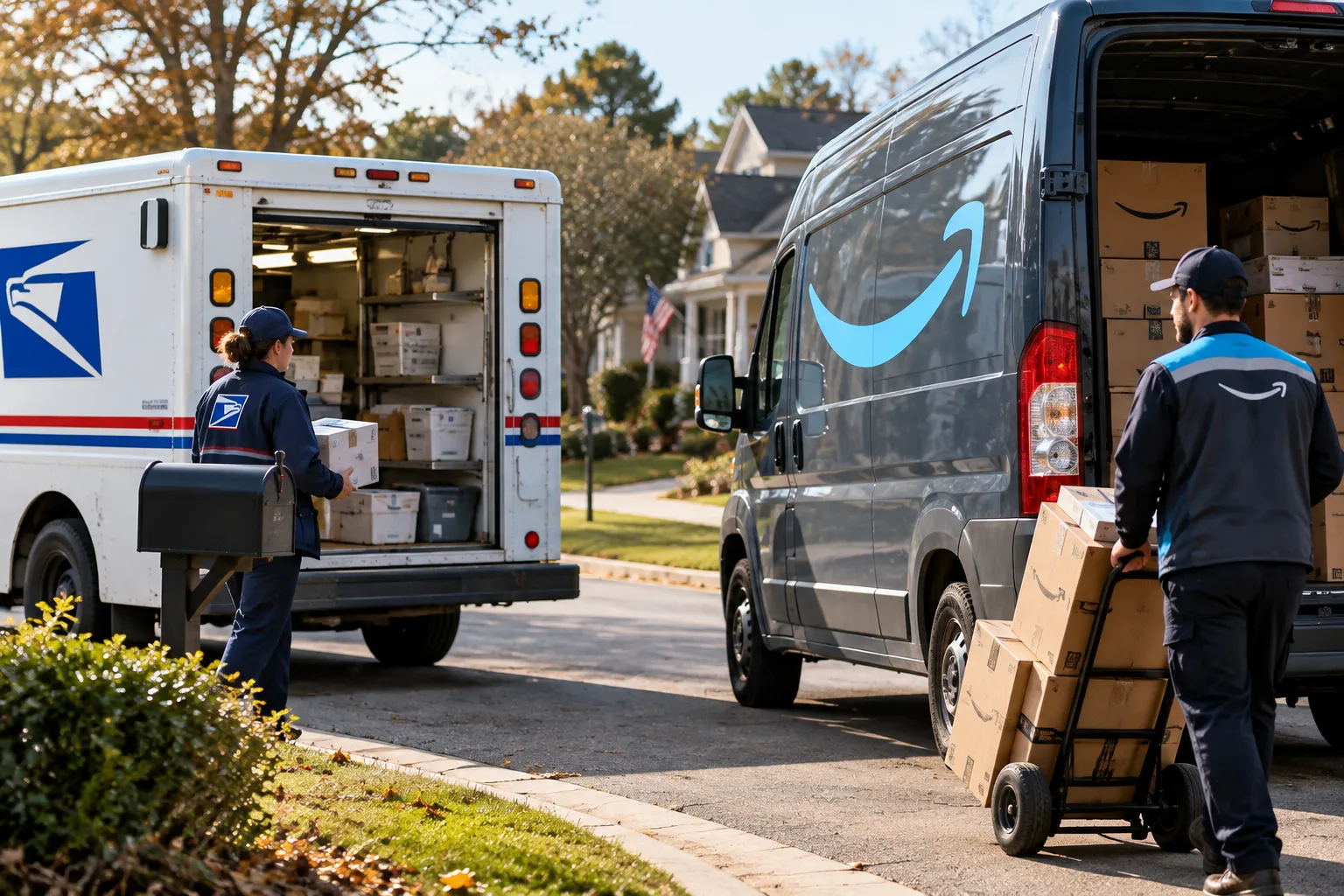
Amazon and the U.S. Postal Service have reached a new delivery agreement following months of tense, on-again-off-again negotiations. Under the deal, USPS will continue handling roughly 80% of the package deliveries it currently makes for Amazon, a meaningful reduction from the prior arrangement, but far smaller than the cut Amazon had reportedly been considering just weeks earlier.
For sellers who rely on Amazon’s delivery network to reach customers, especially in rural and harder-to-reach areas, the agreement removes a source of real uncertainty that had been building since late last year.
What the New Deal Actually Changes
Amazon confirmed it has reached a new agreement with USPS in which the Postal Service will continue making about 80% of the deliveries it currently handles for the retailer. That’s a 20% reduction in USPS-delivered volume, but USPS is still expected to deliver more than 1 billion Amazon packages annually under the new terms.
The agreement is tentative and still requires regulatory approval before taking full effect.
| Detail | Figure |
| USPS share of Amazon deliveries retained | ~80% |
| Reduction from prior volume | ~20% |
| Annual Amazon packages still delivered by USPS | 1+ billion |
| Approximate annual value to USPS | ~$6 billion |
| Cut Amazon had previously considered | Two-thirds or more |
| Deal status | Tentative, pending regulatory approval |
Why Talks Nearly Fell Apart
The path to this agreement wasn’t smooth. Negotiations hit a snag in December 2025, when USPS opened up a bidding process allowing shippers of all sizes, not just its largest customers, to compete for last-mile delivery capacity out of its roughly 18,000 delivery destination units. Previously, that direct-delivery access had been limited to a small number of very large customers, Amazon among them.
Amazon has said its goal going into the talks was to increase USPS-bound volume, but that USPS “abruptly walked away at the eleventh hour” during that process. In a LinkedIn post, John Rosato, a senior manager for public policy at Amazon, said the bidding detour “introduced real uncertainty into our network planning” and that trust between the two organizations “was significantly strained” as a result.
By March, a Wall Street Journal report indicated Amazon was weighing a cut of two-thirds or more of the deliveries it had been routing through USPS, a move that would have been a serious financial blow to the Postal Service. USPS Postmaster General David Steiner had separately warned that the agency risked running out of cash within a year amid declining traditional mail volume and regulatory pressures.
How the Two Sides Landed on 80%
Despite the rocky lead-up, Amazon and USPS ultimately settled on a scaled-back deal rather than a dramatic split. An Amazon spokesperson said the company was “pleased to have reached a new agreement with USPS that furthers our longstanding partnership,” adding that it would let the companies “continue supporting our customers and communities together.”
Amazon remains USPS’s largest single customer, and the relationship is worth an estimated $6 billion a year to the Postal Service. Even with the reduction, that scale gives USPS a critical revenue stream at a moment when the agency is under real financial pressure.
Packages that would have previously gone through USPS under the old terms will now need to move through other channels, most notably Amazon’s own delivery network, which the company has continued expanding in recent years, including opening it up to outside shippers.
Why This Matters for Amazon Sellers
This isn’t just a logistics story between two large companies. USPS remains uniquely positioned to reach rural and low-density areas that are expensive for private carriers to serve, and Amazon has been leaning on that reach as it pushes faster delivery speeds into rural markets. Data cited alongside the deal shows rural Prime customers spend roughly $950 a year on Amazon on average, and that a meaningful share of rural customers already report same-day or one-day delivery on their most recent order.
For sellers, a stable USPS relationship means:
- Continued reliable last-mile coverage in rural and harder-to-reach ZIP codes, where alternatives are limited and costlier.
- Less near-term risk of shipping disruptions or cost volatility tied to a sudden network shift.
- A signal that Amazon still views USPS as a core part of its fulfillment strategy, rather than something being phased out in favor of its own network alone.
- Some packages shifting to Amazon’s own delivery network going forward, which could affect delivery speed or tracking behavior on a subset of orders over time.
What to Watch Next
- Whether the deal clears the regulatory approval it still requires, and on what timeline.
- How USPS’s broader bidding process for last-mile capacity affects pricing or access for other shippers going forward.
- Whether Amazon continues expanding its own delivery network’s role in the packages that shift away from USPS under the new terms.
- Any changes in delivery speed or reliability in rural markets as the new volume split takes effect.
Frequently Asked Questions
1 . What did Amazon and USPS agree to?
Amazon and the U.S. Postal Service reached a new, tentative delivery agreement in which USPS will continue handling about 80% of the package deliveries it currently makes for Amazon, a 20% reduction rather than the two-thirds-or-larger cut Amazon had earlier considered.
2 . How many packages will USPS still deliver for Amazon?
USPS is expected to continue delivering more than 1 billion Amazon packages annually under the new agreement.
4 . Why did Amazon consider cutting USPS deliveries in the first place?
Talks broke down in December 2025 after USPS opened a bidding process allowing other shippers to compete for last-mile delivery capacity, a move Amazon said introduced uncertainty into its network planning. A Wall Street Journal report in March 2026 said Amazon was considering cutting two-thirds or more of its USPS-handled deliveries.
5 . Is the Amazon-USPS deal final?
As reported, the agreement is tentative and still requires regulatory approval before it takes full effect.