
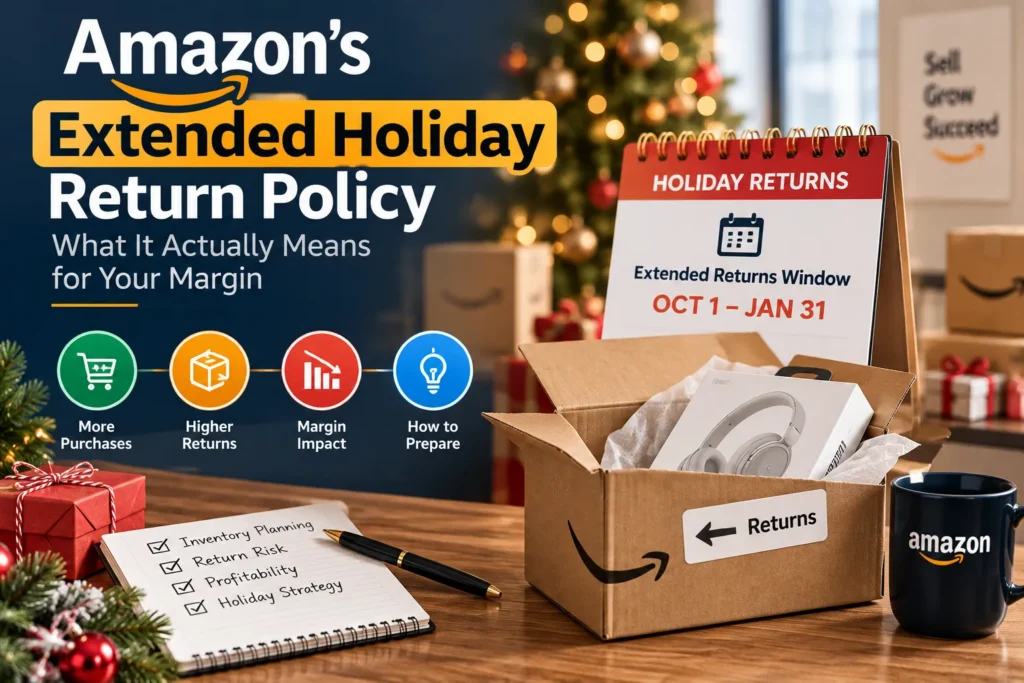
Amazon extends its standard 30-day return window during the holiday season, letting purchases made in November and December be returned well into the following year. It’s good for buyer confidence and good for Amazon’s conversion rates — but for sellers, it means final sales figures aren’t really final until months later, cash flow gets tighter, and a handful of overlooked Seller Central settings quietly determine how much of that returned inventory you actually get to recover.
Key Takeaways
- The extended window covers purchases made across the core holiday shopping period, pushing the return deadline well past Amazon’s standard 30 days — check the exact current-year dates on Amazon’s seller help pages, since they’re set annually.
- This creates six distinct cost pressures, not just “more returns”: processing costs, lost margin, product depreciation, cash flow disruption, volume strain, and fraud risk all compound during this window.
- Three Seller Central settings determine how much of your returned inventory you actually recover: Returned Item Evaluation, Damaged Inventory Ownership, and Returnless Resolutions — most sellers never touch any of them.
- Return rates vary enormously by category — giftable, sizing-dependent, and electronics categories can run several times higher than staple or consumable categories during this specific window.
- The return window’s exact dates differ by marketplace — US, UK, and EU each set their own extended-return calendar, so a multi-marketplace seller can’t assume one date range applies everywhere.
- Response speed to return requests matters beyond customer satisfaction — slow responses during this high-volume window increase the risk of escalation to formal A-to-Z Guarantee claims, which carry their own account-health consequences.
What the Extended Return Window Actually Covers
Amazon’s standard policy allows most items to be returned within 30 days of receipt. During the holiday season, Amazon extends this specifically to accommodate gift purchases — items bought in November and December commonly remain returnable well into the following January, giving early holiday shoppers room to buy without worrying about a gift recipient missing the standard window. Always confirm the exact current-year start and end dates on Amazon’s official seller help pages rather than relying on a fixed date range, since Amazon sets these dates annually and they can shift slightly year to year.
Category and Product Exceptions
Not every purchase automatically qualifies for the extended window. Certain categories — including some electronics, software, gift cards, and hazardous or perishable goods — often carry different or unchanged return terms even during the holiday period, since their standard policies already account for specific handling, licensing, or safety constraints. Before assuming your entire catalog falls under the extended window, check whether any of your specific categories carry a standing exception. A seller who assumes blanket coverage and prices or plans around it can be caught off guard by a category-specific rule that never changes regardless of season.
The Six Ways This Actually Costs You Money
The extended window isn’t just “more returns to process” — it compounds across several distinct cost centers:
- Increased processing costs — return handling, shipping, restocking, and disposal of unsellable items, worsened for FBA sellers by Amazon’s returns processing fees on products with elevated return rates
- Direct profit loss — every refunded sale erases both the revenue and the margin you’d already booked on that unit
- Product depreciation — opened or damaged returns often can’t be resold at full price, forcing a discounted “used” sale or liquidation
- Cash flow disruption — final Q4 sales figures aren’t really final until the extended window closes, and Amazon typically increases payment reserves during this period specifically to cover potential refunds, tightening available cash right when restocking capital matters most
- Volume strain — the return surge concentrates heavily in January, straining processing capacity, especially for FBM sellers handling returns without Amazon’s infrastructure
- Return fraud risk — a longer window creates more opportunity for “wardrobing” (using an item, then returning it) and similar abuse patterns
Worked Example: The Real Dollar Impact on a Mid-Size Seller
Most content on this topic states these six cost mechanisms abstractly without putting a number on them. Here’s a simplified illustration for a seller doing $200,000 in Q4 holiday-period sales across a mixed catalog:
| Factor | Assumption | Dollar Impact |
| Q4 holiday-period revenue | — | $200,000 |
| Blended average return rate during extended window | 12% (blended across giftable and staple SKUs) | 24,000 units of revenue exposed |
| Refunded revenue | 12% of $200,000 | –$24,000 |
| Lost margin on refunded units (avg. 35% margin) | 35% of $24,000 | –$8,400 in margin, in addition to the refunded revenue itself |
| Processing/return-handling fees (FBA, est.) | ~$2 per returned unit, ~1,600 units at $15 AOV | –$3,200 |
| Depreciated/unsellable stock (est. 20% of returns can’t be resold at full price) | 20% of returned units, avg. 30% price haircut | –$1,440 |
| Approximate total margin impact | — | ~$13,000, roughly 6.5% of Q4 holiday-period revenue |
This is a simplified, illustrative model — your actual blended return rate, margin, and per-unit fees will differ by catalog. The point of running this calculation on your own numbers isn’t precision; it’s recognizing that a 12% return rate isn’t just “12% of orders coming back” — it’s a compounding cost across margin, fees, and depreciation that can easily exceed 5-7% of your total holiday-period revenue once every layer is counted.
The Seller Central Settings Most Sellers Never Touch
Three configuration choices directly determine how much value you recover from this season’s returns, and most sellers have never reviewed any of them.
| Setting | What It Controls | Consideration |
| Returned Item Evaluation | Whether Amazon inspects returned items for resale eligibility | Keeping this enabled generally lets sellable-condition returns go back into inventory; disabling it marks items unfulfillable and blocks reimbursement for damage |
| Damaged Inventory Ownership | Whether Amazon takes ownership of items it damages (reimbursing your sourcing cost) or returns them to you | Amazon reselling your damaged stock via Amazon Warehouse can undercut your own listing price; disabling this gives you control at the cost of covering removal yourself |
| Returnless Resolutions | Whether customers can get a refund without shipping the item back | Worth enabling selectively for low-cost or hard-to-resell items where return shipping costs more than the refund; better left off for items worth reselling |
Returned Item Evaluation
This setting decides whether Amazon actually inspects a returned unit before deciding what happens to it. Left enabled, Amazon assesses condition and, where appropriate, returns sellable-condition inventory to your available stock — meaning a customer who returns an unopened, undamaged item doesn’t automatically become a total loss for you. Disabling it removes that inspection step entirely, and Amazon defaults to marking the returned unit unfulfillable, which also forfeits your ability to claim reimbursement if the item actually arrived back damaged. There’s rarely a good reason to disable this setting; the main scenario where sellers consider it is when they’ve had persistent problems with Amazon’s condition assessments misclassifying genuinely sellable stock, which is worth escalating as a support case rather than solving by disabling inspection altogether.
Damaged Inventory Ownership
When Amazon itself damages a returned unit during processing, this setting decides what happens next. Left at the default, Amazon typically reimburses your sourcing cost and takes ownership of the item, which it can then resell at a discount through Amazon Warehouse — sometimes directly alongside your own listing, which can quietly undercut your own price positioning on that ASIN. Disabling this setting keeps ownership (and disposal responsibility) with you, which costs you a removal fee but keeps a damaged unit from resurfacing as discounted competition against your own listing. Brands with strong price positioning or premium brand image are the ones most likely to find this setting worth disabling; commodity sellers competing purely on price have less to lose either way.
Returnless Resolutions
This setting lets you offer a refund without requiring the item to be shipped back — useful specifically when return shipping would cost more than the item is worth, or when the product category makes resale unlikely regardless of condition (certain personal care, food-adjacent, or low-cost items). Enabling it broadly, across your entire catalog, can be a mistake: for higher-value or easily resellable items, you’d rather have the unit back and inspected than issue a blind refund. The setting works best applied selectively, category by category or even SKU by SKU, rather than as an all-or-nothing account-level choice.
Return Rates by Category: What to Actually Budget For
A blended, catalog-wide return rate estimate hides enormous category variance. Budgeting the same return-rate assumption across a mixed catalog will overestimate risk on your staple products and badly underestimate it on your giftable and sizing-dependent ones.
| Category Type | Typical Holiday-Period Return Rate | Why |
| Consumables/staples (household, grocery-adjacent) | 1–3% | Low gift-purchase share, low sizing/fit ambiguity |
| General home/kitchen goods | 3–8% | Moderate gift-purchase share |
| Apparel and footwear | 15–30%+ | High sizing/fit variability, high gift-purchase share, common exchange-driven returns |
| Electronics | 8–15% | Buyer’s remorse, compatibility mismatches, and a meaningful share of “changed my mind” returns during gifting season |
| Toys | 10–20% | High gift-purchase share, frequent duplicate-gift returns |
| Jewelry and accessories | 10–25% | High gift-purchase share, sizing/fit for rings and similar items |
These figures are directional, not Amazon-published statistics — treat them as planning inputs to sanity-check your own historical data against, not as a precise forecast for your specific catalog. If you’re launching a new giftable or apparel SKU without your own return-rate history yet, budgeting toward the higher end of your category’s range is the safer planning assumption for cash flow and inventory purposes.
Does the Extended Window Apply the Same Way Outside the US?
No — and this is worth planning around specifically if you sell across multiple Amazon marketplaces:
| Marketplace | Note |
| US (Amazon.com) | Sets its own annual extended-return calendar, typically covering November-December purchases |
| UK (Amazon.co.uk) | Runs its own extended holiday return policy with dates set independently of the US calendar |
| EU marketplaces | Also set their own extended-return windows, which can differ from both the US and UK dates |
A seller running the same catalog across US, UK, and EU marketplaces should check each marketplace’s specific extended-return dates rather than assuming the US calendar applies everywhere — cash flow and inventory-recovery planning needs to account for each marketplace’s window closing at a potentially different time.
Spotting and Handling Return Fraud
A longer return window creates more opportunity for abuse, and it’s worth knowing the common patterns rather than treating every return as good-faith by default:
- Wardrobing — using an item (commonly clothing, but also tools, electronics, and event-specific items) for its intended purpose, then returning it as if unused
- Item swapping — returning a different, often lower-value or damaged item in place of the one actually purchased
- Empty-box returns — claiming a return while shipping back an empty or wrong-contents package
- Serial return abuse — a small number of accounts responsible for a disproportionate share of returns across multiple orders and sellers
Amazon has its own systems for detecting abusive return patterns at the account level, but sellers can contribute directly: document item condition on arrival at your fulfillment location (or via FBA’s own condition data), keep records of packaging and product photos at time of shipment for comparison, and report suspected serial abuse patterns to Seller Support with specific order and account details rather than assuming Amazon will catch every case proactively. Isolated suspicious returns are rarely worth an extended dispute given the time cost; a documented pattern across multiple orders is worth escalating.
How to Prepare Before the Window Opens
8 Weeks Out
- Forecast your realistic return rate by category, using your own historical data where available and the category ranges above as a sanity check where it isn’t
- Audit packaging and supplier quality control, since damaged-in-transit items are a leading, preventable cause of returns
- Review your three key Seller Central settings (Returned Item Evaluation, Damaged Inventory Ownership, Returnless Resolutions) and set them deliberately rather than leaving account defaults unexamined
4 Weeks Out
- Set aside extra working capital specifically for the cash flow gap created by increased payment reserves during the extended window
- Tighten listing accuracy — size charts, dimensions, compatibility details, and material descriptions — since mismatched expectations are one of the most common, most preventable causes of a return
- Prepare customer service response templates (see below) so return-related messages get handled quickly and consistently once volume increases
During the Window
- Monitor return volume and reasons by ASIN weekly, not just at month-end, so a spike tied to one specific product gets caught and addressed while it’s still happening
- Respond to return and refund requests within about 24 hours, treating this as an account-health priority, not just a service-quality one
- Track patterns that might indicate fraud (see above) rather than processing every return identically without review
Customer Communication That Reduces Escalations
A clear, prompt response to a return request often prevents it from escalating further. A simple template structure that covers the essentials:
“Thanks for reaching out about your return. I can confirm [item] qualifies for our extended holiday return window through [date]. To process your return, please [specific next step — use the prepaid label in your account, or similar]. Once we receive and inspect the item, your refund will be issued within [timeframe]. Let us know if you have any other questions in the meantime.”
The key elements: confirm eligibility explicitly rather than making the customer guess, give one clear next action, and set a specific expectation for when they’ll see resolution. Ambiguous or delayed responses are what push a routine return into a frustrated customer filing an A-to-z claim instead of waiting for your reply.
Responding Fast: The A-to-Z Connection
This is a detail worth connecting explicitly: a slow or unclear response to a return request during this high-volume window doesn’t just risk customer frustration — it raises the odds of a buyer escalating to a formal A-to-z Guarantee claim instead of resolving the issue directly with you. As covered in our A-to-z Guarantee claims guide, claims granted against you count against your Order Defect Rate, while issues resolved directly — including a return request handled promptly — generally don’t carry that same account-health cost. Responding to return requests within about 24 hours during this period isn’t just good service; it’s a meaningful lever for keeping the season’s return surge from also becoming an account-health problem.
Turning Returns Into a Second Chance at a Sale
Not every return has to end as a pure loss. A returned item that’s genuinely unopened and undamaged, restocked promptly via a healthy Returned Item Evaluation setting, simply becomes available inventory again. Beyond that, a return interaction is also a data point: if a specific ASIN generates a disproportionate share of returns for a specific stated reason (wrong size, doesn’t match description, arrived damaged), that’s direct, free feedback on a fixable problem — a listing detail to correct, a packaging change to make, or a sizing chart to clarify before the next selling cycle. Treating each season’s return data as an input to next year’s listing and packaging decisions, rather than just a cost to absorb, is where some of the compounding value in this process actually sits.
What to Do Once the Window Closes
- Reconcile actual return rates against your forecast by category and by ASIN, and update next year’s planning assumptions accordingly
- Review which specific products drove disproportionate returns and address the root cause (listing accuracy, packaging, sizing information) before your next major sales event
- Revisit your three Seller Central settings if this season’s data suggests a different configuration would have recovered more value
- Release any excess working capital held back for the return-window cash flow gap once reserves normalize, redirecting it toward restocking or the next planning cycle
How EcomRanker Helps Sellers Manage Holiday Returns
We treat the extended return window as a cash-flow and settings problem as much as a customer-service one — reviewing your Returned Item Evaluation, Damaged Inventory Ownership, and Returnless Resolutions settings ahead of the season, and building return-rate forecasts by category into your broader Q4-to-January plan rather than reacting to the surge once it’s already underway. This connects directly to our after-Christmas sales strategy work and our account audit service, which tracks ODR and return-driven account health together.
Want your returns settings, category-level forecast, and cash flow plan reviewed before the window opens? Get in touch for a holiday-readiness review.
Frequently Asked Questions
1 . When does Amazon’s extended holiday return policy apply?
It covers purchases made across the core November-December holiday shopping period, extending the return deadline well past the standard 30 days into the following year. Confirm the exact current-year dates on Amazon’s official seller help pages, since they’re set annually.
2 . Does the extended return policy apply to both FBA and FBM sellers?
Yes, generally, as long as the item is fulfilled through Amazon or follows Amazon’s return guidelines. FBM sellers specifically need to ensure their own return policies meet Amazon’s minimum requirements during this period.
3 . Will Amazon hold more of my funds during the extended return window?
Often yes. Amazon commonly increases payment reserves during this period to cover potential refunds, which can tighten available cash through the following January.
4 . What should I do with the Returned Item Evaluation setting?
Most sellers benefit from keeping it enabled, since it allows Amazon to inspect returns for resale eligibility and lets sellable-condition items go back into your available inventory rather than being marked unfulfillable by default.
5 . Should I disable Damaged Inventory Ownership?
It depends on your priorities. Disabling it gives you full control over damaged inventory, preventing Amazon from reselling it via Amazon Warehouse at a potentially lower price than your own listing, but you’ll cover removal costs yourself.
6 . How does the extended return window affect account health?
Indirectly but meaningfully — slow responses to the resulting volume of return requests can push buyers toward formal A-to-z Guarantee claims instead of a direct resolution, and granted claims count against your Order Defect Rate.
7 . Does the extended return window apply the same way in the UK and EU?
No. Each marketplace sets its own extended-return calendar independently, so a seller active across US, UK, and EU marketplaces should check each region’s specific dates rather than assuming one calendar applies everywhere.
8 . How much can return rates increase during the holiday season, by category?
It varies significantly — staple and consumable categories may only see 1-3% returns, while apparel, footwear, and other highly giftable or sizing-dependent categories can spike to 15-30% or more during this specific window.
9 . What’s the biggest preventable cause of holiday returns?
Listing inaccuracy and inadequate packaging are two of the most common, most preventable causes — mismatched size, color, or compatibility expectations, and items damaged in transit due to insufficient protective packaging.
10 . Do all products qualify for the extended return window?
No. Certain categories, including some electronics, software, gift cards, and hazardous or perishable goods, often carry different or unchanged return terms even during the holiday period. Check your specific categories rather than assuming blanket coverage.
11 . How can I tell if a return is fraudulent rather than legitimate?
Watch for patterns like an item returned in clearly-used condition (wardrobing), a returned package containing a different or lower-value item than what was shipped, or a specific account with a disproportionate return history across multiple orders. A single unusual return is rarely worth disputing; a documented pattern is worth escalating to Seller Support.
12 . What should I do with return data after the window closes?
Reconcile actual return rates against your forecast by category and ASIN, and use returns tied to a specific stated reason (wrong size, damaged in transit, doesn’t match description) as direct feedback to fix the underlying listing or packaging issue before your next sales cycle.