
Sponsored Brands video autoplays directly in the search results feed, showing your product in motion to shoppers before they’ve committed to any brand — which makes it the highest new-to-brand acquisition format on Amazon. In 2026, this got more valuable: SBV creative is now eligible to surface in Rufus, Amazon’s AI shopping assistant, meaning the same video can win both a search placement and an AI-generated recommendation. Most brands still judge it by ACoS alone, which is the wrong metric and the reason good campaigns get paused.
Key Takeaways
- SBV wins new customers because of where and how it appears: it sits in the search feed before a shopper opens any product, shows the product in motion, and autoplays without requiring a click.
- In 2026, SBV inventory became Rufus-eligible — the same creative that wins a search placement can now also surface in Amazon’s AI shopping assistant recommendations, a development most current SBV content hasn’t caught up to.
- Don’t confuse SBV with Sponsored Product Video (SPV) — a newer, separate format where video replaces the main image inside the organic search grid itself, rather than appearing as a distinct banner unit.
- ACoS on SBV will look worse than Sponsored Products, and that’s expected — the correct metric is cost per new-to-brand (NTB) customer, measured against customer lifetime value, not ACoS in isolation.
- The first three seconds decide everything, since SBV autoplays muted without an opt-in click — open with the product and one visible benefit, never a logo animation.
- Eligibility requires active Brand Registry enrollment, a Professional selling plan, and some running history with Sponsored Products — typically 2–4 weeks for newly enrolled brands.
What Sponsored Brands Video Is (and Why It Wins New Customers)
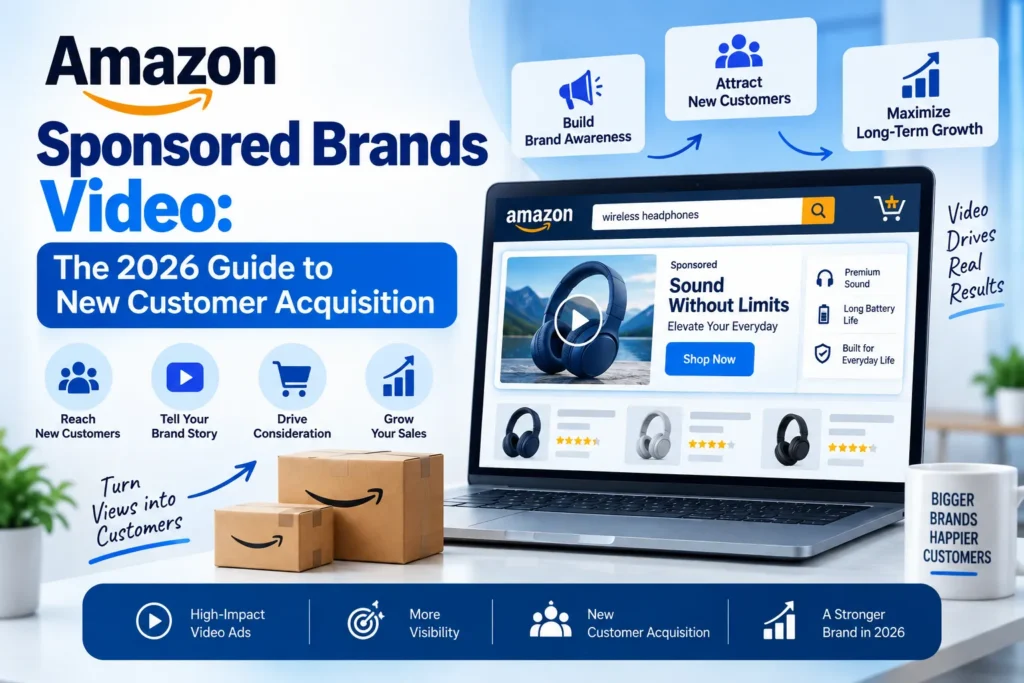
Sponsored Brands video (SBV) is a keyword-targeted, cost-per-click ad format that places an autoplaying product video directly in the Amazon search results feed, usually within the first few rows, well before a shopper has opened any specific listing. Three structural facts explain why it consistently drives more new-to-brand customers than other formats: it reaches shoppers while they’re still undecided, before they’ve formed a preference for any particular brand; it shows the product in motion, which static images can’t do for shoppers who need to see how something works before feeling comfortable buying; and it plays automatically on scroll, capturing attention before the shopper has consciously decided to engage with anything.
The 2026 Change Most Guides Haven’t Caught Up To: Rufus Eligibility
This is a genuinely recent development that most current SBV content, including strong, well-credentialed guides, hasn’t incorporated yet: as of 2026, Sponsored Brands video inventory is eligible to surface within Rufus, Amazon’s generative-AI shopping assistant, not just in traditional search results. In practice, this means the same 15-second creative built to win a keyword search placement can also appear when Rufus generates product recommendations in response to a shopper’s question — effectively extending the reach of a single video asset into a second, AI-driven discovery surface without additional production cost. For brands already running SBV, this is a reason to revisit creative with fresh eyes: a video built purely around a keyword-triggered search placement may or may not translate well into an AI-recommendation context, and this is worth testing rather than assuming. Confirm current Rufus-eligibility scope directly in Amazon Ads documentation before making creative decisions based on this, since rollout details can evolve.
SBV vs. Sponsored Product Video — Don’t Confuse the Two
A separate, newer video format is frequently conflated with SBV, and the distinction matters for how you plan creative and budget:
| Factor | Sponsored Brands Video (SBV) | Sponsored Product Video (SPV) |
| Where it appears | A distinct banner unit in the search feed or product pages | Inside the organic search grid itself, replacing the main image |
| Visual identity | Clearly a wide-format video ad unit | Looks nearly identical to a standard listing, except the image autoplays as video |
| Eligibility | Brand Registry required | Available more broadly, closer to standard Sponsored Products eligibility |
| Best for | Top-of-funnel new-customer acquisition, brand storytelling | Blending video demonstration directly into standard search browsing |
If you’re only optimizing for SBV, you may be missing a complementary opportunity in SPV, which reaches shoppers already deep in a normal search-browsing pattern rather than via a distinct banner placement. The two are not interchangeable, and a full video ad strategy increasingly considers both rather than treating “video ads” as one undifferentiated category.
Technical Specs and Eligibility Requirements
| Spec | Requirement | Practical Note |
| File format | MP4 or MOV | 1920×1080px recommended for production, even though the stated minimum is lower |
| Aspect ratio | 16:9 landscape (vertical/square rejected for SBV specifically) | Confirm current format support directly, as Amazon has expanded vertical (9:16) support for some video placements |
| Length | 6–45 seconds | Brief for 15–30 seconds; shorter consistently outperforms longer in search-feed contexts |
| File size / frame rate | Under 500MB, 23.97fps minimum | Rarely a real constraint on a short cut |
| Sound and claims | Sound optional; no competitor names or pricing claims | Design for sound-off by default |
| Language | Must match the marketplace’s language | Critical for UK, EU, UAE, and India campaigns — a US-only creative won’t clear review for a non-English marketplace |
Eligibility requirements: active Brand Registry enrollment, a Professional selling plan, and some running history with Sponsored Products campaigns. Newly Brand Registry-enrolled brands should generally expect 2–4 weeks of active Sponsored Products history before Sponsored Brands formats unlock.
The Creative Rules That Actually Determine Performance
The three-second rule. SBV autoplays muted, without an opt-in click, as a shopper scrolls past. There’s roughly three seconds to give someone a reason to stop. Opening with a brand logo animation or a slow cinematic reveal — creative habits that work on platforms where the viewer opted in to watch — fails here specifically because the viewer didn’t choose to watch this. Test any SBV creative by watching it on mute and pausing at three seconds: if the product and one clear benefit are visible, the opening works.
The single-benefit principle. A 15–30 second search-feed video can’t carry four or five features. Lead with the single benefit that addresses the biggest objection in your category — the complaint that shows up most often in competitors’ one- and two-star reviews is usually the strongest starting point.
Runtime. Shorter consistently outperforms longer in this specific placement, since shoppers are actively comparing options, not settling in to watch content. Start with a 15-second primary asset; if testing shows room for a longer format, write a new 30-second script rather than trimming a 45-second one, since a video designed for 45 seconds structurally differs from one designed for 15.
Sound-off optimization. Because SBV plays muted by default and most shoppers never enable sound, every claim needs to work visually — high-contrast text overlay for the primary benefit, with audio treated as an enhancement for the minority who do unmute, never as the primary carrier of the message.
Four Video Formats That Work
- Product demonstration — generally the strongest performer; shows the product in action and what it does within the first three seconds, with no brand story or lifestyle framing. Best for tools, gadgets, function-led home goods, and supplements with a physical benefit.
- Problem-solution — opens on a recognizable problem, then presents the product as the resolution. Works well when the target audience is already experiencing the pain point and actively searching for a fix.
- Before-and-after — specific and outcome-based rather than mood-based; works well for personal care, beauty, and home improvement.
- Comparative — positions the product against a generic alternative (never a named competitor, which Amazon prohibits), useful in categories where buyers are actively weighing quality tiers.
Where to Aim Your Targeting Budget
| Put Budget Here | Keep This Off SBV |
| High-volume, non-branded category keywords (exact and phrase match) | Your own branded terms — new-customer rate drops to roughly 15–25% here since these searchers likely already know you |
| Top 5–10 competitor brand keywords, in their own portfolio | Automatic targeting — tends to match loosely related searches and muddies new-customer data |
| — | Broad match generally — too imprecise for clean NTB attribution |
Keeping SBV campaigns in a separate portfolio structure from Sponsored Products campaigns, with a fixed budget cap, helps preserve clean attribution and prevents Sponsored Products spend from crowding out SBV during high-traffic periods.
Measuring SBV Correctly (Worked Example)
SBV’s ACoS will typically run higher than branded Sponsored Products, and that’s expected rather than a sign of failure — SBV is doing the more expensive work of reaching shoppers who don’t know the brand yet, which naturally converts at a lower rate. The correct metric is cost per new-to-brand customer, measured against customer lifetime value:
| Format | Spend | New Customers | Cost per New Customer |
| Sponsored Brands video | $8,000 | 176 | $45.45 |
| Branded Sponsored Products | $6,000 | 96 | $62.50 |
Despite carrying a higher ACoS, SBV in this example acquires new customers at roughly 27% lower cost than the branded campaign. Whether $45.45 is a good cost per new customer depends entirely on CLV: if a typical customer in this category buys repeatedly over time and generates meaningfully more than $45.45 in lifetime value, the campaign is working exactly as intended, regardless of how its ACoS compares to a branded campaign measuring a completely different kind of traffic. Treat ACoS on SBV as a ceiling to monitor, not the primary target — the number that should decide whether to keep running it is cost per NTB customer against your own CLV math.
What Doesn’t Work
- A logo on screen for more than three seconds before the product appears — a broadcast-advertising habit that doesn’t translate to an unopted-in scroll feed
- Multiple products crammed into one video instead of a single hero product the shopper can actually connect with
- Purely atmospheric lifestyle footage with no product in action — works for brand mood elsewhere, fails here where the shopper needs to see the product itself
- A text-heavy feature list — the eye follows motion, not a wall of on-screen bullets, in a fast-scrolling context
- Stretching to 45 seconds without a clear reason — the limit is a maximum, not a target to hit
How EcomRanker Approaches Sponsored Brands Video
We build SBV creative around the single strongest objection in a category — usually surfaced directly from competitor one- and two-star reviews — rather than a generic product showcase, and we measure performance against cost per NTB customer and CLV rather than judging it by the same ACoS benchmark used for branded Sponsored Products. As Rufus eligibility for SBV inventory continues rolling out, we’re testing how existing and new creative performs specifically in that AI-recommendation context, since a video built purely for a keyword-triggered search placement doesn’t automatically translate to an AI-generated recommendation surface. This work sits alongside our broader Amazon PPC management and positioning strategy work, since the objection your SBV creative addresses should match the differentiator your listing and A+ Content already carry.
Want a read on whether your current SBV creative (or your case for starting it) is built to acquire new customers efficiently? Get in touch for a video ad strategy review.
Frequently Asked Questions
1 . What is Amazon Sponsored Brands video?
It’s a keyword-targeted, cost-per-click ad format exclusive to Brand Registry-enrolled sellers that autoplays a product video directly in the Amazon search results feed, typically before a shopper has opened any specific product listing.
2 . Is Sponsored Brands video now eligible to appear in Rufus recommendations?
Yes, as of 2026, SBV inventory has become eligible to surface within Rufus, Amazon’s AI shopping assistant, extending a single video asset’s reach into an AI-driven recommendation surface alongside traditional search placement. Confirm current rollout scope directly with Amazon Ads before making creative decisions based on this.
3 . What’s the difference between Sponsored Brands video and Sponsored Product video?
SBV is a distinct banner-style ad unit in the search feed or on product pages, requiring Brand Registry. Sponsored Product Video appears inside the organic search grid itself, with video replacing the main image, and has broader eligibility closer to standard Sponsored Products.
4 . Why is my Sponsored Brands video ACoS higher than my Sponsored Products campaigns?
SBV reaches shoppers who don’t yet know your brand, which converts at a lower rate than branded search traffic and naturally produces a higher ACoS. The correct comparison metric is cost per new-to-brand customer against customer lifetime value, not ACoS.
5 . How long should a Sponsored Brands video be?
Amazon allows 6–45 seconds, but 15–30 seconds consistently performs better, since shoppers in a search feed are comparing options rather than settling in to watch content.
6 . Do I need Brand Registry to run Sponsored Brands video?
Yes. SBV requires active Brand Registry enrollment, a Professional selling plan, and typically some running history with Sponsored Products campaigns before it unlocks.
7 . Should Sponsored Brands video target my own brand name?
Generally no — the new-customer rate on branded search terms drops significantly, since most of those searchers already know the brand. SBV budget is better spent on non-branded category keywords and select competitor brand terms.
8 . Does language matter for Sponsored Brands video creative across marketplaces?
Yes. On-screen text and voiceover need to match the language of the specific marketplace the ad runs in — a US English creative won’t clear review for a marketplace like Germany, France, or the UAE without localization.
9 . What’s the biggest creative mistake that hurts Sponsored Brands video performance?
Opening with a brand logo or slow cinematic build instead of the product and a clear benefit within the first three seconds — since the video autoplays without an opt-in click, that opening window is the only chance to stop a scrolling shopper.