
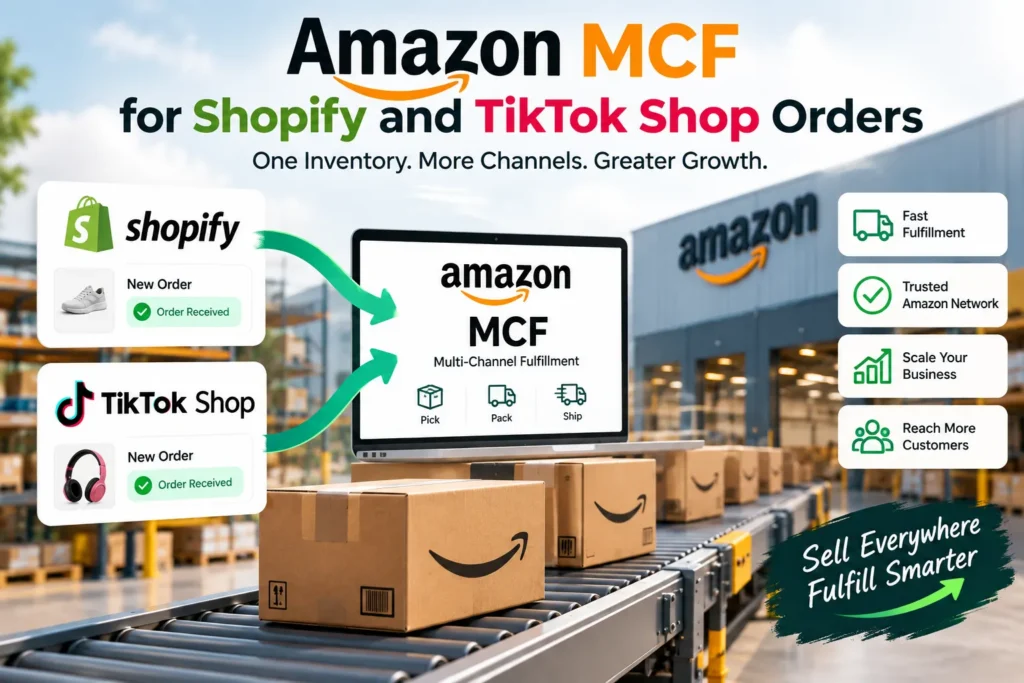
Amazon MCF ships Shopify and TikTok Shop orders from the same FBA inventory pool that serves Amazon listings, skipping the referral fee but charging a higher per-unit fulfillment fee. What it actually costs depends far more on order routing and discount eligibility than on the base rate card — and the biggest discount programs (including the 35% TikTok Shop rate) are US-only. UK sellers have access to MCF too, but under a separate rate card with different discount levers entirely.
Key Takeaways
- MCF and FBA draw from one shared inventory pool — nothing moves, nothing duplicates, no referral fee applies to off-Amazon sales
- Units per order is the biggest cost lever most sellers never pull — bundling into a 4-unit order can cut per-unit fulfillment cost by close to half
- The 35% TikTok Shop MCF discount requires attributed orders through a supported integration — manually keyed orders and unsupported connectors don’t qualify
- The legacy MCF Shopify app deactivates on a fixed date; migrating late costs the discount and then costs fulfillment entirely
- MCF operates in the UK too, but the 35% TikTok Shop discount and the US fuel surcharge are US-specific — UK sellers work from a separate GBP rate card with a different discount program (SIPP packaging)
- Bulky or heavy SKUs usually belong with a 3PL regardless of which channel sold them
How Amazon MCF Actually Works
Amazon Multi-Channel Fulfillment ships orders from Shopify, TikTok Shop, and other off-Amazon channels using the same FBA inventory already sitting in Amazon’s warehouses. Nothing physically moves and nothing gets duplicated — MCF and FBA draw from one shared pool and use the same picking and packing operation. The connection runs through an app or integration that passes each order into Amazon and returns a tracking number to the customer, effectively turning Amazon into a logistics provider for the whole catalog rather than just Amazon-originated sales.
| What changes | FBA | Amazon MCF |
| Where the order starts | Amazon detail page | Shopify, TikTok Shop, other channels |
| Packaging | Amazon-branded | Unbranded by default |
| Referral fee | Charged | Not charged |
| Returns and service | Amazon owns it | The seller owns it |
The referral fee row is the one most operators miss when building their cost model. An off-Amazon sale skips that cut entirely, which is exactly why a Shopify order can out-earn an identical Amazon order even while carrying a noticeably higher fulfillment fee.
MCF is a last-mile service, not a full-service warehouse solution — it doesn’t handle inbound freight, customs clearance, FBA prep, branded unboxing, or reverse logistics. Some of those gaps close within Amazon’s own broader network; the rest genuinely need a separate partner, and that’s worth solving before committing a channel to MCF rather than discovering the gap mid-peak-season.
What Amazon MCF Costs in the US
MCF pricing is set by product size tier, shipping weight, units per order, and delivery speed, with two additional charges layered on top: a fuel and logistics surcharge, and a seasonal peak-period rate increase that applies during the fourth-quarter holiday window.
Units per order is the single biggest lever most sellers never pull. A small item shipped as a single unit costs meaningfully more per unit than the same item shipped as part of a 4-unit order — bundling can cut per-unit fulfillment cost by close to half for no cost beyond the packaging change itself.
Three US discount programs exist, and they don’t all stack:
| Program | Benefit | The catch |
| TikTok Shop promotion | Meaningful discount off Standard and Expedited rates | Attributed orders only, US addresses |
| Preferred Pricing | Tiered discount plus a per-unit FBA credit | Time- or volume-capped |
| New Seller Incentive | Discount on first block of units | One-time, new accounts only |
TikTok Shop orders replace the Preferred Pricing discount rather than stacking with it, though those units still count toward volume thresholds without draining the benefit cap — a nuance that trips up sellers running both programs simultaneously.
The TikTok Shop Discount and Why It Doesn’t Show Up
The word doing the real work in Amazon’s terms is attributed. An order has to reach MCF carrying explicit proof it originated on TikTok Shop, and that proof only travels through a supported integration partner — the promotion requires no enrollment, which is exactly why so many sellers assume they already have it and are confused when the discount doesn’t apply.
Three causes account for nearly all the failures: orders keyed in manually through Seller Central are explicitly excluded from eligibility, an unsupported or improperly configured connector strips the channel attribution field before it reaches Amazon, and legacy fulfillment apps in some cases don’t pass origin data at all. If a discount that should be applying isn’t showing up, the integration path — not the order itself — is almost always where to look first.
UK Sellers: MCF Exists, But the US Discounts Don’t Travel
This is the section a US-focused MCF guide has no reason to include, and it matters directly for any brand running both Amazon.com and Amazon.co.uk fulfillment.
MCF is genuinely available in the UK (alongside several other international marketplaces), running on the same core mechanic — shared inventory pool with FBA, no referral fee on off-Amazon sales, unbranded packaging by default. But the fee structure and discount programs are meaningfully different:
- The 35% TikTok Shop discount is explicitly US-address-only. A UK seller running TikTok Shop orders through MCF should not expect this discount to apply, regardless of integration quality — it’s scoped to the US promotion specifically, not a global MCF benefit.
- The 3.5% US fuel and logistics surcharge does not apply to UK MCF fees. UK sellers work from a separate rate card, priced in GBP, without this particular US-specific line item.
- UK sellers have their own discount lever the US version underuses: SIPP (Ships in Product Packaging). Enrolling eligible ASINs in SIPP — shipping in original manufacturer packaging rather than an added Amazon box — earns a fulfillment fee reduction that scales by size tier (roughly 5% on small standard items, up to around 10% on oversize items), while also reducing packaging waste. This is a real, currently-available discount lever that a US-only playbook wouldn’t surface, since SIPP economics work differently at US vs. UK size-tier fee structures.
- UK Preferred Pricing works similarly to the US version (tiered discounts by volume) but is calculated against UK-specific thresholds and rates — a brand’s US volume tier has no bearing on UK eligibility.
Practical takeaway for multi-marketplace sellers: build separate MCF cost models per marketplace rather than assuming a US per-unit cost estimate transfers to the UK operation. A brand that’s optimized US TikTok Shop routing for the 35% discount needs an entirely different optimization target on the UK side — SIPP enrollment and UK Preferred Pricing tier management, not TikTok attribution.
MCF vs. 3PL: The Real Decision Factors
This decision is rarely made at the brand level — it’s made per SKU. Four factors settle it: unit economics after surcharges, the delivery promise the selling channel makes, whether branded packaging matters to the offer, and how frequently the item gets returned.
| Decision factor | Amazon MCF wins | A 3PL wins |
| Order volume | Below a 3PL minimum that can’t be filled | Steady volume that earns negotiated rates |
| Product size | Small and large standard | Bulky, heavy, or oversized |
| Packaging | Plain box is acceptable | Branded unboxing drives repeat purchase |
| Returns | Low return rate | High return rate needing inspection |
| Destination | Domestic orders | International, freight, or customs-heavy |
Standard-size domestic orders usually favor MCF, since the brand is reusing fulfillment infrastructure it already funds through FBA. The math flips quickly on bulky items — a large, heavy order can start well above what a 3PL with negotiated carrier rates would charge for the same shipment.
Setting Up MCF for Shopify (Step by Step)
Setup takes roughly an afternoon, and the failure points are predictable.
- Connect the Amazon selling account inside the relevant fulfillment/integration app
- Map Shopify SKUs to Amazon SKUs individually — there’s typically no bulk mapping tool
- Build a dedicated shipping profile and map each shipping rate to an MCF delivery speed
- Automate order submission through Shopify’s automation tools or automatic fulfillment settings
- Set fulfillment priority correctly in Shopify’s order routing so the right fulfillment method fires first
- Place a test order and confirm it appears correctly in Seller Central before going fully live
Two constraints worth writing into a standard operating procedure: MCF typically rejects orders above certain unit/SKU-count thresholds per order, and inbound stock is invisible to fulfillment apps until Amazon has actually received and processed it — a shipment “in transit” doesn’t yet count as fulfillable inventory.
Measuring Whether MCF Is Paying Off
Fulfillment decisions tend to get made on assumptions and reviewed only once the invoice arrives — which is backwards. Track five numbers on a fixed schedule instead:
- Landed fulfillment cost per unit, by channel and by marketplace
- Discount capture rate against eligible units
- Peak-period cost variance against a pre-peak baseline
- Dispatch/delivery rate against each channel’s required SLA
- Days of supply by child ASIN
Weekly during peak season, monthly the rest of the year. Pull actual fees from the relevant payments export rather than trusting the published rate card alone, and confirm discount application in the fulfillment dashboard directly — the rate card shows what should apply, not necessarily what did.
FAQs About Amazon MCF
1 . Does Amazon charge a referral fee on MCF orders?
No — since the sale didn’t happen on Amazon, only fulfillment and storage fees apply. This is the core reason an off-Amazon channel can carry a higher fulfillment fee per unit and still net more than an equivalent Amazon-originated sale.
2 . Does Amazon MCF ship in unbranded packaging?
Unbranded is the default for off-Amazon channels at no extra charge, so the customer receives a plain box rather than Amazon-branded packaging.
3 . What happens to returns on MCF orders?
The seller owns the refund decision and the customer conversation throughout. Amazon will grade and restock a returned unit once it physically reaches a returns facility, but only after the seller generates the return label and the customer ships it back.
4 . Is Amazon MCF available outside the US?
Yes — MCF operates in the UK and several other international marketplaces, but under separate, marketplace-specific rate cards and discount programs. US-specific promotions like the 35% TikTok Shop discount do not automatically apply internationally.
5 . Why isn’t my UK MCF account showing the TikTok Shop discount?
That promotion is explicitly scoped to US addresses. UK sellers should look at SIPP (Ships in Product Packaging) enrollment and UK-specific Preferred Pricing tiers as the equivalent cost-reduction levers instead.
6 . Is Amazon MCF worth it for a $1M brand?
Often, yes, since the realistic alternative at that scale is frequently a 3PL minimum the brand can’t consistently fill. Run the comparison per SKU rather than per brand — a heavy or bulky item can lose money on MCF while a small standard item remains genuinely profitable through the same channel.
7 . Can Amazon see customer data through MCF?
Amazon receives the shipping details required to deliver the package. Brands that treat first-party customer data as a strategic asset should review the specific terms before routing significant direct-to-consumer volume through the network.
8. What happens if I don’t migrate off the legacy MCF Shopify app before it’s deactivated?
The legacy app stops working on a fixed deactivation date, and missing that window costs you twice: first the TikTok Shop discount stops applying because attribution runs through the supported integration, then fulfillment itself breaks once the app is fully shut off and orders stop routing to Amazon. Since the switch typically requires remapping SKUs and rebuilding the shipping profile from scratch, treat migration as a task to schedule now rather than something to handle after orders start failing.
9. Are there order size or unit limits on Amazon MCF?
Yes — MCF typically rejects orders above certain unit and SKU-count thresholds, so a large multi-item Shopify or TikTok Shop order can bounce back unfulfilled if it exceeds those caps. This matters most for bundle or multi-pack listings; test your highest-unit order configuration during setup rather than discovering the limit during a real customer order.
Get Your Channel Routing Priced Correctly
Amazon MCF ships Shopify and TikTok Shop orders from FBA stock a brand already owns, which is exactly why both channels can look deceptively cheap until the actual invoice arrives. Size tier, delivery speed, units per order, and — for multi-marketplace sellers — which country’s rate card and discount programs actually apply all decide the real per-unit cost.
Shipping Shopify and TikTok Shop orders through Amazon without knowing what either channel really costs per unit, in the US, UK, or both? Ecom Ranker’s Amazon account audit service prices channel routing before peak season does it involuntarily — or explore our full-service Amazon account management for ongoing multi-channel fulfillment strategy.