
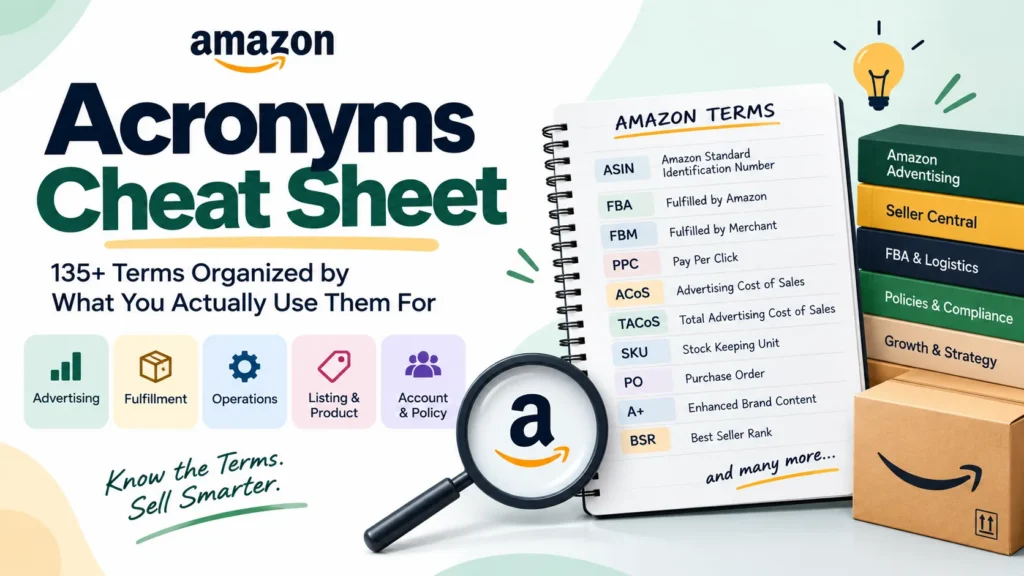
Amazon’s seller ecosystem runs on acronyms — ASIN, ACOS, FBA, ODR, and dozens more — and most cheat sheets just dump them alphabetically with no context. This one is organized by what you’re actually trying to do: set up fulfillment, manage advertising, protect your account health, or handle vendor terms. Jump to your category, find the term, and see why it actually matters to your business, not just what the letters stand for.
Key Takeaways
- This cheat sheet is organized by function, not the alphabet — fulfillment terms are grouped with fulfillment terms, advertising terms with advertising terms, so you can scan the section relevant to what you’re working on instead of hunting through 500 unrelated entries.
- Not every acronym deserves the same depth. High-stakes terms — ODR, AHR, ACOS, IPI — get a “why it matters” note explaining the business consequence, not just the expansion.
- A few terms are genuinely new for 2026 and won’t appear in older glossaries — flagged in their own section near the end.
- This covers Seller Central, Vendor Central, and Walmart Marketplace terms, since most brands scaling past a single channel run into all three vocabularies eventually.
How to Use This Cheat Sheet
Jump to the category matching what you’re working on:
Seller & Business Models · Fulfillment & Logistics · Listings & Catalog · Advertising & PPC · Performance & Account Health · Finance & Fees · Brand Protection & IP · Vendor Central · Walmart Marketplace · 2026-Current Terms
Seller & Business Models
| Acronym | Full Term | What It Means |
| 1P | First-Party (Vendor Central) | You sell wholesale directly to Amazon, and Amazon resells to customers as the retailer of record. |
| 3P | Third-Party (Seller Central) | You sell directly to customers on Amazon’s marketplace, controlling your own pricing, branding, and fulfillment. |
| 3PL | Third-Party Logistics | An outside company handling warehousing, prep, and shipping on your behalf. |
| B2B | Business-to-Business | Commerce between businesses, supported on Amazon via Amazon Business. |
| B2C | Business-to-Consumer | Standard commerce between a business and an individual shopper — most Amazon transactions. |
| DTC | Direct-to-Consumer | Selling directly to shoppers, typically via your own website, outside a marketplace. |
| OA | Online Arbitrage | Buying discounted products from other online retailers to resell on Amazon. |
| PL | Private Label | Products manufactured for you and sold under your own brand. |
| RA | Retail Arbitrage | Buying discounted products from physical retail stores to resell on Amazon. |
| VA | Virtual Assistant | A remote contractor handling operational tasks — listings, customer service, PPC — for your account. |
| WL | White Label | A generic product you brand as your own, typically without manufacturing customization. |
| WS | Wholesale | Buying established branded products in bulk to resell, rather than manufacturing your own. |
Fulfillment & Logistics
| Acronym | Full Term | What It Means |
| FBA | Fulfillment by Amazon | Amazon stores, picks, packs, and ships your inventory, and handles customer service and returns. |
| FBM | Fulfillment by Merchant | You handle storage, packing, and shipping yourself (also called MFN). |
| MFN | Merchant Fulfilled Network | Another name for FBM — seller-controlled fulfillment. |
| MCF | Multi-Channel Fulfillment | Using Amazon’s FBA network to fulfill orders that originated on other channels (your website, other marketplaces). |
| NARF | North American Remote Fulfillment | A program letting a single US FBA inventory pool fulfill orders across Canada and Mexico without separate inventory transfers. |
| EFN | European Fulfillment Network | The EU equivalent of NARF — one inventory pool serving multiple EU marketplaces. |
| AWD | Amazon Warehousing and Distribution | Amazon’s lower-cost, longer-term bulk storage option upstream of standard FBA fulfillment centers. |
| FC | Fulfillment Center | The physical warehouse where FBA inventory is stored and processed. |
| FNSKU | Fulfillment Network Stock Keeping Unit | The barcode Amazon uses to identify your specific inventory unit inside its fulfillment network. |
| SIPP | Ships in Product Packaging | A program certifying a product can ship in its original packaging without an added Amazon box. |
| FFP | Frustration-Free Packaging | Amazon’s easy-open, reduced-waste packaging certification program. |
| GTIN | Global Trade Item Number | The umbrella term for standardized product identifiers, including UPC and EAN. |
| UPC | Universal Product Code | The standard barcode identifier used primarily in the US and Canada. |
| EAN | European Article Number | The barcode standard used primarily in Europe. |
| GS1 | (Global Standards Organization) | The organization that issues and governs UPC/EAN/GTIN barcode standards. |
Listings & Catalog
| Acronym | Full Term | What It Means |
| ASIN | Amazon Standard Identification Number | The unique 10-character code Amazon assigns to every product in its catalog. |
| SKU | Stock Keeping Unit | Your own internal inventory identifier, distinct from the ASIN Amazon assigns. |
| PDP | Product Detail Page | The individual listing page a shopper sees for a specific product. |
| BSR | Best Sellers Rank | A product’s sales rank within its category, updated hourly — lower numbers mean better relative sales velocity. |
| CLR | Category Listings Report | A bulk report showing all your listings within a given category, used for large-scale catalog audits. |
| SQP | Search Query Performance | A Brand Registry report showing which search terms actually drive impressions, clicks, and purchases for your ASINs. |
| POE | Product Opportunity Explorer | A research tool surfacing customer demand data and gaps for potential new products. |
| MKL | Master Keyword List | An internally maintained spreadsheet of every keyword relevant to a product, used to guide listing copy and PPC targeting. |
Advertising & PPC
| Acronym | Full Term | What It Means |
| PPC | Pay-Per-Click | The advertising model where you’re charged only when a shopper clicks your ad. |
| ACOS | Advertising Cost of Sales | Ad spend divided by ad revenue — the core efficiency metric for a single campaign. Why it matters: a rising ACOS on a stable campaign is usually the first sign of increased competition or a listing conversion problem, not just an ad-strategy issue. |
| TACOS | Total Advertising Cost of Sales | Ad spend divided by total revenue (organic + paid) — shows how much your overall business depends on paid traffic. |
| CPC | Cost Per Click | The actual price paid each time a shopper clicks your ad. |
| ACPC | Average Cost Per Click | CPC averaged across a campaign or time period. |
| CTR | Click-Through Rate | Clicks divided by impressions — a signal of how compelling your ad creative and pricing are relative to the competition. |
| ROAS | Return on Advertising Spend | Total sales divided by total ad spend — the inverse framing of ACOS, often preferred in broader marketing contexts. |
| CPA | Cost Per Acquisition | The total ad cost to generate one converted sale. |
| ATC | Add to Cart | A mid-funnel conversion metric tracked in ad reporting, between click and purchase. |
| DSP | Demand-Side Platform | Amazon’s programmatic advertising platform, powering display and video ads both on and off Amazon. |
| SP | Sponsored Products | Keyword- or product-targeted ads that appear within search results and product pages. |
| SB | Sponsored Brands | Ads featuring your brand logo and multiple products, typically at the top of search results. |
| SD | Sponsored Display | Retargeting-style ads that follow shoppers based on browsing behavior, on and off Amazon. |
| ST | Sponsored TV | Amazon’s connected-TV advertising format. |
| BA | Brand Analytics | Registered-brand-only reporting on search terms, demographics, and comparison/basket data. |
Performance & Account Health
| Acronym | Full Term | What It Means |
| ODR | Order Defect Rate | The percentage of orders with a negative outcome (A-to-z claim, chargeback, negative feedback) — Amazon expects this under 1%. Why it matters: ODR is the single most consequential metric on this list — a sustained breach directly risks suspension, not just a warning. |
| AHR | Account Health Rating | Amazon’s 0–1,000 composite score reflecting overall policy compliance and performance history. Why it matters: unlike ODR, AHR factors in your entire violation history, not just current-period defects, making it the metric that determines eligibility for programs like Seller Fulfilled Prime. |
| IPI | Inventory Performance Index | A 0–1,000 score measuring how efficiently you manage FBA inventory (excess stock, sell-through, in-stock rate). Why it matters: falling below Amazon’s threshold can trigger FBA storage limits, directly capping how much inventory you’re allowed to send in. |
| NCX | Negative Customer Experience | Amazon’s internal tracking of signals indicating a poor buyer experience, feeding into broader account health assessments beyond ODR alone. |
| KPI | Key Performance Indicator | Any core metric used to track business performance — a general business term, not Amazon-specific. |
| CB | Chargeback | A payment reversal initiated by the buyer’s bank or card issuer, distinct from an Amazon-mediated refund or A-to-z claim. |
ODR climbing or unsure where your Account Health Rating actually stands? Our Amazon account audit breaks down exactly which metrics are driving risk before it becomes a suspension.
Finance & Fees
| Acronym | Full Term | What It Means |
| COGS | Cost of Goods Sold | The direct cost to produce or acquire the product you’re selling, before Amazon fees or advertising. |
| LP | List Price | The reference “regular” price shown alongside a discounted or deal price. |
| MAP | Minimum Advertised Price | A brand-set floor price that resellers and retailers agree not to advertise below. |
| ROI | Return on Investment | Net profit divided by the total cost invested — a general profitability metric. |
| VAT | Value-Added Tax | A consumption tax applied in the UK, EU, and other regions, distinct from US sales tax. |
| PO | Purchase Order | A formal order document, most commonly used in Vendor Central (Amazon purchasing wholesale from you) or B2B contexts. |
| OPS | Ordered Product Sales | Total dollar value of units ordered in a given period, a standard revenue-tracking metric in Seller/Vendor Central reporting. |
| CRAP | Can’t Realize a Profit | Informal industry shorthand for products whose margins have been squeezed to unprofitability by fees, competition, or rising costs. |
Brand Protection & IP
| Acronym | Full Term | What It Means |
| IP | Intellectual Property | Trademarks, patents, and copyrights — the legal basis for most brand-protection actions and takedown complaints on Amazon. |
| USPTO | United States Patent and Trademark Office | The federal agency issuing US trademarks, a prerequisite for standard Amazon Brand Registry enrollment. |
| LOA | Letter of Authorization | A document from a brand owner authorizing another party (reseller, manufacturer, agency) to act on their behalf, often required for gated-category approval. |
| COA | Certificate of Analysis | Lab-verified documentation of a product’s composition, increasingly required for supplement, cosmetic, and consumable categories. |
| MSDS / SDS | (Material) Safety Data Sheet | Documentation of a product’s chemical composition and safe handling, required for many restricted or hazardous categories. |
Vendor Central (1P)
| Acronym | Full Term | What It Means |
| VC | Vendor Central | The 1P platform where Amazon purchases inventory from you wholesale and controls retail pricing and the customer relationship. |
| PO | Purchase Order | Amazon’s formal order to you for inventory, the core transaction unit in the Vendor Central relationship. |
| MWS | Marketplace Web Services | Amazon’s legacy API framework for programmatic account access, largely superseded by the newer Selling Partner API (SP-API) but still referenced in older documentation and third-party tool integrations. |
Walmart Marketplace
| Acronym | Full Term | What It Means |
| WFS | Walmart Fulfillment Services | Walmart’s answer to FBA — Walmart stores, picks, packs, and ships your inventory. |
| MCS | Multichannel Solutions | Walmart’s equivalent of Amazon MCF — using the WFS network to fulfill orders originating from other channels. |
| VTR | Valid Tracking Rate | A Walmart seller performance standard tracking whether accurate, scannable tracking numbers are provided on time. |
| OTD | On-Time Delivery Rate | A Walmart performance standard measured through actual delivery, not just ship date — a notable contrast to how Amazon measures shipping performance. |
2026-Current Terms Worth Knowing
A handful of terms have become genuinely relevant only recently and won’t appear in older glossaries:
| Term | What It Means |
| AHR (Account Health Rating) | While the concept existed earlier, AHR has become the primary account-standing metric sellers monitor in 2026, alongside — and in some cases ahead of — the older individual metric dashboard. |
| Rufus | Amazon’s generative-AI shopping assistant, which surfaces product recommendations and answers shopper questions conversationally — increasingly relevant to how listing content should be optimized, since Rufus draws on listing copy differently than traditional keyword search. |
| New Seller Savings (Walmart) | Walmart’s 2026 tiered referral-fee discount program for new Marketplace sellers, referenced heavily in current Walmart seller content and worth knowing if you’re evaluating that channel for the first time. |
How We Built This Cheat Sheet
We prioritized organization and practical context over raw term count. Several existing Amazon glossaries run 400–500+ entries with flat, alphabetical, definition-only formatting — genuinely comprehensive, but often hard to scan when you’re trying to solve a specific problem right now. This cheat sheet groups terms by the workflow they belong to (fulfillment, advertising, account health, and so on) and adds a “why it matters” note to the small number of terms — ODR, AHR, IPI, ACOS — where the business consequence isn’t obvious from the expansion alone. For the full alphabetical universe of ecommerce and logistics terminology beyond Amazon-specific acronyms, a dedicated broad glossary is a better fit than this cheat sheet; this page is built specifically for working Amazon (and increasingly Walmart) sellers who need the terms that show up in Seller Central, Vendor Central, and advertising reporting.
Frequently Asked Questions
1 . What’s the difference between FBA and FBM?
FBA (Fulfillment by Amazon) means Amazon stores, ships, and handles customer service for your orders. FBM (Fulfillment by Merchant, also called MFN) means you handle all of that yourself.
2 . What’s the difference between ACOS and TACOS?
ACOS measures ad spend against ad-generated revenue only. TACOS measures ad spend against your total revenue, including organic sales, giving a broader view of how ad-dependent your business is.
3 . Is AHR the same thing as ODR?
No. Order Defect Rate (ODR) is one specific current-period metric. Account Health Rating (AHR) is a broader, composite 0–1,000 score reflecting your entire violation and performance history, not just current defects.
4 . What does 1P vs. 3P mean in practice?
1P (Vendor Central) means Amazon buys your product wholesale and controls retail pricing as the seller of record. 3P (Seller Central) means you sell directly to customers and control your own pricing and fulfillment.
5 . Do these acronyms apply the same way on Amazon UK and other international marketplaces?
Most core terms (ASIN, FBA, ACOS, ODR) apply identically across marketplaces. A few, like VAT, are region-specific rather than global.
6 . What’s the difference between UPC, EAN, and GTIN?
GTIN is the umbrella standard for product identifiers. UPC is the specific format used mainly in the US and Canada; EAN is the equivalent used mainly in Europe.
7 . Why does this cheat sheet include Walmart terms?
A growing number of Amazon sellers also sell on Walmart Marketplace, and several Walmart-specific acronyms (WFS, MCS, VTR) mirror Amazon concepts closely enough that including them side by side is more useful than a separate, disconnected glossary.
8 . How often is this cheat sheet updated?
Amazon and Walmart regularly introduce new programs and terminology, so this page should be treated as a living reference. The “2026-Current Terms” section specifically flags recently relevant additions.