
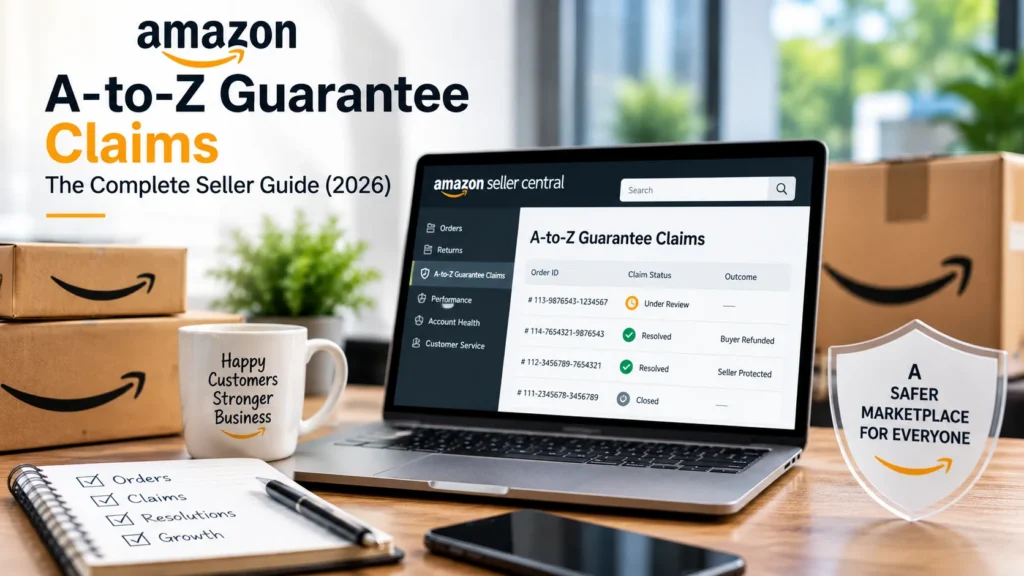
The Amazon A-to-z Guarantee lets buyers request a refund when an order doesn’t arrive, arrives damaged, or doesn’t match its listing — and Amazon changed how these claims actually get resolved. The old model had sellers respond directly to each filed claim within a set window. Amazon has since shifted toward reviewing the buyer-seller messaging and return-request history that happens before a claim is even eligible to be filed — meaning your 48-hour response habits now matter more than your claim-response habits.
Key Takeaways
- A-to-z claims cover six core situations: item not received, late delivery, damaged/defective item, wrong item, refund not issued, and overcharging.
- Amazon has shifted its resolution process. Rather than requiring a standalone “respond to the claim” step in every case, Amazon increasingly reviews the buyer-seller messaging and return-request activity that occurred before the claim was filed — which makes your 48-hour response time to buyer contact and return requests the real point of leverage now, not just your reaction to the claim notification itself.
- Granted claims hit your Order Defect Rate (ODR) — keep it under 1% or risk visibility loss and account health flags; withdrawn claims don’t count against you.
- You have 30 calendar days to appeal a claim decided against you, and appeals succeed most often when they include evidence Amazon didn’t see the first time, not a repeat of the original defense.
- FBM sellers carry more direct exposure than FBA sellers, since FBA shipping, packaging, and delivery execution is Amazon’s responsibility, which shifts much of the “item not received” and “late delivery” claim burden away from the seller.
What Is the A-to-z Guarantee, and Who Does It Apply To?
The A-to-z Guarantee is Amazon’s buyer-protection program for orders sold by third-party sellers. It exists to give buyers the same confidence shopping from a marketplace seller that they’d have buying directly from Amazon — if something goes wrong with a third-party order, Amazon steps in as the arbiter rather than leaving the buyer to negotiate resolution entirely on their own. It applies across virtually every product category sold on Amazon, and it applies whether the order was Fulfilled by Amazon (FBA) or Fulfilled by Merchant (FBM), though which party bears responsibility for a given claim often depends on which side controlled the step that failed.
The Six Situations That Qualify for a Claim
Buyers can file a claim when one of the following applies:
- Item Not Received — the order didn’t arrive within the delivery window Amazon considers reasonable (commonly a few days past the maximum estimated delivery date)
- Item Arrived Late — delivery happened, but after the promised window
- Damaged or Defective Item — the product arrived broken, faulty, or with missing parts
- Materially Different Item — what arrived doesn’t match the listing description, condition, or the item ordered
- Refund Not Issued — the buyer returned the item per policy but never received their refund
- Overcharged — the buyer was charged more than the price they authorized at checkout
Before any of these situations becomes claim-eligible, Amazon requires the buyer to have first attempted contact with the seller — through Buyer-Seller Messaging or a return request — and given the seller a response window (commonly cited around 48 hours) before escalating to a formal claim.
What Actually Happens When a Claim Is Filed — The Real 2026 Process
The Policy Shift Most Content Still Gets Wrong
Much of the content currently ranking on this topic — including guides published earlier in 2026 — describes a process where, once a claim is filed, the seller gets a fixed window (5 business days is the figure most consistently cited in Amazon’s own Pay/Seller documentation) to actively respond to the claim itself: issue a refund or submit evidence directly against that specific claim.
That framework is still broadly accurate for how sellers experience the process — but Amazon has separately announced a change to how it evaluates claims: rather than always requiring you to submit a fresh “Respond to Amazon” action after a claim is filed, Amazon’s review increasingly draws on the buyer-seller messaging and return-request history that occurred before the claim, alongside whatever you’ve already documented. In practice, this means the quality and speed of your response to the buyer’s original contact — not just your reaction after a claim exists — carries more weight than older guidance suggests. Because Amazon has been actively revising this workflow, always follow the specific instructions and deadline shown on your live claim notice in Seller Central rather than relying solely on general guidance, including this article.
The Response Window, Clarified
Several overlapping timeframes show up across seller guidance on this topic, and conflating them is a common mistake:
- 48 hours — the window buyers must generally give sellers to respond to their initial message or return request before a claim becomes eligible to file
- 5 business days — the response window most consistently documented for a seller to act once a claim notification has been issued (issue a refund or submit evidence)
- 30 calendar days — the window to appeal a claim decided against you
- 72 hours — appears in some sources and specific scenarios (particularly follow-up requests for additional information during an active investigation); treat this as a possible secondary deadline rather than the primary claim-response window, and confirm which applies from your actual claim notice
What Evidence Actually Wins a Claim
| Claim Type | Evidence That Matters Most |
| Item Not Received / Late Delivery | Valid tracking number with carrier and service class, order confirmation with shipping address and method, any buyer communication about delivery timing |
| Materially Different Item | Photos/video showing actual item condition at time of sale, the product detail page as it appeared at sale time, buyer communication clarifying the discrepancy |
| Refund/Return Disputes | Proof a return label was issued, your stated return policy, documented communication about the return/refund process |
| Overcharge | Order confirmation showing the agreed price including tax and shipping, any communication clarifying or resolving the charge |
Across all claim types, the common thread is documentation that existed before the dispute, not explanations written after the fact. Tracking numbers, timestamped messages, and product page snapshots carry far more weight than a well-written but undocumented account of what happened.
How A-to-z Claims Affect Your Account Health and ODR
A claim decided in the buyer’s favor counts against your Order Defect Rate (ODR) — the metric Amazon expects sellers to keep below 1%. A rising ODR can suppress visibility and, in sustained or severe cases, contribute to account health flags or suspension risk. A claim that’s withdrawn by the buyer does not count against your ODR, which is one reason resolving the underlying issue directly with the buyer — before they escalate to a formal claim — is worth prioritizing over waiting to see whether a claim gets filed at all. Refunds issued as a result of a granted claim are debited directly from your seller account balance, so beyond the ODR impact, there’s an immediate cash-flow consequence as well.
Watching your ODR climb from A-to-z claims and not sure if it’s putting your account at risk? Our Amazon account audit reviews your defect rate alongside the rest of your account health picture so you know exactly where you stand before it becomes a suspension issue.
How to Appeal a Claim Decided Against You
If Amazon rules in the buyer’s favor and you believe the decision was wrong, you have 30 calendar days to appeal from the point of decision:
- Go to Seller Central → Performance → A-to-z Guarantee Claims
- Locate the specific claim and select the option to appeal
- Upload evidence — ideally information Amazon didn’t have during the original review, since repeating the same evidence rarely changes the outcome
- Submit the appeal within the 30-day window
- Respond promptly if Amazon requests additional information to keep the appeal active
Successful appeals tend to share one trait: they introduce something new — updated tracking confirmation, a delivery signature Amazon didn’t have, additional buyer communication — rather than re-arguing the original case with the same facts.
Preventing A-to-Z Claims Before They’re Filed
- Respond to buyer messages and return requests within the response window — this is now the highest-leverage moment in the entire process, given the shift toward evaluating pre-claim communication
- Use trackable shipping on every order, FBM in particular, since untracked shipments make “item not received” claims nearly impossible to contest
- Keep listings accurate — condition, dimensions, and included contents should match exactly what ships, since “materially different item” claims are almost always a listing-accuracy problem in disguise
- Publish a clear, accessible return policy so buyers can self-serve a resolution instead of escalating to a claim
- Monitor Account Health regularly rather than reactively, so a pattern of late shipments or defects gets caught before it turns into a cluster of claims
FBA vs. FBM — Does Fulfillment Method Change Your Exposure?
| Factor | FBA (Fulfilled by Amazon) | FBM (Fulfilled by Merchant) |
| Shipping/delivery execution | Amazon’s responsibility | Seller’s responsibility |
| “Item Not Received” claim exposure | Lower — Amazon controls fulfillment and typically absorbs this risk | Higher — seller must prove tracking and delivery |
| “Damaged/Defective” claim exposure | Shared — depends on whether damage occurred pre- or post-Amazon handling | Higher — seller packed and shipped the item directly |
| “Materially Different Item” exposure | Same for both — this is a listing-accuracy issue, not a fulfillment one | Same for both |
| Response ownership when a claim is filed | Still requires seller documentation/evidence in most cases | Full seller responsibility |
FBA doesn’t eliminate A-to-z risk, but it does shift a meaningful share of the delivery-execution burden away from the seller — which is one reason listing accuracy (a seller-controlled factor regardless of fulfillment method) tends to be the more common root cause of claims for FBA sellers specifically.
How EcomRanker Helps Sellers Manage A-to-Z Risk
A-to-z claims are rarely random — they cluster around specific, fixable patterns: a listing that overstates condition, a shipping method without reliable tracking, or slow response times to buyer messages. As part of our Amazon account audit and Amazon SEO and listing optimization work, we look at claim patterns alongside ODR trends to identify the specific operational fix — not just the appeal — that stops a recurring claim source. If claims have already pushed your account into unhealthy territory, our account reinstatement guide covers the broader recovery process.
Want a review of what’s actually driving your A-to-z claim rate? Get in touch for an account health audit.
Frequently Asked Questions
1 . How long do buyers have to file an A-to-z Guarantee claim?
This varies by claim type and marketplace, but is commonly cited around 90 days after the maximum estimated delivery date for many claim categories. Always check the specific window that applies to your marketplace and claim type, since this detail varies.
2 . Do I still get a separate window to respond after a claim is filed?
In most cases, yes — 5 business days is the figure most consistently documented for responding once a claim notification is issued. However, Amazon has also signaled a shift toward weighing your pre-claim response history more heavily, so treat both the pre-claim 48-hour window and any post-claim response window shown on your notice as important.
3 . Does a withdrawn A-to-z claim affect my account?
No. A claim withdrawn by the buyer does not count against your Order Defect Rate or account health.
4 . Can fraudulent or bad-faith A-to-z claims still succeed against me?
Unfortunately, yes, in some cases, even with evidence submitted. This is a documented seller frustration point. Strong, timestamped documentation and prompt responses give you the best chance of a favorable outcome, and repeat suspicious claims can be reported to Seller Performance Support.
5 . How much time do I have to appeal a claim decided against me?
30 calendar days from the date of the decision.
6 . What’s the difference between a customer message/return request and a formal A-to-z claim?
A message or return request is a direct conversation between buyer and seller with no Amazon involvement in the outcome. A formal claim asks Amazon to review the situation and decide whether the buyer is owed a refund — it only becomes eligible after the buyer has given the seller a response window and the issue remains unresolved.
7 . Does an A-to-z claim affect my eligibility for Prime or FBA?
Yes, indirectly — a rising volume of granted claims raises your ODR, which can affect eligibility for programs like Seller Fulfilled Prime and contribute to broader account health concerns tied to FBA standing.
8 . Can I dispute a claim after Amazon has already refunded the buyer?
Yes, through the standard appeal process, within the 30-day window. An automatic refund issued because you didn’t respond in time doesn’t close the door on disputing the outcome afterward.
9 . Is FBA fully protected from A-to-z claims?
No. FBA reduces exposure to delivery-execution claims since Amazon controls shipping, but claims tied to listing accuracy (“materially different item”) apply regardless of fulfillment method, since that’s a seller-controlled listing issue, not a fulfillment one.
10 . What should I do if I suspect a buyer is abusing the A-to-z system?
Document everything — order details, communication, tracking — and submit it as part of your response or appeal. Repeat or clearly fraudulent claims from the same buyer can also be reported to Seller Performance Support.
11 . Does the A-to-z Guarantee process differ between Amazon.com and other Amazon marketplaces (UK, EU, etc.)?
The core structure is consistent globally, but specific deadlines, claim windows, and marketplace-level terminology can vary. Always confirm the exact rules for the specific marketplace where the order was placed.