
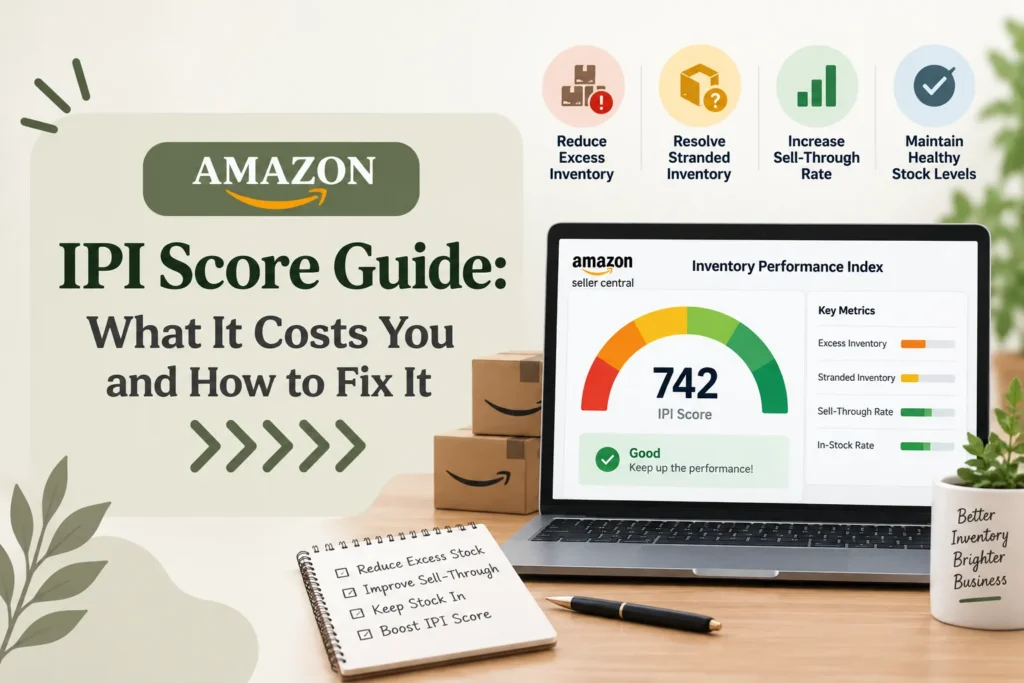
Your Amazon IPI score is a 0–1,000 rating of how efficiently you manage FBA inventory, and it directly controls how much storage capacity Amazon gives you. Amazon updates the number weekly, but the capacity decision that actually matters is checked over a 6-week window each quarter — meaning a bad single week rarely sinks you, but a sustained decline across that window can cap your storage right when you need it most.
Key Takeaways
- IPI ranges from 0 to 1,000 and is built from four metrics: excess inventory percentage, sell-through rate, stranded inventory percentage, and in-stock rate.
- Amazon checks your score weekly, but the capacity decision is based on a 6-week evaluation window at the end of each quarter — a detail most IPI content glosses over in favor of just saying “weekly.”
- The current minimum threshold is 400, though Amazon has changed this multiple times historically (350 at launch, up to 500 during 2020, back to 400 since) and can adjust it quarterly.
- A low score has a real, calculable dollar cost — not just “storage limits,” but a specific combination of higher fees and lost sales that’s worth modeling for your own account.
- New ASINs are generally excluded from IPI for roughly their first 90 days, so a fresh launch won’t tank your score immediately.
- Stockouts don’t directly deduct IPI points, but they drag down your in-stock rate metric, which does.
What Is the Amazon IPI Score?
The Inventory Performance Index measures how efficiently you manage inventory stored in Amazon’s FBA network — specifically, whether you’re keeping enough stock of your best sellers, avoiding excess inventory that ties up warehouse space, and keeping your listings free of the kind of errors that strand otherwise-sellable stock. Amazon uses the score to decide how much storage capacity your account gets. A high score generally means more room to stock aggressively ahead of peak season; a low score means capped storage, blocked inbound shipments, and — in more severe cases — ASIN-level restock limits that throttle individual best sellers even when your overall account isn’t maxed out.
The Four Metrics That Determine Your Score
| Metric | What It Measures | Warning Signal | Fix |
| Excess inventory percentage | Units forecast to take 90+ days to sell | Cash tied up in overstock | Discount, advertise, or remove slow-moving units |
| Sell-through rate | Units sold vs. average units stored over 90 days | Below 0.5 | Raise velocity through promotions and PPC |
| Stranded inventory percentage | FBA units with no active listing | Sellable stock you can’t actually sell | Fix the listing error and relist promptly |
| In-stock rate | Availability of your top replenishable ASINs | Best sellers running out of stock | Reorder earlier and keep buffer stock |
Amazon doesn’t publish the exact weighting between these four metrics, but sell-through rate and excess inventory percentage are generally understood to carry the most weight. Read this table as a diagnostic rather than a checklist — each metric points to a specific, fixable root cause, not just a symptom to monitor.
The Evaluation Window Most Guides Get Wrong
Most content on this topic states that Amazon updates your IPI score weekly and leaves it there — which is accurate but incomplete. The number itself does refresh weekly, typically near the start of the week. But the decision that actually caps your storage capacity is based on your standing during a specific 6-week evaluation window at the end of each quarter, with any resulting limits applied the following quarter. This distinction matters practically: a single bad week doesn’t doom you, since it’s your performance across that sustained window that determines the outcome — but it also means you can’t fix a quarter’s worth of poor inventory management with a single strong week right before the evaluation period ends. Treat the score as a rolling trend to manage continuously, not a number to cram for right before quarter-end.
What a Good IPI Score Actually Looks Like
Amazon no longer publishes one universal numeric threshold — your Inventory Performance Dashboard shows your standing as one of four bands instead:
| Band | What It Means |
| Poor | Storage capacity capped |
| Fair | At risk of restrictions |
| Good | Healthy standing |
| Excellent | Full capacity, including peak-period benefits |
The numeric cutoff behind these bands can vary by account and category, so check your own dashboard rather than assume a fixed number applies universally. That said, the current minimum threshold most sellers should treat as a floor is 400, with 500+ generally considered a comfortably healthy target — historically, this threshold has moved between 350 and 500 over the program’s history, and Amazon reserves the right to adjust it quarterly based on fulfillment network capacity.
What a Low IPI Score Actually Costs You (Worked Example)
Most IPI content stops at “storage gets capped,” without putting a number on what that actually means for a seller’s bottom line. Here’s a simplified illustration:
| Factor | Healthy IPI (550+) | Low IPI (below 400) |
| FBA storage capacity | Full capacity, unrestricted inbound shipments | Capped cubic-foot limit; inbound shipments blocked once exceeded |
| Restock limits | None | ASIN-level restock limits can throttle individual best sellers |
| Long-term storage fees | Minimal — inventory turns before aging into penalty territory | Higher — aging stock accumulates penalty fees the longer it sits |
| Lost sales from stockouts | Rare — buffer stock maintained on top sellers | Common — restock limits on best sellers directly cause stockouts, and Amazon’s own “estimated FBA lost sales” metric quantifies this directly |
The two costs that compound each other here are worth isolating: long-term storage fees on aging excess stock, and lost sales from restock limits hitting your actual best-selling ASINs — the products where a stockout costs the most in absolute revenue terms. A seller sitting comfortably in the “Excellent” band avoids both; a seller capped below 400 often pays more in storage for the stock they’re stuck holding while simultaneously losing revenue on the stock they can’t get enough of. Modeling both sides against your own numbers — not just the score itself — is what makes IPI management a genuine profit lever rather than an abstract compliance metric.
How to Check Your IPI Score
- Log in to Seller Central and open the Inventory Performance Dashboard. Your current score sits at the top.
- Review the four metric breakdowns below the score and note which one is red or trending downward.
- Open Manage Inventory Health to see excess, stranded, and slow-moving SKUs listed by name — this is where the score becomes actionable rather than just a number.
- Check early each week, since Amazon refreshes the score weekly and a monthly check-in cadence reacts too slowly to catch a declining trend before it affects the quarterly evaluation window.
How to Improve a Low IPI Score
- Reduce excess inventory. Aim to hold roughly 30–60 days of forward cover; beyond 60 days, advertise more aggressively or discount to move stock. Avoid deep, permanent markdowns that train customers to expect them going forward — Amazon Outlet and Multi-Channel Fulfillment to your own website are both viable outlets for genuinely excess stock without permanently repricing your core listing.
- Avoid long-term storage fees by setting up automatic removal of aging inventory before it approaches the 365-day mark in a fulfillment center.
- Fix stranded listings immediately. Stock sitting at a fulfillment center with no active listing earns nothing while still costing storage — this is pure waste and usually the fastest metric to fix once identified.
- Keep top ASINs in stock. Reorder before your historical days-of-supply drops below roughly 28 days on replenishable best sellers, since a stockout on a top seller both triggers potential low-inventory fees and drags down organic rank independent of the IPI impact itself.
How Long Does Recovery Actually Take?
Because the score updates weekly but the capacity decision is based on a 6-week evaluation window, meaningful recovery isn’t instant even after you fix the underlying issues. A stranded listing fixed today can improve that specific metric within days, but a sell-through rate problem — built up from months of overstocking — takes sustained improvement across multiple weeks to meaningfully shift, since the metric is calculated against a 90-day rolling average, not a snapshot. Practically: expect visible movement in your weekly score within 1–2 weeks of a genuine fix, but expect the full quarterly capacity impact to take a full evaluation cycle to reflect the improvement.
Does IPI Work the Same Way Across Marketplaces?
The core IPI mechanics apply across Amazon marketplaces, including the UK and EU, though the program’s threshold history has diverged by region at points — European sellers, for instance, saw a temporary threshold increase to 400 in 2020 tied to pandemic-era capacity constraints, on a different timeline than other marketplaces at that point. In practice, this means the underlying discipline (managing excess stock, avoiding stranded listings, maintaining in-stock rate on top sellers) transfers directly across US, UK, and other marketplaces, but the specific numeric threshold and any temporary adjustments should be checked per marketplace rather than assumed to move in lockstep everywhere.
How EcomRanker Manages Inventory Health
Inventory health sits at the intersection of profitability and organic rank — a capped IPI score doesn’t just cost storage fees, it directly limits your ability to keep best-sellers in stock, which affects both revenue and ranking simultaneously. As part of our Amazon Seller Central Management work, we review inventory health alongside advertising and listing performance so a restock-limit situation gets caught and modeled against actual dollar impact, not just flagged as a dashboard warning. During tight restock periods, we coordinate PPC pacing to protect organic rank on constrained ASINs while supply rebuilds, rather than treating advertising and inventory as separate problems.
Want your IPI trend reviewed against the actual cost it’s creating for your account? Get in touch for an inventory health audit.
Frequently Asked Questions
1 . What is a good IPI score on Amazon?
Amazon shows your standing as one of four bands (Poor, Fair, Good, Excellent) rather than a single published threshold, but 500 or above is generally treated as a healthy target, with 400 as the current minimum floor most sellers should avoid falling below.
2 . How often does Amazon update the IPI score?
The number itself updates weekly, typically near the start of the week. However, the capacity-limiting decision is based on your standing across a 6-week evaluation window at the end of each quarter, not the weekly number alone.
3 . Do stockouts lower my IPI score directly?
Not directly — Amazon doesn’t deduct IPI points specifically for running out of stock. But a stockout on a top replenishable ASIN drags down your in-stock rate metric, which does factor into the overall score, and separately triggers lost-sales impact and organic rank loss.
4 . Do new product launches hurt my IPI score?
Generally no. New ASINs are excluded from the IPI calculation for roughly their first 90 days, so a fresh launch won’t immediately affect your score.
5 . Do removals or liquidations count against my IPI score?
No. Removal and liquidation orders don’t count against your IPI score.
6 . How long does it take to improve a low IPI score?
Visible weekly score movement can appear within 1–2 weeks of a genuine fix, but the full quarterly capacity impact typically takes a complete evaluation cycle to reflect the improvement, since metrics like sell-through rate are calculated against a 90-day rolling average.
7 . What actually costs the most when my IPI score is low?
Two compounding costs: higher long-term storage fees on aging excess stock you can’t move, and lost sales from restock limits hitting your actual best-selling ASINs — often the more expensive of the two in absolute revenue terms.
8 . Does the IPI score work the same way in the UK as it does in the US?
The core mechanics and metrics are consistent, but the specific numeric threshold has diverged by region at points historically (for example, European sellers saw a temporary threshold change in 2020). Check your own marketplace’s current threshold rather than assuming it matches exactly.
9 . Where do I check my IPI score in Seller Central?
Open the Inventory Performance Dashboard, found under Inventory > Inventory Planning > Performance. Your current score appears at the top, with the four contributing metrics broken out below it.