
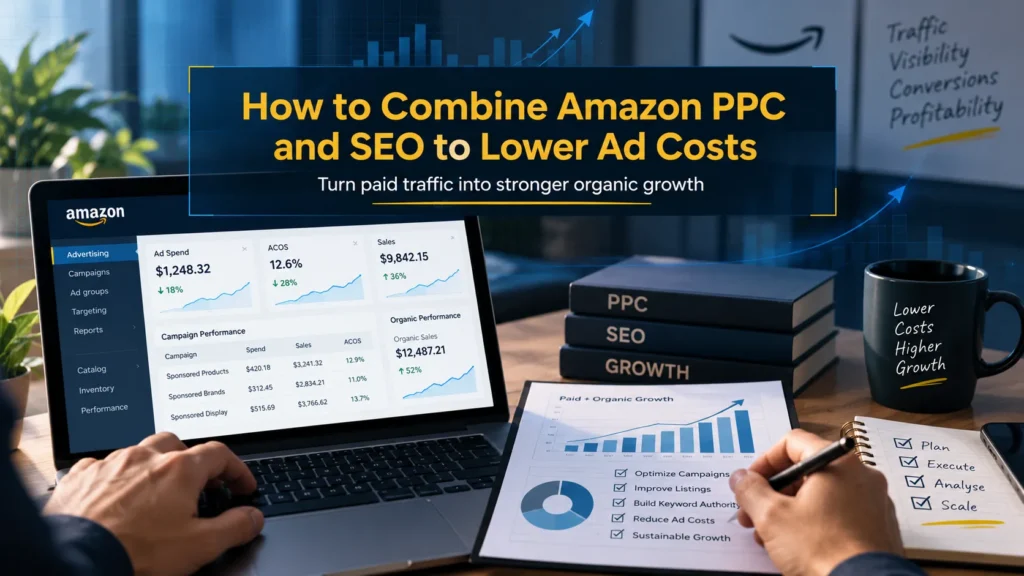
Combining Amazon PPC and SEO means funding one keyword strategy from one budget instead of running paid and organic as separate lines. Amazon doesn’t care whether a sale came from an ad or an organic click — both send the same ranking signal. Ad spend on a keyword you don’t yet own is an investment; ad spend on a keyword your listing already wins organically is a tax. Allocating budget by organic rank tier, not a fixed percentage, is how you tell the two apart.
Key Takeaways
- Fund one keyword strategy from one budget — paid and organic answer to the same algorithm
- Report TACOS, organic click share, and contribution margin to finance; keep ACOS in the weekly operator review
- Allocate PPC budget by organic rank tier, not a fixed percentage of sales
- Find your overlap in Search Query Performance: high organic click share + high ad spend on the same term is money being spent twice
- Only cut bids after three conditions hold together: page one, four consecutive weeks, and organic click share above ~40%
- If you sell in both the US and UK, build separate rank-tier models for each — a #1 US ranking can sit well outside page one on Amazon.co.uk for the identical listing
Why Paid and Organic Belong in One Budget
Amazon’s ranking system rewards relevance, conversion, and sales velocity — and it doesn’t distinguish a paid sale from an organic one when generating that signal. That’s the whole argument for treating PPC and SEO as one budget rather than two: ad spend that buys rank you don’t have is an investment, while ad spend on a term your listing already wins for free is closer to a tax on revenue you’d have gotten anyway.
The reason ACOS can look fine while TACOS quietly climbs comes down to what each metric ignores. ACOS grades a single campaign and has no visibility into organic revenue at all — campaigns can look perfectly efficient while advertising eats a growing share of every dollar sold. A healthy TACOS for a mid-market brand generally sits in the 8%–12% range; sitting well above that for two consecutive quarters usually means a brand is renting rank it already earned instead of buying rank it doesn’t have.
Two things get labeled “keyword cannibalization,” and only one actually costs money. Running the same keyword across multiple campaigns is harmless under Amazon’s auction mechanics. The expensive kind is sales cannibalization — paying for a click the listing would have won organically without the ad running at all.
Three beliefs quietly cost the most margin, and each sounds reasonable in a budget meeting: treating SEO as “free” when it actually costs copy, imagery, and A+ Content investment; assuming a lower ACOS always means better performance, when it often just means less volume; and assuming cutting bids automatically lowers TACOS, when a badly timed cut usually raises it — bids drop, clicks and conversions fall, velocity slows, and organic rank slips until organic sales shrink faster than the spend that was saved.
Allocating Budget by Organic Rank Tier
Allocate against organic rank, not a fixed percentage. The right spend posture for a keyword you don’t rank for at all is the wrong posture for one already sitting at position two.
| Organic rank for the keyword | PPC posture | Where the next dollar goes |
| Not indexed, or page 3+ | Fund discovery and exact match aggressively | PPC |
| Page 2 through position 15 | Hold bids steady, harvest search terms | Split evenly |
| Page 1, positions 4–14 | Trim bids in 10% steps, watch weekly | SEO and conversion work |
| Page 1, positions 1–3 | Defensive spend only, protect the placement | SEO upkeep and new terms |
Read this as a portfolio, not a per-ASIN rule — a 300-SKU catalog sits in all four rows simultaneously, and the real budgeting question is how much revenue currently lives in each row.
As a starting position (not a destination), roughly 10% of sales toward PPC and 3% toward SEO is a common industry baseline — move off it as fast as rank data allows. It breaks down in three common situations: a brand with strong rank but weak listings tends to overspend on PPC, a brand launching into a new category tends to overspend on SEO relative to what a mature catalog needs, and a brand in a high-CPC category may find 10% simply can’t buy enough clicks to gather usable data. In every case, the fix is the same: check the actual rank distribution before arguing about the percentage.
A useful secondary target: aim for roughly twice as many indexed keywords as actively advertised ones. Indexing costs nothing per click; bidding does. A ratio closer to 1:1 usually means a brand is advertising its way around an indexing/listing gap rather than fixing it directly — closing that gap first stretches the same ad budget further before a single bid changes.
Multi-Marketplace Sellers: Your US Rank Doesn’t Transfer to the UK
This is the piece a single-marketplace framework has no reason to cover, and it matters directly for how the rank-tier table above should actually be built if a brand sells in both the US and UK.
Amazon’s US and UK marketplaces run entirely separate search indexes.
A product ranking #1 organically on Amazon.com can rank meaningfully lower — sometimes well outside page one — on Amazon.co.uk for the exact same listing content, because ranking reflects local sales velocity, local conversion history, and local search behavior, none of which carry over between marketplaces. Keyword volume and even terminology differ too (UK shoppers search “trainers,” not “sneakers”; “nappies,” not “diapers”), so a keyword sitting at position 2 in the US might not even be the primary search term a UK shopper types.
What this means practically:
the rank-tier allocation table above needs to be built once per marketplace, not once per brand. A SKU can legitimately sit in the “defensive spend only” row on Amazon.com while sitting in the “fund discovery aggressively” row on Amazon.co.uk for the identical product — and blending both marketplaces into one PPC/SEO budget will systematically under-fund whichever marketplace is earlier in its ranking curve. If reporting currently rolls US and UK ad spend into one blended TACOS figure, that number is very likely obscuring a real allocation problem in one of the two markets.
How to Cut Bids Without Losing Rank
Moving money from paid to organic is where most brands lose rank they spent months or years earning. Treat every reduction as a test, not a decision.
Step 1: Find the overlap. Pull organic click share by query from Search Query Performance (filtered to the correct marketplace — see above) and compare it against ad spend on the same term. High organic click share plus high ad spend on the same query is the actual overlap worth testing, and it’s usually a shorter list than expected.
Step 2: Confirm three conditions together, not just one. Page-one placement, four consecutive weeks holding that placement, and organic click share above roughly 40% for that specific query. Any single condition on its own is noise — rank moves week to week, and cutting spend on a placement held for six days is a fast way to hand rank back to a competitor.
Step 3: Test in small, measured steps. Drop bids by 10%, hold for two weeks, and watch total units, not just ad units. If total units hold, repeat the 10% cut. If organic rank slips or total units fall, restore the bid and wait another month before trying again — gradual reductions after reaching page one are the only reliable way to find the actual floor without paying to rediscover it the hard way.
Almost never cut a top-three keyword’s spend to zero, even at position one. A sponsored slot sitting above an already-strong organic slot takes two placements off the page for competitors entirely — reduce it, don’t eliminate it. Defensive spend on a top-three term is cheap insurance against the far higher cost of winning that position back after losing it.
What to Report to Finance (Not ACOS)
Stop reporting ACOS upward — it answers a campaign-level question, not a business-level one. Finance needs to know whether advertising is buying growth or quietly subsidizing sales that would have happened anyway.
| Cadence | Owner | The question it answers |
| Weekly | PPC manager | Which campaigns need bid or negative-keyword changes |
| Monthly | Ecommerce lead | Is organic click share rising on the top 50 terms (per marketplace) |
| Quarterly | Finance/CFO | Is TACOS trending toward the actual margin target |
Forecast next quarter’s ad spend from the current rank distribution, not last quarter’s spend plus a flat percentage bump. Count the revenue sitting in each row of the rank-tier table and apply the posture that row calls for — this produces a number that’s defensible line by line, and it makes listing investment legible to finance because every dollar maps to a specific tier a keyword is expected to graduate into.
Plan on one to two full quarters before meaningful SEO work visibly moves the ad-spend line — listing changes need indexing, then traffic, then a real conversion history before Amazon’s system trusts the page enough to rank it consistently. Anyone promising faster movement is generally selling a bid cut dressed up as a strategy.
Mistakes That Turn a Reallocation Into a Rank Collapse
Every one of these shows up regularly in accounts inherited after a quarter of chasing a TACOS number by cutting spend too aggressively:
- Cutting more than 10% in a single move
- Acting on a single week of data instead of a sustained trend
- Pulling spend off defensive and branded terms specifically
- Reallocating during Q4 or an active launch window
- Treating every keyword in the catalog identically, regardless of rank tier or marketplace
FAQs About Combining Amazon PPC and SEO
1 . Can Amazon SEO actually reduce my advertising spend?
Yes, once organic rank is strong enough to carry the clicks a business no longer needs to buy. A stronger listing also raises conversion rate directly, which lowers cost per click before a single bid is touched.
2 . How do I know if my ads are cannibalizing organic sales?
Compare organic click share against ad spend for the same query in Search Query Performance — any term scoring high on both is a real candidate for a bid-reduction test.
3 . What’s a healthy TACOS for a mid-market Amazon brand?
Most categories settle in the 8%–12% range, but the real ceiling should come from contribution margin — a 45%-margin brand and a 20%-margin brand can’t sustainably carry the same number.
4 . What organic rank should I hit before cutting ad spend?
Page one, held for four consecutive weeks, with organic click share above roughly 40%. Anything short of all three conditions together is premature.
5 . Should I stop PPC entirely once I hit page one?
No — reduce it instead. Defensive spend protects the placement and costs far less than winning back a position lost to a competitor.
6 . Does hitting page one in the US mean I’ll rank well in the UK too?
No. Amazon.com and Amazon.co.uk run entirely separate search indexes with independent ranking history, so US rank provides no guarantee of UK rank for the identical listing — each marketplace needs its own rank-tier budget model.
7 . How do I budget PPC and SEO together across two marketplaces?
Build a separate rank-tier allocation table for each marketplace rather than one blended budget — a SKU can legitimately need aggressive PPC funding in one market while needing only defensive spend in the other.
Find Your Overlap
Amazon reads a paid sale and an organic sale as the same signal, which is exactly why budgeting them as two separate lines lets ad spend outrun revenue. Allocate against organic rank per marketplace instead of a fixed percentage, and the money follows keywords that still genuinely need buying rather than the ones already owned.
Watching Amazon ad spend climb while nobody can fully explain where the money is going, across one market or two? Ecom Ranker segments spend against organic rank to show exactly which keywords are being paid for twice — see our Amazon PPC management services or our Amazon SEO services for US and UK accounts.