
Understanding the difference between Amazon profit vs revenue is one of the most critical aspects of running a successful Amazon business. Many sellers focus only on revenue numbers, assuming higher sales automatically mean higher earnings. However, this is one of the biggest misconceptions in eCommerce.
Revenue represents the total money generated from sales, while profit is the actual money you keep after deducting all expenses. Without a clear understanding of both, sellers often overestimate their business performance and struggle with profitability despite strong sales numbers.
In this guide, we will break down the difference between Amazon revenue and profit, how to calculate both accurately, and how to optimize your business to increase real earnings.
What Is Amazon Revenue?
Amazon revenue refers to the total sales generated from your products before any costs or expenses are deducted. It is the gross income your business earns from selling products on Amazon.
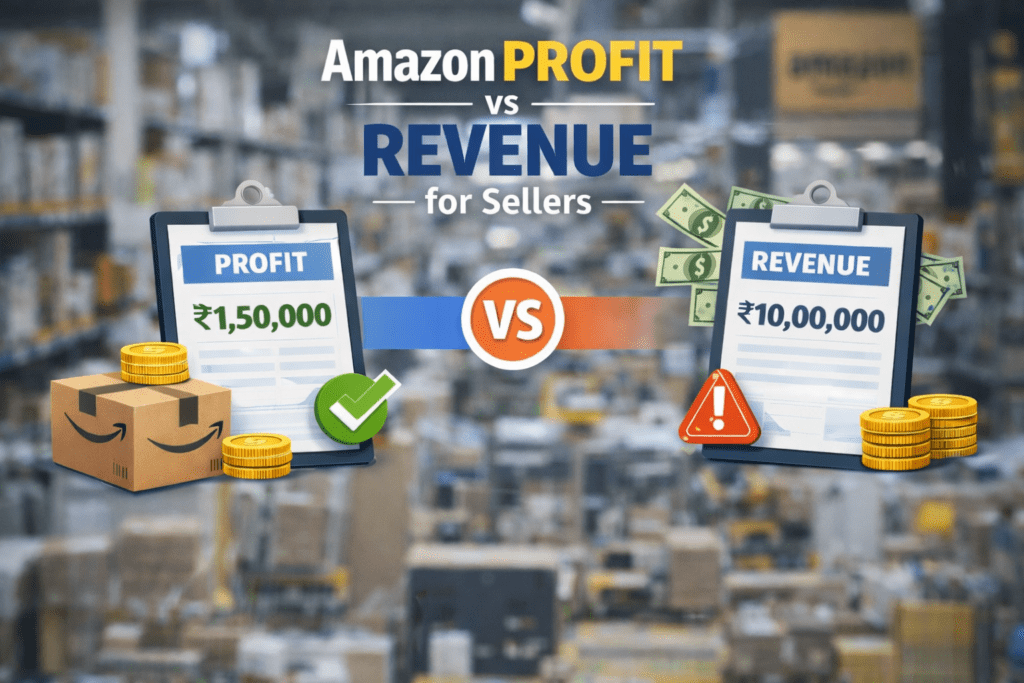
For example, if you sell 1,000 units of a product at ₹1,000 each, your total revenue would be ₹10,00,000. This number looks impressive, but it does not reflect how much you actually earn.
Revenue is important because it indicates demand, sales performance, and growth potential. However, it does not provide insights into profitability.
What Is Amazon Profit?
Amazon profit is the actual earnings you retain after subtracting all business expenses from your total revenue. This is the real measure of your business success.
Expenses that affect profit include:
- Product cost (manufacturing or sourcing)
- Amazon referral fees
- FBA fees (storage, fulfillment, shipping)
- Advertising costs (PPC spend)
- Packaging and logistics
- Returns and refunds
- Taxes and other operational costs
Profit shows how efficiently your business is running and whether your strategies are sustainable.
Complete Breakdown of Amazon Seller Costs
To accurately calculate Amazon profit, it is essential to understand all the costs involved in selling on Amazon. Many sellers underestimate expenses, which leads to incorrect profit calculations.
Major cost components include:
- Product manufacturing or sourcing cost
- Amazon referral fees (category-based)
- FBA fees (storage, fulfillment, shipping)
- Amazon PPC advertising costs
- Packaging and labeling expenses
- Returns and refund costs
- Storage and long-term inventory fees
- Taxes and compliance costs
A clear understanding of these costs helps sellers optimize their pricing and improve profit margins.
Amazon Profit vs Revenue: Key Difference
The difference between Amazon profit and revenue is simple but crucial.
- Revenue = Total sales generated
- Profit = Revenue – Total expenses
While revenue shows how much you sell, profit shows how much you actually earn.
Many sellers generate high revenue but have low profit margins due to high costs, poor pricing strategies, or inefficient advertising.
Amazon Profit vs Revenue – Detailed Comparison
| Aspect | Amazon Revenue | Amazon Profit |
|---|---|---|
| Definition | Total income generated from product sales on Amazon | Earnings left after deducting all costs and expenses |
| Formula | Revenue = Selling Price × Units Sold | Profit = Revenue – Total Expenses |
| Includes Costs | ❌ Does not include any costs | ✅ Includes all costs (fees, ads, product cost, etc.) |
| Purpose | Measures sales performance and growth | Measures actual earnings and business profitability |
| Importance | Indicates demand and market performance | Indicates sustainability and real success |
| Impact of Ads | Increases revenue through more sales | Can reduce profit if ad spend is high |
| Amazon Fees | Not deducted | Fully deducted (referral, FBA, storage, etc.) |
| Business Focus | Short-term growth | Long-term profitability |
| Misconception | High revenue = success | High profit = real success |
| Decision Making | Helps in scaling and expansion | Helps in cost control and efficiency |
| Risk Factor | Can be misleading if costs are high | Gives accurate financial picture |
| Example | ₹10,00,000 sales | ₹1,50,000 net earnings after expenses |
Why High Revenue Doesn’t Always Mean High Profit
One of the biggest mistakes Amazon sellers make is chasing revenue instead of profit. High sales numbers can be misleading if expenses are not controlled.
For example, a seller generating ₹10,00,000 in revenue but spending ₹9,00,000 on costs only earns ₹1,00,000 in profit. On the other hand, a seller with ₹5,00,000 revenue and ₹2,00,000 profit is running a more efficient business.
This is why focusing on profit margins and cost optimization is essential.
How to Calculate Amazon Profit
Calculating profit accurately helps you understand your business performance.
Basic Formula:
Profit = Revenue – Total Costs
Example:
- Revenue: ₹5,00,000
- Product Cost: ₹2,00,000
- Amazon Fees: ₹1,00,000
- Advertising: ₹50,000
- Other Costs: ₹50,000
👉 Profit = ₹1,00,000
This calculation helps you identify where your money is going and how to improve margins.
Understanding Profit Margins on Amazon
Profit margin is the percentage of revenue that turns into profit.
Formula:
Profit Margin = (Profit / Revenue) × 100
A healthy Amazon business typically has:
- 10–20% margin (average)
- 20–30% margin (good)
- 30%+ margin (excellent)
Higher margins indicate better efficiency and profitability.
Key Factors That Impact Amazon Profit
Several factors influence how much profit you make on Amazon.
1. Product Sourcing Cost
Lower sourcing costs improve profit margins significantly.
2. Amazon Fees
Referral fees and FBA costs directly reduce profit.
3. Advertising Spend
High PPC costs can eat into margins if not optimized.
4. Pricing Strategy
Incorrect pricing can either reduce sales or reduce profit.
5. Conversion Rate
Higher conversion rates reduce cost per sale.
How to Increase Amazon Profit (Without Increasing Revenue)
Increasing profit does not always require increasing sales. You can improve profitability by optimizing costs and efficiency.
Effective strategies include:
- Reducing Amazon PPC spend through optimization
- Improving listing conversion rates
- Negotiating better supplier pricing
- Optimizing logistics and shipping costs
- Reducing returns through better product quality
- Increasing average order value
These strategies help improve profit margins without relying on higher sales.
Revenue vs Profit Strategy: What Should You Focus On?
Both revenue and profit are important, but they serve different purposes.
Revenue is useful for scaling and market expansion, while profit determines sustainability and long-term success.
A balanced strategy focuses on:
- Growing revenue steadily
- Maintaining healthy profit margins
- Optimizing costs continuously
- Scaling only profitable products
This ensures long-term business growth.
Common Mistakes Sellers Make
Many sellers misunderstand profit and revenue, leading to poor decisions.
Common mistakes include:
- Focusing only on revenue growth
- Ignoring hidden costs
- Overspending on ads
- Poor pricing strategy
- Not tracking profit margins
Avoiding these mistakes can significantly improve your business performance.
Final Thoughts
Understanding Amazon profit vs revenue is essential for building a sustainable and profitable business. While revenue indicates growth, profit determines success.
The goal should not be to generate the highest sales but to maximize profitability. By focusing on cost optimization, efficient advertising, and strategic pricing, you can build a business that is both scalable and profitable.
Frequently Asked Questions
What is the difference between Amazon profit and revenue?
Revenue is total sales, while profit is what remains after deducting all expenses.
Why is profit more important than revenue?
Profit reflects actual earnings and business sustainability, while revenue only shows sales.
What is a good profit margin on Amazon?
A margin between 20–30% is considered good for most sellers.
How can I increase profit on Amazon?
By reducing costs, optimizing ads, improving listings, and increasing efficiency.