
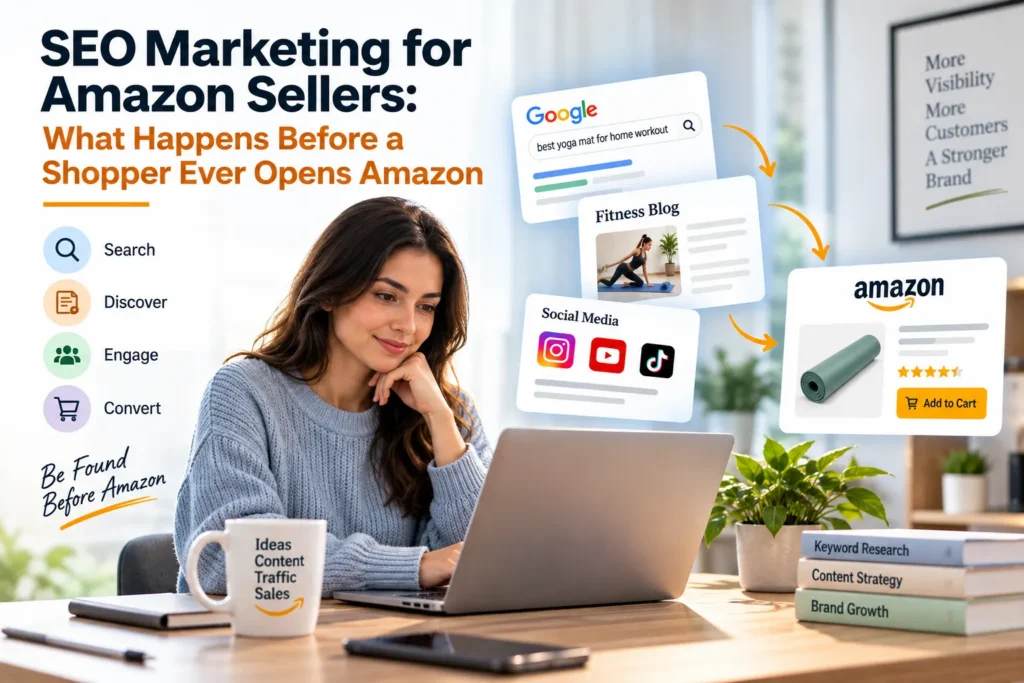
“SEO” means two different things depending on where it’s happening. Amazon SEO gets your listing ranked inside Amazon’s own search bar. SEO marketing — the broader discipline covering Google, your own website, and content — determines whether a shopper discovers your brand at all before they ever type anything into Amazon. Sellers who only think about the first kind are missing a growth channel that increasingly pays them directly.
Key Takeaways
- On-Amazon SEO and general SEO marketing are related but distinct disciplines — one optimizes for Amazon’s internal search algorithm, the other optimizes for Google and external discovery, and most sellers only invest in the first.
- Amazon’s Brand Referral Bonus program directly rewards off-Amazon SEO — traffic you drive to your Amazon listings from outside sources (including organic Google traffic to a linked page) can earn a referral fee discount, often around 10%.
- A brand’s own website ranking on Google creates a discovery path Amazon’s internal search can’t — shoppers researching a product category on Google encounter your brand before they’ve decided which specific product to search for on Amazon.
- Content marketing (blog posts, guides, comparison content) builds topical authority that compounds over time, unlike Amazon PPC spend, which stops producing traffic the moment you stop paying.
- AI search tools increasingly draw on web-wide signals, not just platform-specific data, meaning a brand’s broader off-Amazon SEO presence is becoming relevant to how AI shopping assistants perceive and recommend it, not just how Google ranks it.
Two Different Things Called “SEO” — and Why the Distinction Matters
| Factor | On-Amazon SEO | General SEO Marketing (Off-Amazon) |
| What it optimizes for | Amazon’s A9/A10 search algorithm | Google and other search engines |
| Where the content lives | Product titles, bullets, backend keywords, A+ Content | Your own website, blog, external content |
| What it drives | Rank within Amazon search results | Discovery before a shopper reaches Amazon at all |
| Primary lever | Conversion rate, sales velocity, keyword relevance | Backlinks, content depth, technical site health |
| Direct financial benefit | Higher organic Amazon sales | Can unlock Amazon’s Brand Referral Bonus fee discount |
Both matter, but they’re genuinely separate skill sets solving different problems. On-Amazon SEO is about winning the moment a shopper is already searching on Amazon. General SEO marketing is about earning the discovery that happens before that search — or replacing the need for the shopper to search on Amazon at all if they land directly on your product page from an external link.
Why Amazon Sellers Should Care About Google SEO
A shopper researching “best running shoes for flat feet” on Google is in an earlier, more open-minded stage of the buying journey than one already typing a specific product search into Amazon. If your brand’s own website ranks for that broader research query — through a blog post, buying guide, or comparison page — you’re introduced to that shopper before they’ve committed to a specific product or brand, and before they’re comparing you purely on Amazon’s price-and-review-driven search results page. This is functionally a different, earlier funnel stage than anything Amazon’s internal search can reach, since Amazon SEO only becomes relevant once a shopper is already searching within Amazon specifically.
The Brand Referral Bonus: Where Off-Amazon SEO Pays You Directly
This is the detail most sellers focused purely on Amazon SEO miss entirely: Amazon’s Brand Referral Bonus program rewards Brand Registry-enrolled sellers with a referral fee discount — commonly cited around 10% — on sales attributed to traffic driven from outside Amazon, including organic traffic from your own website. In practice, this means a well-optimized brand website that ranks on Google and links through to your Amazon listings isn’t just a discovery channel — it’s a direct, measurable fee reduction on every sale that traffic converts into. Set up attribution links correctly and this becomes one of the more concretely quantifiable returns on general SEO marketing investment available to an Amazon-first brand.
Content Marketing as an Amazon Growth Channel
Blog content, buying guides, and comparison pages on your own website build something Amazon PPC spend structurally can’t: a compounding, durable asset. A well-ranked blog post continues driving traffic for years without ongoing spend, while PPC traffic disappears the moment the budget stops. For Amazon-first brands, this content doesn’t need to be generic marketing fluff — a genuinely useful buying guide, ingredient/material explainer, or “how to choose” comparison piece both ranks on Google independently and builds the kind of category authority that makes your specific product the obvious choice once a reader does head to Amazon to buy.
SEO for AI Search: The Newest Layer
AI-driven search and shopping tools — both general AI assistants and Amazon’s own Rufus — increasingly draw on broader web signals, not purely platform-internal data, when generating recommendations or answering comparison questions. This means a brand’s general SEO marketing presence — clear, well-structured, factually specific content on its own website — is becoming relevant to how these AI systems perceive and potentially recommend the brand, in a way that’s genuinely separate from optimizing an Amazon listing’s bullets and backend keywords. This is an emerging consideration rather than a fully mature discipline yet, but it reinforces that off-Amazon content quality is not just a Google-ranking exercise — it may increasingly feed into how AI systems represent a brand across multiple discovery surfaces.
Where to Focus First With Limited Resources
Most Amazon-first sellers have finite time and budget, and can’t fully invest in both disciplines simultaneously from day one. A reasonable sequencing:
- If your Amazon listings aren’t yet converting well, prioritize on-Amazon SEO and listing optimization first — driving external traffic to an underperforming listing wastes the traffic.
- If your listings convert well but growth has plateaued, general SEO marketing (a brand website, content, off-Amazon discovery) becomes the more valuable next investment, since you’ve likely captured most of the easy on-Amazon search-based demand already.
- If you have some marketing budget but not enough for both, a small number of genuinely useful, well-researched content pieces on your own site tends to outperform a large volume of thin content — quality and depth compound better than volume in SEO generally.
How EcomRanker Builds SEO Marketing Around Amazon Sellers
We treat on-Amazon and off-Amazon SEO as connected parts of one system, not separate disciplines handled in isolation. Our Amazon SEO services cover the on-platform ranking work, while our broader ecommerce SEO and content strategy work extends that into Google visibility, Brand Referral Bonus setup, and content that builds durable, compounding traffic rather than relying purely on paid Amazon visibility.
Want a read on whether off-Amazon SEO is a worthwhile next investment for your specific brand? Get in touch for a growth-channel review.
Frequently Asked Questions
1 . Is Amazon SEO the same thing as SEO marketing?
No. Amazon SEO specifically optimizes listings to rank within Amazon’s internal search algorithm. General SEO marketing covers Google and external search, typically through a brand’s own website and content, and addresses an earlier stage of the shopper’s discovery journey.
2 . Does my brand need its own website if I only sell on Amazon?
Not strictly, but a website that ranks on Google creates a discovery path Amazon’s internal search can’t reach, and it’s required to participate in Amazon’s Brand Referral Bonus program, which offers a real fee discount on externally-driven traffic.
3 . What is Amazon’s Brand Referral Bonus program?
A program for Brand Registry-enrolled sellers that offers a referral fee discount, commonly cited around 10%, on sales attributed to traffic driven to Amazon from outside sources, including a seller’s own website.
4 . Should I invest in Amazon SEO or general SEO marketing first?
If your Amazon listings aren’t converting well yet, prioritize on-Amazon SEO and listing optimization first. If your listings already convert well and growth has plateaued, general SEO marketing becomes the more valuable next step.
5 . Does content marketing actually help Amazon sales?
Yes, indirectly but meaningfully — well-ranked content on your own website introduces your brand earlier in a shopper’s research process and, when properly attributed, can also qualify for Amazon’s Brand Referral Bonus fee discount.
6 . How is SEO for AI search different from traditional SEO?
AI search tools, including Amazon’s Rufus, increasingly draw on broader web signals rather than purely platform-internal data, meaning a brand’s general off-Amazon content quality may increasingly influence how AI systems represent or recommend it, separate from on-platform listing optimization.
7 . Is general SEO marketing worth it for a small Amazon seller with limited budget?
It depends on where you are — a small number of genuinely useful, well-researched content pieces on your own site tends to outperform a larger volume of thin content, so even a limited budget can produce a meaningful result if focused narrowly.
8 . Do I need a separate team for Amazon SEO and general SEO marketing?
Not necessarily, but the two require somewhat different expertise — Amazon SEO focuses on platform-specific ranking factors, while general SEO marketing requires broader technical and content-strategy skills for Google and external discovery. Coordinating both under one strategy tends to outperform treating them as fully separate efforts.