
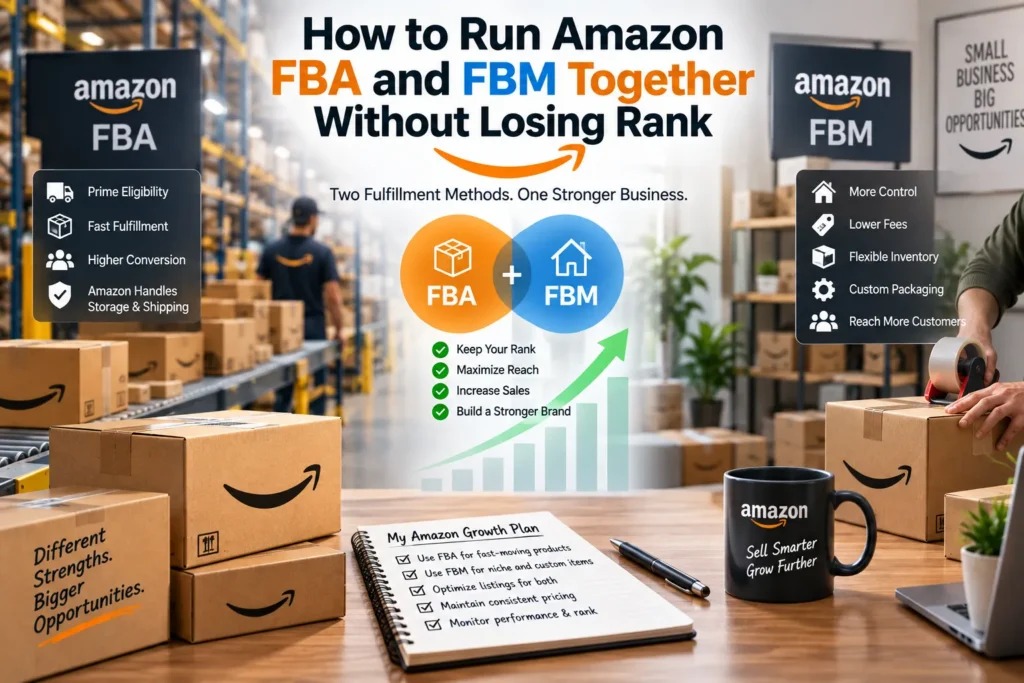
Running Amazon FBA and FBM together means keeping two offers — one FBA, one FBM — live on the same ASIN under separate SKUs, so a stockout, capacity cut, or receiving delay never leaves the listing unbuyable. Amazon shows shoppers whichever offer is more competitive at that moment; the backup offer’s job isn’t to sell in volume, it’s to keep the listing alive long enough that your rank and ad performance never register the gap.
Key Takeaways
- One ASIN can legally carry two offers — one FBA, one FBM, each on its own SKU. A third offer risks being flagged as manipulation
- Amazon’s 2026 changes (FBA prep service discontinuation, tighter storage limits) have made a backup offer a necessity for more sellers, not just an edge case
- Dual fulfillment keeps both offers live permanently; hybrid fulfillment swaps one offer automatically when FBA stock hits zero, with roughly a 15-minute gap
- Decide FBA vs. FBM per ASIN using four inputs: velocity, cube/size, margin after fulfillment, and replenishment risk
- The backup offer needs to be tested monthly, not built cold during an emergency
- UK and international sellers have an added lever: FBM Ship+, which partners with international carriers to narrow the delivery-speed gap
Why This Matters More in 2026 Than It Did Before
The FBA-vs-FBM question used to be mostly theoretical for mid-market sellers — FBA worked, storage was cheap enough to over-buffer, and a backup offer felt like unnecessary complexity. That calculation changed materially in 2026.
Amazon discontinued its FBA prep services as of January 1, 2026, which means sellers who relied on Amazon to handle labeling and prep now have to do it themselves or contract it out — adding cost and a new failure point upstream of every shipment. At the same time, Amazon tightened FBA storage allowances, cutting the forecasting window from six months to five months of forecasted sales, with some sellers reporting capacity cuts of up to 75% on affected ASINs.
Put together, this means the single-channel FBA setup that worked fine in 2023 now carries meaningfully more risk: a prep bottleneck or a storage cut can take a page-one ASIN dark with very little warning. A live, tested FBM backup offer is no longer a nice-to-have for sellers doing real volume — it’s the cheapest insurance available against a policy change you don’t control.
What “Running FBA and FBM Together” Actually Means
It means one ASIN carries two of your own offers, each on its own SKU, each drawing from its own inventory pool. Amazon shows shoppers whichever offer wins the featured position at that moment — price, delivery promise, and performance history all factor in — while the other sits in reserve, ready to take over if the first one goes dark.
Yes, this is fully within Amazon’s rules: both offers belong to the same seller, so there’s no featured-offer share being “split” in any meaningful sense — it’s still your listing either way, just with a safety net underneath it.
Dual Fulfillment vs. Hybrid Fulfillment: What’s the Difference?
These two approaches get used interchangeably, but they behave differently in practice.
| Dual Fulfillment | Hybrid Fulfillment | |
| Offers live at once | Both, continuously | One, automatically swapped |
| Gap when FBA stocks out | None | Roughly 15 minutes during the swap |
| Setup complexity | Higher (two live offers to maintain) | Lower (software-managed swap) |
| Best fit | High-velocity ASINs, peak periods | Steady, predictable-demand SKUs |
A 15-minute gap is invisible on a slow Tuesday and expensive during a traffic spike. For any ASIN doing meaningful daily volume, dual fulfillment is the safer build; hybrid is a reasonable choice for the long tail where the stakes of a short gap are lower.
How Many Offers Can One ASIN Actually Carry?
Two — one per fulfillment channel. Amazon Seller Central guidance and forum moderators have described a practical ceiling of two offers per ASIN, one FBA and one FBM; stacking additional offers beyond that risks being treated as offer manipulation rather than legitimate inventory management. Build one of each and stop there.
Deciding Which ASINs Belong on Which Channel
This isn’t a catalog-wide either/or decision — it’s a per-ASIN scoring exercise based on four inputs.
| Signal | Favors FBA | Favors FBM (as primary or backup-heavy) |
| Sales velocity | Top-selling SKUs | Slower movers |
| Cube/size | Small to standard size | Oversized or awkward to pack |
| Margin after fulfillment cost | Holds up under FBA fees | Improves meaningfully when self-shipped |
| Replenishment risk | Reliable, short lead times | Long lead time or single-supplier dependency |
Amazon allocates FBA storage capacity based on sales velocity and physical space, not raw unit count — which means one bulky, slow-moving SKU can quietly consume the capacity a faster-selling product needed during peak season. Running this scoring exercise across a full catalog is rare; most sellers never formalize it, which is exactly why it’s an area where a competitor doing the analysis pulls ahead.
How to Set Up a Backup FBM Offer on an FBA ASIN (Step by Step)
Setup takes an afternoon. Maintenance — keeping the backup offer from going stale — is the part that actually determines whether it works when you need it.
- Pick your top revenue ASINs first, not the full catalog — start with the 15-25 products where a stockout would actually hurt
- Create the FBM offer on the same ASIN using a clearly suffixed SKU (e.g., your existing FBA SKU plus a -FBM suffix) so inventory reports and any 3PL integration never confuse the two pools
- Set a handling time you can genuinely hit even on a bad week — an aspirational number here defeats the entire purpose of the backup
- Load a small but non-zero live quantity — a listing showing zero FBM stock isn’t a real backup, it’s a placeholder
- Price the offer to cover your own shipping cost, not to compete on price with your own FBA listing
- Push a handful of real orders through it every month so the account health metrics on that SKU stay current and trustworthy
- Review handling time and pricing on a fixed quarterly date, not “whenever something breaks”
A mismatched or inconsistent SKU naming convention is the single most common reason a dual-fulfillment setup fails in its first month — get the naming pattern right before scaling it across more than a handful of ASINs.
What Happens to Your Ads and Rank During the Switch
The entire point of the backup offer is continuity: as long as the ASIN has a buyable offer of any kind, ad campaigns stay eligible to serve and keyword rank has something to hold onto. That continuity is the difference between an account that stalls for a month and one that barely shows a dip.
Expect a real, measurable conversion-rate dip while the FBM offer is carrying the listing — a slower, non-Prime delivery promise converts worse than Prime speed does, and that’s expected, not a sign something’s broken. A softer conversion rate on a live listing still beats a hard zero on a delisted one, and short gaps that stay buyable barely register with Amazon’s ranking system, while longer collapses in availability get read as a genuine drop in product quality or demand.
Measuring a Dual-Fulfillment Mix Correctly
Track these five metrics split by fulfillment channel — blending FBA and FBM performance into one column hides exactly the answer you need.
| Metric | Target | Check |
| Buy Box share by offer | FBA above 95% while in stock | Weekly |
| Days of supply, FBA | 45–60 days | Weekly |
| On-time delivery, FBM offer | 97%+ | Weekly |
| Contribution margin by channel | Within 5 points of each other | Monthly |
| Backup offer test orders | 5+ per month | Monthly |
Getting real channel-level profitability requires segmenting Business Reports by fulfillment channel, then manually loading your own outbound shipping and pick-pack cost against the FBM SKU — Amazon’s default reporting won’t do the second half of that math, which is a common reason sellers overestimate how profitable their FBM backup actually is.
UK & International Sellers: FBM Ship+ Changes the Backup Math
This is the piece most FBA-vs-FBM content written for the US market skips entirely. Amazon has been expanding a program called FBM Ship+, which automates handling time and delivery-window assignment for standard-shipping FBM orders based on partnered expedited carriers — narrowing the delivery-speed gap that used to make an FBM backup feel like an obvious downgrade next to Prime.
The international dimension matters specifically for sellers shipping into or within the UK and EU: expedited carrier partnerships under this program cover key international lanes including the UK, France, Germany, Italy, and Spain, giving sellers shipping cross-border a more competitive delivery promise on the backup offer than a standard international shipping template alone would provide. For a global brand running FBA in the US and FBM as a backup into UK/EU markets, this is worth building into the backup-offer pricing and delivery-promise math rather than defaulting to conservative, generic international transit estimates.
Enrollment happens directly in Seller Central shipping settings, and by default all of a seller’s shipping templates get auto-selected into the program — worth reviewing and adjusting deliberately rather than leaving on the default, since not every SKU benefits equally from expedited carrier routing.
Mistakes That Break a Dual-Fulfillment Setup
Four assumptions cause most of the failures, and all four are wrong in practice:
- “A second offer splits my Buy Box share.” It doesn’t — both offers are yours, so featured-offer share stays in the family regardless of which one wins it.
- “I need a duplicate listing to do this.” You don’t — it’s the same ASIN, a second SKU, nothing else duplicated.
- “FBM backup is only worth it for slow movers.” The ASINs that most need a backup are often the fast movers, since they’re the ones with the most rank and revenue at risk during a stockout.
- “I can build the backup offer during the emergency.” An offer built cold, during an actual stockout, has no order history and stale settings — it generates account-health defects at exactly the moment you need it to perform cleanly. Build and test it in a quiet month, not a crisis one.
Ecom Ranker: Insert a verified before/after result here — e.g., rank recovery time, revenue protected during a specific stockout event, or Buy Box retention rate — from an actual client account. Do not publish with estimated figures.
FAQs About Running FBA and FBM Together
1 . Can I have an FBA offer and an FBM offer on the same ASIN?
Yes, using two separate SKUs on the same ASIN. Amazon’s practical ceiling is two offers per ASIN — one per fulfillment channel — so build one of each and stop there.
2 . Does adding an FBM offer hurt my Buy Box percentage?
No. Both offers belong to you, so your combined featured-offer share is unaffected — the FBA offer will typically win it while it’s in stock, and the FBM offer only steps in when needed.
3 . Can I run more than one FBM offer on a single ASIN?
You shouldn’t. Stacking additional offers on one ASIN beyond the standard FBA/FBM pair risks being treated as offer manipulation rather than legitimate inventory management.
4 . Does running FBM alongside FBA affect my Inventory Performance Index (IPI) score?
Not directly — IPI only measures FBA inventory. Shifting genuinely slow-moving SKUs to FBM as their primary channel can actually improve IPI by lifting FBA sell-through on what remains.
5 . Will FBM orders hurt my account health metrics?
Only if the offer is left untested and stale. Use protected shipping tools, set honest handling times, and hold on-time delivery above 95% to keep it from becoming a liability.
6 . When should I consider pulling a slow-moving ASIN out of FBA entirely?
When days-of-supply cover exceeds roughly 60 days across two consecutive quarters — that inventory is effectively renting FBA capacity your faster-moving SKUs need.
7 . Is a third-party logistics (3PL) provider required to run a backup offer?
No, though it helps at scale. Brands already shipping DTC orders from their own warehouse or 3PL can back up their Amazon listings from the same operation without new infrastructure.
8 . How much backup inventory should I actually hold?
Roughly 15–20% of a rolling 30-day sales forecast on your top ASINs — enough to survive a receiving delay or short capacity cut, not enough to effectively build a second warehouse.
9 . Does FBM Ship+ work for Seller Fulfilled Prime orders?
No — FBM Ship+ currently applies only to Standard Shipping orders, and is not available for Free Economy, Expedited, Premium Shipping, or Seller Fulfilled Prime orders. It’s a separate lever from SFP, not a substitute for it.
Get Your Fulfillment Mix Reviewed
This was never really an FBA-versus-FBM argument. It’s about making sure a receiving delay, a storage cut, or a prep-service change you didn’t ask for never turns into a rank rebuild funded out of your ad budget.
FBA sells your volume; a properly maintained FBM offer protects your position when FBA can’t. The setup takes an afternoon — the discipline of testing it monthly is what actually separates the brands that ride out a disruption from the ones spending a full quarter climbing back.
Not sure which of your ASINs actually need a backup offer, or whether your current setup would survive a real stockout? Ecom Ranker reviews fulfillment mix, rank risk, and ad continuity across US and UK catalogs — see our Amazon account audit service or talk to our team about building a dual-fulfillment setup that holds.