
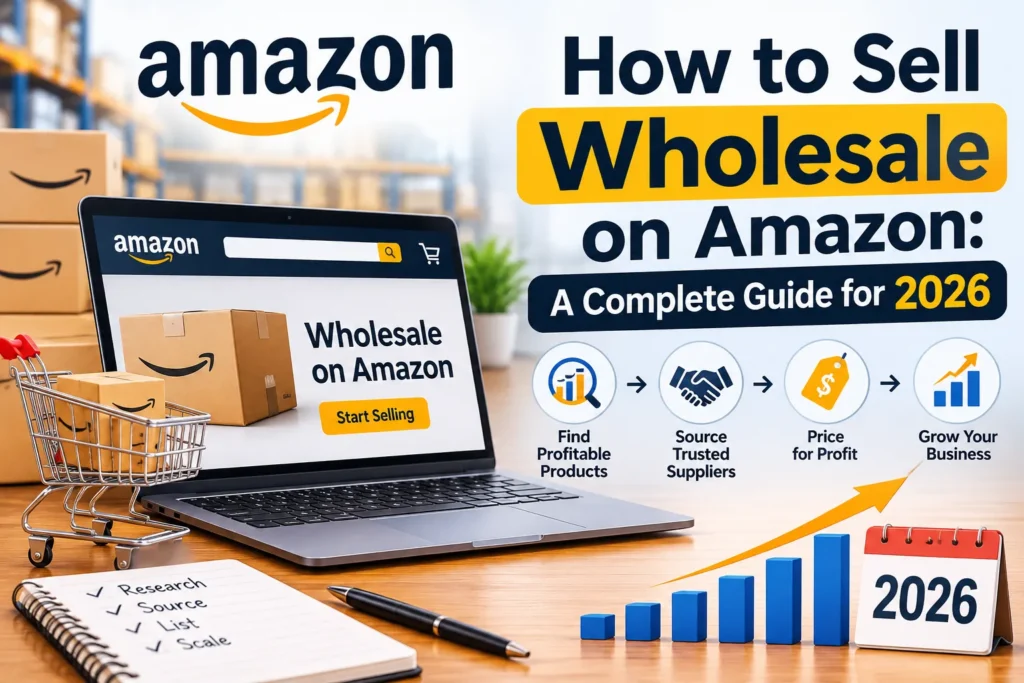
Want to build an Amazon business without creating a brand from scratch? Learning how to sell wholesale on Amazon is one of the most practical places to start.
There are several ways to make money on the world’s biggest marketplace: private label, retail arbitrage, online arbitrage, dropshipping and wholesale. Each model suits a different budget, appetite for risk and level of experience. The Amazon wholesale business model stands out because it lets you sell products that shoppers already know and trust, while you focus on sourcing, pricing, inventory and winning the Buy Box.
But wholesale is not a shortcut. Brand approvals, minimum order quantities (MOQs), price competition and cash flow can trip up new sellers fast. This guide walks through the full process: what Amazon wholesale is, how it compares with other models, how to set up your seller account, how to find wholesale products to sell on Amazon, how to source and negotiate with suppliers, how to protect your margins, and how to scale.
At EcomRanker, we have managed Amazon accounts for brands and sellers across the UK, USA, UAE and India since 2017, so the advice below comes from real account work, not theory. If you want hands-on support at any stage, our Amazon marketing agency team is ready to help.
In short: this guide explains how to start and grow a wholesale business on Amazon, including product research, supplier sourcing, brand approval, listing and advertising tactics, and scaling. It is written for beginners and for sellers moving away from retail arbitrage or private label.
Build a Scalable Amazon Wholesale Business With Expert Support
Want to source profitable products and avoid costly mistakes? Request a free Amazon account audit and our experts will show you where your opportunities are. Talk to EcomRanker.
What Is an Amazon Wholesale Business and How Does It Work?
An Amazon wholesale business works like this: you buy branded products in bulk from a brand, manufacturer or authorised distributor at a discount, then resell them on Amazon at a higher price. Your profit is the gap between your landed cost and your selling price, minus Amazon fees, shipping, prep and advertising.
Think of it as running a small online retail store inside Amazon. You do not create the product, design the packaging or build brand awareness. You supply stock to an audience that is already searching for it.
A typical wholesale workflow looks like this:
- You identify branded products with steady demand and healthy margins.
- You apply to open a wholesale account with the brand or its distributor.
- You negotiate pricing, payment terms and MOQs.
- You send stock to Amazon fulfilment centres (FBA) or ship orders yourself (FBM).
- You compete for the Buy Box by managing price, availability and account health.
- You reorder before stock runs out and keep checking prices against other sellers.
Because many sellers can offer the same product on a single listing, wholesale is a game of operations: sourcing smarter, pricing sensibly, staying in stock and keeping your seller metrics strong.
Is Wholesale the Same as Vendor Central?
No. When you sell wholesale as a third-party seller through Seller Central, you buy stock from brands and resell it. Under Vendor Central, Amazon itself buys from the brand on a first-party basis. Many brands sell through both channels. If you are curious about the difference, our guides to Amazon Seller Central management and Amazon Vendor Central management explain how each model works.
Benefits and Drawbacks of Selling Wholesale on Amazon
Before committing capital, weigh both sides honestly.
Benefits of Selling Wholesale on Amazon
- Faster launch. You list against existing products, so you skip product design, manufacturing and sample rounds.
- Built-in trust. Shoppers already recognise the brands you resell, which makes conversion easier than launching an unknown product.
- No brand building from zero. The brand carries the awareness and the marketing legacy.
- Better unit economics through bulk buying. Volume discounts improve your margin per unit.
- More predictable sales. Proven demand makes forecasting simpler than guessing whether a new private label product will take off.
- Easy to diversify. You can add brands and categories without redesigning a business model.
Drawbacks of Selling Wholesale on Amazon
- High upfront inventory investment. Bulk orders tie up cash.
- Time-consuming sourcing. Research, outreach and negotiation take real effort.
- Rejection is common. Brands often decline small or unknown resellers.
- Price competition. Multiple sellers on one listing can create price wars and thin margins.
- Brand control. The brand can change terms, raise prices or cut off authorised resellers.
- Limited listing control. On an existing detail page you usually cannot edit content the way a brand owner can.
If these drawbacks worry you, that is healthy. The rest of this guide shows how to manage each one.
Wholesale vs Retail Arbitrage vs Private Label
Wholesale is just one route. Here is how the main models compare.
| Factor | Wholesale | Retail / online arbitrage | Private label |
| Product source | Brands and authorised distributors | Stores and websites (discounted stock) | Your own manufacturer |
| Startup cost | Medium to high | Low | High |
| Scalability | High, with repeatable supplier relationships | Low, because deals are one-off | High, but needs brand investment |
| Brand building | None required | None required | Essential |
| Margin control | Moderate | Depends on the deal | High |
| Main risk | Price competition and brand gating | Time spent hunting deals | Product-market fit and launch cost |
Retail Arbitrage
Retail arbitrage means buying discounted items from physical stores and reselling them on Amazon. It is a low-cost way to learn the platform, but finding profitable stock is manual, and you cannot reliably reorder the same items. It rarely scales into a stable business.
Private Label
Private label means creating your own branded products, usually made by a manufacturer. You get full control over listings, branding and pricing, plus the ability to register your brand and use tools like A+ Content and Sponsored Brands. The trade-off is a heavier upfront investment in product development, inventory and marketing. If you are weighing this route, our Amazon brand registry and trademark registration service helps you protect your brand from day one.
So Which Is Best?
It depends on your goal. Retail arbitrage suits people testing the water with little cash. Private label suits builders who want to own a brand. Wholesale is the sweet spot if you want to skip endless deal hunting, sell established brands and keep flexibility on pricing and margins. Many serious sellers eventually blend wholesale and private label, using wholesale cash flow to fund their own brand.
How to Start an Amazon Wholesale Business Step by Step
There is no special wholesale seller account on Amazon. You open a standard seller account, then build your wholesale operation on top. Follow these steps.
Step 1: Register a Seller Account
Create your account in Seller Central for the marketplace you want to sell in. Compare plan fees before you start so you understand your cost base.
Step 2: Verify Your Business Information
Amazon verifies identity, address, bank and tax details. Depending on your country this can include a company registration, VAT or GST details, tax identification numbers and a valid payment card. Complete this carefully, because errors cause delays and account issues. If anything goes wrong, our Amazon troubleshooting service can help.
Step 3: Research a Product Niche
Use product research tools and competitor analysis to shortlist categories and brands. Weigh competition, seasonality, price stability and profit margins.
Step 4: Find Reputable Wholesale Suppliers
Search authorised distributor lists, trade shows and brand websites, then reach out directly. Prioritise suppliers with fair pricing, reliable fulfilment and MOQs that match your budget.
Step 5: Negotiate Your Wholesale Agreement
Agree price, MOQ, payment terms, shipping responsibility, returns and exclusivity expectations in writing.
Step 6: Get Approval and Ungated
If the brand or category is restricted, submit invoices and documents to apply for approval. We cover this in detail later in this guide.
Step 7: Create Shipments and Launch
Buy stock, prepare it to Amazon requirements, and send it to FBA or fulfil it yourself. Match existing listings by ASIN.
Step 8: Monitor Prices, Stock and Buy Box Share
Track competitors daily, reorder before stock-outs and keep your account health strong.
Step 9: Reinvest and Scale
Plough profit into new brands, categories and marketplaces, and consider outsourcing parts of the work, such as advertising or listing support.
Amazon Wholesale Seller Account Requirements
Before you sell, you need the right account type and a clear understanding of what Amazon expects from you.
Individual vs Professional Seller Account
Amazon offers two main selling plans. Fees vary by marketplace and change over time, so always confirm current pricing in Seller Central.
Individual seller account. This plan charges a per-item fee on each sale (in the US it has been $0.99 per item) and has limited tools. It suits casual sellers with under 40 sales a month. It is generally not suitable for serious wholesale, because key features, such as bulk listing tools and advertising, are restricted.
Professional seller account. This plan charges a flat monthly subscription (in the US it has been $39.99, and in the UK it has been around £25 plus VAT) regardless of units sold. It unlocks advertising, bulk inventory tools, advanced reports, promotions and eligibility for the Buy Box. For any wholesale business planning more than 40 monthly sales, this is the sensible choice.
What You Need to Sell Wholesale Products
Amazon does not publish special requirements just for wholesale sellers, but in practice you should have:
- A Professional seller account in good health.
- Business registration where your country requires it, plus tax registration such as VAT or GST where applicable.
- Reliable processes for inventory tracking, repricing, restocking and cash flow forecasting.
- Supplier invoices that meet Amazon’s authenticity requirements.
- A business bank account and payment method that you can use to fund bulk orders.
Also remember that most brands and distributors will ask for a business licence or registration and sometimes a reseller permit before approving a wholesale account. Having your paperwork ready speeds up approvals dramatically.
Struggling to Launch Your Wholesale Store?
We help sellers set up, choose profitable products and avoid account problems. Get a clear strategy today with our Amazon consulting services or learn the basics through our Amazon coaching 1:1.
How to Find Wholesale Products to Sell on Amazon
Your account is ready, so now comes the part that decides your profits: choosing products. You want items with strong, steady demand, manageable competition and enough margin to survive fees and price changes.
Use Amazon Product Research Tools
Product research tools turn guesswork into data. Popular options include Jungle Scout, Helium 10, SmartScout and Keepa. They estimate monthly sales, price history, competitor counts and profit margins, so you can spot listings with real demand that are not overcrowded. Our Amazon seller tools page lists tools we recommend for different stages.
Study Amazon’s Own Data
Seller Central offers free insights. Brand Analytics (for brand-registered sellers) and the Product Opportunity Explorer show trending searches, customer demand and niche performance. Watching Best Sellers, New Releases and Movers & Shakers lists can also reveal products on the rise.
Run a Competitor Analysis
Before buying inventory, review the listing you plan to join. How many sellers share it? Who holds the Buy Box and at what price? How often does the price change? Is Amazon itself a seller? Is there a brand-owned storefront aggressively defending the listing? Our Amazon competitor analysis service digs into exactly these questions.
Check Seasonality
Timing matters. Stocking winter products in summer, or missing the Black Friday and Christmas peak, leaves cash trapped in slow inventory. Map out seasonal peaks (Prime Day, back to school, Halloween, Christmas, Ramadan and Diwali in relevant markets) and place orders early enough to land stock before demand spikes.
Look Beyond the Tools
Software is only one input. Combine it with common sense: look for products that solve real problems, are lightweight, durable and not easily damaged, and have low return rates. Avoid products with high hazmat risk, fragile packaging or strict compliance rules until you have experience. Use our keyword and market intelligence approach to validate demand before you buy.
How to Find Reliable Amazon Wholesale Suppliers
Once you have a product idea, you need a supplier who can provide it at wholesale pricing, consistently and legitimately. Your supplier is the foundation of your business, so choose one you can work with for years.
Where to Find Wholesale Suppliers for Amazon
- Brand websites. Many brands list a “wholesale”, “retailers” or “become a stockist” page. This is often the cleanest route because you buy directly from the source.
- Authorised distributors. Large brands frequently sell through distributors who offer lower MOQs and broader catalogues. Ask the brand who their authorised distributors are.
- Trade shows and industry events. Meeting suppliers face to face lets you see products, build rapport and spot trends early.
- Wholesale marketplaces and directories. Online directories can help you discover suppliers by category and location. Always read reviews and verify the business independently.
- Cold outreach. Email or call brands directly, introduce your business, explain how you will represent their products and ask for a wholesale price list.
- Local and regional wholesalers. In markets such as the UK and India, regional cash-and-carry wholesalers and local distributors can be good sources of fast-moving stock.
How to Vet a Wholesale Supplier
Before you send any money, check that the supplier is genuine:
- Confirm the company is legally registered and has a real address and phone number.
- Ask whether they are an authorised distributor for the brands they supply.
- Request references or look for independent reviews.
- Check that they can issue proper invoices showing their business name, address, your business details, item descriptions and quantities. Amazon may ask for these invoices if a listing is questioned.
- Start with a small trial order to test quality, packaging and delivery speed.
- Be cautious of prices that look too good to be true, because counterfeit or grey-market stock can lead to complaints and account suspension.
Working with unverified suppliers is one of the fastest routes to inauthentic item complaints. If your account ever gets flagged, our Amazon account reinstatement specialists can help you recover, and our Amazon account health management service helps you stay out of trouble in the first place.
How to Negotiate Wholesale Deals With Suppliers
Found a supplier you like? Negotiating well can protect your margin for the life of the relationship. Use these tactics.
- Do your homework. Research typical wholesale prices and the retail price range on Amazon so you know what a fair margin looks like.
- Show your value. Explain how you will list, price and fulfil responsibly, and how you can bring additional sales to the brand through Amazon.
- Negotiate unit price first, then move on to other terms once you have agreement on price.
- Ask for a lower MOQ. If the minimum order is too high for your budget, ask whether they will allow a smaller first order or a mixed-SKU order.
- Request flexible payment terms. Options include upfront payment, split payments or net-30 and net-60 terms once trust is built.
- Discuss shipping and returns. Clarify who pays freight, who handles damaged goods and what happens with expired or faulty stock.
- Ask about MAP and pricing policies. Some brands set a minimum advertised price. Understand it before you list.
- Be professional and patient. Long-term relationships beat one-off discounts. Pay on time, communicate clearly and re-order predictably.
Brand Approval, Gating and Authorised Reseller Rules
This is the stage where many beginners get stuck, so it deserves its own section.
What Is Brand Gating?
Some brands and categories are restricted on Amazon. You cannot list or sell certain products until Amazon approves you. Restrictions commonly apply to categories such as beauty, grocery, health and personal care, and to top-name brands that want tight control over who sells their products.
How to Get Approved (Ungated)
- Check restrictions first. Use Seller Central’s restriction checks, and consider a bulk restriction checker before you buy inventory, so you never purchase stock you cannot sell.
- Prepare compliant invoices. Amazon generally asks for recent supplier invoices or letters of authorisation. The exact requirements (such as quantity and invoice age) differ by category and marketplace, so read the current rules for the product you want to sell.
- Get a letter of authorisation if needed. Some brands will provide an authorisation letter confirming you are an approved reseller.
- Keep your account healthy. Good performance metrics make approvals more likely.
- Be patient and precise. If your request is rejected, read the reason carefully, fix the issue and resubmit rather than sending repeated vague requests.
Authorised Reseller Rules to Know
Brands can limit who sells their products, and Amazon can remove sellers who generate inauthentic item complaints. Only buy from sources you can prove are legitimate, keep every invoice, and never sell goods you cannot trace back to an authorised supplier. If a brand later asks you to stop selling, take it seriously and speak to them first. If you also want to launch your own brand and gain control of the listing, our Amazon brand registry and trademark registration and brand protection and defence services are designed for that move.
Calculating Profit and Fees on Wholesale Products
A product that looks cheap to buy can still lose money once fees are counted. Calculate your numbers before you place any order.
The Costs You Must Include
- Unit cost from the supplier (including any bulk discount).
- Amazon referral fee (a percentage of the selling price, which varies by category).
- FBA fulfilment fee if you use Fulfilment by Amazon, or your own shipping cost if you use FBM.
- Inbound shipping to Amazon and any prep or labelling costs.
- Storage fees, including long-term storage if stock sits too long.
- Returns and damaged stock allowance.
- VAT, GST or sales tax implications in your marketplace.
- Advertising cost, if you plan to run PPC to win visibility.
Worked Example (Illustrative Only)
Suppose you buy a product for $12.00 and sell it for $24.99. Assume a 15% referral fee ($3.75), a $4.50 FBA fee, $0.60 inbound shipping and $0.40 for prep. Your profit per unit is roughly $3.74, which is a margin of about 15% of the selling price and an ROI of about 31% on your $12.00 cost. Those numbers only work if you win sales without expensive advertising, and they can shrink quickly if a competitor drops the price. Always plug in your real fees.
Use Metrics That Matter
Track margin, ROI, sell-through rate and cash conversion time. If you run ads, measure ACoS, TACoS and ROAS so advertising does not erase your profit. Our free Amazon ACoS calculator, TACoS calculator and ROAS calculator make this quick.
How to Win the Buy Box on Wholesale Listings
When several sellers offer the same product, Amazon usually shows one offer in the main Buy Box. Most sales go to whoever holds it, so winning the Amazon Buy Box is critical for wholesale sellers.
While Amazon does not publish its exact formula, the following factors are widely seen to matter:
- Competitive price, including shipping.
- Fulfilment method. FBA offers tend to perform well because of Prime eligibility and fast delivery.
- Stock availability. Running out of stock hands the Buy Box to competitors.
- Seller performance. Order defect rate, late shipment rate, cancellations and customer feedback all count.
- Professional seller account status. Individual accounts are not eligible for the Buy Box in the same way.
Practical Buy Box Tips
- Use a repricing tool with sensible minimum and maximum prices so you do not race to the bottom.
- Do not chase the lowest price at any cost. A slightly higher price with better delivery and stronger metrics can still win share.
- Keep enough inventory to avoid stock-outs, especially before peak seasons.
- Respond to customer messages fast and fix issues before they become negative feedback.
- Avoid listings where Amazon itself or the brand owner dominates the Buy Box, unless the margin still works.
Optimising Listings for Wholesale Products
When you sell wholesale, you often join an existing detail page rather than creating your own. That limits what you can change, but listing quality still matters for you, especially for your own offer and for listings you create.
- Match to the correct ASIN. Make sure the product you are selling is exactly the item on the listing, with the same size, pack count and condition.
- Report content problems. If the page has wrong images or bullet points, you can suggest corrections, although the brand controls the final content.
- Where you can create or edit a listing, use strong images, clear titles and keyword-rich bullet points. Our Amazon listing optimisation and Amazon product listing services can help you do this properly.
- Use bundles. Creating a bundle of complementary items can give you a unique listing that you control, which avoids direct price competition.
- Add premium content where eligible. If you hold brand rights, A+ Content, a Brand Store and professional listing images can raise conversion.
- Follow Amazon’s style and compliance guidelines to avoid suppression and listing issues.
- Collect reviews the right way, by delivering a great experience and using Amazon’s approved review request tools. Never offer incentives for reviews.
Better Amazon SEO and conversion improvements also lift your share of sales on competitive listings, and our conversion rate optimisation service targets precisely that.
Marketing and Advertising Your Wholesale Products
Listing a product is only the beginning. To stand out among other sellers, you need visibility and traffic.
Amazon PPC Advertising
Amazon PPC lets you bid on keywords so your offer appears in search results. For wholesale, note that you can usually only advertise on listings where you hold the Buy Box, so winning it comes first. Start with Sponsored Products on your best sellers, monitor ACoS closely and expand once you have profitable campaigns. Our Amazon advertising services and PPC advertising management teams build campaigns that protect your margin.
Amazon DSP
Once you scale, display and video retargeting through Amazon DSP can help you reach shoppers who viewed but did not buy.
Social Media and Influencers
Platforms like Facebook, Instagram and TikTok can drive outside traffic. Share product demonstrations, run targeted ads and partner with creators whose audience fits your products. Our social media advertising team can help with this.
Bundles, Coupons and Promotions
Offer bundles of complementary products, limited-time coupons or multi-buy deals to raise average order value and differentiate your offer. Plan promotions around events such as Prime Day, Black Friday and seasonal peaks, and make sure your stock levels can support the demand.
Build Your Own Channels
Wholesale sellers who build an email list, a website or a Shopify store reduce their dependence on a single marketplace. Our ecommerce SEO services help you attract customers beyond Amazon.
Inventory, FBA and Cash Flow Management
Cash flow is the lifeblood of any Amazon wholesale business. Bulk orders tie up money, and Amazon pays out on a schedule, so poor planning can leave you profitable on paper but short of cash.
FBA vs FBM for Wholesale
Fulfilment by Amazon (FBA) means Amazon stores, packs and ships your products and handles customer service and returns. It improves Prime eligibility and Buy Box chances, but adds fees and prep requirements. Fulfilment by Merchant (FBM) means you ship orders yourself, which gives more control and can suit bulky, slow-moving or low-volume items, but can reduce Buy Box competitiveness. Many sellers use a mix.
Inventory Management Tips
- Forecast demand using sales history, seasonality and upcoming promotions.
- Set reorder points that account for supplier lead times and Amazon check-in times.
- Avoid overstock, which triggers storage fees and can force you to discount.
- Review slow-moving stock monthly and liquidate before long-term storage fees apply.
- Keep a safety buffer for your best sellers, because stock-outs lose the Buy Box and hurt rankings.
- Track every supplier invoice in an organised folder in case Amazon requests proof of authenticity.
Protect Your Cash Flow
Start with smaller orders, test sell-through, then scale. Negotiate payment terms, reinvest profits gradually and keep a cash reserve for taxes, returns and unexpected fees.
How to Scale Your Amazon Wholesale Business
Once your first products are profitable, scaling is about repeating what works while managing risk.
- Add more brands and SKUs. Spread risk so no single supplier or listing can sink you.
- Deepen supplier relationships. Reliable, repeat buyers often earn better pricing, higher credit limits and early access to new products.
- Expand into adjacent categories where you already understand compliance and demand.
- Go international. Take proven products to new marketplaces such as the UK, Europe, UAE or India. Our Amazon global selling and scaling and growth strategy services help you do this safely.
- Automate. Use repricing, inventory forecasting and reporting tools to free your time for strategy.
- Build a team or outsource. Specialist help for advertising, listing work and account health often pays for itself.
- Consider building your own brand or exploring Vendor Central relationships as you grow.
- Diversify channels. Add Walmart, eBay, TikTok or your own website so you are not reliant on one platform. We offer Walmart management and eBay management services for this.
If you are interested in how successful sellers are scaling, browse our case studies and real results.
Selling Wholesale on Amazon in the UK, US, UAE and India
The wholesale model works across marketplaces, but local rules and buying behaviour differ.
Amazon USA
The US is the largest and most competitive marketplace, with deep supplier networks, trade shows and distributors. Competition on popular listings is intense, so margin discipline and Buy Box strategy matter. See our Sell on Amazon USA guide and Amazon agency USA page.
Amazon UK
UK sellers need to handle VAT registration and returns expectations, and many source from UK wholesalers and European distributors. Peak seasons such as Christmas and Black Friday are major sales drivers. Learn more at Sell on Amazon UK and our Amazon agency UK page, or see why we are rated the best Amazon agency in the UK.
Amazon UAE
The UAE is a growing, less saturated marketplace with strong demand in electronics, home and lifestyle products. VAT registration and local fulfilment options are key considerations. Visit Sell on Amazon UAE and Amazon agency UAE.
Amazon India
India has a vast domestic market with GST rules, many regional distributors and wide category opportunities. Local wholesale and distributor relationships are often the starting point. See Sell on Amazon India and Amazon agency India.
If you are thinking about Europe as well, read about how to sell on Amazon Europe.
Common Mistakes Amazon Wholesale Sellers Make
Most wholesale failures come from a handful of avoidable errors.
- Buying without research. A product that “looks good” can leave you with dead stock. Check demand, competition, price history and fees before ordering.
- Ignoring brand restrictions and Amazon rules. Buying gated brands you cannot sell is an expensive mistake. Check restrictions first.
- Using weak suppliers. Unverified suppliers cause quality problems, delays and inauthentic item complaints that can end in suspension.
- Skipping profit calculations. Forgetting fees, shipping, prep, returns and tax means you may barely break even.
- Underestimating capital. High MOQs, storage and marketing need a realistic budget.
- Racing to the bottom on price. Constant undercutting destroys margin for everyone, including you.
- Over-relying on one brand or supplier. If they change terms or cut you off, your revenue disappears.
- Neglecting account health. Poor metrics hurt Buy Box share and can trigger enforcement.
- Not tracking inventory age. Old stock racks up fees and ties up cash.
- Going it alone for too long. Expert guidance is cheaper than repeated mistakes. A free ASIN audit or PPC audit can reveal quick fixes.
When to Hire an Amazon Agency for Wholesale
You can start wholesale on your own, but growth gets complicated fast. Consider professional help when:
- Your advertising costs are climbing and profit is falling.
- You are struggling to win or hold the Buy Box.
- You face account health issues, restrictions or suspensions.
- You want to expand to new marketplaces.
- You need better listings, creative content and brand protection.
- You do not have time to manage ads, inventory and reporting at once.
At EcomRanker, we are an Amazon-first agency working across the UK, USA, UAE and India since 2017. Our full-service Amazon account management team handles PPC, SEO, listings, account health and growth strategy under one roof, with transparent reporting that connects ad spend to real profit. If you are comparing options, you may want to read EcomRanker vs My Amazon Guy or our guide to Amazon VA vs Amazon agency.
FAQs About Selling Wholesale on Amazon
What are the best wholesale products to sell on Amazon?
Is wholesaling on Amazon profitable?
How much money do I need to start selling wholesale on Amazon?
Do I need a business licence to start Amazon wholesale?
Do I need a Professional seller account for wholesale?
How do I find wholesale suppliers for Amazon?
What is the difference between Amazon wholesale and private label?
Can I sell wholesale on Amazon without Brand Registry?
Is wholesale better than retail arbitrage?
Ready, Set, Sell!
If you want a long-term, scalable Amazon business, wholesale is one of the most proven models. Knowing how to sell wholesale on Amazon lets you build on trusted brands, repeat what works and grow without creating a product from nothing. Choose the right account, research your products, vet your suppliers, protect your margins and keep a close eye on your Buy Box share and cash flow.
Use this guide as your foundation, then keep learning and testing. Every strong wholesale business starts with one good product, one reliable supplier and one well-run listing.
Ready to start or scale your Amazon wholesale business? Our full-service team can help you with account setup, advertising, listing optimisation and growth strategy. Get your free Amazon account audit or explore our Amazon marketing agency services today.
Confused About Where to Start?
Starting wholesale does not have to be overwhelming. Talk to an Amazon expert and get a step-by-step launch plan. Book a free consultation with EcomRanker.