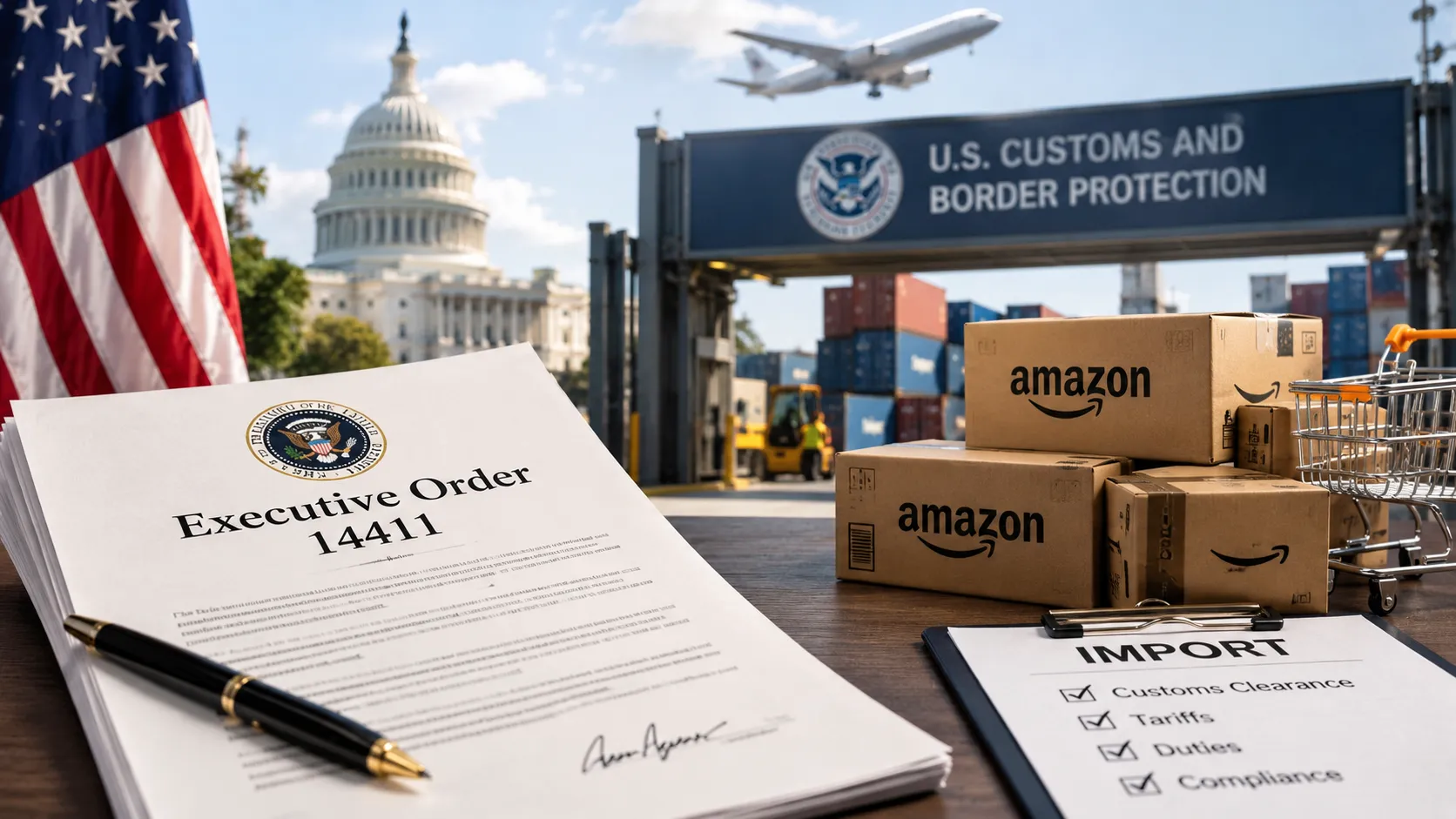
Fake reviews aren’t just an Amazon policy problem anymore — they’re a federal law problem. The FTC’s Consumer Review Rule, active since October 2024, carries civil penalties of up to $53,088 per violation, and the agency sent warning letters to companies in late 2025 signaling active 2026 enforcement. Combined with Amazon’s own escalating crackdown — domain seizures, joint lawsuits with the Better Business Bureau, and AI-driven detection — this is a genuinely higher-stakes environment than it was even a year ago, for both the sellers who buy fake reviews and the honest sellers targeted by fake negative ones.
Key Takeaways
- Fake reviews fall into two categories with different motives: fake positive reviews inflate a seller’s own ratings, while fake negative reviews are used by competitors or bad actors to sabotage a legitimate listing.
- The FTC’s Consumer Review Rule, effective since October 2024, makes fake reviews a federal violation, not just an Amazon policy breach, with civil penalties reaching up to $53,088 per violation — and the FTC signaled active 2026 enforcement after warning letters sent in late 2025.
- Amazon has escalated its own enforcement significantly: gaining control of more than 75 domains connected to fake-review services in mid-2025, and filing a second joint lawsuit with the Better Business Bureau in October 2025 against specific review-broker networks.
- Specific red flags exist for spotting fake reviews: unusual rating distribution, generic overly-enthusiastic language, suspicious reviewer profile patterns, and a lack of Verified Purchase tags.
- Fake reviews carry a real, compounding cost — lost conversion from shopper distrust, wasted ad spend on a listing undermined by fraudulent negative reviews, and account health risk if you’re the one buying them.
- Amazon Vine remains the compliant path to generating legitimate early reviews without the fake-review risk entirely.
What Counts as a Fake Review
Fake reviews split into two categories with fundamentally different motives and effects:
| Type | Who Does It | Effect |
| Fake positive reviews | The seller or someone acting on their behalf, often paying or incentivizing reviewers | Artificially inflates a mediocre product’s rating, misleading shoppers |
| Fake negative reviews | Competitors or malicious third parties | Damages a legitimate seller’s rating and search visibility without cause |
Both violate Amazon’s policies and, as of October 2024, both can trigger genuine federal liability under the FTC’s Consumer Review Rule — this isn’t limited to the seller benefiting from fake positive reviews; a bad actor orchestrating fake negative reviews against a competitor is exposed too.
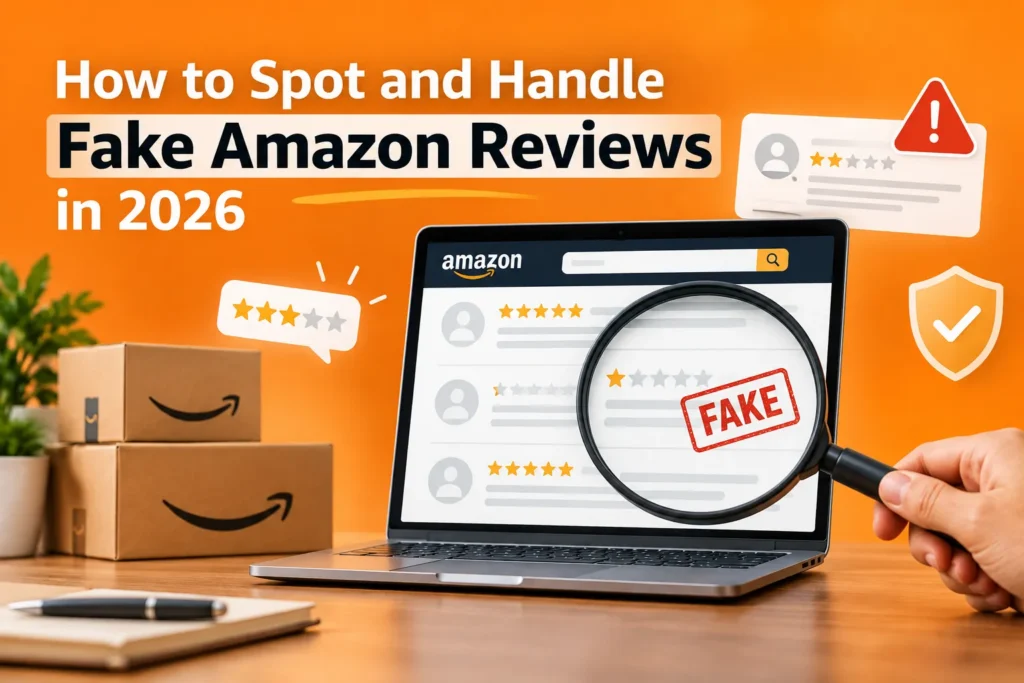
How to Spot Fake Reviews on Your Listings
Recognizing the pattern early is the first defense, whether you’re checking your own listing for suspicious activity or evaluating a competitor’s suspiciously strong ratings:
- Unusual rating distribution — a listing with mostly five-star reviews and a sudden cluster of one-star reviews (or vice versa) deviates from the more gradual, balanced distribution genuine feedback typically produces
- Content that doesn’t match the product — reviews referencing features, colors, or details that don’t exist on the actual listing often indicate a listing was merged with another (a hijacking pattern that carries over old reviews)
- Suspicious reviewer history — a profile with a pattern of exclusively one-star reviews across unrelated products, or an account created very recently with an unusually high review volume, is a red flag worth investigating
- Generic, overly enthusiastic language — vague superlatives (“best product ever,” “life-changing”) without specific product detail are a common tell of fabricated or incentivized reviews
- Sudden spikes in volume — a rapid cluster of reviews (positive or negative) within a short window, especially disconnected from any real sales or marketing event, suggests coordinated activity rather than organic feedback
- Missing Verified Purchase tags — not every unverified review is fake, but a pattern of unverified reviews clustered together is worth closer scrutiny
The Federal Law Most Sellers Don’t Know Exists
Here’s the detail that separates current reality from how most sellers still think about this problem: fake reviews are no longer purely an “Amazon policy” issue. The FTC’s Rule on the Use of Consumer Reviews and Testimonials (commonly called the Consumer Review Rule) took effect on October 21, 2024, and by 2026 has moved from a newly enacted rule into an active enforcement priority. The rule prohibits reviews that misrepresent a reviewer’s actual experience, reviews from people with no genuine experience with the product, undisclosed insider or employee reviews, and compensation offered specifically for positive reviews. Violations can trigger civil penalties of up to $53,088 per violation — a figure that compounds quickly across a catalog with meaningful review volume. In late 2025, the FTC sent warning letters to ten companies during the holiday shopping season specifically about this rule, a signal the agency itself described as indicating imminent, stepped-up enforcement in 2026. This matters regardless of which side of the problem you’re on: a seller buying fake positive reviews is exposed to this rule directly, and a seller orchestrating fake negative reviews against a competitor is exposed to it as well.
What Amazon Is Doing About It
Amazon’s own enforcement has escalated well beyond the detection systems most sellers are already aware of:
- AI-driven detection continues to block hundreds of millions of suspected fake reviews before publication annually
- Domain seizures — in mid-2025, Amazon gained control of more than 75 website domains connected to fake-review broker services, disrupting the infrastructure these operations depend on
- Joint legal action with the Better Business Bureau — Amazon and the BBB filed their second joint lawsuit in October 2025, targeting review-broker networks operating fake-review schemes
- The Coalition for Trusted Reviews, established in 2023, continues coordinating cross-industry efforts on review authenticity standards
- Ongoing broker lawsuits — Amazon has continued pursuing legal action against operators selling fake reviews in bulk to sellers
The pattern across both Amazon’s own enforcement and the FTC’s parallel federal action is the same: this is treated as an infrastructure problem now, not just a whack-a-mole content-moderation issue — going after the brokers and networks, not only individual fake reviews as they appear.
What Fake Reviews Actually Cost You
Whether you’re the target of fake negative reviews or considering (and this guide strongly advises against) buying fake positive ones, there’s a real, quantifiable cost on both sides:
| Scenario | Cost Mechanism |
| Targeted by fake negative reviews | Lower conversion rate on affected traffic, wasted PPC spend driving clicks to a listing with an artificially depressed rating, potential Buy Box impact |
| Buying fake positive reviews | Federal civil penalty exposure (up to $53,088 per violation), Amazon account suspension risk, wasted spend on reviews that provide no genuine product feedback to improve from |
| Either scenario, unaddressed | Compounding reputation damage as shoppers increasingly cross-reference reviews across platforms before purchasing |
The reputational and trust cost is harder to quantify precisely but is arguably the larger long-term risk: as shoppers grow more sophisticated at spotting manipulation patterns themselves, a listing that looks manipulated — even if the seller isn’t the one manipulating it — bleeds trust regardless of who’s responsible.
How to Report a Fake Review
- Collect evidence — review links, screenshots, dates, affected ASINs, and reviewer profile details before starting the report, since a documented pattern is far more actionable than a single flagged review
- Use the “Report Abuse” link directly next to the suspicious review where available
- For a broader pattern, go to Seller Central → Performance → Account Health → Report abuse of Amazon policies, and select the option indicating another seller is attempting to harm your business if that applies
- Include the full pattern in one report rather than reporting the same type of issue repeatedly — explain when it started, which ASINs are affected, and why you believe it violates policy, with your collected evidence attached
- Monitor the Voice of the Customer section in Account Health for ASIN-level patterns that might indicate a coordinated issue worth investigating further
Building Review Defenses Proactively
- Enroll in Amazon Vine for a policy-compliant way to generate legitimate early reviews on new products — see our Amazon Vine guide for enrollment details
- Enroll in Brand Registry, which doesn’t stop fake reviews directly but gives you more control over your listings and reduces the risk of hijacking-driven review transfer
- Monitor reviews regularly rather than discovering a pattern weeks after it started, when both the damage and the reporting burden are larger
- Keep listings accurate and current, since a genuine mismatch between listing claims and product reality generates authentic negative reviews that get incorrectly diagnosed as manipulation when the real fix is the listing itself
What Not to Do
- Never offer compensation for review removal — negotiating with a reviewer to take down or change a review in exchange for a refund or incentive violates policy and now carries federal exposure under the Consumer Review Rule
- Never retaliate publicly — you can’t respond to reviews directly on Amazon, and attempting workarounds (contacting reviewers aggressively, disputing publicly elsewhere) tends to escalate rather than resolve the situation
- Never buy reviews to counteract fake negative ones — fighting manipulation with more manipulation compounds your legal exposure rather than solving the underlying problem
- Don’t assume every negative review is fake — genuine criticism is a normal part of running a listing, and treating all negative feedback as an attack rather than occasionally-valid signal misses real product or listing issues worth fixing
How EcomRanker Protects Sellers From Review Manipulation
We help sellers distinguish genuine negative feedback (a real signal worth acting on) from coordinated fake review activity (a pattern worth reporting), build the evidence needed for an actionable Amazon report, and set up compliant review-generation programs like Amazon Vine so growth doesn’t depend on tactics carrying real federal and account-health risk in 2026’s enforcement environment.
Suspect your listings are being targeted, or want a compliant review strategy built from the start? Get in touch for a review health assessment.
Frequently Asked Questions
1 . What is a fake Amazon review?
A deceptive review that misrepresents genuine customer experience — either a fake positive review used to inflate a seller’s own ratings, or a fake negative review used by competitors or bad actors to damage a legitimate listing.
2 . Is buying fake reviews illegal, not just against Amazon’s policy?
Yes, as of October 2024. The FTC’s Consumer Review Rule makes fake or compensated reviews a federal violation, with civil penalties of up to $53,088 per violation, separate from any Amazon account action.
3 . How can I tell if reviews on a listing are fake?
Watch for unusual rating distribution, generic overly-enthusiastic language without specific product detail, suspicious reviewer profile patterns, content that doesn’t match the actual product, sudden spikes in review volume, and a lack of Verified Purchase tags.
4 . What should I do if I suspect a competitor is leaving fake negative reviews on my listing?
Collect evidence (review links, screenshots, dates, reviewer profiles) and report the pattern through Seller Central’s Account Health abuse-reporting process, selecting the option indicating another seller is attempting to harm your business if applicable.
5 . Has Amazon’s enforcement against fake reviews gotten stricter recently?
Yes. In mid-2025, Amazon gained control of more than 75 domains connected to fake-review broker services, and in October 2025 filed a second joint lawsuit with the Better Business Bureau against specific review-broker networks.
6 . Can I respond publicly to a review on Amazon?
No, sellers cannot post public responses to reviews directly. Focus instead on keeping listings accurate and using Amazon’s official reporting channels for suspected fake or policy-violating reviews.
7 . What’s a compliant way to get more reviews without risking fake-review violations?
Amazon Vine is Amazon’s official program for generating legitimate early reviews from verified reviewers, offering a policy-compliant alternative to any form of paid or incentivized review activity.
8 . Does Brand Registry help prevent fake reviews?
Not directly, but it gives you more control over your listing and reduces the risk of listing hijacking, which can otherwise transfer old, potentially manipulated reviews onto your active listing.
9 . What happens if I’m caught buying fake reviews?
You risk Amazon account penalties up to suspension, and separately, federal civil penalties under the FTC’s Consumer Review Rule of up to $53,088 per violation.
10 . Should I offer a refund or incentive to get a negative review removed?
No. This violates Amazon’s policy and falls within the conduct the FTC’s Consumer Review Rule now explicitly prohibits, carrying real financial and account risk rather than resolving the underlying issue.