

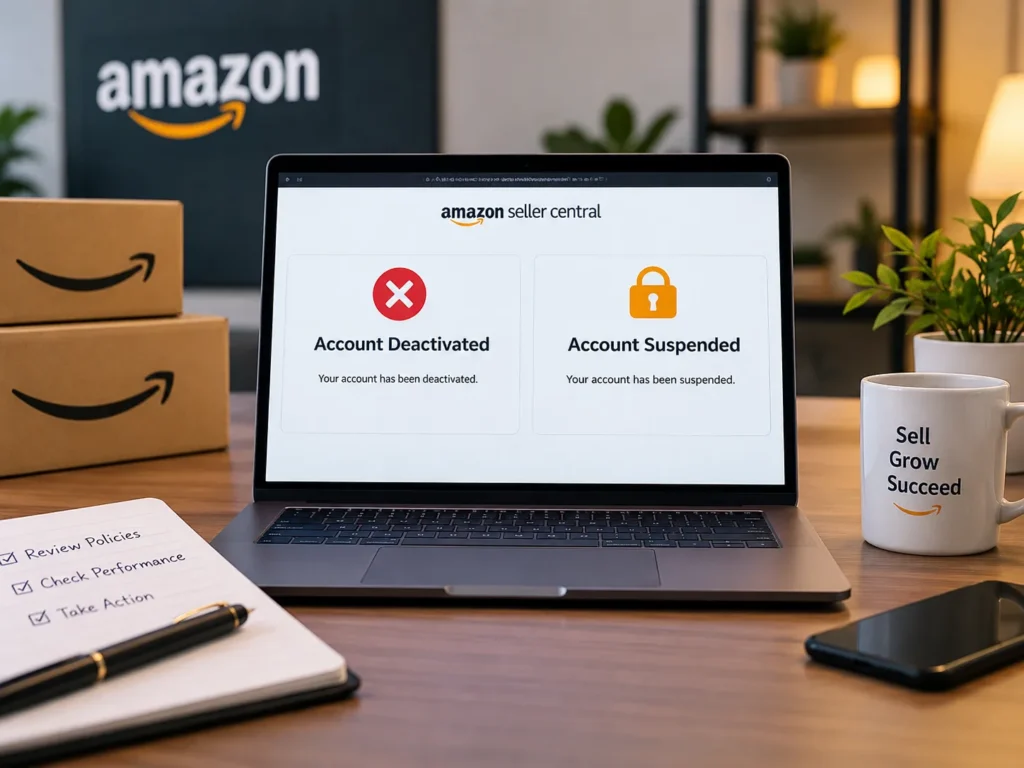
Your Amazon account is deactivated or suspended, and Amazon uses those words to mean very different things. A suspension is a temporary, partial restriction you can usually fix with a targeted Plan of Action. A deactivation is a full account shutdown — listings pulled, funds held longer, and a stricter appeal standard. Knowing which one you have changes your entire recovery strategy.
Key Takeaways
- Suspended = partial, temporary. You keep some Seller Central access, listings go inactive (not deleted), and most cases resolve in days to a few weeks with a correct Plan of Action (POA).
- Deactivated = full shutdown. Listings are removed, access is limited to Appeal and Account Health only, and funds are typically held for 90+ days during Amazon’s review.
- Your Account Health Rating (AHR) — Amazon’s 0–1,000 seller scorecard — influences suspensions but critical violations (counterfeit, fraud, IP theft) can trigger deactivation instantly regardless of your score.
- Never open a second account while one is under review — Amazon treats this as a related-account violation and it can turn a recoverable case into a permanent ban.
- The fix differs by cause, not just by label: a verification-based deactivation needs documentation; a performance-based suspension needs a root-cause POA. Treating them the same is the single most common reason appeals get rejected.
Amazon Deactivated Account vs Suspended Account at a Glance
| Factor | Suspended Account | Deactivated Account |
| What it is | Selling privileges temporarily paused | Account fully shut down |
| Seller Central access | Partial — reports, some tools available | Very limited — mostly Appeal and Account Health only |
| Listing status | Suppressed/inactive, content preserved | Removed entirely; must be rebuilt or relisted after reinstatement |
| Funds | Delayed or on rolling reserve | Frozen, typically for 90+ days |
| Usual trigger | Single policy breach, ODR, late shipments, performance dips | Repeated/serious violations, failed identity verification, linked accounts, fraud |
| Appeal document needed | Root-cause Plan of Action (POA) | POA plus supporting verification documents (ID, business registration, invoices) |
| Typical resolution time | Days to a few weeks | Weeks to months; some cases require escalation |
What Does “Suspended” Mean on Amazon?
A suspension is Amazon pressing pause on your selling privileges while it investigates or waits for you to fix a specific, identifiable problem. You’ll usually still see your Seller Central dashboard, reports, and some account tools — what’s gone is the ability to sell. Amazon treats a suspension as correctable: the assumption baked into the process is that you can identify what went wrong, fix it, and prove it won’t happen again.
Common Triggers for a Suspension
- Order Defect Rate (ODR) climbing above Amazon’s threshold (typically kept under 1%)
- Late Shipment Rate or Valid Tracking Rate breaches
- A cluster of A-to-Z Guarantee claims in a short window
- Intellectual property (IP) complaints from a rights owner or competitor
- Inauthenticity or “used sold as new” complaints
- Restricted product violations — selling in a category or ASIN without required approval
- A single, isolated policy violation rather than a pattern
What Does “Deactivated” Mean on Amazon?
A deactivation is Amazon’s most severe non-legal enforcement action short of a permanent ban. It’s the outcome when Amazon concludes the risk isn’t one fixable issue — it’s the account itself: unverifiable identity or business details, a pattern of repeated violations, or a link to another account that’s already in trouble. Access drops to almost nothing. You’ll typically only see a deactivation banner, the Appeal option, and your Account Health page.
Common Triggers for a Deactivation
- Failed or incomplete identity/business verification (this is the single most common 2026 deactivation cause reported across seller communities — it’s often triggered by a routine document recertification request that gets missed, not a violation at all)
- Related or linked accounts — Amazon detected shared device, IP address, banking, or business details with another seller account
- Repeated policy violations after prior warnings or a previous reinstatement
- Confirmed counterfeit, fraud, or intentional policy circumvention
- A cluster of unresolved suspensions that Amazon escalates into a full shutdown
The 7 Real Differences Between a Deactivated and Suspended Amazon Account
1. Severity and Amazon’s Intent
A suspension signals “fix this specific thing.” A deactivation signals “we no longer trust this account by default until you rebuild that trust with evidence.” That difference in intent is why the same generic apology-and-promise appeal that might work for a suspension almost always fails for a deactivation — Amazon isn’t asking you to promise better behavior, it’s asking you to prove who you are and that the underlying problem is structurally fixed.
2. What You Can Still Access in Seller Central
Suspended sellers typically retain access to inventory reports, some performance data, and messaging. Deactivated sellers are routed almost exclusively to the Reactivate Your Account flow inside Account Health — there’s little else to check or manage until the appeal is resolved.
3. What Happens to Your Listings
This is the difference sellers feel first. Under a suspension, listings go inactive or suppressed but the underlying content — titles, bullets, images, A+ Content — stays intact and reactivates automatically once the suspension lifts. Under a deactivation, listings are pulled from the catalog entirely. Depending on how long the account stays down, some ASINs may need to be relisted from scratch, and any organic ranking built up before the shutdown does not fully carry over.
4. What Happens to Your Money
Suspended accounts commonly see payouts delayed or shifted to a rolling reserve — frustrating, but funds are usually released once the issue clears. Deactivated accounts see funds frozen for a minimum review window (commonly cited at 90+ days industry-wide), and in verification-related cases the hold can extend further while Amazon confirms banking and business details match.
5. How Your Account Health Rating Is Affected
Amazon’s Account Health Rating (AHR) runs on a 0–1,000 scale. New sellers start at 200. You gain roughly 4 points per 200 fulfilled orders over a trailing 180-day window, and lose 2–8 points per policy violation depending on severity. A score sitting in the “Green” zone (200–1,000) generally protects you from AHR-triggered deactivation — but AHR is not a shield against everything. Confirmed fraud, counterfeit claims, or illegal activity can trigger immediate deactivation regardless of where your score sits. This is why a seller with a strong AHR can still wake up to a deactivation notice: the score measures ongoing performance risk, not identity-verification or authenticity risk.
Not sure whether your AHR score or something else caused your action? Our team reviews your Account Health data as part of every Amazon account audit — see what’s actually driving your risk before you appeal.
6. The Appeal Path You Need to Take
For a suspension, the core document is a Plan of Action (POA): root cause, corrective action already taken, and preventive measures going forward — written specifically to the violation named in your notice, not a generic template. For a deactivation, the same POA structure applies, but it must be paired with supporting documentation: government ID, utility bill, business registration, or invoices, depending on the stated reason — and everything must match your Seller Central account details exactly, down to spelling and address formatting.
7. Typical Timeline to Resolution
Suspensions resolve fastest when the fix is procedural — many sellers see a decision within days once a well-documented POA is submitted. Deactivations take longer by design: document review adds time, and cases involving related accounts or repeated violations sometimes require escalation beyond the standard appeal, occasionally to a specialized review team, before a human makes a final call.
How to Check Which One You Have (Right Now)
- Look at the top banner in Seller Central. Amazon typically labels the action directly — “account is deactivated” versus a performance or policy notification tied to a specific metric or complaint.
- Open Account Health → Performance Notifications. This shows the exact reason Amazon cites, not a guess. Screenshot or save this before doing anything else.
- Check what’s still clickable. If reports, inventory, and messaging are still visible (even if selling is blocked), you’re almost certainly suspended. If only “Appeal” and “Account Health” remain, you’re deactivated.
- Check your payout status in Reports → Payments. A rolling reserve or delayed payout points to suspension; a full freeze with a 90-day review notice points to deactivation.
Does the Marketplace Change Anything? US, UK, and Global Sellers
The suspended-vs-deactivated framework itself — the severity difference, the access difference, the AHR mechanics — is identical on every Amazon storefront worldwide. What changes by marketplace is the verification documentation Amazon asks for and the mix of common triggers, not the underlying enforcement logic.
- Amazon US (Amazon.com) — the largest, most competitive marketplace, with the deepest Brand Analytics and DSP data. Verification typically centers on US business registration (LLC/EIN or sole proprietorship), a matching bank account, and government-issued ID.
- Amazon UK (Amazon.co.uk) — verification frequently involves UK-specific documentation: VAT registration, UKCA/CE marking for regulated categories, and UK business registration. UK verification-related deactivations often need a different document set than a US entity would provide, even for the same seller group.
- Amazon UAE (Amazon.ae) — a lower-competition, higher-growth marketplace. Verification commonly requires UAE VAT registration (5%) and, in many categories, Arabic-language listing compliance alongside standard identity documents.
- Amazon India (Amazon.in) — verification typically requires GST registration and India-specific business documentation; local fulfilment and category-approval rules also factor into performance-based suspensions more heavily than on mature Western marketplaces.
- Amazon EU (Germany, France, Italy, Spain, Netherlands, Sweden, Poland, Belgium) — VAT-in-multiple-jurisdictions is the most common verification friction point, since a single EU seller account can span several countries’ tax obligations simultaneously.
- Amazon Canada, Australia, and Japan — generally follow the US-style verification model (business registration, local bank account, ID) with marketplace-specific tax registration layered on top (GST/HST in Canada, GST in Australia, consumption tax in Japan).
A-to-Z Guarantee and IP complaint volumes also differ by category and marketplace maturity, so the specific mix of common suspension triggers shifts slightly from storefront to storefront even though Amazon’s enforcement framework doesn’t.
Selling Across Multiple Marketplaces (US + UK + EU + UAE + India)
If you sell across several Amazon marketplaces, a suspension or deactivation on one storefront does not automatically extend to the others — each marketplace’s account status is evaluated independently. The exception is related-account detection, which can span marketplaces: if banking details, device fingerprints, or business registration information overlap across your US, UK, UAE, or India accounts, Amazon’s systems can flag all of them together even when only one had the original issue. Sellers managing a genuinely global footprint should keep account credentials, banking, and business documentation cleanly separated per marketplace wherever Amazon’s rules allow it, precisely to prevent one regional issue from cascading into a global one.
What NOT to Do — Mistakes That Turn a Suspension Into a Deactivation
- Opening a new seller account while the original is under review — Amazon’s related-account policy treats this as an aggravating factor, not a workaround, and it can escalate a temporary suspension into a permanent shutdown across every linked account.
- Submitting the same POA repeatedly without meaningful changes — resubmitting unchanged content signals you haven’t identified the actual root cause and slows the review.
- Sending emotional or defensive appeals — Amazon’s review process weighs specific, factual, documented explanations far more heavily than assurances.
- Ignoring a document recertification request — a missed compliance deadline for an unread Account Health notification is one of the more common, entirely avoidable causes of a full deactivation in 2026.
- Letting AHR drift without monitoring — reactive appeal-writing is harder and slower than catching a declining score before it triggers enforcement.
How EcomRanker Approaches Account Recovery
We treat suspension and deactivation cases differently from day one, because the evidence Amazon expects is different for each. For a suspension, our first move is a root-cause audit of the specific metric or complaint named in your notice, followed by a POA built to that cause — not a generic template. For a deactivation, we start with a full document and account-detail cross-check before we write a word of the appeal, because a mismatch between your submitted documents and your account details is the fastest way to get a deactivation appeal rejected on a technicality.
We’ve handled both types across Amazon US, UK, UAE, and India accounts since 2017, and every engagement starts with a free, no-obligation account review so you know exactly which situation you’re in before committing to anything. See our full Amazon account suspended reinstatement guide for the complete step-by-step recovery process, or our Amazon appeal and POA writing guide for how to structure the appeal document itself.
[SUGGESTED FUTURE INTERNAL LINK: a dedicated “Amazon Account Verification Documents Checklist by Country” page — US, UK, UAE, and India requirements side by side — would be a strong deep link from the “US vs UK” section above and doesn’t currently exist on the site.]
Ready to find out exactly which situation you’re in and what it will take to recover? Start with a free Amazon account audit — no commitment, 5–7 business day turnaround, and a written report of what’s actually driving the risk on your account.
Frequently Asked Questions
1 . Is a deactivated Amazon account the same as being banned?
No. A deactivation is a serious but generally appealable enforcement action, while a ban is typically permanent and reserved for confirmed fraud, repeated deactivations, or refusal to comply with Amazon’s verification process. Most deactivated sellers can still submit an appeal and recover their account.
2 . How long does Amazon hold funds after a deactivation?
Industry-reported figures commonly cite a minimum 90-day review window for deactivated accounts, though verification-related cases can extend longer if Amazon needs additional documentation. [DATA NEEDED: Amazon does not publish an official fixed number — this figure reflects commonly reported seller and agency experience, not an Amazon policy document, and should be framed as such in the live copy.]
3 . Can I sell on Amazon while my account is suspended?
No. Both suspension and deactivation block your ability to sell. The difference is in what else you can access and how your listings and funds are treated while the account is under review, as detailed in the comparison table above.
4 . Will my Account Health Rating recover after reinstatement?
Yes, but not instantly. AHR rebuilds over time as you accumulate clean fulfilled orders in the trailing 180-day window and avoid new violations — there’s no manual “reset” after a successful appeal.
5 . Should I open a new Amazon account if mine is deactivated?
No. This is against Amazon’s related-accounts policy and is one of the most common ways sellers turn a recoverable single-account issue into a permanent, multi-account ban.
6 . What’s the difference between an ASIN suspension and an account suspension?
An ASIN or listing-level suspension restricts a single product, while an account suspension restricts your entire ability to sell across all listings. Sellers sometimes mistake a category or ASIN restriction for a full account action — the required response is narrower and listing-specific, not a full account-level POA.
7 . Does a suspension or deactivation affect my Amazon PPC campaigns?
Yes. Active advertising campaigns are typically paused automatically when selling privileges are restricted, since ads can’t drive traffic to listings that aren’t live.
8 . How do I know if my issue is a performance problem or a verification problem?
Check your Performance Notification wording in Account Health. Performance issues reference specific metrics (ODR, late shipment rate) or a named policy violation. Verification issues reference identity documents, business registration, or a request to “confirm your identity” or “verify your business.”
9 . Can a professional appeal service guarantee reinstatement?
No legitimate service can guarantee an outcome, since Amazon makes the final decision. What a professional service can improve is the quality, completeness, and accuracy of your appeal — which materially affects your odds, particularly on complex or previously-rejected cases.
10 . Does Amazon tell you exactly why your account was suspended or deactivated?
Usually, yes — Amazon cites a reason in the Performance Notification, though the wording can be generic in some cases (particularly related-account issues, where Amazon doesn’t always name the linked account explicitly).
11 . If my appeal is rejected once, can I try again?
Yes, but resubmitting the same content rarely changes the outcome. A rejected appeal should be revised with substantive new information, documentation, or a more precise root-cause explanation before resubmission.
12 . Is Vendor Central affected differently than Seller Central?
The suspended-vs-deactivated distinction applies primarily to Seller Central (third-party sellers). Vendor Central relationships are governed by different terms and typically involve account management deactivation through your Amazon vendor manager rather than the same automated Performance Notification system.
13 . If I sell on Amazon US and Amazon UK, does a suspension on one affect the other?
No, each marketplace’s account status is evaluated independently. The exception is related-account detection: if banking details, devices, or business registration overlap across your US, UK, UAE, EU, or India accounts, Amazon can flag multiple marketplaces together even when only one had the original issue.
14 . Does verification documentation differ between Amazon marketplaces?
Yes. US verification centers on business registration, ID, and a matching bank account. UK adds VAT and UKCA/CE requirements for regulated categories. UAE requires VAT registration and often Arabic-language listing compliance. India requires GST registration. EU sellers frequently juggle VAT obligations across multiple countries on a single account.