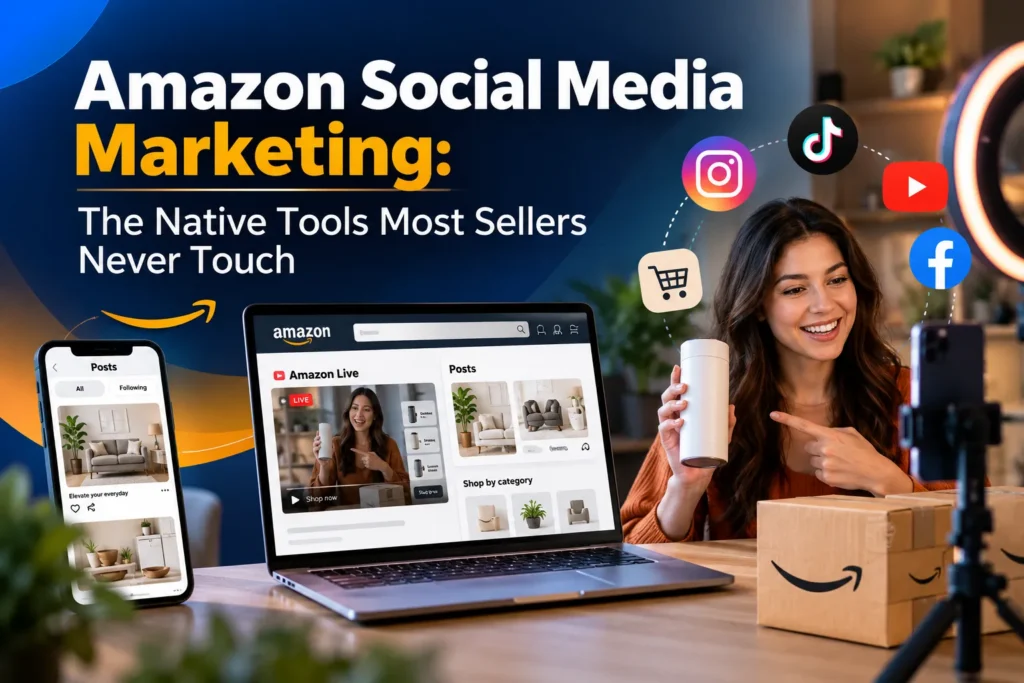
Most “Amazon social media marketing” content is entirely about external platforms — Facebook ads, TikTok videos, Pinterest pins — driving traffic back to your listing. That’s half the picture. Amazon has its own native social commerce tools, Amazon Live and Amazon Posts, that most sellers never touch, despite being free and built directly into the platform your customers already trust.
Key Takeaways
- “Amazon social media marketing” actually means two different things: using external platforms (Facebook, Instagram, TikTok, Pinterest) to drive traffic to Amazon, and using Amazon’s own native social features (Amazon Live, Amazon Posts) that most content skips entirely.
- Amazon was ranked the #1 brand on TikTok by earned media value in a recent 12-month analysis, ahead of the NBA, NFL, and Sephora — signaling just how much organic social attention already surrounds the platform.
- User-generated video content now appears directly on product detail pages, not just on external social platforms, meaning UGC strategy has become a listing optimization tactic, not purely an external-traffic one.
- Amazon’s Brand Referral Bonus program rewards external social traffic specifically with a referral fee discount, giving social media efforts a direct, quantifiable financial return beyond just brand awareness.
- Not every platform deserves equal investment — Pinterest’s effectiveness for driving Amazon sales specifically remains less proven than Facebook, Instagram, or TikTok, and should be tested cautiously rather than assumed.
Two Different Things Called “Amazon Social Media Marketing”
| Factor | External Platform Marketing | Amazon’s Native Social Tools |
| Where it happens | Facebook, Instagram, TikTok, Pinterest | Directly inside Amazon (Amazon Live, Amazon Posts) |
| Cost | Paid ads or organic content investment | Free to use, no platform fee |
| Primary goal | Drive external traffic to your listing | Engage shoppers already browsing Amazon |
| Attribution | Requires Amazon Attribution tags or UTM tracking | Native, built into Amazon’s own reporting |
| Brand Registry required | No | Generally yes |
Most content on this topic — including the primary competitor’s piece — covers only the left column. The right column is where a genuinely underused opportunity sits, since these tools are free, native, and require no external ad spend to start.
Amazon’s Own Native Social Tools (Usually Skipped)
Amazon Live
Amazon’s livestream shopping feature lets brand-registered sellers broadcast live video directly on Amazon, demonstrating products, answering viewer questions in real time, and linking directly to purchase — all without the shopper ever leaving Amazon. This is functionally similar to TikTok Live or Instagram Live shopping, but with the advantage of happening on the same platform where checkout is one click away, removing the external-traffic friction that Facebook or TikTok content still has to overcome.
Amazon Posts
A native, Instagram-feed-style content format where brand-registered sellers publish lifestyle images and short captions that appear on their Brand Store, on relevant product pages, and in a dedicated feed shoppers can browse. It’s a low-effort way to build an ongoing content presence without needing an external platform strategy at all — genuinely underused given how few sellers actively maintain a Posts feed compared to how many run external social ads.
Amazon Influencer Program
Distinct from the general Associates affiliate program, this is specifically for social media influencers, letting them build a dedicated Amazon Storefront and earn commissions (commonly 1-20% depending on category) promoting products through their own content, primarily on TikTok, Instagram, and YouTube. For brands, partnering with Amazon Influencer Program creators is a specific, trackable way to generate off-Amazon content that drives traffic back to a listing — see our best Amazon influencer marketing agencies guide if you’re evaluating hiring an agency to manage these relationships rather than doing it in-house.
External Platforms: What Actually Works
Amazon was ranked the #1 brand on TikTok by earned media value in a 12-month analysis (March 2023–February 2024), ahead of the NBA, NFL, Sephora, and Fortnite — a signal of just how much organic social attention already surrounds the platform, independent of any single seller’s own campaigns.
Facebook and Instagram
Facebook Ads let sellers target based on demographics, interests, and behaviors, and generally cost less per click than Amazon PPC, with enhanced tracking tools available to measure which clicks actually convert to Amazon sales. Instagram, under the same ad platform, extends this to a more visually-driven audience.
TikTok
Short-form video content — unboxings, demonstrations, before-and-after comparisons — performs well specifically because the format rewards authentic, unpolished content over produced advertising. The #FoundItOnAmazon hashtag has become a genuine discovery mechanism, with creators actively tagging Amazon product content this way, giving brands a real way to find engaged creators already promoting products in their category.
Worth a specific honest note: Pinterest’s effectiveness for driving Amazon sales specifically is still less proven than Facebook, Instagram, or TikTok. Treat it as a smaller, lower-priority test rather than a core channel, particularly for categories outside home decor, fashion, and similar highly visual, planning-oriented purchases where Pinterest’s browsing behavior naturally fits.
The Landing Page Question
Sending social traffic directly to an Amazon listing works, but a well-optimized landing page in between can filter serious buyers, capture emails for future marketing, and improve overall conversion quality before the click ever reaches Amazon. This adds a step and some technical setup (URL formatting for Amazon-bound traffic can get finicky), but for a brand with the resources to build and maintain it, the additional data capture is a real, ongoing asset that sending traffic directly to Amazon doesn’t provide.
User-Generated Content Now Lives on Your Product Page
This is a detail most social media marketing content hasn’t caught up to: UGC video content — an influencer’s genuine unboxing or demonstration — increasingly appears directly on the Amazon product detail page itself, not just on the external platform where it was originally posted. A fitness influencer’s resistance-band demonstration video, for example, can now function as social proof at the exact moment a shopper is deciding whether to buy, embedded right where that decision happens. This changes how to think about influencer content: it’s not purely a top-of-funnel, external-traffic tactic anymore — the same content can also serve as on-listing conversion support.
The Brand Referral Bonus Connection
As covered in our SEO marketing for Amazon sellers guide, Amazon’s Brand Referral Bonus program rewards Brand Registry-enrolled sellers with a referral fee discount for traffic driven to Amazon from outside sources — including properly-attributed social media traffic. This gives social media marketing a concrete, quantifiable financial return beyond brand awareness: a well-tagged social campaign that converts isn’t just building awareness, it’s directly reducing your effective referral fee on those sales.
Measuring What Actually Matters
Track traffic, conversion rate, and engagement by platform and campaign — not just follower count or impressions, which don’t reliably correlate with actual Amazon sales. Use Amazon Attribution tags on every external link driving to your listings so the resulting sales are actually traceable back to the specific platform and campaign responsible, rather than disappearing into “organic” traffic in your reporting.
How EcomRanker Builds Social Strategy Around Amazon Listings
We treat social media as one input into Amazon performance, not a separate marketing silo — coordinating Amazon Live and Posts content with external platform campaigns, tracking Brand Referral Bonus-eligible traffic, and ensuring UGC content gets deployed both externally and on the product page itself where it can influence the actual purchase decision.
Want a social strategy that ties directly back to measurable Amazon sales impact? Get in touch for a strategy review.
Frequently Asked Questions
1 . What is Amazon social media marketing?
It covers two distinct approaches: using external platforms like Facebook, Instagram, TikTok, and Pinterest to drive traffic to Amazon listings, and using Amazon’s own native social tools like Amazon Live and Amazon Posts directly on the platform.
2 . What is Amazon Live?
A native livestream shopping feature for Brand Registry-enrolled sellers, letting them demonstrate products and answer questions in real time while shoppers purchase without leaving Amazon.
3 . What is Amazon Posts?
A native, Instagram-feed-style content format where brand-registered sellers publish images and captions that appear on their Brand Store, relevant product pages, and a browsable feed.
4 . Is the Amazon Influencer Program the same as Amazon Associates?
No. Amazon Associates is a general affiliate program for any content creator. The Amazon Influencer Program is specifically for social media influencers and includes a dedicated Amazon Storefront tied to their content.
5 . Which external social platform works best for driving Amazon sales?
Facebook, Instagram, and TikTok have the strongest track record. Pinterest’s effectiveness for Amazon-specific sales is less proven and works best for highly visual, planning-oriented categories like home decor and fashion.
6 . Does social media traffic actually affect my Amazon ranking?
Indirectly, yes — traffic that converts contributes to sales velocity, a genuine ranking factor, and properly-attributed traffic can also qualify for the Brand Referral Bonus fee discount.
7 . Can influencer content appear directly on my Amazon listing?
Yes. UGC video content increasingly appears directly on product detail pages, functioning as social proof at the point of purchase decision, not just on the external platform where it was originally posted.
8 . Should I send social traffic directly to Amazon or to a landing page first?
Both are valid. Direct-to-Amazon is simpler and captures the immediate sale. A landing page adds a data-capture and filtering step, better suited to brands with the resources to build and maintain one.
9 . Do I need Brand Registry to use Amazon’s native social tools?
Generally yes — Amazon Live and Amazon Posts both require active Brand Registry enrollment.