
Amazon has quietly rolled out a new Prime-exclusive promotion that rewards shoppers for reordering products they’ve bought before. Prime members who add five qualifying items to a single order get an automatic 10% discount at checkout — no coupon clipping, no promo code. The deal was first spotted by deal-tracking outlets Miles to Memories and Danny the Deal Guru, and it’s been showing up across a wide range of Prime accounts since late August 2026.
Amazon hasn’t published a Seller Central announcement, a press release, or a seller-blog post naming this promotion. That silence matters, because the five-item threshold and the discount size line up closely with an existing program most consumables sellers already have running in the background: Subscribe & Save.
How the Offer Looks to Shoppers
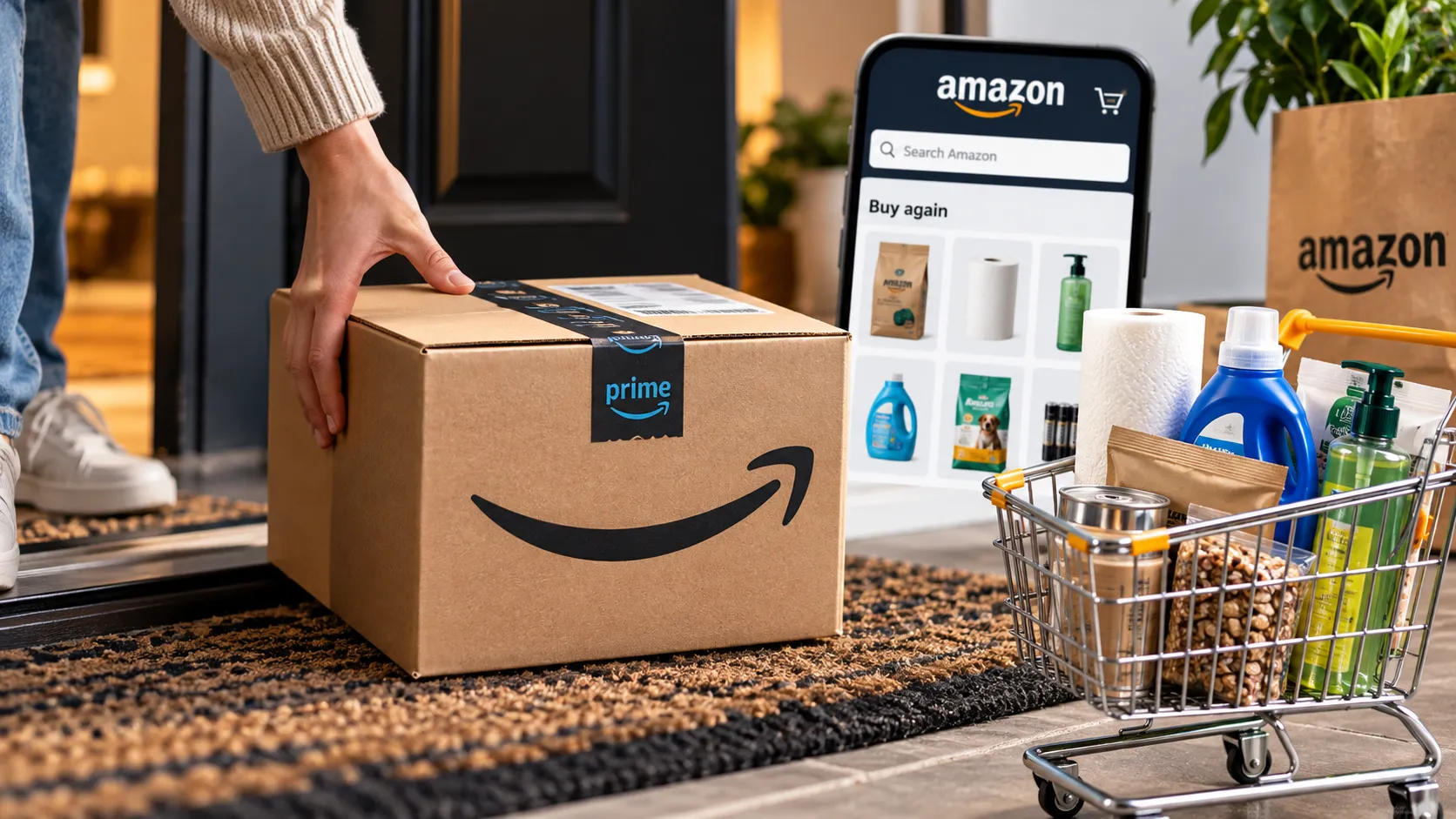
Eligible listings carry an on-page label reading “Save 10% when you reorder 5 qualifying items with Prime.” Add five labeled items to one order and the 10% comes off automatically at checkout. The published terms add a few details worth knowing:
- Only items carrying the qualifying label count toward the five-item threshold — four qualifying items plus one non-qualifying item earns nothing.
- The promotion is valid for a limited time and subject to item availability, and Amazon can modify or cancel it at any time.
- Eligible categories skew toward consumables and replenishables: groceries, household supplies, baby products, and personal care items.
- If a discounted item is returned, the refund equals the price actually paid — the discounted amount, not the full list price.
- The offer is Prime-gated and non-transferable; non-Prime shoppers never see the label.
The Funding Question: What Amazon Actually Confirms
Amazon’s own Subscribe & Save program page (published on sell.amazon.com, independent of any deal-blog coverage) spells out the mechanic that this new promotion appears to be riding on. Every product enrolled in Subscribe & Save starts at a 0% seller-funded discount, which a seller can raise to 5% or 10%. Separately, Amazon funds its own additional 5% discount whenever a customer’s Subscribe & Save delivery includes five or more items from that seller.
A five-item threshold triggering roughly 10% off is exactly what Subscribe & Save already does at the seller’s 5% tier once Amazon’s automatic 5% stacks on top. It’s a reasonable inference — not a confirmed fact, since Amazon hasn’t said so directly — that “Reorder 5, Save 10%” extends that same funding logic to one-time Prime purchases, not just active subscriptions. Sellers who never enrolled in Subscribe & Save optimization, or who kept their seller-funded tier at 0%, may simply not show up in this promotion at all.
Check Your Exposure in 10 Minutes
Rather than guess, look at your own account. Amazon’s Subscribe & Save documentation gives a direct path: in Seller Central, hover over Growth, click Explore Programs, click Increase conversion, then open the Subscribe & Save card. That page lists every enrolled ASIN, its current seller-funded discount tier, and program-level performance metrics — which is the fastest way to see whether your catalog is sitting at 0%, 5%, or 10%.
- If a product shows a 5% or 10% seller-funded tier, assume it’s a candidate for the reorder promotion and model the margin impact below.
- If a product is auto-enrolled at 0%, the exposure is limited to whatever Amazon funds on its own.
- FBA products meeting the category, pricing, and performance bar are enrolled automatically; merchant-fulfilled sellers who want in have to request enrollment through Seller Support.
What a 10% Reorder Discount Actually Does to Margin
A flat 10% price cut costs more than 10% of profit, because referral fees shrink with price but fixed fulfillment fees don’t. Take a $32.00 pet-supplement listing with $9.00 in landed cost, a 15% referral fee ($4.80), and a $6.20 FBA fee. Net profit per unit at full price is $12.00.
Apply the 10% reorder discount and the price drops to $28.80. The referral fee falls to $4.32, the FBA fee stays fixed at $6.20, and landed cost is unchanged at $9.00 — leaving $9.28 in profit per unit. That’s a profit decline of roughly 23%, nearly double the 10% revenue drop, and it means unit volume would need to rise by close to 30% just to break even on total profit.
Amazon reports that Subscribe & Save discounts in the 10% to 15% range can drive up to a 1.8x lift in conversion — comfortably above that breakeven threshold if the extra volume is genuinely incremental. The risk is cannibalization: a customer who already reorders your product every month without any nudge now gets 10% off for behavior you were getting for free. Protecting your margin means segmenting reorder volume between customers who needed the discount and those who didn’t — that’s the only way to know if it paid for itself.
A Separate Tool Sellers Still Control: Reorder Coupons
It’s worth not confusing this site-wide promotion with the “Reorder” coupon type already available in Seller Central’s Amazon coupons manager. They are different mechanisms with different owners:
- Reorder 5, Save 10% (this promotion): Site-wide, Amazon-initiated, applied automatically at checkout once a Prime cart hits five qualifying items — sellers don’t set the percentage or the trigger.
- Reorder Coupons (Seller Central): Created and funded individually by sellers, targeted at their own past customers who haven’t reordered within an expected window, with standard clip and redemption fees and a run time of up to 180 days.
If margin discipline matters more than blanket enrollment, a self-funded Reorder Coupon still lets a seller choose the discount percentage, the budget, and which ASINs are included — rather than waiting to find out whether a listing was pulled into Amazon’s version.
The Bottom Line
“Reorder 5, Save 10%” reads like a shopper convenience, but for consumables sellers it’s a margin question hiding behind a checkout label. Pull up the Subscribe & Save card in Seller Central this week, check which ASINs are funded at 5% or 10%, run the profit math before assuming the conversion lift pays for itself, keep Reorder Coupons in mind as the version of this discount you can actually control, and think about retention strategy beyond one promotion so repeat-purchase revenue doesn’t depend on whichever checkout nudge Amazon is running this quarter.