
Why Listing Design Is Worth Taking Seriously
A shopper decides whether to click your listing based almost entirely on your main image and price — before they’ve read a single word of your title or bullets. Once they’ve clicked, it’s the rest of your image set — lifestyle shots, infographics, size/scale references — that does the heavy lifting on whether they actually buy. Amazon’s own data shows Basic A+ Content can lift sales by up to 8%, and well-executed Premium A+ Content by up to 20% — and both depend heavily on the underlying visual assets being genuinely strong, not just present.
Weak images have a specific, predictable cost: a confusing secondary image creates hesitation, a missing size reference drives returns, a crowded infographic gets skipped entirely, and a lifestyle image that looks obviously generic or AI-generated undermines trust right at the moment a shopper is deciding whether to buy from you.
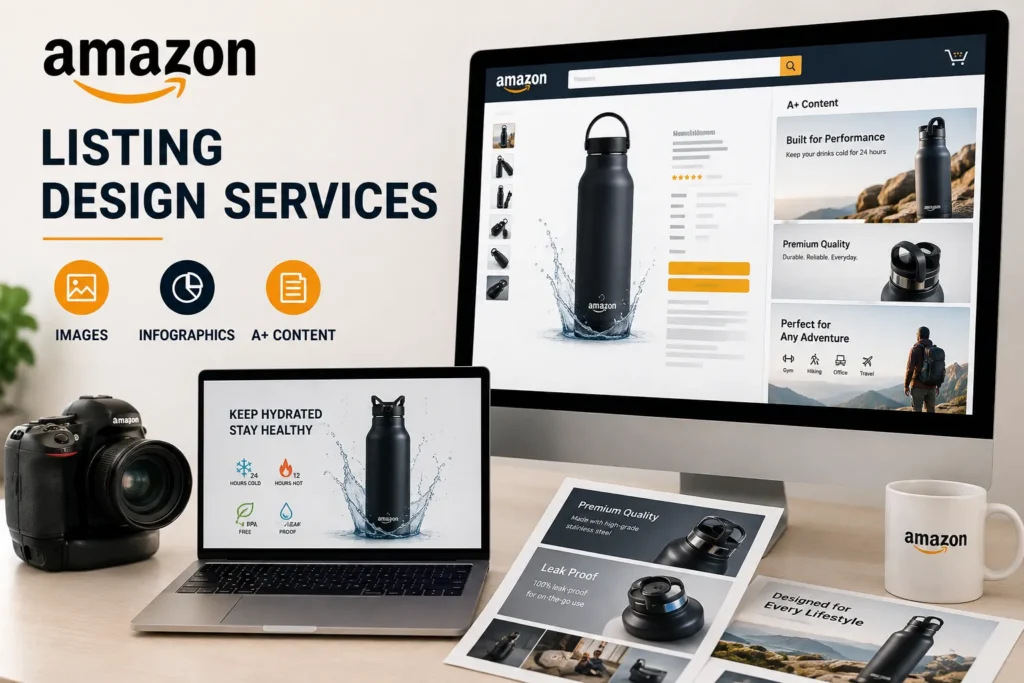
What’s Included in Our Listing Design Service
- Main image design (Amazon-compliant: pure white background, 85%+ frame fill)
- Lifestyle images showing the product in real-world use context
- Infographics communicating key features, benefits, and use cases at a glance
- Size, scale, and dimension charts to reduce buyer uncertainty and returns
- A+ Content / Enhanced Brand Content modules (Basic and Premium)
- Brand Storefront design (banners, category pages, homepage layout)
- Comparison charts for multi-variant or competitive listings
What Listing Design Typically Costs in 2026
Pricing across the market varies enormously depending on whether you’re working with a freelancer, a templated budget service, or a full custom build with strategy and copy included:
| Provider Type | Typical Range | What You’re Actually Getting |
| Freelancer (1-3 images) | $50-150 per image | Fast, cheap execution — works if you can brief clearly and the category isn’t compliance-heavy |
| Templated budget service | $99-350 for a full set | Functional, compliant images at low per-ASIN cost, with little strategic customization |
| Mid-tier agency, full set + A+ | $500-1,500 per ASIN | Custom design with some research, revisions included |
| Premium custom build | $2,500-8,000 per ASIN | Full research, copywriting, photography, and premium A+ Content bundled in |
What you should spend depends on your monthly ad spend behind the listing and how competitive the category is — a listing carrying significant PPC spend justifies a stronger investment in images, since every wasted click from a weak image set is wasted ad spend, not just a missed organic sale.
Freelancer vs. Agency vs. AI Tools: What Actually Works
- A freelancer makes sense when: your budget is under roughly $500, you can brief clearly, the category isn’t compliance-heavy, and you need one to three images rather than a full strategic set.
- An agency makes sense when: the category is competitive enough that image quality is a real differentiator, you’re running meaningful paid traffic and a weak image set is actively wasting ad spend, or you need compliance-sensitive elements (supplement label callouts, accurate dimension diagrams) done correctly the first time.
- AI tools are useful for: mood-boarding and testing visual directions before a real briefing call — but as of 2026 they’re not yet reliable for final Amazon deliverables. AI-generated images consistently struggle with Amazon’s 85% frame-fill requirement without manual correction, accurate dimension diagrams, compliance-heavy callouts, and lifestyle images that read as genuinely in-context rather than obviously synthetic.
Our Design Process
Step 1: Creative Brief
We start with your product, category, competitive set, and any existing brand guidelines — not a blank template. If you’re targeting UK and US storefronts, we account for spelling and cultural context differences at this stage rather than retrofitting them later.
Step 2: Initial Concepts
You receive first-round concepts reflecting distinct creative directions, not minor variations on one idea, so you’re genuinely choosing a direction rather than approving the only option.
Step 3: Revisions
Once you’ve picked a direction, we refine it against your feedback until it’s right — not a single take-it-or-leave-it deliverable.
Step 4: Compliance Check
Every image is checked against Amazon’s current technical requirements (background, frame fill, resolution) before delivery — automated upload validation catches some of this, but not compliance issues specific to your category, like supplement label callouts or accurate size representation.
Step 5: A/B Testing Guidance
We recommend treating your first delivered image set as a hypothesis, not a finished product — run it through Amazon’s Manage Your Experiments tool where eligible. Main image changes tend to move CTR; full-set changes tend to move conversion rate. This connects directly to your broader Amazon Listing Optimization work, since design and copy should be tested and iterated together, not treated as a one-time deliverable.
Frequently Asked Questions
Q: How much do listing images actually affect conversion rate?
A: Significantly — images are widely estimated to drive roughly 70% of a listing’s conversion rate. If traffic is clicking through but not buying, the image set is almost always the first thing worth investigating.
Q: What’s the difference between Basic and Premium A+ Content?
A: Basic A+ Content uses standard modules and can lift sales by up to roughly 8%. Premium A+ Content adds video, interactive modules, and more sophisticated layout options, and well-executed builds can lift sales by up to roughly 20%.
Q: How many images does my listing actually need?
A: A typical strong set includes a main image, one or two lifestyle images, and three to five infographics covering features, benefits, use cases, and size/scale — seven images total is a common baseline before considering A+ Content separately.
Q: Can you use AI-generated images for my listing?
A: AI tools are useful earlier in the process for mood-boarding and direction-testing, but as of 2026 they’re not yet reliable for final Amazon deliverables — they consistently struggle with Amazon’s frame-fill requirements, accurate dimension diagrams, and compliance-heavy callouts without significant manual correction.
Q: What’s Amazon’s main image frame-fill requirement?
A: Amazon requires the product to fill at least 85% of the image frame on a pure white background for the main image — a common and easily avoidable rejection reason for DIY or AI-generated images.
Q: Do you need my own product photos, or can you create everything from scratch?
A: We can work from your existing product photography, or coordinate photography as part of a fuller package if you don’t have usable shots yet — lifestyle and infographic elements are typically designed around real product photography rather than generated from nothing.
Q: How long does listing design typically take?
A: Initial concepts are typically ready within a few business days of a completed brief, with revision rounds turning around quickly after that — full timelines depend on scope (a single image set vs. a full A+ Content and brand store build).
Q: Will new images affect my existing reviews or ranking?
A: No — updating listing images doesn’t affect your accumulated reviews or organic ranking history. It can, however, meaningfully change your conversion rate and therefore your sales velocity going forward.
Q: Should I redesign my images if my listing is already selling well?
A: Often yes, if it’s been a while — competitor listings improve, customer expectations shift, and Amazon periodically adds new attribute and template options. A quarterly or biannual creative refresh keeps a catalogue competitive rather than slowly falling behind newer listings.
Q: What’s the difference between listing images and Brand Store design?
A: Listing images live on the individual product detail page. Brand Store design is your dedicated storefront — a multi-page branded destination shoppers can browse, often linked from Sponsored Brands ads — and is priced and scoped separately from individual listing image sets.
Q: Do you handle supplement or compliance-heavy categories?
A: Yes — compliance-heavy categories like supplements require specific label callouts and formatting that generic design services and AI tools frequently get wrong; this is exactly the kind of detail worth an experienced agency over a templated or DIY approach.
Q: How does listing design connect to my PPC performance?
A: Directly — a weak image set means paid clicks convert poorly, which raises your effective ACOS without any change to bids or targeting. Improving images is one of the highest-leverage ways to make existing ad spend work harder, not just an organic-traffic concern.