
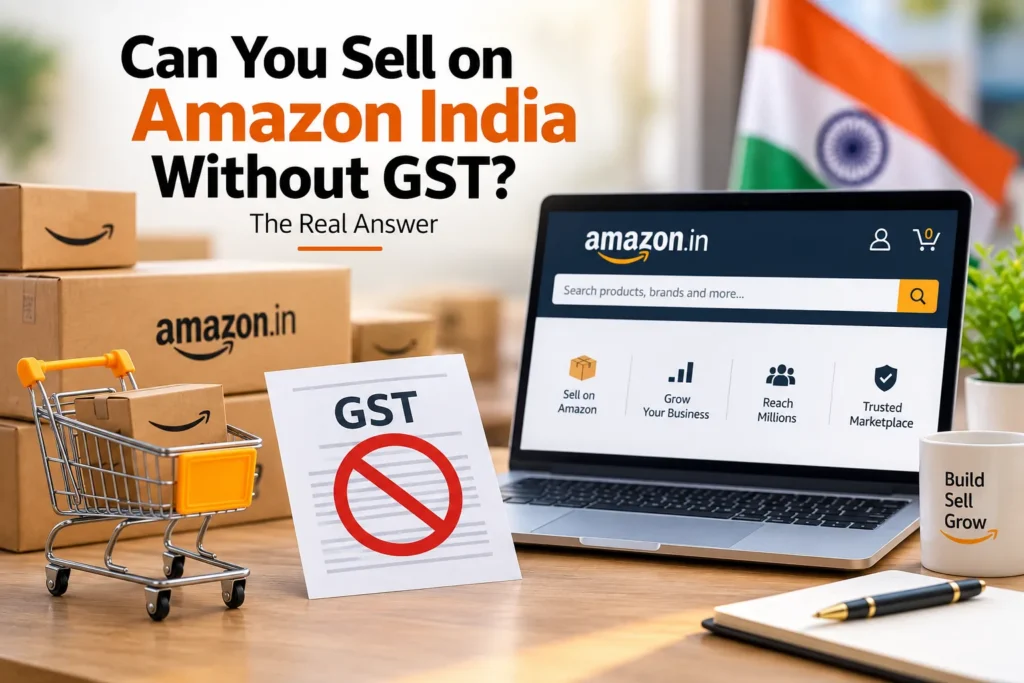
For most Amazon India sellers, the answer is no — and a specific, commonly repeated claim about a turnover-based exemption is incorrect. Under Section 52 of the CGST Act, e-commerce sellers don’t get the general turnover exemption that applies to other small businesses. The two genuine paths to skip GST are selling only fully exempt goods, or using a newer, narrower Enrollment ID scheme for intra-state sales only.
Key Takeaways
- The general GST turnover exemption (₹40 lakh for goods, lower for special category states) does not apply to e-commerce sellers — multiple sites repeat this as if it does, but Section 52 of the CGST Act specifically requires GST registration for anyone selling through an e-commerce operator like Amazon, regardless of turnover.
- There are two genuine paths to sell without a full GSTIN: selling only products that are fully GST-exempt under law, or using the Enrollment ID scheme for intra-state-only sales below a certain threshold.
- GST-exempt categories are narrow and specific — certain unprocessed agricultural products, some printed books, and similarly defined goods — not a broad category most sellers’ products fall into.
- Amazon requires proof of exemption before allowing exempt-goods listing, not just a self-declaration.
- FBA generally isn’t compatible with GST-exempt selling — sellers without a GSTIN typically need to use FBM (self-fulfillment) instead, since FBA’s warehousing model has its own tax implications.
The Widespread Misinformation on This Topic
Searching this question turns up genuinely conflicting information. Several sources suggest that Amazon sellers below the standard GST turnover threshold (₹40 lakh for goods in most states, ₹20 lakh in special category states) don’t need to register — treating Amazon sellers the same as any other small business. This is incorrect, and it’s worth being direct about why: e-commerce sellers are treated differently under GST law specifically, and the standard turnover exemption doesn’t apply to them the way it does to a seller operating purely offline or through their own website.
Why the Turnover Threshold Doesn’t Save You Here
Under Section 52 of the CGST Act, any seller operating through an e-commerce operator — Amazon, Flipkart, Meesho, and similar platforms — is subject to Tax Collected at Source (TCS) requirements that trigger a GST registration obligation regardless of turnover. This is the specific legal mechanism that separates e-commerce sellers from the general small-business exemption: Amazon deducts TCS from your payments as an e-commerce operator, and that TCS system depends on you having a GSTIN. If you’re selling standard taxable products through Amazon, being below ₹40 lakh in turnover does not exempt you — this is the single most important correction to make against the misinformation circulating on this topic.
The Two Genuine Paths to Selling Without a Full GSTIN
Path 1: Selling Only GST-Exempt Goods
If every product you sell falls under a genuinely GST-exempt category, you may be able to list on Amazon without a full GSTIN. This is narrow — exempt categories include things like certain unprocessed agricultural products, specific printed books, and similarly defined goods under GST law’s exemption notifications. Amazon requires proof that your goods are actually exempt before allowing this — it’s not a self-declared status you can simply claim during registration. If your catalog includes even one taxable product alongside exempt ones, this path doesn’t apply to your account as a whole.
Path 2: The Enrollment ID for Intra-State Sales
A newer, narrower option: some small sellers may be able to use an Enrollment ID obtained through the GST portal, rather than a full GSTIN, specifically for intra-state sales only (selling only within your home state) and typically tied to a lower turnover threshold. This is a real, distinct mechanism from the exempt-goods path above, but it’s also more limited: it doesn’t extend to inter-state sales, which most Amazon sellers naturally do given Amazon’s national customer base.
| Factor | GST-Exempt Goods Path | Enrollment ID Path |
| What you can sell | Only fully exempt product categories | Any category, but only within your home state |
| Geographic scope | National (exemption follows the product) | Intra-state only |
| Proof required | Documentation that goods are genuinely exempt | Enrollment ID from the GST portal |
| Practical fit for most sellers | Narrow — most catalogs aren’t fully exempt | Narrow — most sellers want national reach |
What Happens If You List Without Proper GST Compliance
- Your Amazon account can be blocked entirely, preventing you from listing, selling, or receiving payments
- You cannot claim input tax credit on your business purchases without a valid GSTIN
- Inter-state sales become impossible without proper GST registration
- Financial penalties apply for non-compliance — commonly cited as 10% of tax due (with a stated minimum) for unregistered sales, escalating significantly for deliberate evasion
These consequences apply whether the non-compliance was deliberate or simply a misunderstanding based on inaccurate information about the turnover exemption — which is exactly why clearing up that specific misconception matters.
FBA vs. FBM Considerations for Exempt Sellers
If you do qualify to sell without a GSTIN through the exempt-goods path, FBA (Fulfilled by Amazon) generally isn’t compatible with that setup. Amazon’s FBA warehousing model has its own tax registration implications tied to where inventory is stored, which typically requires GST registration regardless of your product’s exemption status. Sellers pursuing the GST-exempt path should generally plan on FBM (Fulfilled by Merchant) instead, handling fulfillment themselves rather than assuming FBA remains available without a GSTIN.
When You Should Just Register for GST Instead
For most sellers, especially anyone planning genuine national reach, a mixed catalog, or FBA fulfillment, pursuing GST registration directly is simpler and more scalable than trying to structure an entire business around one of the two narrow exemption paths above. GST registration is free, fully online, and commonly completes within 7–10 working days when documentation is in order — a modest time investment against the risk of account blocking, penalties, or being structurally locked out of FBA and inter-state sales. For our full walkthrough of the broader registration process, see our guide to starting an Amazon seller business in India.
How EcomRanker Helps Sellers Navigate GST Compliance
We help sellers determine honestly whether an exemption path genuinely applies to their catalog, or whether standard GST registration is the more practical route — correcting the kind of turnover-threshold misconception that circulates widely on this specific topic before it becomes an account-blocking problem.
Unsure whether your product catalog genuinely qualifies for a GST exemption path, or ready to register properly? Get in touch for a compliance review.
Frequently Asked Questions
1 . Can I sell on Amazon India without a GST number?
In most cases, no. E-commerce sellers are subject to Section 52 of the CGST Act, which requires GST registration regardless of turnover. The only genuine exceptions are selling exclusively GST-exempt goods, or using the newer Enrollment ID scheme for intra-state-only sales.
2 . Does the ₹40 lakh GST turnover exemption apply to Amazon sellers?
No. This is a common misconception. The standard small-business turnover exemption does not apply to sellers operating through an e-commerce operator like Amazon, which is subject to separate TCS requirements under GST law.
3 . What products are GST-exempt on Amazon?
Exempt categories are narrow and specific, including certain unprocessed agricultural products and some printed books, defined under GST law’s exemption notifications — not a broad category most standard product catalogs fall into.
4 . Do I need proof to list GST-exempt products without a GSTIN?
Yes. Amazon requires documentation confirming your goods are genuinely exempt before allowing this kind of listing — it’s not a self-declared status.
5 . What is the Enrollment ID and how is it different from a GSTIN?
The Enrollment ID is obtained through the GST portal and allows some small sellers to sell without a full GSTIN, but only for intra-state sales (within your home state), unlike a GSTIN which allows national sales.
6 . Can I use FBA without a GST number?
Generally no. FBA’s warehousing model has its own tax registration implications, and sellers pursuing a GST-exempt path typically need to use FBM (self-fulfillment) instead.
7 . What happens if I sell on Amazon without proper GST compliance?
Your account can be blocked entirely, you cannot claim input tax credit, inter-state sales become impossible, and financial penalties apply, potentially including a percentage of tax due with an escalating penalty for deliberate evasion.
8 . Should I just register for GST instead of trying to qualify for an exemption?
For most sellers, yes. Registration is free, fully online, and typically completes within 7-10 working days, which is simpler than restructuring a business around one of the narrow exemption paths.
9 . Is GST registration required even for a small, part-time Amazon seller?
Yes, in most cases. Unlike other small businesses, e-commerce sellers don’t benefit from the standard turnover-based exemption, so even modest sales volume typically requires registration.
10 . Where can I verify the current GST-exempt category list for Amazon?
Check the official GST portal directly and confirm with Amazon Seller Central’s current guidance, since exempt categories and enrollment mechanisms can be updated by both the government and the platform.