
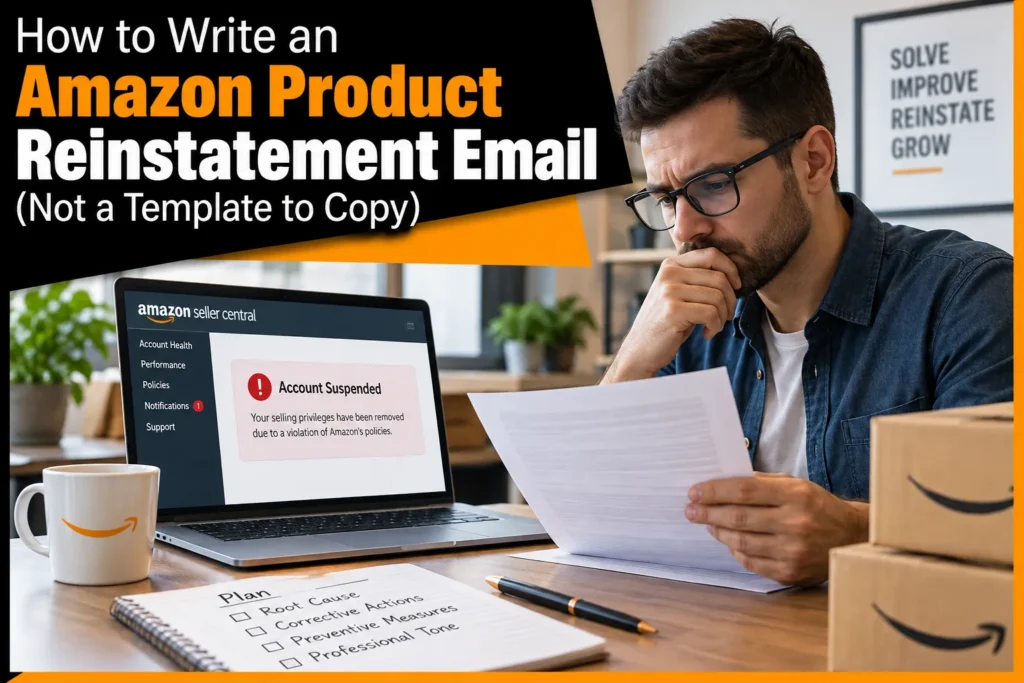
A product takedown needs a genuinely customized appeal, not a copy-pasted template — Amazon’s reviewers see thousands of appeals, and generic templated language is a documented reason appeals get rejected. This guide covers the real structure (root cause, corrective action, preventive measures), the correct department to route your case to, and what documentation actually moves the needle, so you can write something specific to your actual situation.
Key Takeaways
- A product/ASIN-level takedown is different from an account-level suspension — it typically routes to a specific internal team (Notice Dispute, Listing Evaluation, or Product Compliance) rather than the general account-health appeal process.
- Copy-pasted templates are a documented cause of rejected appeals — multiple sources in this space, including reinstatement specialists themselves, explicitly warn against reusing generic templates rather than writing a case-specific response.
- Every effective appeal follows the same underlying structure: root cause, corrective action, and preventive measures — but the specific content within that structure has to match your actual situation, not a fill-in-the-blank script.
- Documentation matters more than wording — invoices, Certificates of Analysis, authorization letters, and other concrete evidence carry more weight than persuasive writing alone.
- Escalation paths exist beyond the standard teams for genuinely stuck or repeated false-claim situations, but should be used sparingly and only after the standard process has been exhausted.
Why Copy-Paste Templates Actually Hurt Your Case
This is worth stating plainly before anything else: reusing a generic reinstatement email template you found online is a documented way to weaken your appeal, not strengthen it. Amazon’s reviewers process large volumes of appeals and can recognize generic, non-specific language that doesn’t actually address the specific violation cited in your notice. Independent reinstatement specialists in this space explicitly warn against this — one describes seeing “countless” sellers reuse the same widely-circulated template, which does nothing to demonstrate genuine understanding of the root cause. The goal of this guide isn’t to hand you a script to copy — it’s to teach you the underlying structure so you can write something that actually reflects your specific ASIN, violation, and corrective steps.
Who to Contact for a Product-Level Takedown
Unlike account-level suspensions, which route through the general Account Health appeal process, product-level takedowns typically go to a specific internal team depending on the issue:
| Team | Handles | Typical Contact |
| Notice Dispute Team | Copyright, trademark, and IP-related disputes | notice-dispute@amazon.com |
| Listing Evaluation Team | Product detail page accuracy, title, and listing issues | listings-evaluation@amazon.com |
| Product Compliance Team | Product safety, restricted ingredients, policy compliance | product-compliance@amazon.com |
Confirm the current, correct address for your specific case type directly in your Seller Central notification rather than assuming these addresses are permanently fixed — Amazon periodically updates routing, and Seller Support can also confirm the correct team if your notice doesn’t specify one clearly.
The Structure Every Effective Email Follows
Regardless of the specific violation, a genuinely effective appeal follows the same three-part skeleton — the content within each part is what needs to be specific to you:
- Root Cause — State plainly and specifically what actually happened. Avoid vague language (“there was a misunderstanding”) in favor of a precise explanation tied to the exact issue Amazon cited.
- Corrective Action — Describe what you’ve already done to fix the immediate problem: corrected documentation submitted, a supplier relationship verified, a listing detail updated.
- Preventive Measures — Explain the specific process change that prevents this from recurring, not a general promise to “be more careful.” A specific new verification step, a documented supplier vetting process, or an updated internal review checklist all demonstrate more than a general assurance.
Writing genuinely to this structure — filling in your own specific facts rather than adapting someone else’s example — is what separates a customized appeal from a templated one, even when the underlying skeleton looks similar across cases.
Illustrative Structure (Not a Template — Replace Every Bracket With Your Own Specifics)
The example below shows how the three-part structure looks in practice for a restricted-ingredients takedown. This is not meant to be copied with just the bracketed fields swapped out — the actual sentences should be rewritten in your own words, reflecting your specific product, lab results, and process changes. Its only purpose is showing what “specific” looks like versus “generic”:
Weak (generic, templated): “We assert that this product does not contain any restricted ingredients and have attached the certificate of analysis as proof that this product is in full compliance with Amazon Policy.”
Stronger (specific, case-built): “The cited concern was [specific ingredient] exceeding [specific threshold]. Our attached Certificate of Analysis from [accredited lab name], dated [date], confirms [specific finding] at [specific measured level], below the applicable threshold. We have also updated our supplier quality agreement to require a COA with every incoming batch, attached as a second document, to prevent this specific gap going forward.”
Notice what changed: the second version names the specific ingredient and threshold, cites a specific lab and date, and describes a specific process change — none of which a generic template can pre-fill for you, because it depends entirely on your actual case.
Escalation Example: When a Pattern of False Claims Persists
For a genuinely persistent pattern — not a single takedown — some sellers have used a direct escalation channel (historically an executive-level contact) as a last resort, after standard appeals repeatedly succeeded on individual ASINs but the underlying pattern of false claims continued. If you pursue this route, the substance matters more than the channel: document every Case ID involved, show that each individual appeal was previously resolved in your favor, and frame the request as asking Amazon to investigate the source of a repeated pattern — not as a way to skip the standard process for a single case. Response times for this kind of escalation are typically measured in weeks, not days, and it should be reserved for exactly this kind of documented, repeated pattern rather than routine use.
What Documentation to Include by Takedown Reason
| Takedown Reason | Documentation to Include |
| Restricted or unsafe ingredients | Certificate of Analysis (COA) from an accredited lab |
| Brand or trademark dispute | Brand Registry proof, supplier invoices establishing authorized chain of custody |
| Authenticity/counterfeit concern | Valid invoices from authorized distributors, supplier documentation |
| Missing or invalid documentation | The specific missing document (safety certification, test report) in current, valid form |
| Incorrect categorization | Updated listing details showing the correction already made |
Across every category, the common thread is documentation that existed or was created because of the corrective action you took — not documentation assembled purely to argue your case after the fact. Highlighting or labeling the relevant section of a longer document (rather than expecting a reviewer to search through it) makes verification faster and easier.
Common Product Takedown Reasons
- Policy or listing violations — incorrect product information or misleading claims on the listing itself
- Restricted or unsafe ingredients — flagged compositions requiring lab documentation to resolve
- Brand or trademark disputes — another party claiming ownership or rights conflict over your listing
- Authenticity concerns — counterfeit allegations requiring supply chain proof
- Missing or invalid documentation — required certifications that were never submitted or have expired
- Incorrect categorization — a listing placed in the wrong category or with inaccurate details triggering a compliance flag
Tone and Delivery: What Actually Works
- Be direct and specific from the first line — state the ASIN, the issue, and your request clearly rather than easing into it
- Avoid emotional language or blame — a factual, professional tone reads as more credible than a defensive or frustrated one, even when the takedown genuinely feels unfair
- Take ownership where it’s warranted — phrases acknowledging responsibility, paired with concrete corrective steps, build more trust than deflecting responsibility entirely
- Proofread before sending — an incorrect ASIN, a missing attachment, or unclear explanation can delay resolution independent of how strong your underlying case is
When to Escalate Beyond the Standard Teams
For genuinely stuck cases — particularly a pattern of repeated, seemingly unfounded takedowns against a brand-registered product — an escalation path beyond the standard teams exists, but should be treated as a last resort after the standard process has been exhausted and documented. Reserve escalation for situations with a real, demonstrable pattern (multiple Case IDs, a clear history of resolved-then-recurring false claims), not a single takedown, since overusing an escalation channel for routine cases undermines its effectiveness for situations that genuinely need it.
International Routing Considerations
Department routing and specific contact addresses can differ by marketplace — a US-focused address list doesn’t necessarily apply identically to Amazon.co.uk, Amazon.ae, or Amazon.in cases. If you’re managing a product takedown on a non-US marketplace, check the specific routing indicated in that marketplace’s Seller Central notification rather than assuming the US addresses transfer directly.
How EcomRanker Approaches Product-Level Appeals
We build every product reinstatement case around the specific violation, ASIN, and documentation available — never from a template — because a generic response doesn’t demonstrate the genuine understanding Amazon’s reviewers are actually evaluating. This mirrors our broader account reinstatement approach: manual, customized appeals built on root-cause analysis, not fill-in-the-blank scripts.
Dealing with a product takedown and want a case-specific appeal built rather than a template adapted? Get in touch for a reinstatement review.
Frequently Asked Questions
1 . Should I use a copy-paste email template to appeal a product takedown?
No. Reusing a generic template is a documented cause of rejected appeals, since Amazon’s reviewers can recognize non-specific language that doesn’t address your actual violation. Use the underlying structure, but write content specific to your case.
2 . Who do I contact for an Amazon product takedown?
It depends on the reason: copyright/trademark issues typically go to the Notice Dispute Team, listing accuracy issues to the Listing Evaluation Team, and safety/compliance issues to the Product Compliance Team. Confirm the current correct address in your specific Seller Central notification.
3 . What’s the correct structure for a product reinstatement appeal?
Root cause (what specifically happened), corrective action (what you’ve already done to fix it), and preventive measures (the specific process change preventing recurrence) — with content specific to your actual situation in each section.
4 . How long does Amazon take to respond to a product reinstatement email?
Commonly 24 to 48 hours, though it can take up to a week depending on the case and team. If there’s no response after about a week, follow up using the same case ID rather than opening a new one.
5 . Can I use the same appeal for multiple different ASINs?
No. Each ASIN and violation is different, and a generic appeal reused across multiple products reads exactly like the templated language that gets appeals rejected.
6 . What documentation should I include with a restricted ingredients takedown?
A Certificate of Analysis (COA) from an accredited lab, specifically verifying the ingredients in question meet compliance requirements.
7 . What should I do if my reinstatement appeal is rejected?
Review Amazon’s specific feedback to identify what was missing or unclear, then revise with a more precise explanation and stronger documentation addressing that feedback directly — don’t resubmit the same content with minor wording changes.
8 . Is there an escalation path if standard appeals aren’t working?
Yes, for genuinely stuck cases with a documented pattern of repeated issues, though this should be reserved for serious, well-documented situations rather than routine takedowns.
9 . Does product takedown routing work the same way on UK, UAE, or India marketplaces?
Not necessarily. Check the specific routing indicated in that marketplace’s Seller Central notification rather than assuming US department addresses apply directly.
10 . Can you show me an example of what a reinstatement email should actually look like?
Yes, in structure only — this guide includes an illustrative weak-versus-strong comparison showing what specific, case-built language looks like versus generic templated language, but the actual sentences should always be rewritten to reflect your own product, documentation, and corrective actions.