
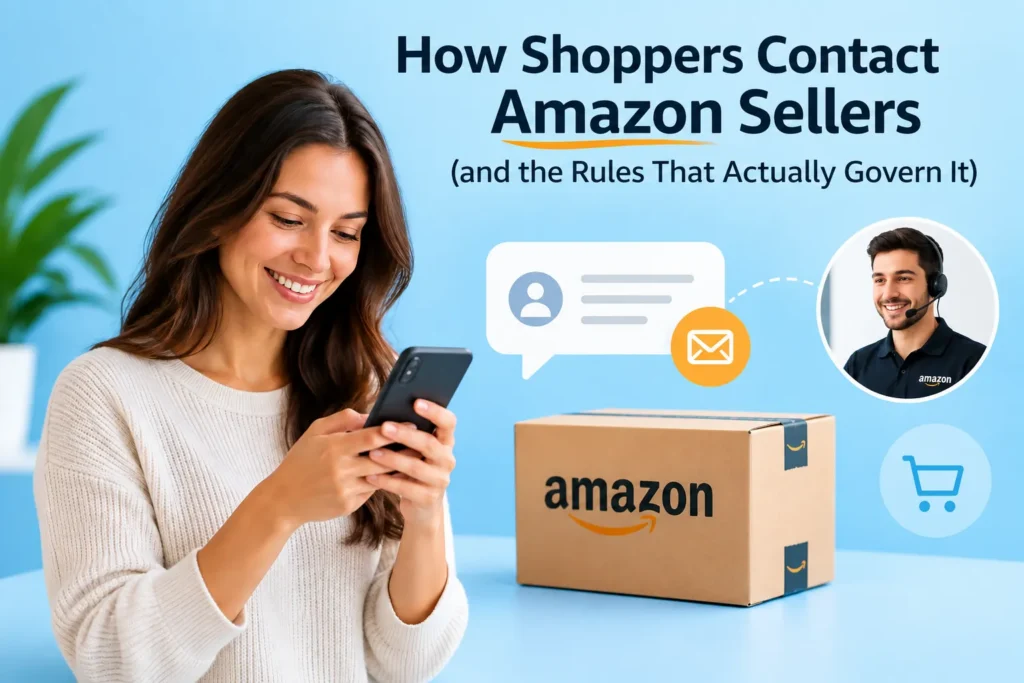
Shoppers reach Amazon sellers through a handful of predictable channels — mainly Buyer-Seller Messaging, triggered from a product page or an order page — but the system running underneath it has a strict, specific rulebook most seller guides only gesture at. Amazon expects a response within 24 hours, tracks that against a 95% compliance threshold tied to your account health, and explicitly prohibits certain content categories that can get your messaging privileges revoked entirely if ignored.
Key Takeaways
- Most shopper contact happens through two in-platform entry points: the “Ask a Question” flow from a product/seller page, and the “Contact Seller” flow from an existing order — both route into Buyer-Seller Messaging.
- Amazon’s response standard is a specific 24-hour window, tracked as a percentage compliance metric (commonly cited around 95% over a rolling 30-day period) that feeds into your account health, not just a vague best practice.
- Amazon explicitly prohibits specific content categories in Buyer-Seller Messaging: promotional content, discount codes, external links, and any request for a positive review or removal of a negative one — violations carry real consequences, not just a warning.
- There’s a defined enforcement ladder for violations: a warning first, then revoked messaging privileges for continued non-compliance, and account suspension in severe or repeated cases.
- A slow or unclear response doesn’t just risk a bad review — it directly increases the odds of a buyer escalating to an A-to-z Guarantee claim, which carries its own account-health consequences.
- FBA sellers have a narrower messaging scope — Buyer-Seller Messaging for FBA orders is meant for product inquiries specifically, with general customer service (shipping, delivery) routed to Amazon Customer Service instead.
The Channels Shoppers Actually Use
Inside Amazon: Product Page and Order-Based Messaging
Shoppers have two primary in-platform paths to reach a seller, both of which route into the same underlying Buyer-Seller Messaging system:
- Pre-purchase, from the product page: a shopper clicks the seller’s name under the product title, finds “Ask a Question” on the seller profile, and sends a message before ever placing an order — commonly used for questions about dimensions, compatibility, or details missing from the listing.
- Post-purchase, from an order: a shopper goes to “Your Orders,” selects “Problem with Order,” chooses a specific topic (item not received, product issue, and similar), and selects “Contact Seller” to message directly about that specific order.
Both paths land in the same place for sellers: Seller Central’s Message Center, accessible either through Feedback Manager or the direct Messages tab, with mobile app support that syncs in real time with the desktop dashboard.
Outside Amazon: Packaging, Websites, and Social Media
Some shoppers bypass Amazon’s built-in tools entirely:
- Contact information on packaging or product inserts — a business email, phone number, or website included in the box itself, giving shoppers a direct line for post-purchase questions or warranty issues
- A seller’s own website — brands with a DTC presence sometimes field product questions there instead of through Amazon
- Social media — shoppers occasionally reach out publicly through a brand’s social channels, particularly for complaints they want visibility on
External channels offer more flexibility for detailed conversations or business inquiries (bulk orders, wholesale interest) than Amazon’s more restricted in-platform messaging allows — but as covered below, that flexibility doesn’t extend to what’s permitted inside the Amazon messaging system itself.
Why Shoppers Reach Out
Three broad categories cover most contact reasons: getting information the listing doesn’t already answer (dimensions, materials, compatibility), resolving an order problem (delayed shipment, wrong item, defect, missing tracking), and providing feedback — positive or negative — about their experience. Recognizing which category a message falls into early helps triage response priority: order problems generally need faster, more specific resolution than general information requests, since they carry more direct account-health and immediate-customer-satisfaction weight.
The Exact Response Time Standard (and What Breaks It)
Amazon expects sellers to respond to buyer-initiated messages within 24 hours. This isn’t just a customer-service best practice — it’s tracked as a compliance metric, with a commonly cited threshold around 95% of messages responded to within that window over a rolling 30-day period. Fall below that threshold and your seller performance rating is affected, which connects directly to broader account health rather than sitting as an isolated customer-service score. Buyer-initiated messages carry the most weight in this calculation; seller-initiated messages (order confirmations, shipping updates) are treated differently and face their own content restrictions, covered next.
What You’re Legally and Contractually Not Allowed to Say
This is the part most general “how to handle customer messages” content treats vaguely or skips entirely. Amazon’s messaging policy explicitly prohibits specific content categories, regardless of how the conversation started:
- Promotional content — including discount codes, coupons, or any marketing material
- Requests for a positive review, or for a customer to remove or change an existing negative review
- External links to untrusted websites, which Amazon reserves the right to strip from messages
- Unsolicited outreach to cold prospects or past buyers to promote new products — the messaging system is fundamentally reactive to buyer contact, not a marketing channel
Amazon reserves the right to determine what counts as “inappropriate content” or an “untrusted website,” which means borderline content is genuinely at Amazon’s discretion, not a fixed technical rule you can test against in advance. When in doubt, the safer position is to keep messages strictly limited to the order or product question actually being addressed, and to route anything that even resembles a review request or promotional content through a different channel entirely, if at all.
The Enforcement Ladder for Messaging Violations
Violating these content rules doesn’t jump straight to the harshest consequence. Amazon generally works through an escalating sequence:
- A warning, reminding the seller of the applicable communication policy
- Revoked messaging privileges for continued non-compliance after the warning
- Account suspension in severe cases, or if unsolicited/prohibited messaging continues after prior warnings
This matters practically: a single accidental review-request message is unlikely to end your account, but treating the warning stage as a formality to ignore is a mistake — the ladder exists precisely because Amazon escalates for repeated or ignored violations, not just first offenses.
The A-to-Z Connection Most Guides Don’t Make Explicit
Here’s a mechanism worth stating directly rather than leaving implicit: Amazon’s own customer-facing help documentation tells buyers that if a seller doesn’t respond within roughly 48 hours, they should check whether their order is covered by the A-to-z Guarantee — meaning a slow response doesn’t just risk a frustrated customer, it’s the specific, documented trigger point Amazon itself points buyers toward for escalating past you entirely. As covered in our A-to-z Guarantee claims guide, a granted claim counts against your Order Defect Rate, while an issue resolved directly through messaging generally doesn’t carry that same account-health cost. Treating your messaging response time as directly connected to ODR risk — not just a soft customer-service metric — is the more accurate way to think about why this actually matters.
FBA-Specific Messaging Rules
FBA sellers can enable Buyer-Seller Messaging specifically for product-related inquiries — questions about how the product works, materials, or usage — while general order and fulfillment customer service (shipping status, delivery issues) is meant to route to Amazon Customer Service instead, since Amazon controls fulfillment execution for FBA orders. To enable it: go to Settings → Notification Preferences → Messaging section → select Buyer Messages → enter the email address for product-related buyer messages → save. Understanding this division matters because it shapes what you should and shouldn’t be fielding personally as an FBA seller — a shipping complaint routed to you unnecessarily is often better redirected to Amazon Customer Service than handled directly, since Amazon owns that part of the fulfillment experience.
Best Practices for Handling Inquiries
- Respond within the 24-hour window as a hard floor, not an aspirational target, given its direct tie to account health metrics
- Be specific and complete in your first response — vague or incomplete answers generate follow-up messages that cost more total time than a thorough first reply would have
- Personalize where genuine — using the shopper’s name and addressing their specific situation reads as materially different from a generic template, without needing to abandon efficient response workflows entirely
- Verify before responding — check your own return/warranty policy and relevant Amazon policy before committing to a specific resolution, since an incorrect answer creates more work than a brief delay to confirm
- Distinguish spam from genuine inquiries so response effort goes toward messages that actually need it
- Use messaging patterns as product feedback — a cluster of similar questions often points to a listing gap (a detail missing from the description) worth fixing at the source rather than answering repeatedly
When to Bring In Help
As order volume grows, message volume grows with it, and a founder or small team fielding every inquiry personally eventually becomes the bottleneck rather than the strength. Signals worth watching for: response times creeping toward the 24-hour edge consistently, messages going unanswered during off-hours or weekends, or customer service quality becoming inconsistent as more people handle inquiries without shared standards. At that point, a trained team or a managed service becomes less about outsourcing a chore and more about protecting the account-health metrics that this response window directly feeds.
How EcomRanker Manages Customer Communication
We treat Buyer-Seller Messaging compliance and response-time discipline as an account-health function, not just a customer-service nicety — tracking response rates against the 24-hour/95% standard, training response templates that stay clearly inside Amazon’s content rules, and connecting message-volume patterns back to listing content that needs fixing at the source. This work sits alongside our account audit service, which reviews messaging metrics as part of overall account health, not in isolation.
Want your current response times and messaging compliance reviewed? Get in touch for an account health check.
Frequently Asked Questions
1 . How do shoppers contact Amazon sellers?
Mainly through Buyer-Seller Messaging, accessed either via “Ask a Question” on a seller’s profile page before purchase, or “Contact Seller” from an existing order afterward. Some shoppers also use external channels like packaging contact info, a seller’s own website, or social media.
2 . How quickly do I need to respond to Amazon buyer messages?
Within 24 hours. This is tracked as a compliance metric, commonly cited around a 95% response rate within that window over a rolling 30-day period, and it feeds into your seller performance rating.
3 . What am I not allowed to say in Buyer-Seller Messaging?
Promotional content (including discount codes), requests for a positive review or removal of a negative one, external links to untrusted websites, and unsolicited marketing outreach to past or prospective buyers are all prohibited.
4 . What happens if I violate Amazon’s messaging content rules?
Amazon generally escalates through a warning first, then revoked messaging privileges for continued non-compliance, and account suspension in severe or repeated cases.
5 . Does a slow response to a buyer message affect my account health?
Yes, both directly (falling below the response-rate threshold affects your seller performance rating) and indirectly, since Amazon tells buyers to consider an A-to-z Guarantee claim if a seller doesn’t respond within roughly 48 hours.
6 . Can I ask a customer to leave a review through Buyer-Seller Messaging?
No. Requesting a positive review, or asking a customer to remove or change a negative one, is explicitly prohibited and can trigger enforcement action.
7 . Is Buyer-Seller Messaging different for FBA sellers?
Yes, in scope. FBA sellers can enable it for product-related inquiries specifically, while general fulfillment customer service (shipping, delivery issues) is meant to route to Amazon Customer Service instead, since Amazon controls that part of the order experience.
8 . Can I include a link to my website in a message to a buyer?
Generally risky. Amazon reserves the right to strip links to what it considers untrusted websites from messages, and external links are commonly cited among restricted content categories.
9 . Should I outsource customer message handling as my store grows?
It’s worth considering once response times start creeping toward the 24-hour edge consistently, messages go unanswered during off-hours, or service quality becomes inconsistent across whoever’s handling inquiries — at that scale, professional support protects the metrics tied to your account health.
10 . Do all these rules apply the same way across Amazon marketplaces?
The core mechanics (Buyer-Seller Messaging, prohibited content categories, the general response-time expectation) are broadly consistent, but always confirm current specifics for your particular marketplace rather than assuming a single global standard.