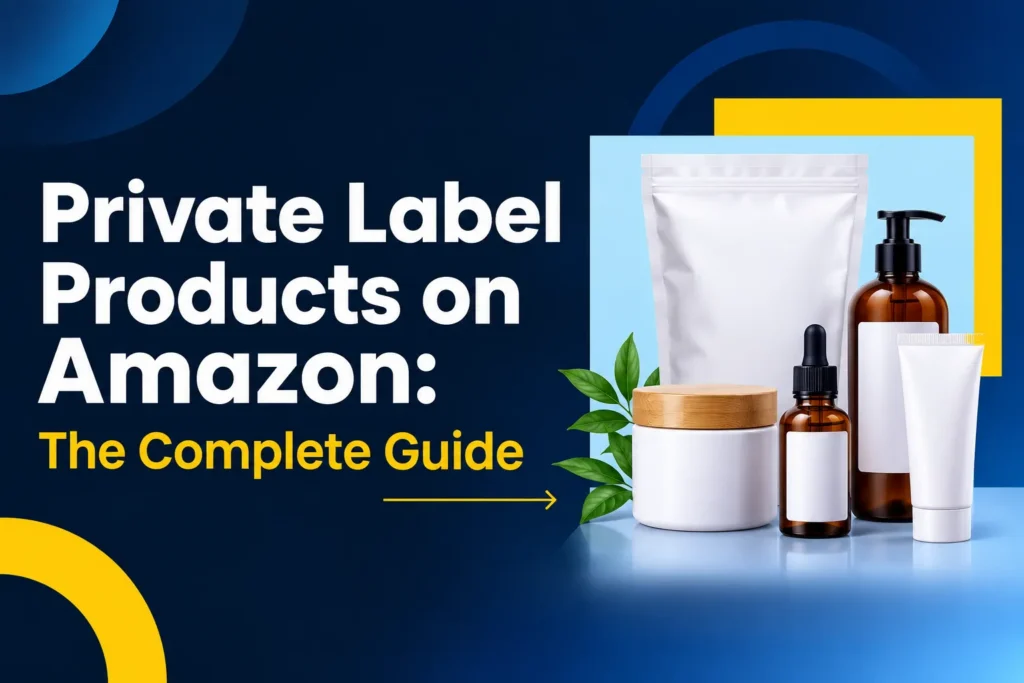
Why Private Label Products on Amazon Are Still Worth Building in 2026
Private label products on Amazon are items made by a third-party manufacturer and sold under your own brand name, which means you control the listing, the price, the packaging and the customer relationship instead of fighting other resellers for the same Buy Box. That control is the reason so many sellers move from reselling to brand building, and it is why the private label model keeps attracting new entrants even as competition grows.
Let’s be honest about the trade-off. Selling an Amazon private label product takes more work and more cash up front than reselling someone else’s brand. You pay for product research, samples, branding, trademark filing, inventory and advertising before you earn a dollar. Sellers who treat it like a quick flip usually lose money. Sellers who treat it like a real brand business, with a clear niche, a better product and a disciplined launch, can build an asset that earns healthy margins and can even be sold later.
This guide walks you through the whole path, from the first idea to a scaled brand. You will learn:
- What private label means, and how it differs from white label, wholesale, retail arbitrage and dropshipping
- The real benefits and risks of selling private label on Amazon
- What it costs, including Amazon’s current referral fees and Vine pricing
- How to find, validate and source a winning product
- How to protect your brand with a trademark and Amazon Brand Registry
- How to optimize your listing and launch with pricing, reviews and Amazon PPC
- How to manage FBA inventory and scale without repeating the mistakes that sink most new brands
Every fee and program detail quoted here comes from Amazon’s own seller pages, so you can plan with real numbers instead of guesses. If you want a team that lives inside Amazon advertising every day, Ecomranker specializes in Amazon PPC and can help once your product is ready to launch.
What Are Private Label Products on Amazon?
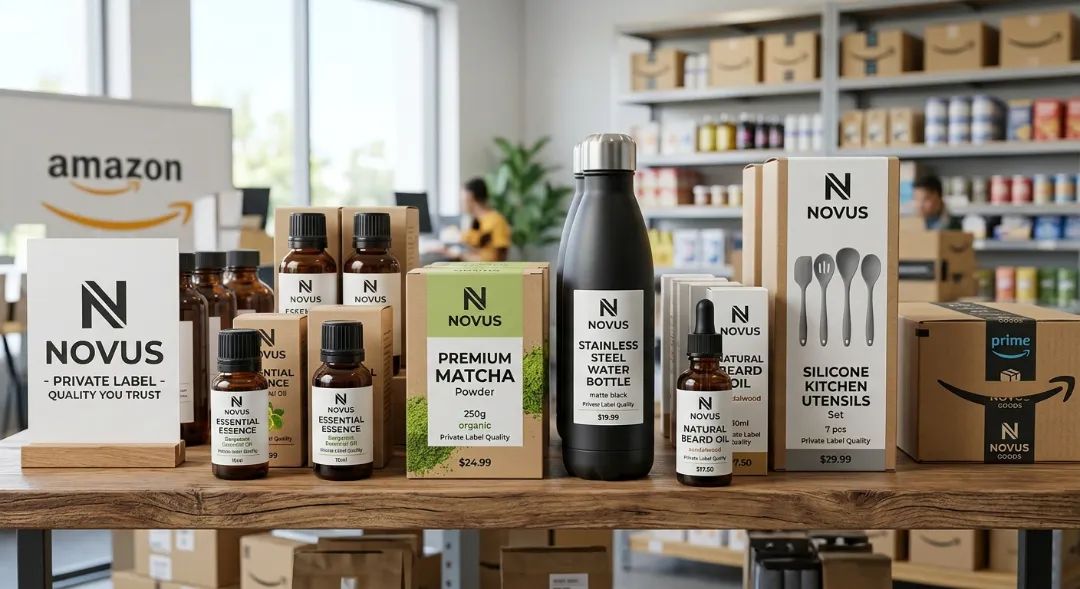
A private label product is merchandise manufactured by one company and sold under another company’s brand name. You will also hear these items called store brands or own-label products. On Amazon, the seller is usually not the factory owner. Instead, you contract a manufacturer, give them your specifications, and put your brand on the finished product and its packaging. Amazon Basics is the best-known example of a private label brand, covering everything from batteries to bedsheets.
The seller owns the parts that matter most: the brand name, the design choices, the pricing, the listing content and the marketing. The manufacturer owns production. Because you work directly with a factory, you skip the middleman and the national-brand advertising premium, which is how private label sellers can price competitively and still protect their margin.
Private label vs white label products
The two terms get mixed up constantly. In the strictest sense, a white label product is a generic item that a manufacturer sells to many different resellers, who each add their own label. A private label product is usually made to your specification, often with custom features, materials or packaging, and is not sold to your direct competitors under another name. In everyday Amazon conversation, sellers use “white label products” and “private label products” interchangeably, so check how a supplier uses each term before you place an order. The more you customize, the harder you are to copy.
Private label vs wholesale, retail arbitrage and dropshipping
Private label is only one of several ways to build an Amazon business. This table shows how the main models compare.
| Model | What you sell | Upfront cost | Brand control | Margin potential | Best for |
| Private label | Products made by a manufacturer and sold under your brand | Higher | Full | Typically higher | Sellers who want to build a brand asset |
| Wholesale | Established brands bought in bulk from authorized distributors | Lower | Limited | Typically lower | Sellers who want faster turnover with less setup |
| Retail arbitrage | Discounted items bought from stores and resold | Low | None | Inconsistent | Testing the marketplace with small budgets |
| Dropshipping | Items shipped by a supplier only after you receive an order | Lowest | Limited | Thin | Low-risk experiments, with careful policy checks |
The main difference is ownership. With wholesale and retail arbitrage, the listing and the brand belong to someone else, so you compete for the Buy Box and can lose it to a lower price at any time. With private label, the listing is yours. Only you (and sellers you authorize) can sell it, provided you protect the brand through Amazon Brand Registry, which we cover later in this guide.
Benefits and Risks of Selling Private Label Products on Amazon
Private label is not automatically better than other models. It is a trade of effort and capital for control. Here is what you gain and what you take on.
Benefits for sellers
- Higher margin potential. You are not buying a finished national brand at a markup, so more of the sale price can stay with you.
- A brand you own. A trademarked brand with reviews, a Brand Store and repeat customers is a business asset that can be expanded, licensed or sold.
- Control over everything customers see. You decide the product design, packaging, price, images, A+ Content and advertising strategy.
- Listing protection. Once your brand is enrolled in Amazon Brand Registry, you get tools to report violations and stop hijackers and counterfeiters.
- Easier catalog growth. A winning product earns trust that carries over to complementary products under the same brand name.
- Customer loyalty. When shoppers love one of your products, they are less likely to comparison shop and more likely to buy again.
Benefits for customers
Shoppers get lower prices, because own-label brands skip the big advertising budgets of national names. Many private label items now match national brands on quality, and sellers who study search data and reviews can build features that mainstream brands overlook. That customer-first angle is exactly where a new brand can win.
Risks and drawbacks
- Higher upfront cost. Product development, samples, branding, packaging, trademark fees, inventory and launch advertising all come before revenue.
- Long lead times. Overseas production and shipping can stretch for weeks or months, which ties up cash and makes forecasting harder.
- A real advertising learning curve. A new product has no reviews and no sales history, so you usually need paid traffic to get started.
- Slow path to profit. Many sellers need several months before a new private label product turns consistently profitable.
- Inventory risk. Order too much and storage fees and discounting eat the margin. Order too little and a stockout can wreck your rankings.
- Competition and copycats. If your product is easy to copy and you do nothing to differentiate it, someone will undercut you.
- Platform dependence. Amazon sets the rules and can change fees, policies and ad auctions without asking you.
None of these risks is a reason to avoid the model. They are reasons to plan for cash flow, pick a product you can improve, and budget realistically for advertising from day one.
How Much Does It Cost to Sell Private Label Products on Amazon?
Your total cost depends on the product, the factory and the category, but the cost buckets are the same for everyone. Knowing them before you order inventory is the best protection against a launch that never becomes profitable.
Amazon selling fees
According to Amazon’s pricing page, the Professional selling plan costs $39.99 per month, while the Individual plan charges $0.99 per item sold. Private label sellers almost always choose Professional, because Amazon Vine and bulk listing tools require it. On top of the plan fee, Amazon charges a referral fee on every sale, which is a percentage of the total price or a minimum of $0.30, whichever is greater. Rates vary by category:
| Category | Referral fee |
| Home and Kitchen | 15% |
| Beauty, Health and Personal Care | 8% up to $10.00, then 15% above $10.00 |
| Clothing and Accessories | 5% up to $15.00, 10% from $15.01 to $20.00, 17% above $20.00 |
| Pet Supplies | 15% (22% for veterinary diets) |
| Sports and Outdoors | 15% |
| Automotive and Powersports | 12% |
| Consumer Electronics | 8% |
| Electronics Accessories | 15% up to $100.00, then 8% above $100.00 |
Fees change, so confirm your category on Amazon’s page before you finalize pricing. If you use Fulfillment by Amazon, add FBA fulfillment and storage fees, which Amazon’s Revenue Calculator estimates by product size and weight.
Your own business costs
- Product cost: the unit price from your manufacturer, plus tooling or customization fees.
- Samples: budget for several rounds before you approve production.
- Freight, import duties and customs: always calculate the landed cost per unit, not just the factory price.
- Packaging and design: a professional designer and compliant packaging pay for themselves.
- Trademark and UPC or GS1 barcodes: needed for Brand Registry and product identification.
- Photography and A+ Content: your images do most of the selling.
- Advertising: budget for Amazon PPC from launch day. Plan this like inventory, not like an afterthought.
- Amazon Vine: per Amazon’s Vine page, enrolling up to 2 units costs $0, 3 to 10 units costs $75, and 11 to 30 units costs $200 per parent product.
A simple unit-economics example
This hypothetical example is for illustration only. Replace every number with your own quotes and Amazon’s Revenue Calculator results.
| Line item | Per unit |
| Selling price | $29.99 |
| Referral fee at 15% | $4.50 |
| Landed product cost | $7.00 |
| FBA fees (estimate) | $5.50 |
| Advertising at about 10% of price | $3.00 |
| Profit before overhead | $9.99 (about 33%) |
If the same product had a landed cost of $12.00 instead of $7.00, profit would drop to $4.99, roughly 17%. That is why you test the math before you commit to a purchase order.
How to Find Winning Private Label Products to Sell on Amazon
Product research is where most new sellers either set themselves up for success or waste their first budget. The goal is simple: find a product with proven demand, room to improve, and enough margin to survive advertising. Base the decision on data, not on what you personally like.
Where to look for product ideas
- Amazon Product Opportunity Explorer. In Seller Central, open Growth, then Product Opportunity Explorer. According to Amazon, it groups products into niches and shows search volume, purchasing behavior, pricing, niche saturation, reviews, returns and the product features that drive sales.
- Amazon Best Sellers and Movers & Shakers. Drill into sub-categories, not just top-level lists. The big categories are crowded, but the sub-categories reveal smaller, more winnable niches.
- Third-party research tools. Platforms such as Jungle Scout help you estimate monthly sales, review counts and listing quality for competing products.
- Customer reviews. Read the 1-, 2- and 3-star reviews of the top sellers. Repeated complaints about sizing, durability, missing parts or confusing instructions are product opportunities.
- Other marketplaces and communities. Reddit threads, eBay listings and supplier marketplaces like Alibaba show what people are asking for and what factories already produce.
- Your own frustrations. The best niche ideas often come from a product you use and wish worked better.
The private label product research checklist
Use criteria like these to filter ideas quickly. The exact numbers vary by category, so treat them as a starting point and tighten them as you learn.
| Criterion | What to look for |
| Price | A selling price high enough to absorb fees and ads. Many sellers look in the $20 to $70 range |
| Demand | Steady monthly sales across several competitors, not just one dominant brand |
| Competition | Top listings with modest review counts, so a new brand can realistically compete |
| Rating gap | Competing products rated around 4 stars or below, which signals room to improve |
| Listing quality | Weak images, thin bullets and no A+ Content from competitors |
| Size and weight | Small, light, durable items that keep FBA and shipping costs down |
| Seasonality | Year-round demand, or a plan for the off-season |
| Sourceability | Several manufacturers that can make it at the quality you need |
| Complexity | Few moving parts, batteries or electronics, which reduces returns and compliance work |
| Legal risk | No patents, trademarks or regulated claims that could block the listing |
Private label product ideas by category
These categories consistently attract private label sellers. Treat them as places to start digging, not as ready-made answers.
- Beauty and personal care: skincare tools, hair accessories, bath essentials, with standout ingredients or packaging.
- Kitchen and dining: utensils, food storage, drinkware and small gadgets that solve everyday cooking problems.
- Home and organization: closet organizers, storage bins and cleaning tools.
- Automotive: phone mounts, seat organizers and cleaning kits.
- Pet supplies: feeders, toys, grooming tools and travel accessories.
- Sports and outdoors: fitness accessories, camping gear and recovery tools.
- Clothing, shoes and jewelry: niche apparel, comfort wear, accessories and jewelry organizers.
- Electronics accessories: chargers, cables, stands and cases, although this space moves fast and margins can be thin.
Validate before you order
Before you place a bulk order, confirm three things. First, check that people actually search for the terms that describe your product. Second, order samples from competitors and from your supplier, and write down exactly how you will make yours better. Third, run your unit economics using the real landed cost and a realistic advertising budget. If the numbers only work with perfect conditions, move on to the next idea.
How to Source Private Label Products: Suppliers, Samples and Quality Control
A great idea fails quickly with a weak supplier. Sourcing is where you turn a concept into a product that customers will rate five stars, so slow down and verify everything.
Where to find private label suppliers
- Online supplier marketplaces such as Alibaba and IndiaMART let you filter by minimum order quantity (MOQ), materials, price and certifications across millions of manufacturers.
- Search engines. A query like “silicone kitchen tools private label manufacturer” surfaces factories that already offer branding services.
- Trade shows and wholesale markets let you handle products in person, meet decision-makers and negotiate face to face.
- Referrals from other sellers, sourcing agents and industry groups, especially if you are in a regulated or technical category.
When you can, deal directly with the manufacturer rather than a trading company. You get better pricing, clearer communication and more control over quality. One-off orders from retail-style sites are fine for testing an idea, but a long-term brand needs a factory relationship.
How to vet a supplier
Ask every shortlisted supplier the same questions so you can compare them fairly:
- Which products in my category have you made, and can you share references or certifications?
- What is your MOQ, and how does the unit price change at higher volumes?
- What are your production and shipping lead times?
- How do you inspect quality during and after production?
- Can you customize materials, colors, packaging and inserts to my specification?
- What are your payment terms, and will you accept a deposit with the balance due after inspection?
Responsiveness matters as much as price. A supplier who answers slowly or vaguely before you pay will be worse after.
Samples, quotes and landed cost
Request quotes and samples from at least three suppliers. Confirm the sample matches your standards, then compare quotes on a landed-cost basis: the unit price plus shipping, import duties, customs fees and packaging. A cheap factory price can become an expensive product once freight and duties are added.
When you are happy, define the product in a written specification: dimensions, materials, tolerances, colors, packaging and labeling. Keep one approved “golden sample” so any future production can be compared against it.
Quality control and compliance
Protect your brand before units reach Amazon. Arrange a third-party pre-shipment inspection for your first orders, and check a sample of the production run against your golden sample. Amazon packaging requirements are strict, so confirm that cartons, labels and barcodes meet FBA rules before the goods leave the factory.
You are also responsible for safety and legal compliance. Depending on your category, you may need test reports from approved labs, certifications, specific warnings or listing approvals, and Amazon can ask for updated documents when regulations change. Check the requirements for your product type early, because a compliance issue discovered after inventory is in transit can freeze your launch.
Branding, Trademark and Amazon Brand Registry for Private Label Sellers
Without a brand you can protect, a private label product is just a generic item with your logo on it. Branding and legal protection turn it into an asset.
Build a brand customers remember
Choose a name that is easy to spell and say, then check that it does not conflict with existing trademarks before you commit to packaging or inventory. Amazon even offers an AI-powered brand name generator in Seller Central to help you shortlist options. Decide on a consistent visual identity (logo, colors, fonts, packaging style) and write a short brand story that explains who the product is for and why it exists. Everything a customer touches, from the main image to the unboxing experience, should feel like it came from the same brand.
Design choices should also reflect your target audience. A premium kitchen brand and a budget-friendly organizer brand should not look alike, even if both are private label products.
Register your trademark early
A trademark protects your name and logo, and it is also the key that unlocks Amazon Brand Registry. File early, because approval takes time and you want protection in place before your product gains traction. If you do not have a trademark yet, Amazon’s IP Accelerator program connects you with vetted legal service providers who can help you file and enroll faster. You can add trademarks for other countries later, which matters if you plan to sell in more than one Amazon marketplace.
Enroll in Amazon Brand Registry
Amazon Brand Registry is free. To enroll, Amazon requires that you:
- Have a logo that includes your brand name permanently affixed to your products or packaging
- Own a pending or registered trademark, either a word mark or an image mark containing words, letters or numbers, issued by the trademark office of a country with a corresponding Amazon store
- Be the trademark owner, or have the owner enroll the brand and add you as a user
- Provide the trademark number and the product categories your brand belongs in
Once approved, you unlock tools that matter for private label growth: A+ Content, Brand Stores, Sponsored Brands ads, Brand Analytics, Manage Your Experiments, Amazon Vine, Transparency and automated protection against counterfeits, plus a Report a Violation tool for infringement. Amazon’s page also lists new seller incentives for enrolled brands, including a Vine credit and a percentage back on early branded sales, so check the current terms when you sign up.
Get your barcodes right
Amazon needs a valid product identifier, usually a UPC or GS1 barcode, for most new listings. Buy your codes from a legitimate source such as GS1 so they match the brand and product data on your listing. Mismatched or reused barcodes cause listing errors and can block your Brand Registry benefits.
How to Optimize Your Private Label Listing for Amazon Search and Conversions
Your listing is your salesperson, and for a new private label product it has two jobs: get found in search and convince shoppers to buy. Treat both jobs seriously before you send a single click to the page.
Start with keyword research
Find the exact words shoppers type into Amazon. Use Brand Analytics (available after Brand Registry), Product Opportunity Explorer, third-party tools and the search terms from competing listings. Group keywords by intent: the main product term first, then features, use cases, audiences and common misspellings. Place your most important keywords naturally in the title and bullets, and use the remaining relevant terms in the description and backend search terms. Never stuff keywords at the expense of readability, because shoppers still have to want to click.
Listing elements and best practices
| Element | Best practice |
| Title | Lead with the brand, product type and your strongest keyword, then add the key feature, size or quantity. Keep it readable. |
| Bullet points | Put the benefit first, support it with a feature, and answer the objections reviewers raise about competitors. |
| Main image | Clean, high-resolution and compliant with Amazon’s image rules. Test versions to find the one that earns the most clicks. |
| Secondary images | Show scale, use cases, comparison charts, dimensions and packaging so shoppers do not need to guess. |
| Video | A short demo reduces uncertainty and returns. |
| A+ Content | Use the brand story, comparison charts and lifestyle images to build trust. |
| Backend search terms | Add relevant synonyms and alternate spellings that do not fit naturally in the visible copy. |
| Price | Set it with your launch plan and margin in mind, not just to match the lowest competitor. |
Use A+ Content, a Brand Store and testing
Amazon’s own data suggests the investment pays off. According to the Brand Registry page, basic A+ Content can increase sales by up to 8%, and well-implemented Premium A+ Content by up to 20%. Shoppers who visit a Brand Store during their journey purchase more often and have a higher average order value than those who do not, per Amazon’s internal data. These are Amazon figures, not guarantees, but they show why branded content deserves attention.
Once your listing is live, keep improving it. Use Manage Your Experiments to test titles, images and A+ Content, then keep what wins. Small gains in click-through rate and conversion rate multiply across every ad dollar you spend.
Do not publish until the basics are ready
A professional image set, benefit-led bullets and a clear brand story are what separate a listing that converts from one that burns ad budget. Hire a photographer and a designer if you are not confident in those skills. The cost is small compared with the cost of sending paid traffic to a page that does not sell.
How to Launch Private Label Products on Amazon: Pricing, Reviews and Amazon PPC
A launch is not a single day. It is a sequence of decisions that give a brand-new product enough early sales, reviews and ad data to earn visibility. Plan it before the inventory arrives.
Pre-launch checklist
- Trademark filed and brand enrolled in Amazon Brand Registry
- UPC or GS1 barcodes assigned and matched to the listing
- Product, packaging and labels approved against your golden sample
- Inventory shipped to Amazon (or prepped for fulfillment by merchant)
- Listing complete with images, bullets, A+ Content and backend keywords
- Amazon Vine enrollment submitted
- Launch date chosen and PPC campaigns built
A launch timeline you can follow
| Phase | Timing | Main focus |
| Pre-launch | 3 to 4 weeks before launch | Vine enrollment, inventory at Amazon, listing finalized, ad structure ready |
| Launch | Weeks 1 to 4 | Introductory pricing, Vine and early reviews, aggressive discovery advertising |
| Optimization | Weeks 5 to 12 | Raise price in steps, cut wasted ad spend, test images and content |
| Scale | Month 4 and beyond | Expand keywords, add Sponsored Brands, grow the catalog |
Launch pricing
A new listing has no reviews, so shoppers need a reason to take a chance on it. Many sellers launch with a deliberately low introductory price to win early orders, then raise the price in small steps over several weeks while watching conversion rate and profit. The exact discount depends on your margin, so model it first. Do not set a launch price that you cannot afford to hold for a few weeks.
Build reviews the right way with Amazon Vine
Reviews are the biggest trust signal on a new listing, but you must earn them within Amazon’s rules. Never offer incentives or pay for reviews outside approved programs. Amazon Vine is the approved route. Per Amazon, you can enroll an FBA product that has fewer than 30 reviews and provide up to 30 units to trusted Vine Voices, who review them for free. Enrolling up to two units costs $0, three to ten units costs $75 and eleven to thirty units costs $200 per parent product. You are not charged until after your first review is published, and not at all if no review arrives within 90 days. Amazon recommends having inventory in its network at least three weeks before launch so reviewers have time to try the product. Amazon also says Vine can lift sales by an average of 30%, though that is its own internal figure.
Beyond Vine, deliver a product that matches the listing, respond quickly to customer questions and use Amazon’s built-in review request button on delivered orders.
Use Amazon PPC to create launch momentum
New private label products depend on advertising because ranking organically with zero sales history is slow. Well-run Amazon PPC management gets your product in front of high-intent shoppers while it earns reviews and sales velocity.
A practical launch structure looks like this:
- Automatic Sponsored Products campaign to discover which search terms actually convert for your product.
- Manual campaigns using exact, phrase and broad match on your best keywords and competitor ASINs.
- Negative keywords added weekly so spend stops leaking into irrelevant searches.
- Sponsored Brands once your brand is registered, to showcase multiple products and your Brand Store.
- Sponsored Display to retarget shoppers who viewed your listing.
Track ACoS, TACoS, click-through rate and conversion rate together. ACoS alone can mislead you, because a launch campaign may run at a higher ACoS on purpose to buy ranking. TACoS shows how ad spend relates to total sales, including organic sales the ads helped create.
If your launch budget is tight, bring in an experienced partner. Ecomranker’s Amazon PPC services focus on structuring and optimizing campaigns so private label brands spend ad dollars where they convert. You can also drive outside traffic from social media, email and influencers to widen your funnel, and measure it with Amazon Attribution, a Brand Registry tool.
Do not forget customer service
Fast answers, accurate listings and well-packed shipments protect the reviews and ratings you worked to earn. Fulfillment by Amazon handles shipping and most customer service for you, but you still own the product experience.
FBA, Inventory Management and Scaling Your Private Label Brand
Once the launch works, your priorities shift from proving the product to keeping it in stock, protecting your margin and growing the brand.
FBA vs FBM for private label products
You have two main fulfillment options, and the right one depends on your volume, product and goals.
| Fulfillment by Amazon (FBA) | Fulfillment by Merchant (FBM) | |
| Who ships | Amazon stores, packs and ships orders | You or your logistics partner |
| Customer service | Amazon handles most of it | You handle it |
| Prime eligibility | Yes | Only through specific programs |
| Best for | Most private label sellers, hands-off scaling, Vine eligibility | Low volume, oversized or custom-packed products |
| Watch out for | Fulfillment and storage fees, storage limits | Slower delivery and more operational work |
Most private label brands start with FBA because the Prime badge lifts conversion and fulfillment is handled for them. Amazon Vine also requires FBA inventory. Compare the full cost of each method with Amazon’s Revenue Calculator before you decide.
Plan inventory so you never run dry
Running out of stock can destroy the ranking you spent months building. Overstocking ties up cash and increases storage fees. A practical approach is to work out a reorder point: average daily sales multiplied by your supplier lead time plus shipping time plus a safety buffer. Place your next purchase order before inventory dips below that point. Review sales forecasts monthly, use Amazon’s inventory management tools to watch stock levels, and adjust for seasonality. Remember that factories can run late, so build extra time into every schedule.
Scale the brand step by step
- Add complementary products. Use customer reviews and search data to find the next logical item for the same buyer, then reuse your brand name and trust.
- Use variations and bundles. Colors, sizes and virtual bundles raise average order value and make your listing look more complete.
- Offer Subscribe & Save on consumables so customers reorder automatically.
- Strengthen the Brand Store. Give shoppers a place to explore your whole catalog.
- Expand to new marketplaces carefully. Master your home marketplace first, then evaluate other countries for demand, regulations and logistics. Brand Registry lets you add trademarks for other countries after enrollment.
- Diversify beyond Amazon. Your own website, email list and other marketplaces reduce dependence on a single platform.
Scaling also means paying closer attention to advertising efficiency, because a bigger catalog multiplies your ad spend. Ecomranker works with Amazon brands at this stage to keep campaigns profitable as product lines grow.
10 Common Private Label Mistakes on Amazon (and How to Avoid Them)
Most failed private label launches share the same handful of causes. Learn them now and you can avoid paying for the lessons yourself.
- Picking a product by gut feeling. Personal taste is not demand. Validate every idea with search volume, sales estimates and competitor review analysis before you spend money.
- Skipping samples and inspections. A bad batch sent to FBA produces returns, negative reviews and possible listing suppression. Approve a golden sample and inspect your first shipments.
- Ignoring landed cost. Freight, duties, packaging and Amazon fees can erase a margin that looked fine on the factory quote. Run the full math before you order.
- Launching without brand protection. If your trademark and Brand Registry are not in place, copycats and hijackers can sell against you the moment your product starts to rank.
- Weak listing content. Dark photos, generic bullets and no A+ Content waste every ad click. Invest in a professional image set before launch.
- Treating advertising as optional. A new product with no history needs traffic. Budget for Amazon PPC from day one and review search term reports every week.
- Obsessing over review count. Reviews help, but product quality, sales velocity and a strong listing matter just as much. Use Vine and deliver a product that earns honest reviews rather than chasing shortcuts that break Amazon’s rules.
- Running out of stock, or overordering. Both are expensive. Use a reorder point, allow for supplier delays and watch storage fees.
- Expanding to every marketplace too fast. Each country adds regulations, logistics and language needs. Build a profitable base first, then expand deliberately.
- Overlooking compliance and intellectual property. Selling a product that infringes a patent or trademark, or that lacks required safety documents, can get listings removed and accounts suspended. Check before you source.
If you avoid these ten, you sidestep the problems that most often derail new private label launches.
Frequently Asked Questions About Private Label Products on Amazon
What are private label products on Amazon?
Is selling private label products on Amazon profitable?
How much money do I need to start an Amazon private label business?
What is the difference between private label and white label?
Is private label the same as dropshipping?
Do I need a trademark to sell private label products on Amazon?
Should I use FBA or FBM for private label products?
How do I get my first reviews on a new product?
How long does it take to see a profit?
Which country is best for private label on Amazon?
Final Thoughts: Build a Private Label Brand That Lasts
Private label products on Amazon reward sellers who plan carefully and execute consistently. You now have the full roadmap:
- Research products with real demand and room to improve.
- Source from a vetted manufacturer and approve samples before production.
- Protect your brand with a trademark and Amazon Brand Registry.
- Build a listing with strong keywords, images and A+ Content.
- Launch with smart pricing, Amazon Vine and a structured advertising plan.
- Manage FBA inventory so you never run out of your best seller.
- Scale with complementary products, new marketplaces and diversified sales channels.
No single step guarantees success, but skipping any of them is how most new brands stall. Start with the numbers, protect what you build and treat advertising as part of the product, not an add-on.
If you are ready to launch and want experienced help turning ad spend into profitable growth, visit Ecomranker to learn how we work with Amazon sellers, or explore our Amazon PPC management services to see how a structured advertising strategy can support your private label launch.