
Pay-Per-Click advertising has become one of the most important growth strategies for ecommerce businesses, Amazon sellers, and online brands looking to increase visibility, traffic, and conversions. However, many businesses launch PPC campaigns without defining clear objectives, which often leads to wasted ad spend, poor conversion rates, and low return on investment. A successful PPC campaign always starts with goal setting because your advertising goals determine everything from keyword targeting and bidding strategies to campaign structure and performance measurement.
Whether you are running Amazon Sponsored Ads, Google Ads, or ecommerce marketplace campaigns, setting realistic and measurable PPC goals helps businesses optimize advertising budgets and achieve sustainable growth. Clear goals also make it easier to analyze performance metrics, improve campaign efficiency, and scale profitable strategies over time.
As a professional ecommerce growth agency, Ecom Ranker helps brands build data-driven PPC strategies focused on increasing visibility, improving organic rankings, and maximizing profitability. Their integrated approach combines PPC management, Amazon SEO, listing optimization, and conversion-focused ecommerce growth solutions.
Why Setting PPC Goals Is Important
Many advertisers believe PPC success simply means generating more clicks or impressions. While traffic is important, the real value of PPC advertising comes from achieving measurable business outcomes such as increased sales, higher conversion rates, stronger brand awareness, or improved profitability.
Without clearly defined goals, PPC campaigns often become difficult to optimize because there is no benchmark for success. Businesses may overspend on irrelevant traffic, target the wrong keywords, or scale campaigns without understanding profitability.
Setting PPC goals provides strategic direction for:
- Budget allocation
- Keyword targeting
- Bid optimization
- Audience segmentation
- Campaign structure
- Conversion tracking
- Performance analysis
Clear objectives also help businesses measure advertising performance accurately and make data-driven decisions that support long-term growth.
Professional PPC agencies like EcomRanker focus on aligning advertising campaigns with broader ecommerce business goals to improve overall marketplace performance.
Understanding Different Types of PPC Goals
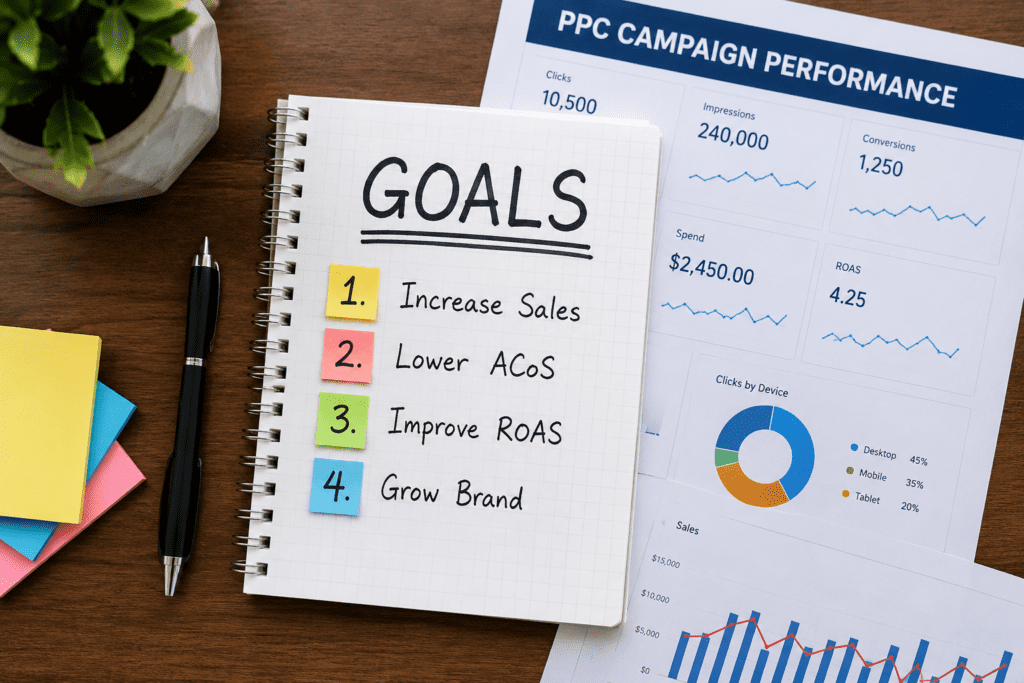
Every business has different advertising priorities depending on its stage of growth, competition level, and overall ecommerce strategy. Some businesses focus on immediate profitability, while others prioritize market expansion or brand awareness.
Understanding the different types of PPC goals helps advertisers build more effective campaigns that align with specific business objectives.
1. Brand Awareness Goals
Brand awareness campaigns focus on increasing visibility and introducing products or services to potential customers. These campaigns are especially useful for new brands, product launches, or businesses entering competitive marketplaces.
The primary objective of awareness campaigns is not always immediate sales. Instead, these campaigns aim to:
- Increase impressions
- Improve reach
- Build customer familiarity
- Strengthen brand recognition
- Generate initial engagement
Amazon Sponsored Brands campaigns and display advertising are often used for awareness-focused strategies because they allow businesses to showcase logos, multiple products, and brand messaging.
Strong brand visibility can improve long-term customer trust and increase repeat purchases over time.
2. Traffic Generation Goals
Some PPC campaigns are designed primarily to increase website or product listing traffic. These campaigns help businesses attract potential customers who may later convert into buyers.
Traffic-focused campaigns are useful for:
- Launching new products
- Increasing listing visibility
- Building remarketing audiences
- Improving engagement metrics
- Testing keyword opportunities
However, driving traffic alone is not enough. Businesses must ensure that product listings, landing pages, and website experiences are optimized for conversions.
An optimized ecommerce listing strategy from Amazon Listing Optimization Guide can help improve conversion performance after traffic is generated.
3. Sales and Revenue Goals
Sales-focused PPC campaigns are designed to generate direct conversions and maximize revenue growth. These are among the most common PPC objectives for ecommerce businesses and Amazon sellers.
Revenue-focused campaigns typically prioritize:
- High-converting keywords
- Purchase-intent audiences
- Optimized product listings
- Competitive bidding strategies
- Conversion tracking
Advertisers often use metrics such as:
- ROAS (Return on Ad Spend)
- Conversion Rate
- Total Sales
- ACoS (Advertising Cost of Sale)
to evaluate campaign success.
Sales-focused PPC campaigns require continuous optimization because customer behavior, keyword trends, and marketplace competition constantly change.
4. Profitability and ROAS Goals
Not all PPC campaigns should focus solely on increasing sales volume. For many businesses, maintaining profitability is even more important.
Profitability-focused campaigns prioritize:
- Lower ACoS
- Higher ROAS
- Reduced CPC
- Efficient keyword targeting
- Waste reduction
These campaigns often involve:
- Aggressive negative keyword optimization
- Bid management
- Audience refinement
- Campaign segmentation
Businesses with lower profit margins especially benefit from efficiency-focused PPC strategies because controlling advertising costs directly impacts overall profitability.
Experienced ecommerce agencies like Ecom Ranker help businesses balance growth and profitability through advanced PPC optimization strategies.
5. Product Launch Goals
Launching a new product on Amazon or ecommerce marketplaces can be challenging because new listings often lack reviews, sales history, and organic visibility.
Product launch PPC campaigns focus on:
- Increasing initial visibility
- Accelerating sales velocity
- Improving keyword indexing
- Building organic rankings
- Generating customer engagement
During product launches, advertisers may temporarily accept higher ACoS levels in exchange for long-term organic ranking improvements.
A successful launch strategy often combines:
- Sponsored Products
- Sponsored Brands
- Listing optimization
- Amazon SEO
- Competitive keyword targeting
Businesses can strengthen launch performance by integrating PPC with Amazon SEO Strategy Services.
6. Customer Retention and Repeat Purchase Goals
Acquiring new customers is important, but retaining existing customers is often more profitable over time.
Retention-focused PPC campaigns aim to:
- Encourage repeat purchases
- Promote complementary products
- Cross-sell related items
- Increase customer lifetime value
Sponsored Display campaigns and retargeting ads are commonly used for customer retention because they reconnect with previous shoppers who already interacted with the brand.
Businesses that build strong customer retention strategies typically achieve better long-term profitability and lower customer acquisition costs.
How to Set SMART PPC Goals
One of the most effective methods for setting PPC goals is using the SMART framework. SMART goals ensure that campaign objectives are realistic, measurable, and actionable.
SMART stands for:
- Specific
- Measurable
- Achievable
- Relevant
- Time-Bound
For example, instead of setting a vague goal like:
“Improve Amazon PPC performance,”
a SMART goal would be:
“Increase ROAS by 25% within the next 90 days while reducing ACoS below 20%.”
SMART goals help businesses create clearer optimization strategies and improve campaign accountability.
Align PPC Goals With Business Objectives
PPC campaigns should support broader business objectives rather than operate independently.
For example:
- A startup brand may prioritize visibility and customer acquisition.
- An established business may focus on profitability and retention.
- A seasonal business may prioritize short-term sales growth.
Aligning PPC goals with business priorities helps advertisers allocate budgets more effectively and improve long-term growth planning.
Professional ecommerce agencies often combine:
- PPC management
- SEO optimization
- conversion optimization
- marketplace expansion
to create integrated growth systems that support overall business success.
Important Metrics for Measuring PPC Goals
Tracking the right metrics is essential for evaluating campaign performance and identifying optimization opportunities.
Important PPC metrics include:
ACoS (Advertising Cost of Sale)
Measures ad spend relative to generated sales.
Tracks how much revenue is generated per advertising dollar spent.
Measures how often users click ads after seeing them.
Indicates how effectively traffic converts into customers.
CPC (Cost Per Click)
Tracks the cost efficiency of keyword targeting.
TACoS (Total Advertising Cost of Sale)
Measures advertising spend relative to total account revenue.
Monitoring these metrics regularly helps businesses refine campaigns and improve advertising profitability.
Common Mistakes When Setting PPC Goals
Many advertisers struggle with PPC performance because they set unrealistic or unclear objectives.
Common mistakes include:
- Focusing only on impressions
- Ignoring profitability metrics
- Setting unrealistic ROAS expectations
- Scaling campaigns too quickly
- Not tracking conversion data
- Using poor keyword targeting
- Failing to optimize listings
Businesses should also avoid treating PPC campaigns as isolated marketing channels. PPC works best when combined with SEO, listing optimization, and strong conversion-focused content.
Why PPC Goals Should Evolve Over Time
PPC goals should not remain static. As businesses grow, advertising objectives often change based on:
- Market competition
- Product lifecycle
- Seasonal trends
- Budget changes
- Marketplace expansion
For example:
- New product launches may focus on visibility.
- Established products may prioritize profitability.
- Mature brands may focus on customer retention and scaling.
Continuous campaign analysis helps businesses adapt strategies and maintain long-term advertising efficiency.
Combining PPC Goals With Amazon SEO
One of the most effective ecommerce growth strategies is combining PPC advertising with Amazon SEO optimization.
While PPC drives immediate traffic and sales, SEO improves long-term organic visibility. Together, they create a powerful growth cycle where paid advertising improves sales velocity and SEO strengthens organic rankings.
Businesses that integrate PPC with:
- keyword optimization,
- listing optimization,
- backend search terms,
- conversion-focused content,
- and customer engagement strategies
often achieve stronger marketplace performance.
Helpful resources include:
How EcomRanker Helps Businesses Build Goal-Driven PPC Campaigns
Ecom Ranker helps ecommerce businesses create advanced PPC strategies designed around measurable growth objectives.
Their services include:
- Amazon PPC Management
- Amazon SEO Services
- Listing Optimization
- A+ Content Development
- Brand Store Optimization
- Marketplace Growth Strategies
- Conversion Rate Optimization
By combining data analysis, keyword research, conversion optimization, and marketplace expertise, EcomRanker helps businesses improve advertising performance while maximizing long-term profitability.
Final Thoughts
Setting clear goals for your PPC campaign is one of the most important steps toward building profitable and scalable ecommerce advertising strategies. Without defined objectives, businesses often struggle with wasted ad spend, inefficient targeting, and poor campaign performance.
Successful PPC campaigns require:
- strategic planning,
- measurable goals,
- continuous optimization,
- keyword research,
- listing optimization,
- and performance analysis.
Whether your objective is increasing brand awareness, generating more sales, improving profitability, or launching new products, goal-driven PPC strategies help businesses make smarter advertising decisions and achieve sustainable growth.
Businesses looking to maximize ecommerce performance can benefit from integrated advertising and SEO strategies offered by EcomRanker.
Frequently Asked Questions About Setting Goals for Your PPC Campaign
1 . Why is setting goals important for a PPC campaign?
Setting goals is one of the most important steps in creating a successful PPC campaign because it provides clear direction for your advertising strategy. Without defined goals, businesses often struggle to measure performance, optimize campaigns effectively, or control advertising costs. Clear PPC goals help advertisers understand exactly what they want to achieve, whether it is increasing sales, improving brand visibility, generating traffic, or maximizing profitability.
Goal setting also helps businesses allocate advertising budgets more efficiently. For example, a campaign focused on brand awareness may prioritize impressions and reach, while a sales-focused campaign may concentrate on conversions and ROAS. When goals are clearly defined, advertisers can select the right keywords, bidding strategies, and campaign structures to support those objectives.
Professional ecommerce agencies like Ecom Ranker help businesses create data-driven PPC strategies aligned with long-term ecommerce growth and marketplace profitability.
2 . What are the most common goals for PPC campaigns?
PPC campaigns can serve multiple business objectives depending on the company’s growth stage, market competition, and overall advertising strategy. Some businesses focus on increasing immediate sales, while others prioritize visibility, customer acquisition, or long-term brand growth.
Common PPC campaign goals include:
- Increasing product visibility
- Driving website or listing traffic
- Generating more sales and revenue
- Improving return on ad spend (ROAS)
- Lowering advertising costs
- Launching new products
- Building brand awareness
- Improving organic rankings
- Increasing repeat purchases
- Growing customer lifetime value
Each goal requires a different campaign approach. For example, product launch campaigns often involve aggressive bidding strategies to gain visibility quickly, while profitability-focused campaigns emphasize efficient keyword targeting and lower ACoS.
Businesses that align PPC goals with broader ecommerce objectives typically achieve stronger and more sustainable results.
3 . How do I choose the right goal for my PPC campaign?
Choosing the right PPC goal depends on your business objectives, product lifecycle, competition level, and advertising budget. The best PPC strategies start by identifying what your business needs most at the current stage of growth.
For example:
- New brands may focus on awareness and customer acquisition.
- Established brands may prioritize profitability and scaling.
- Seasonal businesses may focus on short-term sales growth.
- Product launches may prioritize visibility and keyword indexing.
Before setting goals, businesses should analyze:
- Current sales performance
- Profit margins
- Advertising budget
- Competition levels
- Customer behavior
- Organic ranking position
A realistic understanding of these factors helps businesses create achievable advertising goals that support long-term marketplace growth.
Professional services from EcomRanker can help businesses develop customized PPC strategies tailored to their specific ecommerce objectives.
4 . What is a SMART PPC goal?
A SMART PPC goal is a structured objective designed to improve clarity and campaign accountability. SMART goals help businesses create measurable and actionable advertising plans rather than vague expectations.
SMART stands for:
- Specific
- Measurable
- Achievable
- Relevant
- Time-Bound
For example, instead of saying:
“Improve PPC performance,”
a SMART goal would be:
“Increase Amazon PPC conversion rate by 20% within the next 60 days while maintaining ACoS below 25%.”
This type of goal provides a clear performance target and a specific timeframe for measuring success. SMART goals also make it easier to track campaign performance and identify optimization opportunities over time.
5 . How does PPC help improve Amazon rankings?
PPC advertising can significantly improve Amazon rankings because Amazon’s algorithm rewards products that generate strong sales velocity, engagement, and conversion rates. When PPC campaigns drive consistent sales, products often begin ranking higher organically for targeted keywords.
This creates a powerful growth cycle:
- PPC increases visibility
- More visibility generates clicks
- Clicks generate sales
- Sales improve organic rankings
- Higher rankings increase organic traffic
Over time, businesses can reduce dependency on paid advertising as products gain stronger organic visibility.
Combining PPC campaigns with Amazon SEO optimization further strengthens ranking performance. Helpful strategies can be found through Amazon SEO Strategy Guide.
6 . What metrics should I track for PPC campaign goals?
Tracking the right metrics is essential for measuring the success of PPC campaigns. Different goals require different performance indicators, but several core metrics are important for most ecommerce advertising strategies.
Key PPC metrics include:
- ACoS (Advertising Cost of Sale)
- ROAS (Return on Ad Spend)
- CTR (Click-Through Rate)
- CPC (Cost Per Click)
- Conversion Rate
- Total Sales
- Impressions
- TACoS (Total Advertising Cost of Sale)
- Organic Keyword Rankings
For example, awareness campaigns may prioritize impressions and CTR, while profitability-focused campaigns may focus heavily on ROAS and ACoS.
Regular campaign analysis helps businesses identify trends, optimize keyword targeting, and improve advertising efficiency over time.
7 . How long does it take to achieve PPC campaign goals?
The timeline for achieving PPC goals depends on several factors including competition level, budget size, campaign optimization, product demand, and listing quality.
Some goals, such as increasing traffic or impressions, may show results within a few days. However, profitability improvements and organic ranking growth often take several weeks or months because ecommerce algorithms evaluate performance consistency over time.
Product launch campaigns may require aggressive advertising initially before long-term organic growth becomes visible. Businesses should also understand that PPC optimization is an ongoing process that involves testing, analyzing, and refining campaigns continuously.
Patience and consistent optimization are critical for achieving sustainable long-term PPC success.
8 . Why is listing optimization important for PPC goals?
Even highly targeted PPC campaigns can fail if product listings are poorly optimized. Listing optimization directly impacts conversion rates because it influences customer trust, engagement, and purchasing decisions.
An optimized ecommerce listing should include:
- SEO-focused product titles
- Persuasive bullet points
- High-quality product images
- Clear product descriptions
- A+ Content
- Relevant backend keywords
Strong listings improve both advertising performance and organic ranking potential because marketplaces reward products with better customer engagement and higher conversion rates.
Businesses looking to improve PPC performance should combine advertising with professional listing optimization services from Amazon Listing Optimization Guide.
9 . What are the biggest mistakes businesses make when setting PPC goals?
Many businesses struggle with PPC advertising because they set unrealistic or unclear objectives. One common mistake is focusing only on vanity metrics such as impressions or clicks without considering profitability and conversion quality.
Other common mistakes include:
- Setting unrealistic ROAS expectations
- Ignoring keyword research
- Overbidding too early
- Scaling campaigns too quickly
- Failing to monitor search term reports
- Not using negative keywords
- Ignoring listing optimization
- Running campaigns without proper tracking
Businesses should also avoid treating PPC campaigns as isolated marketing activities. The most successful ecommerce growth strategies integrate PPC advertising with SEO, conversion optimization, and customer retention planning.
10 . Should small businesses invest in PPC advertising?
Yes, small businesses can benefit significantly from PPC advertising when campaigns are properly optimized and strategically managed. PPC advertising allows smaller brands to compete with larger competitors by targeting highly specific keywords and customer segments.
One major advantage of PPC is budget flexibility. Small businesses can start with modest advertising budgets and gradually scale campaigns based on performance data. Long-tail keyword targeting and niche audience strategies often help smaller businesses achieve strong profitability even in competitive marketplaces.
Professional PPC management can also help small businesses avoid costly advertising mistakes and improve campaign performance more quickly.
11 . How often should PPC campaigns be optimized?
PPC campaigns should be reviewed and optimized regularly because ecommerce marketplaces constantly change. Competition levels, customer behavior, keyword trends, and advertising costs can fluctuate frequently.
Most successful advertisers monitor campaigns weekly or even daily depending on campaign size and budget.
Regular optimization activities include:
- Adjusting bids
- Reviewing search term reports
- Adding negative keywords
- Scaling profitable campaigns
- Reducing wasted spend
- Testing new keywords
- Improving audience targeting
Continuous optimization helps businesses maintain efficiency while improving long-term advertising profitability.
12 . Why should businesses hire a professional PPC agency?
Managing PPC campaigns effectively requires advanced knowledge of keyword research, bidding strategies, campaign structure, conversion optimization, and marketplace algorithms. Many businesses struggle to achieve profitable results because PPC advertising has become increasingly competitive and data-driven.
Professional agencies provide:
- Advanced keyword research
- Bid management strategies
- Conversion optimization
- Campaign scaling support
- Detailed performance reporting
- Long-term growth planning
Experienced ecommerce growth agencies like EcomRanker help businesses improve advertising performance while maximizing ROI and supporting sustainable marketplace growth.
13 . How does EcomRanker help businesses achieve PPC goals?
EcomRanker offers comprehensive ecommerce growth solutions designed to help businesses improve visibility, increase conversions, and achieve long-term advertising success.
Their services include:
- Amazon PPC Management
- Amazon SEO Services
- Listing Optimization
- A+ Content Development
- Brand Store Optimization
- Conversion Rate Optimization
- Marketplace Growth Strategy
By combining advertising expertise with SEO and conversion-focused optimization strategies, EcomRanker helps ecommerce brands build scalable and profitable growth systems tailored to their business objectives.