
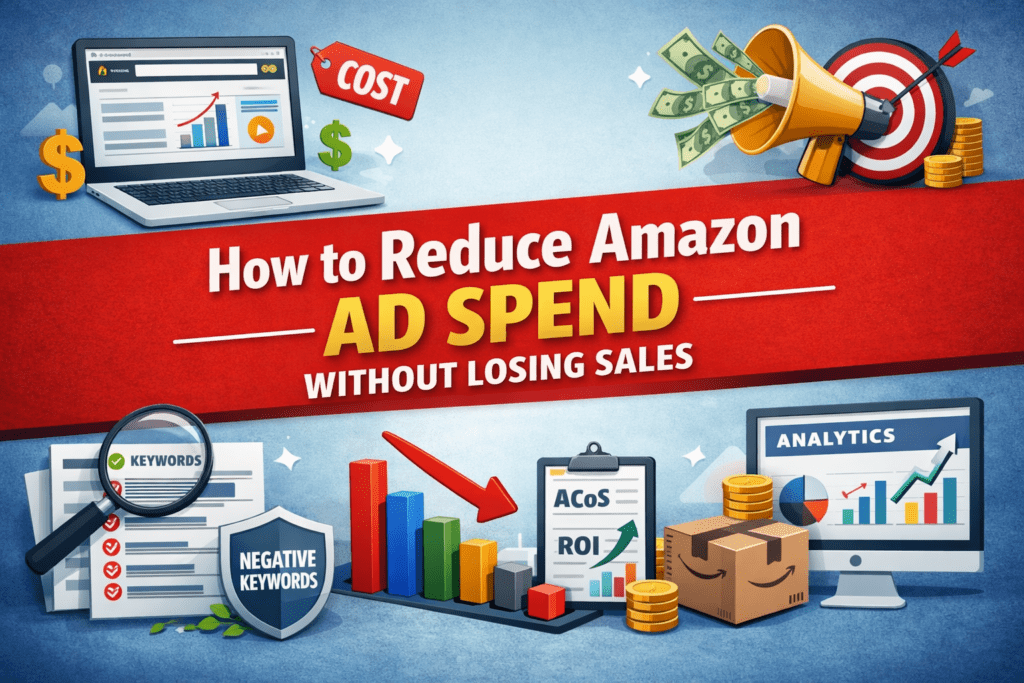
Reducing Amazon ad spend while maintaining or increasing sales is one of the most important challenges for sellers in today’s competitive marketplace. As Amazon PPC costs continue to rise, many sellers struggle with high ACoS, low ROI, and heavy dependency on paid traffic. However, reducing ad spend does not mean cutting visibility—it means optimizing efficiency.
A well-structured Amazon advertising strategy focuses on eliminating wasted spend, improving conversion rates, and increasing organic sales. When done correctly, you can reduce Amazon PPC costs while maintaining strong revenue growth and profitability.
Why Amazon Ad Spend Gets High
Amazon advertising costs increase when campaigns are not optimized properly. Many sellers rely on broad targeting, high bids, and generic strategies without analyzing performance data. This results in wasted clicks, low conversion rates, and inefficient budget allocation.
Another major reason is weak listing optimization. If your product page does not convert well, you need more clicks to generate sales, which increases your advertising cost. Similarly, poor keyword targeting and lack of negative keywords lead to irrelevant traffic, further increasing ad spend.
Advanced Keyword Optimization Strategy
Reducing Amazon ad spend starts with keyword precision. Instead of targeting only high-volume keywords, you need to focus on intent-driven keywords that convert.
There are four types of keywords you should target:
- High-intent keywords (ready to buy)
- Long-tail keywords (low competition, high conversion)
- Brand keywords (defensive strategy)
- Competitor keywords (strategic targeting)
By focusing on these keyword types, you can reduce cost per click while improving conversion rates.
Negative Keywords: The Most Powerful Cost-Control Tool
Negative keywords are essential for eliminating wasted ad spend. Without them, your ads will appear for irrelevant searches, leading to clicks without conversions.
A data-driven approach involves regularly analyzing search term reports and removing non-performing keywords. This ensures your budget is spent only on relevant traffic, significantly improving campaign efficiency.
Bid Optimization & Smart Budget Allocation
Bid management is one of the most important aspects of Amazon PPC optimization. Many sellers overspend because they use aggressive bidding strategies without considering performance data.
To reduce ad spend:
- Lower bids on non-performing keywords
- Increase bids only for high-converting keywords
- Use dynamic bidding strategies
- Allocate more budget to profitable campaigns
This ensures that your budget is used efficiently while maximizing returns.
Conversion Rate Optimization (CRO) to Reduce Ad Spend
Improving your listing conversion rate is one of the fastest ways to reduce Amazon advertising costs. If your product converts better, you need fewer clicks to generate sales.
A high-converting listing includes:
- High-quality product images
- SEO-optimized title with clear value proposition
- Benefit-driven bullet points
- Persuasive product descriptions
- Strong reviews and ratings
Better conversion rates directly reduce your cost per acquisition and overall ad spend.
ACoS vs TACoS: The Real Performance Metrics
Understanding ACoS and TACoS is critical for managing ad spend effectively.
- ACoS (Advertising Cost of Sales): Measures ad efficiency
- TACoS (Total Advertising Cost of Sales): Measures total business growth
A declining TACoS indicates that your organic sales are increasing, which reduces dependency on ads. Instead of focusing only on ACoS, a balanced approach ensures sustainable growth.
Campaign Structure Optimization
A well-structured campaign reduces wasted spend and improves control over performance.
Best practices include:
- Separate automatic and manual campaigns
- Use exact, phrase, and broad match strategically
- Create campaigns based on product categories
- Segment high-performing and low-performing keywords
This structured approach allows better budget allocation and performance tracking.
Shift from Paid to Organic Growth
The ultimate way to reduce Amazon ad spend is to reduce dependency on ads. This can be achieved by improving organic rankings.
Organic growth strategies include:
- Keyword-optimized listings
- Consistent sales velocity
- Review generation
- Competitive pricing
As your organic rankings improve, you rely less on paid traffic.
Advanced PPC Strategies to Reduce Costs
To further reduce ad spend, implement advanced strategies:
- Use dayparting to run ads during high-conversion hours
- Focus on retargeting campaigns
- Optimize Sponsored Brands and Sponsored Display ads
- Analyze competitor ad strategies
- Use placement bid adjustments
These strategies improve efficiency and reduce unnecessary spend.
Common Mistakes That Increase Amazon Ad Spend
Many sellers unknowingly increase their advertising costs due to poor strategies.
Common mistakes include:
- Targeting irrelevant or broad keywords
- Not using negative keywords
- Overbidding without analyzing performance
- Ignoring listing optimization
- Running unstructured campaigns
- Depending entirely on ads for sales
Avoiding these mistakes can significantly reduce your ad spend.
How Long Does It Take to Reduce Amazon Ad Spend?
Results depend on your current campaign structure and competition level. Initial improvements can be seen within 1–2 weeks, while significant cost reduction typically takes 30–60 days.
Consistency in optimization is key to achieving long-term results.
Final Thoughts
Reducing Amazon ad spend is not about cutting budgets—it’s about improving efficiency. By optimizing keyword targeting, improving conversion rates, and leveraging data-driven strategies, you can lower your advertising costs while maintaining or even increasing sales.
The most successful sellers focus on smart spending rather than high spending.
Frequently Asked Questions About Reducing Amazon Ad Spend
How can I reduce Amazon ad spend without losing sales?
Reducing Amazon ad spend without losing sales requires optimizing your campaigns rather than cutting budgets blindly. By focusing on high-converting keywords, improving listing conversion rates, and eliminating wasted spend through negative keywords, you can maintain or even increase sales while lowering overall advertising costs.
What is the best way to lower ACoS on Amazon?
The best way to lower ACoS (Advertising Cost of Sales) is by improving both keyword targeting and conversion rates. High-intent keywords, optimized bids, and strong product listings help reduce cost per sale, leading to a lower ACoS while maintaining performance.
Why is my Amazon PPC spend so high?
Amazon PPC spend becomes high when campaigns are not optimized. Common reasons include targeting broad or irrelevant keywords, not using negative keywords, poor listing conversion rates, and inefficient bid strategies. Fixing these issues can significantly reduce ad spend.
Do negative keywords really reduce Amazon ad costs?
Yes, negative keywords are one of the most effective ways to reduce Amazon ad costs. They prevent your ads from appearing on irrelevant search terms, which reduces wasted clicks and improves overall campaign efficiency.
How does listing optimization reduce Amazon ad spend?
Listing optimization improves conversion rates, meaning you need fewer clicks to generate the same number of sales. This directly reduces your cost per acquisition and overall advertising spend while improving profitability.
What is the difference between ACoS and TACoS?
ACoS measures the efficiency of your ad spend relative to ad-generated sales, while TACoS measures total ad spend relative to total revenue (including organic sales). A lower TACoS indicates that your organic sales are increasing and your dependency on ads is decreasing.
How often should I optimize Amazon PPC campaigns?
Amazon PPC campaigns should be optimized regularly, ideally every week. Continuous monitoring allows you to adjust bids, remove non-performing keywords, and improve campaign performance, ensuring your ad spend remains efficient.
Can I completely stop Amazon ads after ranking organically?
While strong organic rankings reduce dependency on ads, completely stopping Amazon ads is not recommended. Ads help maintain visibility, defend rankings, and capture additional traffic. A balanced strategy works best.
Which keywords reduce Amazon advertising cost the most?
Long-tail and high-intent keywords tend to reduce advertising costs the most because they have lower competition and higher conversion rates. These keywords attract more qualified buyers, leading to better ROI.
How long does it take to reduce Amazon ad spend?
You can start seeing improvements within 1–2 weeks after optimizing campaigns, but significant results typically take 30–60 days depending on competition, product category, and optimization efforts.