
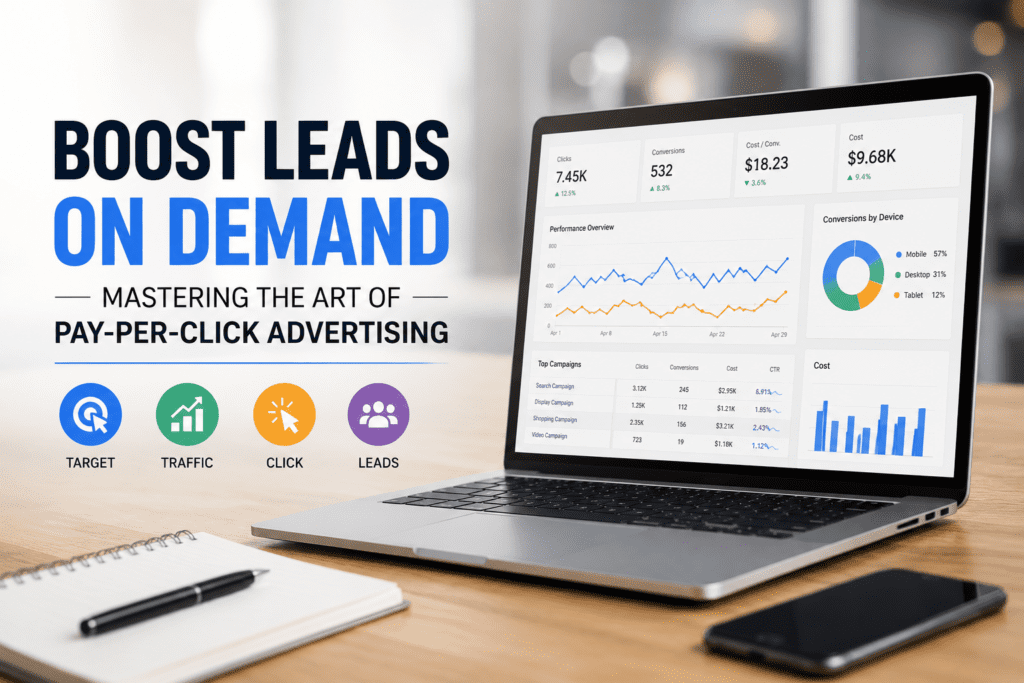
In today’s competitive digital marketplace, businesses cannot afford to rely solely on organic traffic to generate leads and sales. While search engine optimization builds long-term visibility, it often takes months to produce consistent results. This is where Pay-Per-Click advertising becomes one of the most powerful growth tools for ecommerce businesses, local companies, and service providers looking to generate immediate traffic and qualified leads.
PPC advertising allows brands to position themselves directly in front of potential customers at the exact moment they are searching for products or services online. Whether through Google Ads, Amazon Sponsored Ads, Bing Ads, LinkedIn campaigns, or Meta advertising, PPC creates opportunities for businesses to increase visibility, accelerate conversions, and scale revenue quickly.
As highlighted by Ecom Ranker, combining PPC advertising with strong SEO strategies helps businesses create a balanced digital marketing system focused on both short-term lead generation and long-term organic growth. PPC acts as the fast-moving traffic engine, while SEO builds sustainable marketplace authority over time.
Why PPC Advertising Matters for Modern Businesses
The digital advertising landscape has become increasingly competitive. Millions of businesses compete for visibility online, making it difficult to rank organically for highly competitive keywords without investing significant time and resources. PPC advertising solves this challenge by allowing businesses to instantly appear at the top of search engine results pages.
Unlike traditional marketing methods, PPC campaigns are highly measurable and performance-driven. Businesses only pay when users click on their advertisements, making PPC one of the most efficient digital marketing models available. This targeted advertising approach allows brands to reach audiences actively searching for products or services related to their business.
PPC campaigns also provide valuable customer insights. Businesses can analyze keyword performance, customer behavior, conversion trends, and audience demographics to improve overall marketing strategies. These insights help advertisers continuously optimize campaigns for better results and stronger return on investment.
Professional ecommerce growth agencies like EcomRanker specialize in building data-driven PPC strategies that improve visibility, lower advertising costs, and maximize lead generation performance.
What Is Pay-Per-Click Advertising?
Pay-Per-Click advertising is a digital marketing model where advertisers pay only when users click on their ads. Instead of paying for impressions or estimated reach, businesses invest directly in customer engagement and traffic generation.
PPC ads commonly appear:
- At the top of Google search results
- On Amazon product pages
- Inside social media feeds
- Across display advertising networks
- Within video content platforms
The most common PPC platforms include:
- Google Ads
- Amazon Advertising
- Bing Ads
- Meta Ads
- LinkedIn Ads
- Pinterest Ads
Each platform offers different targeting options, audience behaviors, and advertising opportunities. Businesses often select platforms based on their industry, target audience, and campaign goals.
According to the uploaded PPC guide, PPC works especially well when businesses need immediate visibility rather than waiting for long-term SEO growth.
The Relationship Between PPC and SEO
Many businesses mistakenly believe PPC and SEO compete against each other. In reality, they work best together.
SEO builds long-term organic visibility by improving website authority, content quality, and keyword relevance. PPC, on the other hand, generates immediate traffic by placing ads directly in front of targeted users.
When combined effectively:
- PPC drives quick leads and sales
- SEO improves long-term organic rankings
- Paid traffic supports keyword testing
- SEO insights improve PPC targeting
- Brand visibility increases across multiple channels
Businesses using integrated SEO and PPC strategies often achieve stronger digital growth compared to relying on a single marketing channel.
Helpful resources from EcomRanker Amazon SEO Strategy Guide explain how businesses can combine organic optimization with advertising strategies for sustainable marketplace growth.
Choosing the Right PPC Platform
Selecting the right advertising platform is critical for campaign success because different platforms attract different types of audiences.
Google Ads
Google Ads remains the most dominant PPC platform because it captures high-intent search traffic. Businesses can target users actively searching for solutions, products, or services related to their offerings.
Google Ads supports:
- Search campaigns
- Shopping ads
- Display campaigns
- Video advertising
- Retargeting campaigns
Because Google handles billions of searches daily, it provides massive traffic potential for businesses across nearly every industry.
Amazon Advertising
For ecommerce brands and marketplace sellers, Amazon PPC is one of the most effective advertising systems available.
Amazon Sponsored Products, Sponsored Brands, and Sponsored Display campaigns help sellers:
- Increase product visibility
- Improve sales velocity
- Generate conversions
- Boost organic rankings
- Launch new products
Amazon advertising works especially well because shoppers already have strong purchase intent when browsing the platform.
Businesses can strengthen advertising performance further through Amazon Listing Optimization Services.
Meta Ads (Facebook & Instagram)
Meta advertising focuses heavily on audience targeting and brand awareness. These platforms allow businesses to target users based on:
- Interests
- Demographics
- Behaviors
- Shopping habits
- Engagement history
Meta Ads work particularly well for:
- Ecommerce brands
- Lifestyle products
- Visual storytelling
- Brand awareness campaigns
- Retargeting strategies
Social media PPC often complements search advertising by reinforcing brand visibility across multiple channels.
LinkedIn Ads
LinkedIn advertising is especially valuable for B2B companies because it offers highly detailed professional targeting options.
Businesses can target users based on:
- Job titles
- Industries
- Company size
- Professional experience
- Skills and certifications
LinkedIn PPC campaigns are commonly used for:
- Lead generation
- Corporate services
- SaaS products
- Recruitment campaigns
- Professional consulting
Building a PPC Campaign That Generates Leads
A successful PPC campaign requires far more than simply launching ads. High-performing campaigns depend on strategic planning, audience targeting, conversion optimization, and continuous data analysis.
Step 1: Keyword Research and Search Intent
Keyword research forms the foundation of every PPC strategy. Choosing the wrong keywords can waste advertising budgets and attract irrelevant traffic.
Effective keyword research focuses on:
- Search volume
- Buyer intent
- Competition level
- Cost-per-click
- Conversion potential
Businesses should prioritize keywords that align closely with customer intent. For example, long-tail keywords often generate higher-quality leads because they reflect more specific searches.
Examples:
- “Luxury spa near downtown Chicago”
- “Amazon PPC management services”
- “Best ecommerce SEO agency”
The uploaded PPC guide emphasizes that advertisers should focus on quality over quantity when selecting keywords. High search volume does not always mean higher conversions.
Step 2: Campaign Structure and Ad Groups
Campaign organization directly affects PPC performance. Poorly structured campaigns create budget waste, data confusion, and inefficient optimization.
Successful advertisers organize campaigns based on:
- Product categories
- Audience intent
- Geographic targeting
- Match types
- Business objectives
Ad Groups should remain tightly focused around related keyword themes. This improves ad relevance and increases click-through rates.
For example:
- Men’s running shoes
- Women’s luxury handbags
- Local plumbing services
- Ecommerce SEO services
Segmented campaign structures improve optimization control and help businesses analyze performance more accurately.
Step 3: Writing High-Converting PPC Ads
Ad copy plays a major role in attracting clicks and generating leads. Effective ads must communicate value quickly while encouraging users to take action.
Strong PPC ads typically include:
- Attention-grabbing headlines
- Clear customer benefits
- Strong calls-to-action
- Relevant keywords
- Trust-building language
Examples of effective CTA phrases:
- Get Your Free Quote
- Book a Free Consultation
- Start Your Free Trial
- Shop Best Sellers Today
Businesses should continuously test different headlines, descriptions, and calls-to-action to identify the highest-performing ad variations.
Step 4: Landing Page Optimization
Driving traffic through PPC campaigns is only effective if landing pages convert visitors into leads or customers.
High-converting landing pages should include:
- Fast loading speeds
- Mobile optimization
- Clear messaging
- Strong visual design
- Easy navigation
- Visible calls-to-action
- Trust indicators
Poor landing page experiences often increase bounce rates and lower conversion performance, regardless of ad quality.
Conversion-focused optimization from EcomRanker helps businesses improve both PPC results and overall customer engagement.
Budget Management and Cost Control
Managing advertising budgets effectively is critical for long-term PPC success. Without proper monitoring, businesses can overspend quickly without generating profitable results.
The uploaded PPC guide recommends:
- Setting daily budgets
- Monitoring CPC trends
- Reviewing campaign performance weekly
- Using alerts for spending spikes
- Scaling gradually based on results
Advertisers should also use negative keywords to reduce wasted clicks and improve campaign efficiency.
Examples of negative keywords:
- Cheap
- Free
- DIY
- Low-cost
- Jobs
Negative keyword optimization improves targeting precision while lowering advertising costs.
The Importance of Tracking PPC Performance
PPC campaigns should always be data-driven. Without proper tracking, businesses cannot accurately measure profitability or identify optimization opportunities.
Important PPC metrics include:
Cost-Per-Lead (CPL)
Measures how much it costs to generate each lead.
Return on Ad Spend (ROAS)
Tracks revenue generated relative to advertising spend.
Conversion Rate
Measures the percentage of users who complete desired actions.
Click-Through Rate (CTR)
Shows how often users click ads after seeing them.
Cost-Per-Click (CPC)
Measures the efficiency of keyword bidding strategies.
The uploaded guide highlights that ROI remains the ultimate measure of PPC success because it reflects overall campaign profitability.
Best Practices for PPC Success
Successful PPC advertisers consistently follow proven optimization practices.
Geo-Targeting
Local businesses should limit ads to service areas to avoid irrelevant clicks.
Ad Extensions
Extensions improve visibility by adding:
- Phone numbers
- Locations
- Additional links
- Customer reviews
Mobile Optimization
Since a large percentage of traffic comes from mobile devices, landing pages must perform well on smartphones and tablets.
A/B Testing
Advertisers should continuously test:
- Headlines
- Ad copy
- Images
- Calls-to-action
- Landing page layouts
The uploaded PPC guide strongly emphasizes continuous testing and optimization as essential for long-term campaign performance.
Advanced PPC Strategies for Scaling Leads
Once campaigns become profitable, businesses can scale strategically through advanced PPC techniques.
These include:
- Remarketing campaigns
- Audience segmentation
- Dynamic search ads
- Smart bidding automation
- Cross-platform advertising
- AI-powered optimization
Modern PPC platforms increasingly use artificial intelligence to automate bidding and targeting decisions. While AI can improve efficiency, businesses should still monitor campaigns carefully to ensure advertising goals remain aligned with profitability objectives.
Why Businesses Need Professional PPC Management
PPC advertising has become increasingly complex as competition grows and digital platforms evolve.
Managing successful campaigns now requires:
- Advanced keyword research
- Audience analysis
- Bid optimization
- Landing page testing
- Data interpretation
- Conversion optimization
Professional agencies provide:
- Strategic campaign management
- Performance reporting
- Advanced optimization tools
- Long-term growth planning
Experienced ecommerce agencies like EcomRanker help businesses improve lead generation while maximizing advertising efficiency and ROI.
How Ecom Ranker Helps Businesses Generate Leads Through PPC
EcomRanker offers comprehensive ecommerce growth services focused on helping businesses generate more leads, improve visibility, and scale profitably.
Their services include:
- Amazon PPC Management
- Ecommerce SEO Services
- Listing Optimization
- Conversion Rate Optimization
- Marketplace Growth Strategy
- A+ Content Development
- Brand Store Optimization
By combining PPC advertising with advanced SEO and conversion optimization strategies, EcomRanker helps brands build scalable digital growth systems focused on long-term profitability.
Final Thoughts
Pay-Per-Click advertising remains one of the fastest and most effective ways to generate qualified leads, increase sales, and improve brand visibility online. While SEO builds long-term authority, PPC provides immediate opportunities to connect with customers actively searching for solutions.
Successful PPC campaigns require:
- Strategic planning
- Keyword research
- Audience targeting
- Budget management
- Landing page optimization
- Continuous performance tracking
Businesses that combine PPC advertising with SEO, conversion optimization, and data-driven growth strategies often achieve the strongest long-term results.
For brands looking to improve lead generation and accelerate ecommerce growth, EcomRanker provides professional PPC and marketplace optimization services designed to maximize performance and profitability.
Frequently Asked Questions About Pay-Per-Click Advertising
1 . What is Pay-Per-Click (PPC) advertising?
Pay-Per-Click advertising, commonly known as PPC, is a digital advertising model where businesses pay only when someone clicks on their ad. Unlike traditional advertising methods where businesses pay for exposure regardless of results, PPC focuses on measurable engagement and targeted traffic generation.
PPC ads can appear on search engines like Google and Bing, ecommerce marketplaces like Amazon, and social media platforms such as Facebook, Instagram, and LinkedIn. The main advantage of PPC is that businesses can instantly place their products or services in front of users who are actively searching for related solutions.
PPC advertising is especially valuable for businesses looking to generate immediate traffic, leads, and sales while building brand visibility online. When combined with SEO strategies, PPC creates a balanced digital marketing system that supports both short-term growth and long-term organic success.
Professional ecommerce growth agencies like Ecom Ranker help businesses build optimized PPC strategies designed to improve conversions and maximize return on investment.
2 . How does PPC advertising work?
PPC advertising operates through an auction-based system where advertisers bid on specific keywords or audience segments. When users search for related terms or match selected targeting criteria, the platform determines which ads appear based on factors such as bid amount, ad relevance, and quality score.
For example, on Google Ads, businesses bid on search terms like:
- “Amazon PPC services”
- “Best SEO agency”
- “Local plumbing company”
If the ad wins the auction, it appears within search results. The advertiser pays only when a user clicks the advertisement.
Platforms like Amazon Advertising and Meta Ads use similar models but may include additional audience targeting options such as demographics, shopping behavior, and interests.
Effective PPC campaigns require:
- Keyword research
- Audience targeting
- Budget management
- Bid optimization
- Landing page optimization
- Continuous performance analysis
Businesses that consistently optimize campaigns usually achieve better conversion rates and stronger advertising profitability.
3 . Why is PPC important for businesses?
PPC advertising is important because it helps businesses generate immediate visibility and targeted traffic in highly competitive online markets. Unlike SEO, which may take months to produce results, PPC campaigns can begin driving traffic and leads almost instantly after launch.
PPC is particularly valuable for:
- Ecommerce businesses
- Amazon sellers
- Service providers
- Local businesses
- B2B companies
- Product launches
One of the biggest advantages of PPC is precision targeting. Businesses can reach users based on:
- Search intent
- Geographic location
- Interests
- Device usage
- Demographics
- Online behavior
This level of targeting helps improve conversion rates while reducing wasted advertising spend.
Businesses that combine PPC advertising with conversion optimization and SEO strategies often achieve stronger long-term growth and higher customer acquisition efficiency.
4 . What is the difference between PPC and SEO?
PPC and SEO are both digital marketing strategies designed to increase online visibility, but they work differently.
SEO focuses on improving organic rankings through:
- Content optimization
- Keyword targeting
- Website improvements
- Backlink building
- Technical SEO
SEO is a long-term strategy that helps websites earn unpaid traffic from search engines.
PPC, on the other hand, generates paid traffic by placing ads directly in front of users. Businesses pay for clicks, allowing them to gain immediate visibility without waiting for organic rankings to improve.
The best digital marketing strategies often combine both PPC and SEO because they complement each other. PPC delivers quick results, while SEO builds sustainable long-term traffic and brand authority.
Helpful resources are available through EcomRanker Amazon SEO Services.
5 . Which PPC platform is best for ecommerce businesses?
The best PPC platform depends on the type of business, target audience, and advertising goals.
For ecommerce brands and Amazon sellers, Amazon PPC is often the most effective platform because shoppers already have strong purchase intent when browsing products.
Google Ads is highly effective for:
- Broad search visibility
- Lead generation
- Ecommerce traffic
- Shopping campaigns
Meta Ads (Facebook and Instagram) work well for:
- Visual product promotion
- Brand awareness
- Retargeting
- Lifestyle brands
LinkedIn Ads are ideal for:
- B2B lead generation
- Professional services
- Corporate targeting
Many successful businesses use multiple PPC platforms together to maximize visibility and customer acquisition opportunities.
6 . How much should businesses spend on PPC advertising?
There is no universal PPC budget because advertising costs vary based on:
- Industry competition
- Keyword pricing
- Geographic targeting
- Business goals
- Product margins
- Campaign objectives
Some businesses begin with small daily budgets to collect performance data before scaling campaigns gradually. Others invest aggressively during product launches or seasonal promotions.
A good PPC strategy focuses on profitability rather than simply increasing ad spend. Businesses should monitor metrics such as:
- Cost-Per-Click (CPC)
- Cost-Per-Lead (CPL)
- ROAS (Return on Ad Spend)
- Conversion Rate
- ACoS (for Amazon sellers)
Careful budget management helps businesses avoid overspending while improving campaign efficiency over time.
7 . What are keywords in PPC advertising?
Keywords are the search terms advertisers target within PPC campaigns. When users search for those terms, ads may appear in search results or marketplace listings.
Keyword research is one of the most important aspects of PPC management because targeting the wrong keywords can waste advertising budgets and attract low-quality traffic.
There are different keyword types:
- Broad Match Keywords
- Phrase Match Keywords
- Exact Match Keywords
- Long-Tail Keywords
Long-tail keywords are often highly valuable because they attract users with stronger purchase intent.
Examples:
- “Best Amazon PPC agency”
- “Affordable ecommerce SEO services”
- “Luxury spa near downtown Chicago”
Successful keyword strategies focus on relevance, buyer intent, and conversion potential rather than search volume alone.
8 . What are negative keywords in PPC campaigns?
Negative keywords prevent ads from appearing for irrelevant searches. They help businesses avoid wasting money on clicks that are unlikely to generate conversions.
For example, a luxury furniture brand may exclude terms like:
- Cheap
- Free
- Discount
- DIY
By filtering out low-quality traffic, negative keywords improve:
- Click-through rates
- Conversion rates
- Advertising efficiency
- Return on investment
Regular search term analysis is essential for identifying irrelevant keywords and refining campaign targeting.
Negative keyword optimization is considered one of the most important PPC cost-control strategies.
9 . Why is landing page optimization important for PPC?
Driving traffic through PPC campaigns is only effective if landing pages convert visitors into leads or customers. Poor landing page experiences often result in high bounce rates and wasted advertising budgets.
A high-converting landing page should include:
- Fast loading speed
- Mobile-friendly design
- Clear messaging
- Strong call-to-action
- Trust indicators
- Easy navigation
- Relevant content
The landing page should also match the messaging used within the advertisement. Consistency between ads and landing pages improves user experience and conversion performance.
Businesses that optimize landing pages alongside PPC campaigns typically achieve stronger lead generation and higher ROAS.
10 . What metrics should businesses track in PPC campaigns?
Tracking performance metrics is essential for understanding whether PPC campaigns are profitable and effective.
Important PPC metrics include:
Click-Through Rate (CTR)
Measures how often users click on ads after seeing them.
Conversion Rate
Tracks the percentage of users who complete desired actions after clicking.
Cost-Per-Click (CPC)
Measures how much each click costs.
Cost-Per-Lead (CPL)
Tracks the cost required to generate each lead.
Return on Ad Spend (ROAS)
Measures revenue generated relative to advertising spend.
ACoS (Advertising Cost of Sale)
Important for Amazon sellers to track advertising efficiency.
These metrics help businesses identify optimization opportunities and improve overall campaign profitability.
11 . How long does it take for PPC campaigns to show results?
PPC campaigns can begin generating impressions, clicks, and traffic almost immediately after launch. However, optimizing campaigns for profitability usually takes time because advertisers need sufficient data to analyze performance trends.
Factors that affect PPC performance timelines include:
- Competition level
- Budget size
- Keyword quality
- Audience targeting
- Landing page performance
- Conversion optimization
Most businesses begin seeing meaningful optimization opportunities within several days or weeks. Long-term profitability improvements typically require ongoing testing and campaign refinement.
Continuous optimization is critical for maintaining strong performance as competition and customer behavior evolve.
12 . What are the biggest PPC mistakes businesses make?
Many businesses struggle with PPC advertising because they make avoidable mistakes such as:
- Targeting overly broad keywords
- Ignoring negative keywords
- Sending traffic to poor landing pages
- Overspending without tracking ROI
- Failing to monitor campaigns regularly
- Ignoring mobile optimization
- Using weak ad copy
- Scaling campaigns too quickly
One of the most common problems is “setting and forgetting” campaigns without continuous optimization. PPC requires regular monitoring because advertising platforms, competition, and customer behavior constantly change.
Businesses that actively refine campaigns based on data analysis generally achieve much stronger long-term results.
13 . Why should businesses hire a professional PPC agency?
Managing PPC campaigns successfully requires expertise in:
- Keyword research
- Bid optimization
- Audience targeting
- Conversion optimization
- Landing page testing
- Performance tracking
- Campaign scaling
Professional PPC agencies help businesses avoid costly advertising mistakes while improving lead generation and advertising efficiency.
Agencies also provide:
- Advanced optimization tools
- Strategic planning
- Data analysis
- Performance reporting
- Long-term growth strategies
Experienced ecommerce agencies like Ecom Ranker specialize in helping businesses improve visibility, lower advertising costs, and generate more qualified leads through data-driven PPC management strategies.