
Introduction: Why Most Sellers Get This Wrong
If you’ve been running Amazon ads for a while, you’ve probably faced this confusion:
👉 “Should I go with automatic campaigns or manual campaigns?”
On the surface, it feels like a simple choice. One is easy. The other is more advanced.
But after working with hundreds of brands at Ecom Ranker, I can tell you something most blogs won’t:
👉 This is not a choice between two options.
👉 This is about building a system that uses both strategically.
The problem is, most sellers:
- Either rely fully on automatic campaigns
- Or jump straight into manual campaigns without data
And both approaches limit growth.
This guide will help you understand not just what they are, but how they actually work together in real-world Amazon scaling.
Understanding Amazon PPC Beyond Basics
Before comparing campaigns, you need to understand something deeper.
Amazon PPC is not just about running ads to get traffic.
👉 It’s a system that influences:
- Customer discovery
- Conversion behavior
- Organic ranking
How It Connects to Ranking
When you run ads:
- You bring targeted traffic
- That traffic converts into sales
- Amazon sees increased sales velocity
- Your product starts ranking higher organically
This is why PPC is directly connected to
Amazon SEO Strategy Guide
And if your listing is not optimized, your ads won’t perform well.
That’s why the first step always connects back to
Amazon Listing Optimization Guide
Automatic Campaigns: The Discovery Layer (Explained Deeply)
Most sellers think automatic campaigns are “basic” or “beginner-level.”
That’s not true.
Automatic campaigns are your data engine.
How Automatic Campaigns Actually Work
When you launch an automatic campaign, Amazon’s algorithm analyzes your product listing.
It looks at:
- Title
- Bullet points
- Description
- Backend keywords
- Category placement
Based on this, it decides:
- Which search queries to show your product for
- Which product pages to display your ad on
- Which audience segments might be relevant
This is why strong keyword placement matters.
If your listing is weak, Amazon will target the wrong audience.
You can fix this through
Amazon Keyword Research Guide
Why Automatic Campaigns Are So Powerful (Detailed Breakdown)
1. They Reveal Real Customer Search Behavior
When you do keyword research manually, you rely on tools.
But tools only show estimated data.
Automatic campaigns show:
What customers are actually typing on Amazon
Example:
You may think your product keyword is:
- “vanity tray”
But customers might search:
- makeup storage tray
- dressing table organizer
- perfume holder tray
These insights are extremely valuable.
At Ecom Ranker, we use automatic campaigns to uncover these hidden opportunities before scaling.
2. They Capture Long-Tail Keywords That Convert Better
Short keywords bring traffic.
But long-tail keywords bring sales.
Example:
- “tray” → high traffic, low intent
- “gold crystal vanity tray for makeup organizer” → lower traffic, high intent
Automatic campaigns help you find these high-converting long-tail keywords.
3. They Help Amazon Understand Your Product Faster
When your product is new, Amazon has limited data.
It doesn’t fully understand:
- Who your audience is
- Which keywords convert
- Where to rank your product
Automatic campaigns help Amazon:
Learn your product faster through real customer interaction
This is especially important during launch, which connects with
Amazon Product Launch Strategy Guide
4. They Build the Foundation for Manual Campaigns
This is the most important point.
Automatic campaigns are not meant to be your final strategy.
They are meant to:
Feed data into your manual campaigns
Without this data, manual campaigns become guesswork.
The Real Limitations of Automatic Campaigns (Detailed)
1. Lack of Precision Targeting
Amazon decides everything.
That includes:
- Broad keywords
- Low-intent searches
- Sometimes irrelevant placements
This leads to wasted ad spend.
2. No Keyword-Level Control
You cannot:
- Increase bids for winning keywords
- Reduce bids for poor keywords individually
- Focus on high-performing search terms
This limits your ability to scale profitably.
3. Inefficient Budget Usage Over Time
As your campaign runs:
- Some keywords perform well
- Some don’t
But automatic campaigns continue spending on all of them.
That’s why costs increase without proper optimization.
4. Not Designed for Scaling
Automatic campaigns are built for:
Discovery, not dominance
To scale, you need structured campaigns, which is explained in
Amazon PPC Optimization Strategy Guide
Manual Campaigns: The Scaling Engine (In Depth)
If automatic campaigns are your research phase…
Manual campaigns are your growth phase
What Makes Manual Campaigns Powerful
In manual campaigns, you control:
- Which keywords to target
- How much to bid
- Which match type to use
- Where your ads appear
this control allows you to optimize performance deeply.
Why Manual Campaigns Drive Profit (Detailed)
1. High Intent Targeting
Manual campaigns allow you to focus on:
Keywords that actually convert
Instead of targeting everything, you focus only on:
- Proven keywords
- Buyer-intent searches
- High-conversion terms
This improves your
Amazon Conversion Rate Optimization Guide
2. Better Cost Control (Lower ACoS)
With manual campaigns, you can:
- Increase bids for profitable keywords
- Reduce spend on weak ones
- Remove non-performing keywords
This directly improves profitability.
3. Structured Campaign Strategy
Manual campaigns allow you to create:
- Exact match campaigns (high conversion)
- Phrase match campaigns (controlled expansion)
- Broad match campaigns (testing)
This creates a full funnel strategy.
4. Competitor Targeting (Advanced Growth)
Manual campaigns allow you to:
- Target competitor keywords
- Show ads on competitor listings
This is a powerful scaling strategy used by agencies like Ecom Ranker
Challenges with Manual Campaigns (In Depth)1. Requires Experience
Manual campaigns require:
- Keyword strategy
- Bid management
- Data analysis
Without this, performance suffers.
2. Continuous Optimization Needed
You cannot “set and forget” manual campaigns.
You need to:
- Monitor performance
- Adjust bids
- Add negative keywords
This is why many brands use
Amazon PPC Management Services
3. Limited Discovery
Manual campaigns depend on:
What you already know
That’s why automatic campaigns are still needed.
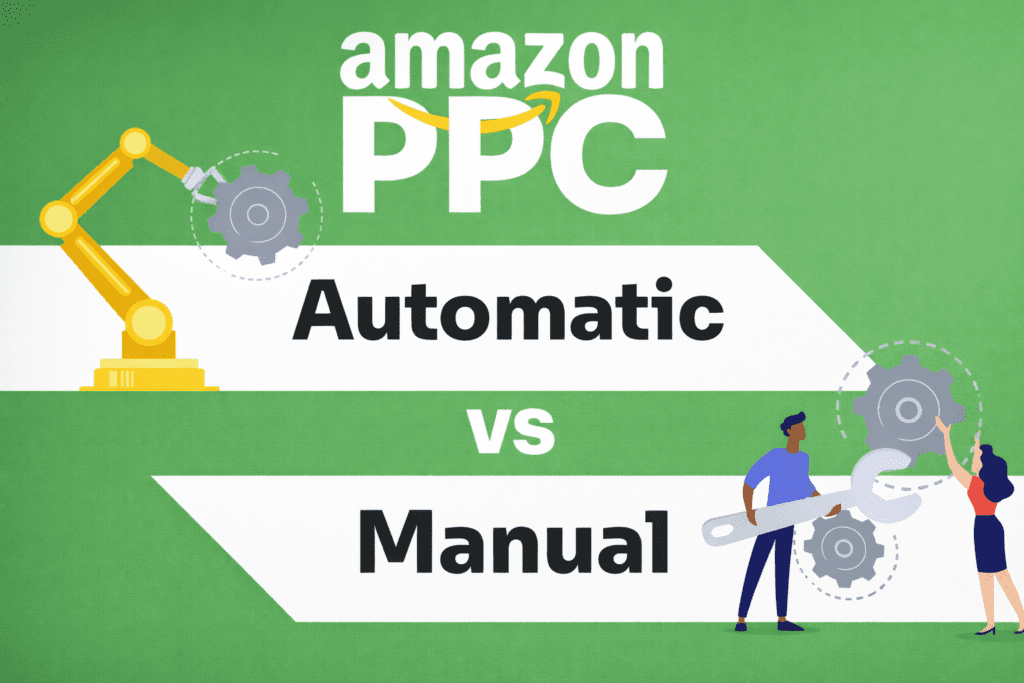
The Truth: Automatic vs Manual Is Not a Competition
This is the biggest misunderstanding.
👉 It’s not Auto vs Manual.
👉 It’s Auto + Manual.
The Proven Hybrid Strategy (Ecom Ranker System)
Step 1: Run Automatic Campaigns
Purpose:
- Discover keywords
- Gather data
- Understand audience
Step 2: Analyze Search Term Reports
Find:
- High-performing keywords
- High-conversion search terms
- Low-performing queries
Step 3: Build Manual Campaigns
Move winning keywords into:
- Exact match
- Phrase match
Step 4: Optimize and Scale
- Increase bids on winners
- Add negative keywords
- Improve performance
This creates a continuous improvement loop.
How This Impacts Your Overall Amazon Growth
When done correctly:
- Better targeting
- Higher conversion
- More sales
- Stronger ranking
👉 This connects directly with
How to Rank Your Product on Amazon First Page
Final Insight
The biggest difference between average sellers and top sellers:
👉 Top sellers don’t run campaigns.
👉 They build systems.
They combine:
- Listing optimization
- Keyword strategy
- PPC campaigns
- Conversion optimization
That’s how real growth happens.
Final Thoughts
If you want to scale on Amazon:
Don’t choose between automatic and manual.
Learn how to use both together.
Automatic campaigns help you discover opportunities.
Manual campaigns help you profit from them.
Want Expert PPC Management?
At Ecom Ranker, we help brands:
- Build profitable PPC systems
- Reduce ACoS
- Scale Amazon sales
Explore: Amazon PPC Management Services
FAQs
Which campaign is better for beginners?
Automatic campaigns.
Which is better for scaling?
Manual campaigns.
Should I use both?
Yes — always.
Can PPC improve organic ranking?
Yes, by increasing sales velocity.