
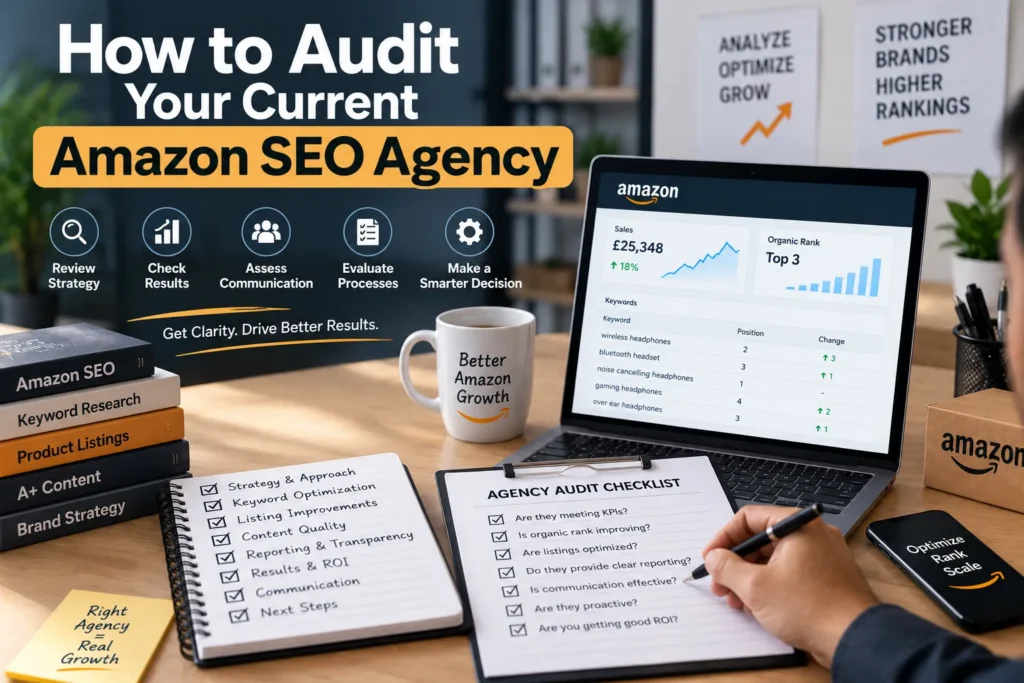
Auditing your Amazon SEO agency means pulling Amazon’s own Search Query Performance data before reading their report, then checking whether that report survives contact with the numbers. Your agency controls the report; Amazon controls the truth. A 30-day audit using free Seller Central data, one change-log request email, and about four hours of your time is enough to reach a verdict on any retainer.
Key Takeaways
- Pull Search Query Performance data yourself before trusting the agency’s monthly report — it’s free and it’s yours
- Subtract ad-attributed sales from any reported “SEO win,” since Amazon’s data doesn’t separate organic from sponsored automatically
- Request a dated change log — every real edit, by ASIN, with a reason — and judge how fast (and how completely) it arrives
- Judge against share metrics (impression, click, purchase share), not rank position or screenshot volume
- UK sellers need one extra check: Brand Analytics defaults to the US marketplace even when logged into a UK account — an agency reporting on the wrong marketplace’s data is a real, common failure mode
- Rule out stockouts, price changes, and new competitors before blaming the agency for flat organic sales
Why the Monthly Report Can’t Be the Evidence
The report your agency sends is the thing under audit — it can’t also serve as the evidence for its own case. Letting a monthly PDF settle whether the retainer is working is structurally the same as asking the defendant to write the verdict.
An agency covering a genuinely flat quarter has easy tools available without any dishonesty required: screenshot volume, rank tracking on branded terms that were never at risk anyway, and month-over-month comparisons quietly chosen against a seasonal low point. None of that requires bad faith — it just requires a report optimized to demonstrate effort rather than outcome, and most agencies build reports that way by default.
Three assumptions send genuinely good agencies out the door while keeping bad ones on the payroll: believing flat revenue always means bad SEO, treating keyword rank as the real scoreboard, and judging every phase of the work on a 90-day window. Stockouts, a price increase, or a well-funded new competitor entering the category can each flatten organic sales while an agency is doing everything correctly — rule those three out before ruling on anything else.
What to Expect at Your Revenue Level
A fair retainer at $1M in annual Amazon revenue looks like neglect at $10M. Anchor expectations to what your spend level typically buys.
| Annual Amazon revenue | Reasonable reporting cadence | Accounts per manager (workable range) |
| $1M–$3M | Monthly report, quarterly strategy call | 15–20 |
| $3M–$10M | Biweekly report, monthly strategy call | 8–15 |
| $10M+ | Weekly report, named escalation path | 8–12 |
Most agencies price Amazon SEO management as a percentage of ad spend or a flat retainer starting in the low thousands per month — judge the fee against the specialist count and manager ratio behind it, not the number alone, since a cheap retainer split across 30+ accounts per manager typically costs more in lost opportunity than it saves in fees. Ask your current agency directly for their per-manager account count, and treat outright refusal to answer as itself an answer.
On timeline: indexing changes can show up within days, click share moves over weeks, and purchase share needs a full sales cycle to reflect properly. Meaningful, defensible agency results generally take three to six months to fully materialize. Eight months in with zero movement on any of the three isn’t patience anymore — it’s a real signal. Eight weeks in, it’s simply too early to judge.
The 30-Day Audit, Step by Step
Run this in four weeks, one focus area per week, in this order — each step narrows what the next one has to explain.
Step 1: Pull Your Search Query Performance Data
In Seller Central: Brands → Brand Analytics → Search Query Performance. Compare your top 20 non-branded queries from the month before your agency started against the most recent full month. Flat impression share means nothing new got indexed; flat click share with rising impressions means the title and main image were never actually touched; flat purchase share with rising clicks means the work stopped at the top of the funnel and never reached conversion elements.
Step 2: Separate Organic Growth From Paid
Before crediting your agency with anything from Step 1, subtract ad-attributed units across both periods — Search Query Performance combines organic and sponsored results without separating them by default. If ad spend climbed in lockstep with every reported “SEO win,” you may be paying an SEO retainer for what is functionally paid traffic wearing an organic label.
Step 3: Request the Listing Change Log
Ask for every listing edit by ASIN, with a date and a one-line reason, across the full engagement. An agency doing genuinely real work sends this within a day, because the log already exists as a byproduct of the work itself. An agency that can’t produce one has no actual record of what it did.
Copy and send this today: “Please send a change log covering our full engagement. For each edit, include the ASIN, the date, the field changed, and the reason. Cover titles, bullets, backend search terms, images, A+ content, and category or attribute changes.”
Step 4: Get Written Answers on SEO Phases
Ask which phase the account is in right now, what the exit criteria were for the phase before it, and what specifically triggers the next one. Any competent operator runs a phased plan; an agency without one genuinely can’t tell you what’s finished, what’s next, or what causes the transition between stages.
Step 5: Verify Partner Status Claims
Look up your current agency in Amazon’s public Ads Partner Directory and confirm any partner badge on their site actually appears there. A badge doesn’t prove quality on its own, but a claimed badge that doesn’t appear in Amazon’s own directory is a meaningful red flag worth following up on directly.
UK Sellers: One Setting That Silently Skews This Whole Audit
This is a failure mode that’s specific to running this audit on a UK (or any non-US) Amazon account, and it’s easy to miss entirely.
Amazon’s Brand Analytics and Search Query Performance dashboards default to the US marketplace by selection, even when you’re logged into a UK seller account. If you (or your agency) pull a Search Query Performance export without deliberately setting the marketplace selector to the UK first, the data you’re looking at may reflect US search behavior — not the UK results your agency is actually supposed to be optimizing for.
Before running Step 1 above on a UK account, confirm the marketplace dropdown at the top right of the report is explicitly set to the UK, not left on its US default. If your current agency has been sending you reports without ever confirming this, it’s worth asking directly which marketplace their underlying pull was actually filtered to — this is one of the more common, entirely avoidable reporting errors on multi-marketplace accounts, and it can make a UK account look like it’s underperforming (or overperforming) relative to what’s actually happening on Amazon.co.uk.
The Metrics That Actually Prove the Work
Share metrics beat rank position every time, because rank is measured against nothing in particular — share is measured against every shopper who actually searched that term in your category.
| Metric | Where it lives | Good 90-day movement |
| Impression share | Search Query Performance | Rising on target non-branded terms |
| Click share | Search Query Performance | Rising faster than impression share |
| Purchase share | Search Query Performance | Rising, or holding flat while share overall grows |
| Organic share of total sales | Business Reports vs. ad reports | Rising, or holding steady as ad spend drops |
| Indexed keyword count | Search Query Performance | Growing on new non-branded terms |
| TACOS | Ad reports against total sales | Falling as organic strength builds |
What’s deliberately absent from this table matters as much as what’s in it: screenshot counts, tasks completed, and hours logged all prove an agency was busy. None of them prove a shopper ever actually found the product.
A genuinely good report leads with the change (the delta) and explains it in three parts: what moved, what the agency changed to move it, and what they’re changing next. A report describing activity without ever stating what happens next is visibility without direction — and that gap is usually visible months before the revenue impact is.
Is It Your Agency, or Is It Your Listing?
Sometimes the audit clears the agency entirely, and that’s a legitimate, useful outcome. High impression share paired with low purchase share usually points to price, reviews, or A+ Content — not keyword work.
Check impression share first, since it cleanly splits the diagnosis. Impression share falling means visibility work genuinely failed, and that sits with the agency. Impression share holding steady while purchases fall means shoppers saw the product and chose something else — a conversion problem wearing an SEO costume, and one your agency may have already flagged in a recommendation that got declined months earlier. The change log from Step 3 will settle that question either way.
Before You Fire Anyone
Renegotiate scope before terminating — the actual fix is often smaller than the decision to leave. A large share of underperforming accounts trace back to one brand manager carrying far more clients than a workable range, and the same agency frequently delivers once that account moves to someone with real capacity for it.
If you do switch, overlap retainers by two weeks and hand the incoming team a full keyword map before they touch a single ASIN. Never let an incoming agency rewrite a converting title in week one — that’s one of the most common, entirely self-inflicted reasons keyword rankings drop right after a change of partner.
FAQs About Auditing an Amazon SEO Agency
1 . Is my Amazon agency doing a good job?
Pull impression share, click share, and purchase share on 20 non-branded queries and compare the current month against the month before they started, using Search Query Performance data you already have free access to.
2 . How much should Amazon SEO management cost per month?
Most agencies price at a percentage of ad spend or a flat retainer, typically starting in the low thousands monthly. Judge the fee against the specialist count and manager-to-account ratio behind it — a cheap retainer split across an unworkable number of accounts per manager often costs more in lost opportunity than it saves.
3 . Can I audit my Amazon agency myself without hiring another one?
Yes, and you should run it yourself first. Everything in this guide uses data already inside your own Seller Central account.
4 . What are the biggest Amazon SEO agency red flags?
Reports that never state what changes next, an agency that can’t name your current strategic phase, and refusal to disclose how many accounts a manager carries.
5 . Is my agency just running PPC and calling it SEO?
Subtract ad-attributed units from every reported gain and see what’s left. Search Query Performance doesn’t separate organic from sponsored by default, which makes bought share easy to present as earned share if nobody checks.
6 . Should I fire my Amazon SEO agency if rankings dropped?
Not before checking inventory levels, recent price changes, and new competitors in the category — rank movement has multiple causes, and only some of them sit with the agency.
7 . Does my agency need Amazon Ads Partner status to be legitimate?
No, but a claimed badge should genuinely appear in Amazon’s public Partner Directory. Treat it as one data point among several, not proof of performance on its own.
8 . Why would my UK account’s audit numbers look wrong?
Check whether the Search Query Performance report was pulled with the marketplace selector explicitly set to the UK — it defaults to the US even on UK-logged-in accounts, and a report pulled on the wrong marketplace will misrepresent actual performance.
Get an Honest Second Read
An agency audit isn’t an accusation — it’s a measurement. Amazon hands you the funnel data for free; your agency owes you a dated record of what they actually changed. Thirty days is enough to put both side by side and see whether they agree.
Paying an Amazon SEO retainer without knowing whether it’s actually working?
Ecom Ranker’s Amazon account audit service gives you a straight, second-opinion read on your listings and current agency’s work — or explore our Amazon SEO services for US and UK accounts if it’s time to make a change.