

Why Amazon Organic Ranking is the Key to Success
Amazon organic ranking is the foundation of long-term success for any seller. While paid advertising (PPC) can provide immediate traffic, it is organic ranking that ensures consistent sales without ongoing ad spend. Products that rank higher organically receive the majority of clicks, leading to better visibility, higher trust, and increased profitability.
Amazon’s A9/A10 algorithm is designed to prioritize products that are most likely to generate sales. This means your ranking depends not only on keyword relevance but also on performance metrics like click-through rate (CTR), conversion rate, and sales velocity. To rank #1, sellers must optimize every part of their listing while maintaining strong performance signals.
Key Benefits
- Free and consistent traffic
Once your product ranks organically, it continuously receives traffic without ongoing ad spend, ensuring stable and cost-effective visibility. - Higher profit margins
With reduced dependence on PPC ads, you save on advertising costs, leading to better profit margins on each sale. - Reduced dependency on PPC
Strong organic rankings allow you to rely less on paid campaigns, making your business more sustainable and less risky. - Long-term brand growth
Consistent visibility and strong rankings help build brand trust, recognition, and customer loyalty over time.
What is Amazon Organic Ranking Strategy?
Amazon organic ranking strategy is the process of optimizing product listings, keywords, and performance metrics like click-through rate (CTR), conversion rate, and sales velocity to rank higher in Amazon search results and generate consistent sales without relying heavily on paid ads.
A strong Amazon SEO strategy focuses on improving keyword relevance, increasing conversions, and maintaining steady sales performance. By combining listing optimization, keyword research, and customer-focused content, sellers can achieve higher rankings and long-term profitability.
Key Elements of Amazon Organic Ranking
- Keyword optimization in title, bullets, and backend
- High click-through rate (CTR) with strong images
- High conversion rate through optimized listings
- Consistent sales velocity
- Positive reviews and ratings
How Amazon Ranking Algorithm Works
Amazon’s algorithm focuses on one core objective: maximizing revenue per customer search. Unlike Google, which prioritizes information relevance, Amazon prioritizes products that are most likely to convert into sales.
The algorithm evaluates how well your product matches customer search queries and how effectively it performs compared to competitors. If your product consistently generates clicks and conversions, Amazon will rank it higher.
Core Ranking Factors
- Keyword relevance and indexing
Amazon first checks whether your product matches the customer’s search query. Proper keyword placement in titles, bullet points, and backend ensures your product is indexed and visible for relevant searches. - Click-through rate (CTR)
CTR measures how many people click your product after seeing it in search results. A higher CTR indicates that your listing is attractive and relevant, which positively impacts ranking. - Conversion rate (CR)
Conversion rate shows how many visitors actually purchase your product. A higher conversion rate signals strong product-market fit, encouraging Amazon to rank your listing higher. - Sales velocity
Sales velocity refers to how quickly and consistently your product generates sales. Products with higher and stable sales trends are prioritized by Amazon’s algorithm. - Reviews and ratings
Customer feedback plays a major role in ranking and trust. Products with higher ratings and more positive reviews are more likely to rank higher and convert better.
Products that perform better in these areas naturally move toward the top positions.
Step-by-Step Amazon Organic Ranking Strategy
1. Advanced Keyword Research
Keyword research is the starting point of any successful Amazon SEO strategy. Without targeting the right keywords, your product will not appear in relevant searches, no matter how good your listing is.
The goal is to identify keywords with high search volume and strong buying intent. Instead of focusing only on broad keywords, sellers should prioritize long-tail keywords that are easier to rank and convert better.
Keyword Research Strategy
- Use tools like Helium 10, Jungle Scout
- Analyze competitor listings
- Focus on buyer-intent keywords
- Extract keywords from PPC campaigns
Strong keyword research ensures maximum visibility and targeted traffic.
2. Listing Optimization
Your product listing is the most critical factor in Amazon SEO. Every element must be optimized with relevant keywords while maintaining readability and customer appeal.
A well-optimized listing not only improves ranking but also increases conversion rate, which further strengthens your position.
Key Elements to Optimize
- Title (main keyword + benefits)
- Bullet points (features + emotional triggers)
- Product description (detailed + keyword-rich)
- Backend search terms
Optimization improves both discoverability and conversions.
3. Keyword Intent Strategy
Not all keywords drive sales. Understanding keyword intent helps you focus on high-converting search terms that improve ranking faster.
Transactional keywords (buy intent) are the most important because they directly generate sales.
Types of Keywords
- Informational (low conversion)
- Commercial (comparison stage)
- Transactional (high conversion)
Focus more on transactional keywords to improve ranking speed.
4. Click-Through Rate (CTR) Optimization
CTR measures how often users click your product when it appears in search results. A higher CTR tells Amazon that your listing is attractive and relevant.
Even if your product ranks well, poor CTR can reduce your ranking over time.
How to Improve CTR
- High-quality main image
- Clear and benefit-driven title
- Competitive pricing
- Strong review ratings
Higher CTR = stronger ranking signal.
5. Conversion Rate Optimization
Conversion rate is one of the strongest factors in Amazon ranking. If your product converts better than competitors, Amazon will push it higher.
A high conversion rate indicates that your product satisfies customer expectations.
How to Increase Conversion
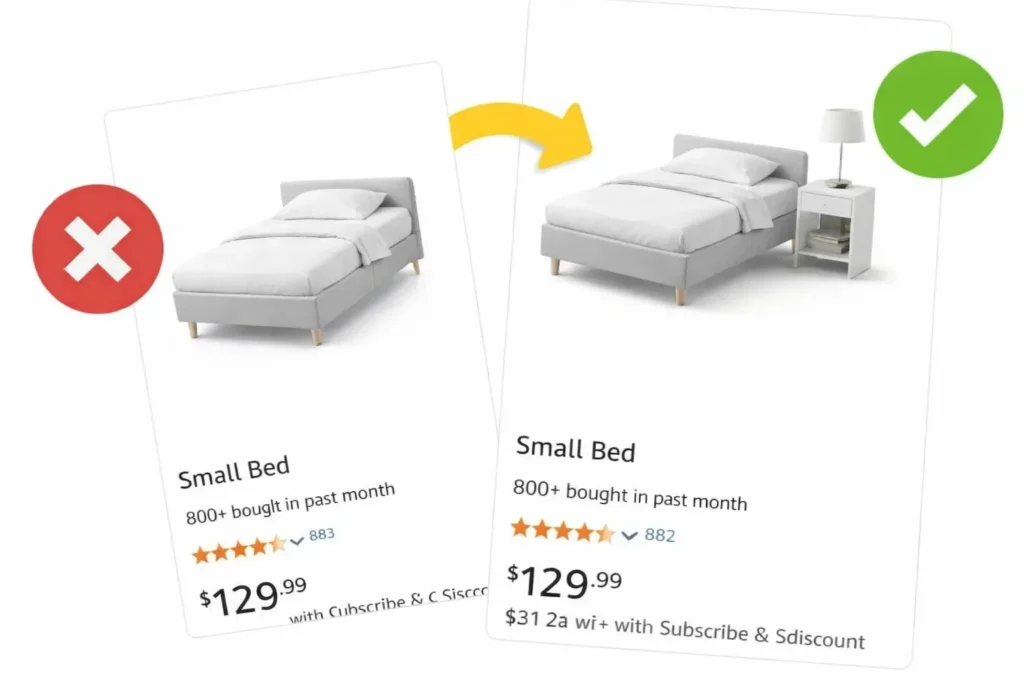
- Use lifestyle images
- Add A+ content
- Highlight key benefits
- Build trust with reviews
Better conversion = higher ranking + more sales.
6. Sales Velocity Strategy
Sales velocity refers to how quickly your product generates sales. Amazon favors products with consistent and increasing sales trends.
A spike in sales can significantly boost your ranking within a short period.
How to Increase Sales Velocity
- Run PPC campaigns
- Offer discounts
- Launch promotions
- Use external traffic
More sales = faster ranking growth.
7. Reviews & Ratings Optimization
Customer reviews influence both ranking and purchasing decisions. Products with higher ratings and more reviews tend to perform better.
How to Improve Reviews
- Deliver high-quality products
- Provide excellent customer service
- Follow up with buyers
Strong reviews = higher trust + better ranking.
8. Backend SEO Optimization
Backend keywords help Amazon index your product for additional search queries that are not visible on the listing.
Backend Strategy
- Use all available space
- Avoid duplication
- Add synonyms and variations
This expands your reach and improves discoverability.
9. External Traffic Strategy
Driving traffic from outside Amazon can improve ranking by increasing engagement and sales.
External Traffic Sources
- Google SEO blogs
- Social media ads
- Influencer marketing
- YouTube reviews
External traffic signals boost Amazon’s trust in your product.
Advanced Strategies Used by Top Sellers
TTo achieve top rankings on Amazon, sellers must go beyond basic optimization and implement advanced strategies that focus on performance, data, and continuous improvement. These techniques are used by top sellers to accelerate growth, dominate keywords, and maximize profitability.
op sellers use advanced techniques to dominate rankings and outperform competitors.
Advanced Techniques
- PPC keyword ranking push
This strategy involves aggressively targeting specific high-value keywords through PPC campaigns to quickly boost their ranking, and then maintaining those positions organically. - Listing A/B testing
By testing different versions of titles, images, and bullet points, sellers can identify what drives higher clicks and conversions, leading to better overall performance. - Funnel-based PPC strategy
This approach targets customers at different stages—starting with broad awareness campaigns and narrowing down to exact-match keywords for high-converting buyers. - Data-driven optimization
Decisions are made based on real performance metrics like CTR, conversion rate, and ACOS, allowing continuous refinement and improved ROI over time.
These strategies create a strong competitive advantage.
Common Mistakes to Avoid
Many Amazon sellers struggle to rank because they overlook fundamental strategies or rely too heavily on shortcuts. Avoiding these common mistakes is essential to improve your organic ranking, reduce costs, and build a profitable business.
Avoid These Mistakes
Over-reliance on PPC
Depending only on ads increases costs and reduces profitability, especially without strong organic ranking support.
Ignoring keyword research
Without proper keyword research, your product won’t appear in relevant searches, limiting visibility and sales potential.
Poor listing optimization
Weak titles, unclear bullet points, and missing keywords reduce both discoverability and conversion rates.
Low-quality images
Poor visuals fail to attract clicks and reduce trust, leading to lower CTR and fewer conversions.
Not tracking performance metrics
Without monitoring metrics like CTR, conversion rate, and ACOS, you cannot identify issues or optimize effectively.
Conclusion: The Winning Formula for Amazon Ranking
Amazon organic ranking is not based on luck—it is driven by strategy, data, and execution.
Final Formula
Keywords + CTR + Conversion Rate + Sales Velocity = #1 Ranking
Sellers who optimize all these factors consistently can dominate Amazon search results and build a profitable, scalable business.
FAQs: Amazon Organic Ranking Strategy
1. How does Amazon organic ranking work?
Amazon organic ranking is based on how well your product performs in terms of keyword relevance, sales velocity, click-through rate (CTR), and conversion rate. The algorithm prioritizes products that generate more sales and satisfy customer intent.
2. How can I rank my product #1 on Amazon?
To rank #1, you need to optimize your listing with high-converting keywords, improve CTR and conversion rate, and maintain consistent sales velocity through SEO and PPC strategies.
3. How important is keyword research for Amazon ranking?
Keyword research is critical because it determines whether your product appears in search results. Targeting the right keywords increases visibility, traffic, and sales.
4. Does PPC help improve organic ranking on Amazon?
Yes, PPC helps boost organic ranking by increasing visibility, generating sales, and improving keyword performance, which signals relevance to Amazon’s algorithm.
5. How long does it take to improve Amazon organic ranking?
It can take anywhere from a few weeks to a few months depending on competition, keyword difficulty, and how well your listing is optimized.
6. What is sales velocity in Amazon ranking?
Sales velocity refers to the speed and consistency of sales over time. Higher sales velocity indicates strong demand, which helps improve your ranking.
7. Can I rank on Amazon without using PPC?
Yes, but it is slower. PPC helps accelerate ranking by generating initial traffic and sales, while SEO builds long-term organic growth.