

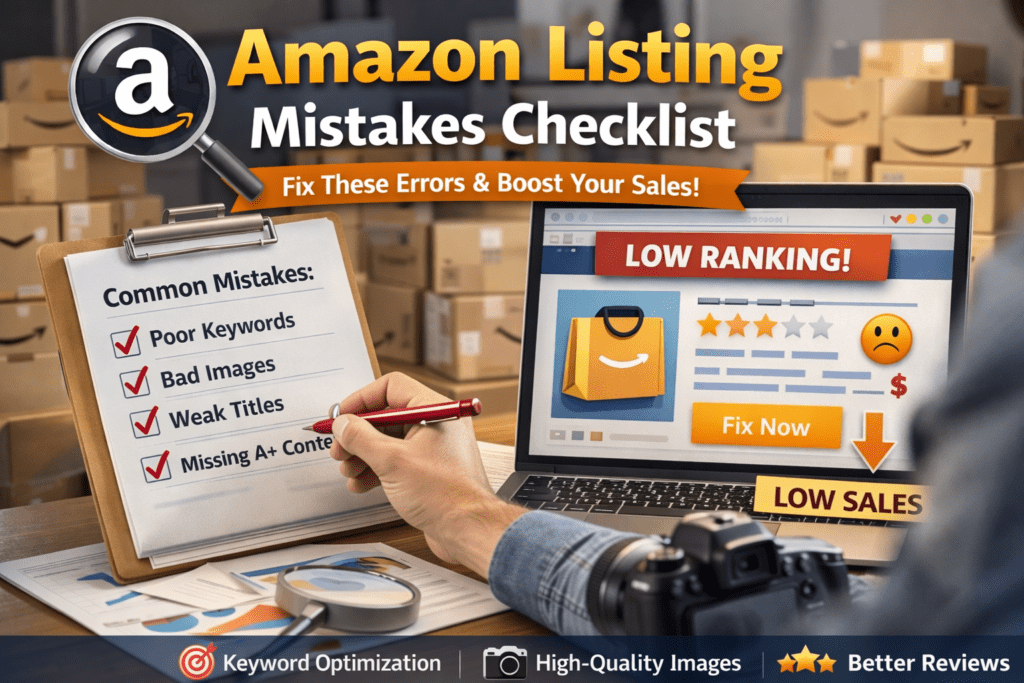
Selling on Amazon today is no longer just about uploading a product—it’s about building a fully optimized, conversion-focused listing that aligns with Amazon’s A9/A10 algorithm. Many sellers struggle because they unknowingly make critical listing mistakes that reduce visibility, lower click-through rates, and kill conversions.
This Amazon listing mistakes checklist is a complete, in-depth guide that explains every major mistake in detail, along with actionable fixes to help you rank higher and sell more.
1. Poor Keyword Research (Foundation-Level Amazon SEO Mistake)
Keyword research is the backbone of Amazon SEO, yet many sellers either skip it or do it incorrectly. Without targeting the right keywords, your product simply won’t appear in relevant search results, no matter how good your product is. This leads to low impressions and almost zero organic sales.
Most sellers focus only on broad keywords, ignoring long-tail keywords that carry higher buying intent. For example, a keyword like “trash can” is highly competitive, while “small bathroom trash can with lid” is more specific and converts better.
To fix this, you need to build a complete keyword strategy that includes primary keywords, secondary keywords, and long-tail variations. Use tools like Helium 10 or Jungle Scout to identify high-volume, low-competition keywords and integrate them naturally across your listing.
2. Keyword Stuffing Instead of Smart Optimization
One of the biggest misconceptions about Amazon SEO is that adding more keywords automatically improves ranking. In reality, keyword stuffing can harm both readability and conversion rates. When your title or bullet points look unnatural, customers lose trust and are less likely to buy.
Amazon’s algorithm has evolved to prioritize conversion-driven content, meaning listings that perform well with customers rank higher. If your content is difficult to read, your conversion rate drops, and your ranking follows.
The solution is to focus on contextual keyword placement. Instead of repeating the same keyword multiple times, use variations and write naturally. Your goal should be to create a listing that reads smoothly while still being keyword-rich.
3. Weak or Non-Optimized Product Title
Your product title is the most critical element for both ranking and click-through rate. A poorly written title either fails to rank or fails to attract clicks, both of which directly impact sales performance.
Common mistakes include missing primary keywords, not highlighting key product features, or creating titles that are either too short or excessively long. A weak title doesn’t communicate value or relevance to the customer.
An optimized title should include your main keyword at the beginning, followed by essential details like size, color, use case, and unique features. It should be structured in a way that appeals to both Amazon’s algorithm and human buyers.
4. Low-Quality Product Images (Major Conversion Killer)
Images are often the deciding factor for customers browsing Amazon. Even if your listing ranks well, poor-quality images can drastically reduce your conversion rate. Customers rely heavily on visuals to evaluate the product, especially since they cannot physically inspect it.
Low-resolution images, lack of lifestyle shots, and missing infographics are common issues. These mistakes make your listing look unprofessional and reduce perceived value.
To fix this, invest in high-quality visual content. Use clear, high-resolution images with a white background for the main image, and include lifestyle images that show the product in use. Infographics highlighting features and benefits can significantly improve conversion rates.
5. Missing Backend Search Terms (Hidden Ranking Loss)
Backend keywords are an often-overlooked aspect of Amazon listing optimization. Many sellers leave this section empty or fill it incorrectly, missing out on valuable indexing opportunities.
This section allows you to include keywords that may not fit naturally into your visible content, such as synonyms, alternate spellings, and related search terms. Ignoring backend search terms limits your product’s discoverability.
To optimize this section, include relevant keywords without repetition. Avoid using commas or repeating words already present in your listing. Think of this as a hidden SEO layer that boosts your ranking potential.
6. Bullet Points That Don’t Convert
Bullet points are not just for listing features—they are your opportunity to persuade customers. Many sellers make the mistake of writing generic bullet points that fail to communicate real value.
Instead of simply describing the product, you should focus on how it benefits the customer. Shoppers are not interested in features alone—they want to know how the product solves their problem or improves their life.
A strong bullet point follows a feature-benefit-use case structure, making it more engaging and conversion-focused. This approach helps customers quickly understand why they should choose your product over competitors.
7. Poor Product Description (Missed SEO & Engagement Opportunity)
The product description is often underutilized, yet it plays a crucial role in both SEO and customer engagement. Many sellers either ignore it or write a short, uninformative paragraph that adds little value.
A well-written description allows you to expand on your product’s benefits, tell a story, and naturally include additional keywords. It also helps customers feel more confident about their purchase decision.
To optimize your description, write detailed, engaging content that highlights use cases, benefits, and product quality. This not only improves SEO but also increases conversion rates.
8. Not Using A+ Content (Massive Conversion Gap)
A+ Content is one of the most powerful tools available to brand-registered sellers, yet many fail to use it effectively. Without A+ Content, your listing lacks visual depth and brand storytelling, which can reduce customer trust.
A+ Content allows you to showcase your product through enhanced images, comparison charts, and structured layouts. It improves the overall shopping experience and helps differentiate your brand from competitors.
By adding A+ Content, you can significantly increase conversion rates and build a stronger brand presence on Amazon.
9. Ignoring Customer Reviews & Ratings
Customer reviews are a critical ranking and conversion factor. A product with poor ratings or very few reviews struggles to gain trust, leading to lower sales and reduced visibility.
Negative reviews also provide valuable insights into product issues, which many sellers ignore. Failing to address these issues can result in ongoing negative feedback and declining performance.
To improve this, focus on delivering high-quality products and excellent customer service. Encourage reviews through follow-ups and continuously improve your product based on feedback.
10. Wrong Category Selection (Visibility Issue)
Choosing the wrong category can severely limit your product’s exposure. If your product is placed in a category that doesn’t match customer search behavior, it won’t rank effectively.
Many sellers either select overly competitive categories or irrelevant ones, making it difficult for their product to gain traction.
To fix this, research the best category for your product based on relevance, competition, and search volume. Proper categorization improves both ranking and discoverability.
11. Pricing Strategy Mistakes
Pricing plays a significant role in both conversion rate and competitiveness. Setting your price too high can deter buyers, while pricing too low can reduce perceived value and profit margins.
Customers often compare multiple listings before making a purchase, so your pricing must align with market expectations.
A smart pricing strategy involves competitor analysis, psychological pricing, and occasional promotions to boost sales and visibility.
12. Not Optimizing for Mobile Users
A large percentage of Amazon shoppers use mobile devices. If your listing is not optimized for mobile viewing, you risk losing potential customers.
Long paragraphs, unclear images, and cluttered content can make it difficult for mobile users to engage with your listing.
To improve mobile optimization, keep your content concise, use clear formatting, and ensure images are easily viewable on smaller screens.
13. Ignoring Competitor Analysis
Competitor analysis is essential for identifying gaps and opportunities in your listing. Without understanding what top-performing competitors are doing, you are essentially operating blindly.
By analyzing competitor listings, you can discover high-ranking keywords, pricing strategies, and content ideas that work.
This allows you to create a more competitive and optimized listing that stands out in the marketplace.
14. No Unique Selling Proposition (USP)
If your product looks identical to others, customers have no reason to choose it. A lack of differentiation leads to low conversion rates and weak brand identity.
Your USP should clearly communicate what makes your product better or different, whether it’s quality, design, functionality, or added features.
Highlighting your USP effectively can significantly improve both click-through rate and conversions.
15. Inconsistent Branding
Brand consistency builds trust and recognition. If your listing lacks a cohesive brand identity, it can appear unprofessional and unreliable.
Inconsistent visuals, messaging, and tone can confuse customers and reduce confidence in your product.
To fix this, maintain a consistent brand style across images, content, and A+ Content. Strong branding helps establish credibility and encourages repeat purchases.
16. Ignoring Conversion Rate Optimization (CRO)
Many sellers focus only on ranking, ignoring the importance of conversion rate optimization. However, conversion rate is a key factor in Amazon’s ranking algorithm.
Even if your product gets traffic, poor conversion means wasted opportunities and lower rankings over time.
Improving CRO involves optimizing images, copy, pricing, and overall presentation to maximize sales.
17. Poor Inventory Management
Running out of stock can severely impact your ranking. Once your product goes out of stock, it loses sales momentum and drops in search rankings.
Recovering from this can take time and effort, making inventory management crucial for long-term success.
Always maintain adequate stock levels and plan ahead to avoid disruptions.
18. Not Using PPC to Support Organic Ranking
Amazon PPC is not just for paid traffic—it also helps improve organic ranking by increasing sales velocity.
Without PPC, it can be difficult for new listings to gain initial traction and visibility.
Running targeted campaigns allows you to generate data, identify high-performing keywords, and boost your overall performance.
19. Duplicate or Repetitive Content
Repeating the same keywords across your listing does not improve SEO—it actually reduces effectiveness.
Amazon’s algorithm ignores duplicate keywords, meaning you are wasting valuable space that could be used for additional terms.
Instead, focus on using keyword variations to maximize your indexing potential.
20. Ignoring Seasonal Keywords & Trends
Seasonal demand plays a huge role in Amazon sales. Ignoring seasonal keywords means missing out on high-converting traffic during peak periods.
Customers often search using occasion-based keywords like “Christmas gift” or “Diwali decoration,” which can significantly boost visibility.
Updating your listing with seasonal keywords helps capture this demand and increase sales.
21. Not Updating Listings Regularly
Amazon SEO is constantly evolving, and listings that remain static tend to lose competitiveness over time.
Regular updates based on performance data, keyword trends, and customer feedback are essential for maintaining ranking.
Continuous optimization ensures your listing stays relevant and competitive.
22. Poor Packaging Presentation
Packaging plays a subtle but important role in perceived value. If your product packaging looks cheap or unattractive, it can negatively impact customer perception.
Showcasing premium packaging in your images can enhance the overall appeal of your product.
This is especially important for giftable items and premium categories.
23. Lack of Trust Signals
Customers need reassurance before making a purchase. Without trust signals, they may hesitate or choose a competitor.
Trust signals include guarantees, certifications, quality claims, and clear product information.
Adding these elements helps build confidence and improve conversion rates.
24. Ignoring Click-Through Rate (CTR)
CTR determines how many people click on your listing after seeing it in search results. A low CTR indicates that your listing is not appealing enough.
Your main image and title play the biggest role in improving CTR.
Optimizing these elements can significantly increase traffic and sales.
25. No Data-Driven Optimization Strategy
Relying on guesswork instead of data is one of the biggest mistakes sellers make. Without analyzing performance metrics, it’s impossible to identify what’s working and what needs improvement.
Using tools like Amazon Brand Analytics and Helium 10 allows you to make informed decisions and continuously improve your listing.
A data-driven approach is essential for long-term success on Amazon.
FAQs: Amazon Listing Mistakes & Optimization
1. What are the most common Amazon listing mistakes?
The most common Amazon listing mistakes include poor keyword research, keyword stuffing, low-quality product images, weak product titles, missing backend keywords, and non-converting bullet points. Many sellers also fail to optimize A+ Content, ignore customer reviews, and choose the wrong product category. These mistakes reduce visibility, lower click-through rates, and negatively impact conversion rates, ultimately affecting sales and rankings.
2. How do I optimize my Amazon listing for SEO?
To optimize your Amazon listing for SEO, start with in-depth keyword research using tools like Helium 10 or Jungle Scout. Place your primary keyword in the title, include secondary keywords in bullet points and description, and fill backend search terms properly. Focus on writing conversion-driven content, use high-quality images, and continuously update your listing based on performance data to improve rankings.
3. Why is my Amazon listing not ranking?
If your Amazon listing is not ranking, it could be due to poor keyword targeting, low sales velocity, weak conversion rates, or high competition. Amazon’s A9 algorithm prioritizes listings that generate sales, so if your listing is not converting well, your ranking will drop. Improving images, optimizing content, and running PPC campaigns can help boost visibility and ranking.
4. How important are keywords in Amazon product listings?
Keywords are extremely important in Amazon product listings because they determine whether your product appears in search results. Without proper keyword optimization, your listing will not be indexed or visible to potential buyers. However, it’s equally important to use keywords naturally and focus on customer experience to maintain high conversion rates.
5. What is Amazon A9 algorithm and how does it work?
Amazon’s A9 algorithm is the system that ranks products based on relevance and performance. It considers factors like keyword relevance, sales velocity, conversion rate, pricing, and customer satisfaction. Listings that generate more sales and provide a better customer experience are ranked higher in search results.
6. How do product images affect Amazon sales?
Product images have a direct impact on conversion rates. High-quality images increase trust, improve click-through rates, and help customers understand the product better. Listings with professional images, lifestyle shots, and infographics tend to convert significantly better than those with basic or low-quality visuals.
7. What are backend search terms in Amazon?
Backend search terms are hidden keywords that help Amazon index your product for additional search queries. These include synonyms, alternate spellings, and related keywords that may not fit naturally into your visible listing. Properly optimizing backend keywords improves discoverability and overall SEO performance.
8. How can I improve my Amazon conversion rate?
To improve your Amazon conversion rate, focus on high-quality images, compelling bullet points, competitive pricing, and strong product descriptions. Adding A+ Content, showcasing customer reviews, and highlighting your unique selling points also help increase trust and drive more sales.
9. Does Amazon PPC help with organic ranking?
Yes, Amazon PPC (Pay-Per-Click advertising) helps improve organic ranking by increasing sales velocity and keyword data. When your product generates more sales through PPC campaigns, Amazon’s algorithm considers it more relevant, which can boost its organic ranking over time.
10. How often should I update my Amazon listing?
You should regularly update your Amazon listing based on performance data, keyword trends, and customer feedback. Continuous optimization helps maintain rankings, improve conversion rates, and stay competitive in the marketplace.
11. What is the ideal Amazon product title format?
An ideal Amazon product title includes the brand name, primary keyword, key features, size, color, and use case. It should be clear, keyword-rich, and easy to read. A well-structured title improves both search visibility and click-through rates.
12. Why are my Amazon sales low despite good traffic?
If your Amazon listing gets traffic but has low sales, the issue is likely with conversion rate optimization. Poor images, weak bullet points, lack of trust signals, or uncompetitive pricing can prevent customers from purchasing. Improving these elements can significantly increase conversions.
13. How do I find high-ranking keywords for Amazon?
You can find high-ranking Amazon keywords using tools like Helium 10, Jungle Scout, or Amazon Brand Analytics. These tools provide data on search volume, competition, and keyword trends, helping you identify the best keywords to target for your listing.
14. What is A+ Content and is it necessary?
A+ Content is an advanced content feature available to brand-registered sellers that allows you to add enhanced visuals, comparison charts, and detailed product descriptions. While not mandatory, it significantly improves conversion rates and helps build brand trust.
15. How do reviews impact Amazon ranking?
Customer reviews play a crucial role in Amazon ranking and conversions. Products with higher ratings and more positive reviews are more likely to rank higher and attract buyers. Reviews also provide social proof, which increases customer trust and purchase likelihood.
Conclusion: Fix These Amazon Listing Mistakes to Dominate Rankings
Success on Amazon requires a combination of SEO, conversion optimization, and continuous improvement. By following this detailed Amazon listing mistakes checklist, you can identify weaknesses, fix critical issues, and create a high-performing listing that ranks and converts.