
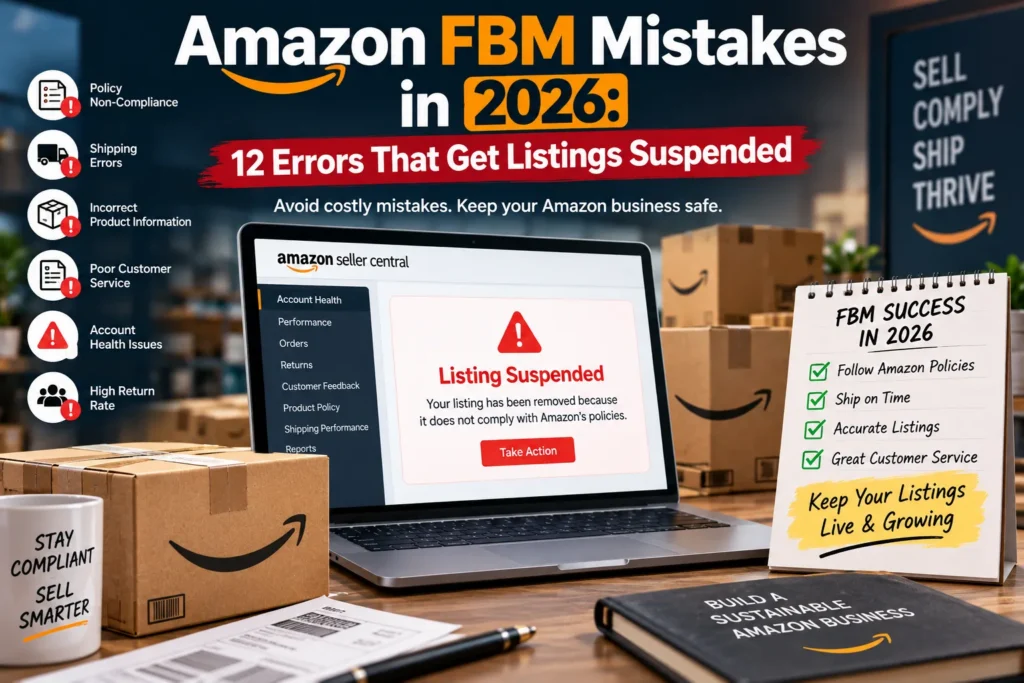
Amazon FBM mistakes in 2026 are settings problems, not shipping problems. Handling times set once at launch, on-time delivery held at Amazon’s 90% floor instead of a safer margin, and shipping labels bought outside Amazon’s protected system are the three biggest drivers of suspended FBM listings and lost Buy Box share this year — for both US and UK sellers, under two different rule sets that took effect in mid-2026.
Key Takeaways
- Amazon now requires SKU-level, accurate handling times in the US (from June 29, 2026) and has quietly tightened UK account-level defaults to 0–1 day (from July 15, 2026)
- Sitting at the 90% on-time delivery floor is not a safety margin — hold 95% or higher
- Buy every label through Amazon’s protected shipping tools; outside labels lose tracking and OTDR protection
- UK sellers have an extra rule US sellers don’t: a 90% business-hour delivery rate for Amazon Business customers from September 30, 2026
- SAFE-T claims must be filed within 30 days, and refunds auto-trigger after 4 calendar days if returns aren’t inspected in time
- Most of this is preventable with a one-hour-a-week review, not a warehouse overhaul
What Is Amazon FBM, and Why Is 2026 Different?
Fulfillment by Merchant (FBM) means the seller — not Amazon — stores, packs, and ships every order. Amazon still owns the listing, the checkout, and the customer relationship; the seller owns everything that happens after the order is placed, including the consequences when something goes wrong.
FBM isn’t a niche setup. A large share of Amazon’s active sellers run at least some of their catalog this way, often as a hybrid alongside FBA — using FBM for oversized items, slow movers, or as a backup offer during stockouts. The tradeoff is straightforward: Amazon absorbs carrier delays on its own FBA shipments, but every FBM delay, missing tracking number, or slow return response is logged directly against the seller’s account health.
What makes 2026 different is the pace of change. Amazon tightened seller-fulfilled requirements on at least four separate fronts this year — handling time accuracy, on-time delivery enforcement, SAFE-T claim windows, and Seller Fulfilled Prime (SFP) speed thresholds — and UK sellers are working through a parallel but distinct rollout on top of that. A listing configured correctly in 2023 is very likely running against rules that no longer exist.
The 12 Amazon FBM Mistakes Costing Sellers Listings and the Buy Box
Most FBM problems trace back to a Seller Central setting nobody has revisited since launch — not a warehouse failure. Here are the twelve we see most often, and the fastest fix for each.
1. Handling Times That No Longer Match How Fast You Actually Ship
As of June 29, 2026, Amazon requires accurate, SKU-level handling times for every seller-fulfilled listing in the US. If a SKU consistently ships faster than the stated handling time over a rolling 30-day window, Amazon flags it and gives sellers roughly 30 days to correct it before assigning a value automatically.
The Fix
Pull 30 days of real ship times and compare them against every SKU’s current setting. If your operation is consistent, turn on Amazon’s Automated Handling Time (AHT) so it self-corrects; if it isn’t yet reliable, keep manual control but put a recurring review on the calendar — not a one-time fix.
2. Ignoring the UK’s Separate Handling Time Default Change
This is the mistake most US-focused guides miss entirely. On Amazon UK, 90% of FBM orders already ship within one day, so from July 15, 2026, account-level default handling time settings only display 0-day and 1-day options. Any account still defaulted to two days is automatically changed to one day — even if the underlying operation can’t actually hit that speed.
The Fix
UK sellers should audit account-level defaults before mid-July lands, then set any SKU that genuinely needs longer than one day at the SKU level individually, since the account-wide two-day option is going away, not the ability to set it product-by-product.
3. Confirming Orders Late and Blaming the Carrier
Amazon reads the order confirmation timestamp, not the day the box physically left the building. An order sitting unconfirmed past the stated handling window counts as late even when it shipped on schedule — which is why Late Shipment Rate climbs on accounts that swear they ship on time.
The Fix
Audit weekend and holiday cutoffs first; that’s where confirmation delays cluster hardest. Late Shipment Rate needs to stay under 4%, and fixing confirmation timing alone usually recovers most of that gap.
4. Treating the 90% On-Time Delivery Floor as a Safe Target
Since February 28, 2026, Amazon has shifted enforcement to remove the specific listings dragging OTDR down rather than deactivating the entire seller-fulfilled catalog — which sounds gentler but actually means underperforming SKUs get picked off individually, more often.
The Fix
Hold on-time delivery at 95% or better. Sitting on the 90% floor leaves zero room for one bad carrier week, a weather delay, or a warehouse staffing gap.
5. Buying Shipping Labels Outside Amazon’s Protected Tools
Buying labels through Amazon’s own shipping tools isn’t mandatory — it’s just the most expensive shortcut to skip. Labels bought this way carry on-time delivery protection and item-not-received coverage, and they upload valid tracking automatically.
The Fix
Route every label through Amazon’s protected shipping system by default, and treat any outside label as an exception that needs sign-off. Valid tracking rate should stay above 95%; manual workflows are exactly where it slips below that.
6. Letting Your Own FBA Offer Cannibalize Your FBM Offer
On hybrid catalogs, an FBM offer can lose the Buy Box to the seller’s own FBA listing on the same product. The FBA offer shows a faster delivery date and the Prime badge, so Amazon surfaces whichever offer is statistically more likely to convert.
The Fix
Decide in advance which offer should win. Price the FBM offer to protect margin and position it as the reserve channel that catches overflow demand — not the one you expect to carry volume.
7. Running Transit Times Set From Memory, Years Ago
Templates written once at launch are the single most common stale setting in FBM accounts. Amazon’s Shipping Settings Automation pulls real transit times by destination ZIP and updates the delivery promise on the listing directly, removing the guesswork.
The Fix
Turn on automated transit time settings, then spot-check the delivery promise on a handful of far-zone destinations to confirm it’s realistic.
8. Missing the SAFE-T Claim Window on Returns
As of January 26, 2026, the FBM refund window moved to 4 calendar days before an Automated Refund triggers, and the SAFE-T claim filing window was cut from 60 days to 30 days. A returns process still built on the old timeline misses both deadlines without anyone noticing until the chargeback lands.
The Fix
Log every return the day it posts and inspect on a fixed schedule — not “when someone gets to it.” A 30-day filing window leaves almost no room for a backed-up inspection queue.
9. Pricing Oversized FBM SKUs on Last Year’s Carrier Rates
Whether an oversized item belongs on FBM or FBA can flip the moment carrier rates move, because zone-based pricing and fuel surcharges shift FBM cost quietly while FBA charges one published rate regardless of distance.
The Fix
Rerun the per-unit shipping math twice a year, not once at launch. If FBM cost has crept above FBA’s published rate for a given SKU, that’s a signal to switch fulfillment method, not to absorb the margin loss.
10. Keeping an Untested FBM Offer as a “Just in Case” Stockout Backup
A dormant FBM listing is not a real stockout safety net. Stale handling times and no recent order history mean that offer starts generating defects the moment real order volume actually hits it during an FBA stockout.
The Fix
Build and lightly test the FBM offer before you need it, keeping a small trickle of real orders flowing through it so the settings stay accurate and the account health stays clean.
11. Running Seller Fulfilled Prime Without the Speed to Hold It
SFP only pays off if the operation can clear Amazon’s delivery-speed bar. Standard-size SFP offers need one-day delivery on a meaningful share of Prime page views and two-day delivery on the majority. Amazon also raised SFP delivery thresholds further as of July 6, 2026, and separately lowered the required on-time rate for its Premium Shipping program from 97% to 93.5% over a 30-day window — a sign Amazon is tightening delivery speed requirements while loosening delivery consistency requirements slightly, which is easy to misread if you’re only tracking one metric.
The Fix
Model real delivery coverage against Amazon’s current thresholds before enrolling or renewing SFP. A single-warehouse operation on one coast rarely clears the bar without regional fulfillment support.
12. Ignoring the UK’s New Business-Hour Delivery Requirement
This is the mistake with almost no coverage in US-focused content, because it doesn’t exist in the US. From September 30, 2026, Amazon UK expects FBM sellers to hit a 90% business-hour delivery rate for shipments to Amazon Business customers — measuring whether deliveries land within the buyer’s stated hours of operation, to cut down on failed redelivery attempts.
The Fix
UK sellers with any B2B/Amazon Business exposure should check current business-hour delivery performance now, well before the September enforcement date, rather than finding out from a performance notification.
US vs UK: Which 2026 Rule Changes Apply to You
Global sellers running both marketplaces are the most likely to mix these up. Here’s the split:
| Rule Change | Market | Effective Date | Applies To |
| SKU-level accurate handling time required | US | June 29, 2026 | All FBM SKUs (except custom, handmade, and Heavy & Bulky LTL items) |
| Account-level handling time defaults to 0–1 day | UK | July 15, 2026 | Account-wide default; SKU-level overrides still allowed |
| SFP delivery speed thresholds raised | US | July 6, 2026 | Sellers enrolled in Seller Fulfilled Prime |
| Premium Shipping on-time requirement lowered (97% → 93.5%) | US | June 29, 2026 | Sellers using Amazon’s Premium Shipping program |
| OTDR enforcement targets specific listings, not whole catalog | Global | February 28, 2026 | All FBM sellers below 90% OTDR |
| SAFE-T claim window cut to 30 days | Global | Rolled out early-mid 2026 | All FBM sellers filing claims |
| Refund auto-trigger shortened to 4 calendar days | Global | January 26, 2026 | All FBM sellers processing returns |
| Business-hour delivery rate requirement (90%) | UK | September 30, 2026 | FBM sellers shipping to Amazon Business customers |
Amazon FBM Performance Thresholds to Hold (Not the Floor)
Set internal targets above Amazon’s published minimums — the floor is where enforcement begins, not where safety lives.
| Metric | Amazon’s Floor | Recommended Hold | Where to Check |
| On-time delivery rate | 90% | 95%+ | Account Health → delivery defects report |
| Late shipment rate | 4% | Under 2% | Account Health |
| Order defect rate | 1% | Under 0.5% | Account Health |
| Valid tracking rate | 95% | Above 98% | Account Health |
| Handling time accuracy | Flagged after 30-day drift | Matches last 30 days of ship times exactly | Modify Handling Time tool |
Check these weekly, not monthly. Amazon now evaluates on rolling windows, so a strong month no longer offsets one genuinely bad week the way it used to.
Building a Weekly FBM Review Routine
Prevention here is a routine, not a cleanup project. Six habits stop nearly every mistake on this list before it becomes a suspended listing:
- Confirm every order the day it lands, with one named owner and a hard daily cutoff
- Buy every shipping label through Amazon’s protected shipping tools so tracking and coverage apply automatically
- Reconcile stated handling time against actual ship times monthly, per SKU
- Let automated transit time tools own delivery promises instead of a template written years ago
- Work returns on a fixed inspection day so no claim ages past the 30-day SAFE-T window
- Rerun FBM unit economics every six months, or immediately after a carrier rate change
Ecom Ranker: Insert a verified before/after result from an actual client audit here (e.g., late shipment rate reduction, OTDR recovery, or Buy Box share change over a specific time period). Do not publish with fabricated or estimated figures — pull real numbers from account history before this goes live.
The pattern holds regardless of the client: availability and settings discipline protect margin more reliably than bidding harder on ads ever does. Fixing FBM mistakes is a settings review, not a shipping-speed race — see our full Amazon account audit checklist for the complete process we run before touching a single ad campaign.
FAQs About Amazon FBM Mistakes
1 . What metrics does Amazon track for FBM sellers?
Amazon tracks on-time delivery rate, late shipment rate, order defect rate, and valid tracking rate. To stay compliant, keep late shipment rate below 4%, order defect rate below 1%, and valid tracking rate above 95% — though holding tighter than these floors is safer.
2 . What happens if my on-time delivery rate drops below 90%?
Since February 2026, Amazon primarily deactivates the specific listings dragging the ratio down rather than the entire seller-fulfilled catalog, though repeated or severe misses can still trigger broader account action.
3 . Does FBM hurt my Buy Box chances?
Not inherently, but slow or inaccurate delivery promises reduce Buy Box share. On hybrid catalogs, an FBM offer can also lose the Buy Box to the seller’s own better-performing FBA offer on the same listing.
4 . Do I have to set handling time per SKU now?
In the US, yes — as of June 29, 2026, accurate handling time is required at the SKU level for most seller-fulfilled products, with limited exceptions for custom, handmade, and certain Heavy & Bulky items.
5 . Is the UK handling time rule the same as the US rule?
No. The US rule (June 29, 2026) requires SKU-level accuracy. The UK rule (July 15, 2026) changes the account-level default to 0–1 day, while still allowing SKU-level overrides for products that genuinely need longer.
6 . How long do I have to file a SAFE-T claim now?
30 days, down from the previous 60-day window, so returns need to be logged and inspected on a fixed schedule rather than an ad hoc one.
7 . What is Amazon’s business-hour delivery requirement?
It’s a UK-only metric, effective September 30, 2026, requiring a 90% delivery rate within an Amazon Business customer’s stated operating hours — aimed at reducing failed redelivery attempts to commercial addresses.
8 . Should I use Automated Handling Time or set it manually?
If your operation ships consistently, Automated Handling Time removes the manual burden and self-corrects. If ship times vary significantly by season or supplier, manual SKU-level control with a monthly review is usually safer.
9 . Can I still offer 2-day handling time in the UK after July 2026?
Only at the SKU level for products that genuinely require it. The account-level default no longer offers a 2-day option, so blanket settings need to move to individual product configuration.
10 . Does the Seller Fulfilled Prime speed requirement apply to all FBM sellers?
No — only sellers enrolled in SFP. Standard (non-Prime) FBM listings aren’t held to the same one-day/two-day delivery-speed thresholds, though they still need to meet standard OTDR and handling time requirements.
11 . Why did Amazon lower the Premium Shipping on-time requirement to 93.5%?
Amazon hasn’t published a specific rationale, but the change (from 97% to 93.5%, effective June 29, 2026) coincides with tighter handling-time accuracy requirements — suggesting Amazon is trading slightly more tolerance on delivery consistency for stricter accuracy on delivery promises upfront.
Get Your FBM Settings Audited
The sellers losing FBM listings in 2026 aren’t sloppy — they’re careful operators running 2023 settings against 2026 enforcement, across two different rule sets if they sell in both the US and UK.
Fixing it rarely means a new warehouse or faster carriers. It means accurate SKU-level handling times, on-time delivery held at 95% instead of the floor, every label bought through Amazon’s protected shipping tools, and a market-specific review of whichever 2026 rule changes actually apply to your account.
Are your FBM listings running on settings nobody has reviewed since launch? Ecom Ranker audits handling times, delivery promises, and account health across US and UK Amazon accounts — see our Amazon account audit service or book a free FBM review before Amazon makes these decisions for you.