
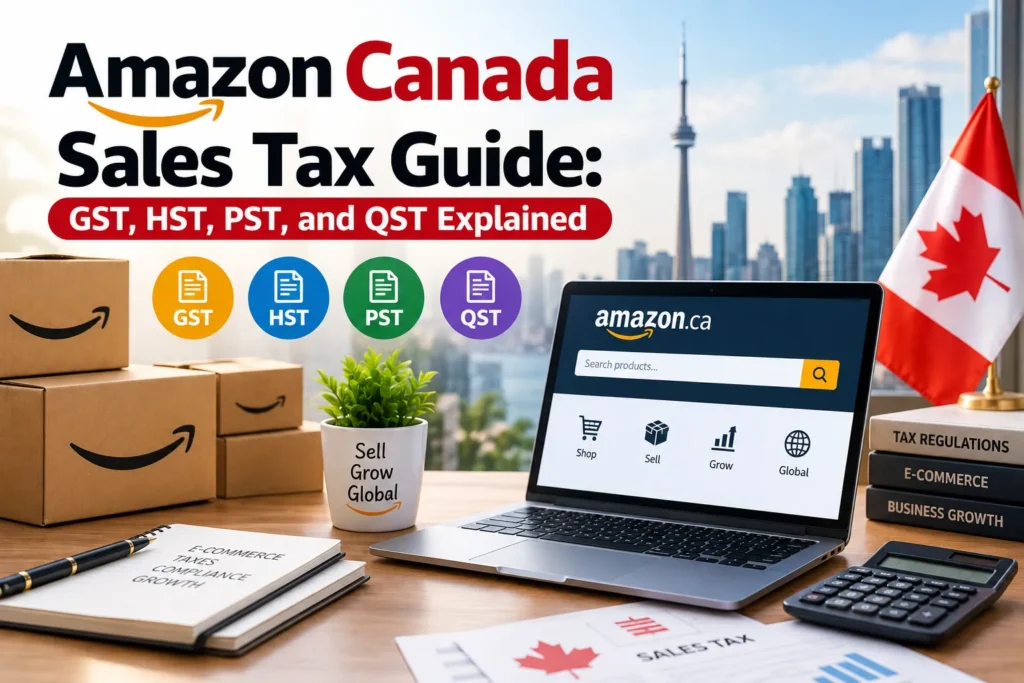
Whether you remit Canadian sales tax yourself or Amazon does it for you depends entirely on your GST/HST registration status — not on the tax type itself. Register, and Amazon hands you the GST/HST/QST portion in your payout for you to remit, while handling PST directly with the provinces. Don’t register, and Amazon remits everything on your behalf as marketplace facilitator. Getting this backwards is the single most common source of confusion.
Key Takeaways
- Four distinct taxes apply to Amazon Canada sales: GST (federal, 5%), HST (combined federal+provincial, 13-15%), PST (separate provincial tax in BC, SK, MB), and QST (Quebec’s 9.975% provincial tax).
- Who remits what flips entirely based on your GST/HST registration status — this is the single mechanism that determines your actual obligations, more than the tax type itself.
- Registration becomes mandatory once your sales exceed CAD $30,000 over four consecutive quarters — below that, registration is optional but can still be worth it for Input Tax Credits.
- NARF (North American Remote Fulfillment) sales carry their own distinct tax reporting treatment on Amazon’s Canadian tax reports — a detail most sales tax guides for Canadian sellers don’t connect to NARF mechanics at all.
- Import taxes and duties paid as Importer of Record can be reclaimed as Input Tax Credits — a detail frequently missed, effectively meaning sellers overpay by treating this as a pure cost rather than a refundable credit.
The Four Taxes You’re Dealing With
| Tax | Rate | Where It Applies | Federal or Provincial |
| GST (Goods and Services Tax) | 5% | Applies nationally to most goods and services | Federal |
| HST (Harmonized Sales Tax) | 13–15% (varies by province) | Ontario, New Brunswick, Nova Scotia, PEI, Newfoundland and Labrador | Combined federal + provincial |
| PST (Provincial Sales Tax) | Varies | British Columbia, Saskatchewan, Manitoba | Provincial only |
| QST (Quebec Sales Tax) | 9.975% | Quebec, in addition to GST | Provincial |
Provinces without HST use GST alone (5%) unless they also have a separate PST, in which case the two are added together for the effective rate a customer pays.
Who Actually Remits What (This Depends on Your Registration Status)
This is the mechanism most sellers get backwards, so it’s worth stating plainly:
| Your Status | GST/HST/QST | PST (BC, SK, MB) |
| Registered for GST/HST | Amazon collects it and includes it in your payout — you remit it to CRA (or Revenu Québec for QST) | Amazon collects and remits directly to the province on your behalf |
| Not registered for GST/HST | Amazon collects and remits everything on your behalf as marketplace facilitator — you do nothing | Same — Amazon remits directly regardless of your GST/HST status |
The practical takeaway: registering for GST/HST doesn’t reduce your administrative work overall — it shifts specific responsibility to you (GST/HST/QST remittance) while Amazon continues handling PST either way. The upside of registering is access to Input Tax Credits, covered below, which unregistered sellers can’t claim.
Worked Example: Two Scenarios, Same Sale
Take a $100 product sold to a customer in Alberta (GST-only province, no PST) and a separate $100 sale to a customer in British Columbia (GST + PST province):
| Scenario | Alberta Sale (5% GST only) | BC Sale (5% GST + 7% PST) |
| If you’re GST/HST registered | Amazon collects $5 GST, includes it in your payout — you remit $5 to CRA | Amazon collects $5 GST (in your payout, you remit) + $7 PST (Amazon remits directly to BC — not your responsibility) |
| If you’re NOT registered | Amazon collects $5 GST and remits it to CRA on your behalf — you do nothing | Amazon collects both the $5 GST and $7 PST and remits both on your behalf — you do nothing |
This example makes the registration-status mechanism concrete: the tax collected from the customer doesn’t change based on your registration status, but who ends up responsible for sending it to the government does.
The NARF Tax Wrinkle Most Guides Don’t Cover
This is a genuinely underserved detail: if you’re a US seller using NARF (North American Remote Fulfillment) to sell into Canada using your existing US inventory, those sales carry their own distinct reporting treatment on Amazon’s Canadian tax reports, separate from standard Canadian-fulfilled sales. Since NARF sales originate from US inventory but sell to Canadian customers, the tax collection and reporting mechanics involve a layer most general Canadian sales tax guides don’t address at all, since they’re written assuming a seller with Canadian-based inventory rather than one testing the market via NARF. If you’re using NARF (covered in more depth in our Top Selling Products on Amazon Canada guide), specifically check how these sales appear in your Sales Tax Report and confirm your accountant is treating NARF-sourced Canadian revenue correctly, rather than assuming it’s identical to a standard Canadian-fulfilled sale for reporting purposes.
When You Must Register for GST/HST
Registration becomes mandatory once your total sales exceed CAD $30,000 over four consecutive quarters. Below that threshold, registration is optional — but voluntary registration is often still worthwhile, since it’s the only way to claim Input Tax Credits on your business expenses and Amazon fees. Track your rolling sales total specifically against this threshold rather than checking only at year-end, since crossing it mid-year still triggers the registration requirement from that point forward.
How to Register for GST/HST: Step by Step
- Confirm you need (or want) to register — mandatory once you cross CAD $30,000 in sales over four consecutive quarters, optional but often worthwhile below that.
- Apply for a Business Number (BN) through the CRA if you don’t already have one — this is the base identifier your GST/HST account attaches to.
- Register for a GST/HST account under that Business Number, either online through the CRA’s Business Registration Online portal, by phone, or by mail.
- Enter your GST/HST number in Seller Central under your Canada marketplace tax settings, so Amazon begins including the GST/HST portion in your payouts for you to remit rather than remitting it on your behalf.
- Register separately for provincial taxes where required — PST in BC, Saskatchewan, or Manitoba only if you’re taking on remittance responsibility yourself rather than relying on Amazon’s marketplace facilitator handling, and QST with Revenu Québec if applicable to your situation.
- Set your filing frequency with the CRA based on your revenue (see below), and calendar your filing deadlines immediately rather than waiting for a reminder notice.
Tax Calculation Services and Product Tax Codes
Amazon’s Tax Calculation Services (TCS) automatically calculates the correct tax on each order based on the buyer’s location and the product type. To get accurate results, every listing needs the correct Product Tax Code (PTC) assigned — since tax treatment genuinely differs by product category (groceries and children’s clothing, for example, carry different tax treatment than general merchandise in several provinces). An incorrectly assigned PTC can mean charging a customer the wrong tax amount, which creates a reconciliation headache later and, in the case of undercharging, a shortfall you may need to cover yourself. Review PTC assignments across your catalog periodically, not just at initial listing creation, since Amazon and provincial rules both evolve.
Filing Frequency: What to Expect
Once registered, the CRA assigns a filing frequency — monthly, quarterly, or annually — based primarily on your revenue level. Higher-revenue sellers are generally required to file more frequently. Missing a filing deadline triggers penalties and interest that compound the longer the return remains outstanding, so calendar every deadline the moment your frequency is confirmed rather than tracking it informally. If your revenue changes significantly, check whether your assigned frequency has changed too, since the CRA can adjust this based on updated filings.
Input Tax Credits: The Refund Most Unregistered Sellers Miss
Amazon charges sales tax on many of its own seller fees — referral fees, FBA fulfillment, advertising. Registered sellers can claim these taxes back as Input Tax Credits, effectively recovering that portion of what they paid Amazon. Unregistered sellers cannot claim this credit and must treat it as a non-recoverable cost.
A simplified worked example: a seller paying $2,000/month in combined Amazon referral fees, FBA fulfillment fees, and advertising spend, in a province with 13% HST, is paying roughly $260/month in tax on those fees alone. A registered seller reclaims that $260 as an Input Tax Credit; an unregistered seller simply absorbs it as a cost. Across a full year, that’s over $3,000 in recoverable tax an unregistered seller at this spend level is leaving unclaimed — a concrete number worth weighing against the modest administrative step of registering.
Import Taxes and Duties as Importer of Record
When you ship inventory into Canada, you’re responsible as the Importer of Record for paying applicable GST and duties at the border. This is a cost most sellers correctly anticipate — but the detail frequently missed is that these import taxes can be reclaimed as Input Tax Credits on your GST/HST return, provided you’re registered and track them properly. Treating border-paid GST as a pure cost of goods, rather than a refundable credit, is a documented way sellers quietly overpay and erode margin they didn’t need to give up.
Common Mistakes Sellers Make With Canadian Tax Compliance
- Assuming Amazon handles everything regardless of registration status — once registered, GST/HST/QST remittance genuinely becomes your responsibility, not Amazon’s
- Registering for GST/HST but never claiming Input Tax Credits, leaving real recoverable money on the table out of not knowing to track and claim it
- Missing the CAD $30,000 threshold by checking sales only at year-end instead of tracking the rolling four-quarter total continuously
- Misassigning Product Tax Codes, leading to incorrect tax charged and a reconciliation problem discovered much later
- Treating import GST and duties as a pure cost instead of a refundable Input Tax Credit
- Assuming Canadian and US tax obligations are linked or interchangeable when selling on both Amazon.ca and Amazon.com — they are separate systems requiring separate compliance
- Not adjusting filing frequency assumptions when revenue changes significantly, risking a missed deadline under a new CRA-assigned schedule
Selling on Both Amazon.ca and Amazon.com
If you sell across both marketplaces, Canadian tax obligations run alongside — not instead of — US tax considerations (state sales tax nexus, and potentially US withholding/reporting requirements depending on your business structure). These are genuinely separate compliance systems that don’t substitute for each other; confirm both are handled correctly rather than assuming Canadian registration covers any US-side obligations, or vice versa.
How EcomRanker Helps Sellers Navigate Canadian Tax Compliance
We help sellers determine the right GST/HST registration timing, confirm NARF sales are being reported correctly if that applies to their setup, and make sure Input Tax Credits on both Amazon fees and import duties aren’t being left unclaimed. This connects to our broader Amazon Canada services, since tax compliance is part of the same operational picture as account setup and listing strategy.
Selling into Canada and want your current tax setup reviewed for compliance and missed credits? Get in touch for a compliance review.
Frequently Asked Questions
1 . Do I need to register for GST/HST to sell on Amazon Canada?
Registration becomes mandatory once your sales exceed CAD $30,000 over four consecutive quarters. Below that, it’s optional, though voluntary registration allows you to claim Input Tax Credits.
2 . If I’m not registered for GST/HST, do I need to do anything about Canadian sales tax?
Generally no — Amazon collects and remits GST/HST/QST and PST on your behalf as marketplace facilitator when you’re not registered.
3 . If I am registered for GST/HST, does Amazon still handle PST for me?
Yes. Amazon collects and remits PST directly to British Columbia, Saskatchewan, and Manitoba regardless of your GST/HST registration status.
4 . What are Input Tax Credits and why do they matter?
Input Tax Credits let registered sellers reclaim GST/HST paid on business expenses, including Amazon fees and import duties. Unregistered sellers cannot claim this.
5 . Does NARF change how Canadian sales tax works?
Yes, in terms of reporting — NARF sales carry their own distinct treatment on Amazon’s Canadian tax reports, separate from standard Canadian-fulfilled sales.
6 . Can I reclaim GST paid at the border when importing inventory into Canada?
Yes, if you’re registered for GST/HST, import taxes paid as Importer of Record can be reclaimed as Input Tax Credits.
7 . What happens if the CRA determines I should have been collecting tax but wasn’t?
You become responsible for paying the uncollected amount yourself, which can be a significant, unexpected liability.
8 . Do I need separate tax registrations for Quebec if I already have a GST/HST number?
Yes. QST is Quebec’s separate provincial tax and requires its own registration with Revenu Québec if required.
9 . Does selling on Amazon.ca affect my US tax obligations if I also sell on Amazon.com?
Canadian and US tax obligations are separate systems that don’t substitute for each other.
10 . How does Amazon determine which province’s tax rate to apply?
Amazon calculates tax based on the buyer’s shipping address, applying the applicable rate for that specific province or territory.
11 . What is a Product Tax Code and why does it matter?
A Product Tax Code (PTC) tells Amazon’s Tax Calculation Services how to tax a specific listing, since treatment differs by category in several provinces. An incorrect PTC can mean charging customers the wrong tax amount.
12 . How often will I need to file my GST/HST return?
The CRA assigns monthly, quarterly, or annual filing based primarily on your revenue level, with higher-revenue sellers generally filing more frequently.
13 . How much money can I actually recover through Input Tax Credits?
It scales with your fee spend — a seller paying roughly $2,000/month in combined Amazon fees in a 13% HST province is paying about $260/month in recoverable tax on those fees alone, over $3,000 a year left unclaimed if unregistered.