
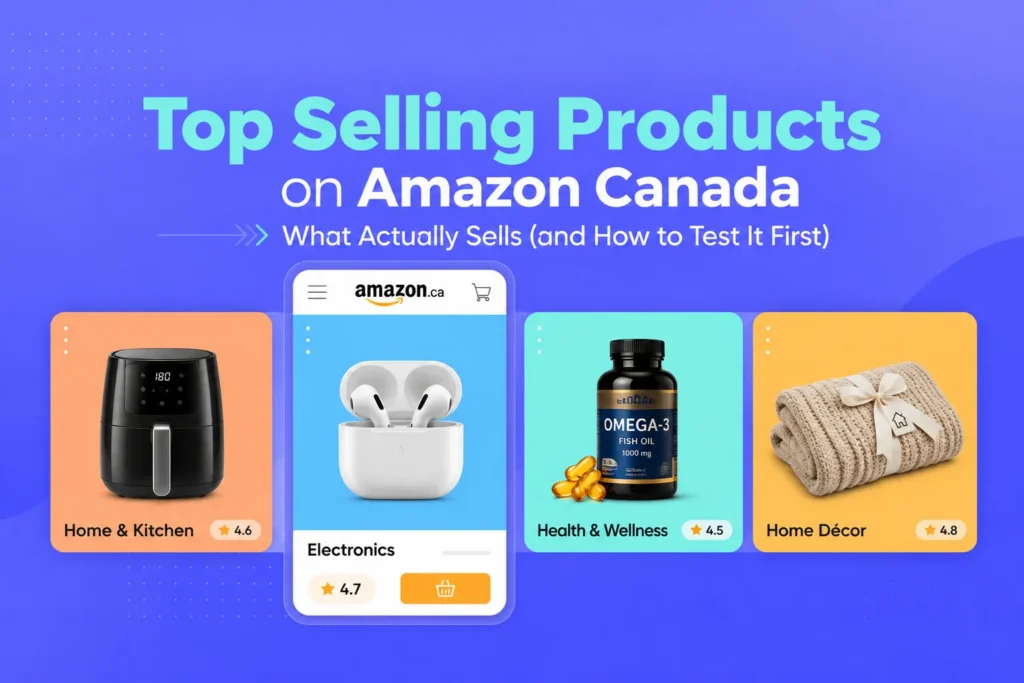
Home & Kitchen, Health & Personal Care, and Electronics consistently top Amazon.ca’s bestseller categories — but before shipping inventory north, US sellers can test Canadian demand risk-free using NARF, their existing US FBA inventory, without a separate Canada launch. Category selection matters, but so does validating a product against Canada-specific requirements — bilingual listings and Health Canada certification — that most generic “what to sell” lists skip entirely.
Key Takeaways
- Home & Kitchen, Health & Personal Care, and Electronics are consistently among the top-performing categories on Amazon.ca, driven by everyday utility, recurring purchase behavior, and steady tech demand.
- A simple validation filter beats copying a bestseller list: look for products selling 10+ units a day, with fewer than 10 sellers competing on the main listing, and at least a 10% net margin after all Amazon fees.
- US sellers can test Canadian demand without committing inventory using NARF (North American Remote Fulfillment), though sales volume through NARF alone is typically much lower than a dedicated Canadian FBA listing — useful for validation, not a long-term strategy.
- Bilingual English/French listings are a genuine differentiator most sellers skip, despite Quebec representing a meaningful share of Canadian e-commerce demand.
- Health Canada certification (NHP for natural health products) is required for supplements and many personal care items — a regulatory step generic US-market product research doesn’t prepare sellers for.
The Validation Framework: Don’t Just Copy a Bestseller List
A category performing well on Amazon.ca doesn’t mean any product in that category will succeed — competition, margin, and actual demand vary enormously within a category. A useful filter for evaluating a specific product idea: does it sell an estimated 10 or more units per day, does it have fewer than 10 sellers actively competing for the Buy Box on the main listing, and does it clear at least 10% net margin after all Amazon fees, landed cost, and shipping are accounted for. A product clearing all three is worth deeper research; one that fails even one deserves real scrutiny before committing capital.
Test Before You Commit: Using NARF to Validate Demand
This is a genuinely underused strategy in most “what to sell in Canada” content: if you’re already a Professional seller with active US FBA inventory, Amazon’s North American Remote Fulfillment (NARF) program lets your existing US inventory become available to Canadian customers on Amazon.ca — without shipping or storing anything in Canada. Enrollment requires a Professional account and an active US FBA listing; once enrolled, Amazon evaluates and automatically adds eligible ASINs. This is a genuinely low-risk way to see whether a product you’re already selling in the US has real Canadian demand before committing to a dedicated Canadian FBA launch.
Be realistic about the limitation: sales volume through NARF alone is commonly reported as running significantly lower — some estimates suggest as much as 90% lower — than what the same product would generate through a dedicated Canadian FBA listing with local inventory. Treat NARF as a validation signal, not a long-term go-to-market strategy. If a product shows meaningful traction through NARF over a testing period, that’s a strong, low-risk signal to invest in a full Canadian FBA launch; if it shows nothing, you’ve avoided a costly, uninformed inventory commitment.
Top Categories on Amazon Canada
Home & Kitchen
Consistently one of the strongest categories, covering everyday items — storage containers, bedding, kitchen gadgets — that Canadians repurchase regularly. High demand comes with high competition and frequent price pressure, so differentiation matters more here than in less crowded categories.
Health & Personal Care
Strong, recurring demand from a loyal customer base willing to pay for quality. This is also one of the most regulated categories — see the Health Canada certification section below before sourcing products here specifically.
Electronics
Steady demand driven by constant device upgrades and smart home adoption. Margins can be attractive on higher-ticket items, but fast product turnover and counterfeit risk are real considerations.
Pet Supplies
A growing category with strong repeat-purchase potential as Canadian pet ownership continues rising. Bulky items create real storage and shipping cost considerations worth modeling before committing to a specific product.
Sports & Outdoors
Canada’s outdoor culture supports steady demand, though many products in this category see real seasonal swings — plan inventory and cash flow around that pattern rather than assuming flat year-round demand.
Baby Products
Consistent demand from an ongoing stream of new parents, with buyers often willing to pay a premium for trusted, safety-certified products. Regulatory requirements here are strict, similar to health and personal care.
The Canada-Specific Details Most Guides Skip
Bilingual (English/French) Listings
This is a genuine, actionable differentiator most sellers — and most “what to sell in Canada” content — overlook entirely: offering listing content in both English and French can meaningfully improve reach and conversion, particularly for Quebec’s substantial share of Canadian e-commerce demand. A product with only English content is invisible, functionally, to a real segment of Canadian shoppers who prefer or require French listings. This is a relatively low-cost addition (translation, not a full separate product) with a real, underexploited upside.
Health Canada Certification for Supplements and Personal Care
Beyond the general product research checklist, supplements and many personal care products require Natural Health Product (NHP) certification from Health Canada before they can be legally sold — a regulatory step with no direct US equivalent that catches sellers off guard when they assume a product that sells in the US can simply be relisted in Canada. Factor certification timelines and costs into your launch planning specifically for these categories, since this can meaningfully extend time-to-market compared to less regulated categories.
Common Mistakes
- Assuming US bestsellers automatically transfer to Canada without checking Canadian-specific demand, competition, and regulatory requirements
- Skipping the validation filter and committing to inventory based purely on category popularity rather than product-level unit economics
- Ignoring Health Canada certification requirements for supplements and personal care, discovering the requirement only after sourcing inventory
- Underestimating Amazon fees and cross-border logistics costs, eroding margins that looked healthy on paper
- Committing to a full Canadian FBA launch without testing demand first, when NARF could have validated the opportunity at much lower risk
How EcomRanker Helps Sellers Validate and Launch in Canada
We help sellers validate product-market fit for Canada before committing capital — running the 10/10/10 filter against real Canadian marketplace data, assessing NARF as a testing strategy where appropriate, and flagging Health Canada certification requirements early in the sourcing process rather than after inventory has already arrived. Once a product is validated, our Amazon Canada setup and account services cover the full launch, from account configuration through bilingual listing optimization.
Considering an expansion into Amazon Canada and want your product idea validated first? Get in touch for a Canada market opportunity review.
Frequently Asked Questions
1 . What are the top selling product categories on Amazon Canada?
Home & Kitchen, Health & Personal Care, and Electronics consistently perform strongest, followed by Pet Supplies, Sports & Outdoors, and Baby Products.
2 . Can I test Canadian demand without shipping inventory to Canada?
Yes, through Amazon’s NARF (North American Remote Fulfillment) program, which makes your existing US FBA inventory available to Canadian customers without separate Canadian storage — though sales volume is typically lower than a dedicated Canadian FBA listing.
3 . Do I need special certification to sell supplements on Amazon Canada?
Yes. Supplements and many personal care products require Natural Health Product (NHP) certification from Health Canada, a regulatory step with no direct US equivalent.
4 . Should my Amazon Canada listings be in French as well as English?
It’s a genuine, underused opportunity — bilingual listings can meaningfully improve reach given Quebec’s share of Canadian e-commerce demand, and most competing sellers skip this entirely.
5 . What’s a good way to validate a specific product idea for Canada?
A useful filter: does it sell an estimated 10+ units a day, does it have fewer than 10 sellers competing on the main listing, and does it clear at least 10% net margin after all Amazon fees.
6 . Will a product that sells well on Amazon US automatically sell well on Amazon Canada?
Not necessarily. Canadian consumer behavior, competition levels, and regulatory requirements differ, and assuming direct transferability is a common, costly mistake.
7 . How much lower is sales volume through NARF compared to a dedicated Canadian listing?
Estimates vary, but some sources suggest sales through NARF alone can run significantly lower — as much as 90% lower in some estimates — than a fully-stocked Canadian FBA listing, making NARF better suited to validation than long-term strategy.
8 . What’s the biggest regulatory risk when choosing a product for Amazon Canada?
Assuming a product that’s compliant in the US is automatically compliant in Canada — health, personal care, baby, and toy categories in particular carry Canada-specific safety and certification requirements worth checking before sourcing.
9 . Is Amazon Canada worth the investment compared to focusing only on the US?
For many sellers, yes — Amazon holds a substantial share of Canadian retail e-commerce, and geographic and regulatory proximity to the US makes it a comparatively low-friction first international expansion, provided product selection and compliance are handled deliberately.