
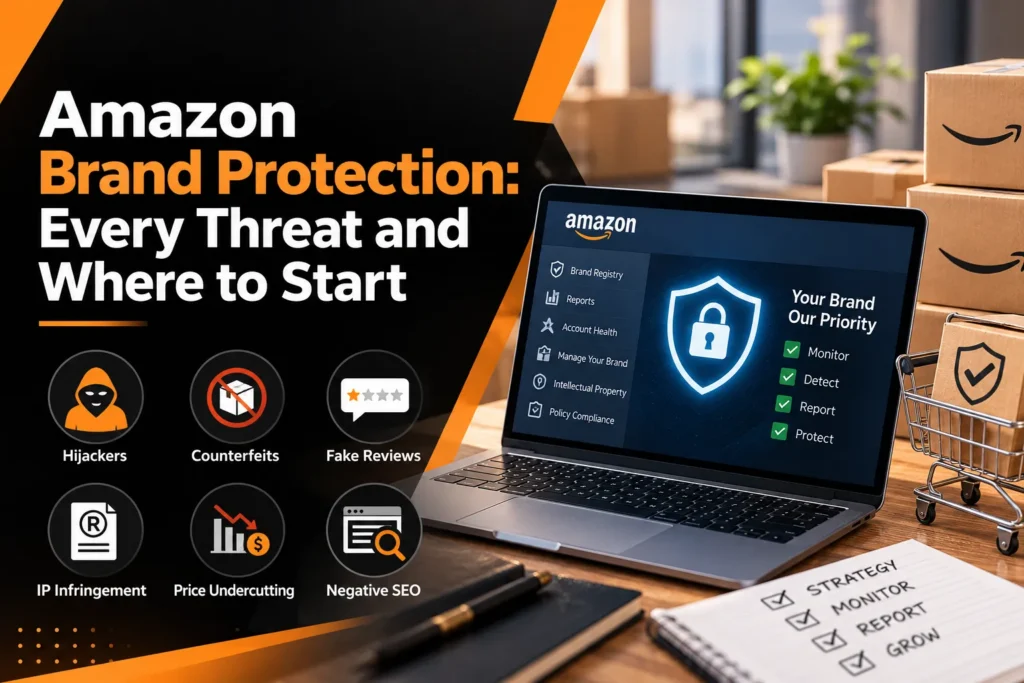
Six distinct threats can damage an Amazon brand — hijacking, counterfeits, fake reviews, IP infringement, price undercutting, and negative SEO — and most sellers actively monitor for maybe two of them. This guide maps the full threat landscape, points to the deep-dive resource for each threat EcomRanker has already covered in detail, and goes deep on the two threats most brand protection content skips entirely.
Key Takeaways
- Six distinct threats make up the real Amazon brand protection landscape: listing hijacking, counterfeit/unauthorized sellers, fake reviews, IP infringement, price undercutting, and negative SEO/fake complaints.
- Brand Registry, Brand Gating, Transparency, and Project Zero are the foundational tools underlying almost every defense against these threats — none of them work in isolation from the others.
- Price undercutting and negative SEO are the two threats most sellers never actively monitor for, despite being just as damaging to margin and account health as more visible threats like hijacking or counterfeits.
- An authorized reseller program is a proactive defense, not just a reactive tool — clear terms with distributors prevent unauthorized resale before it becomes a brand protection incident.
- A regular monitoring routine, not just reactive reporting, is what actually catches problems early — most brand protection failures are detection failures, not response failures.
What Amazon Brand Protection Actually Covers
Amazon brand protection is the set of proactive strategies and tools that secure a brand’s intellectual property, control who’s authorized to sell its products, and preserve the customer trust that comes from consistent, genuine product experiences. It’s not a single action or a one-time setup — it’s an ongoing discipline spanning legal tools (trademark enforcement), platform tools (Brand Registry, Transparency), and operational practices (monitoring, reseller agreements).
The Six Core Threats
| Threat | What It Is | Where to Go Deeper |
| Listing hijacking | An unauthorized seller adds themselves to your exclusive listing, often with counterfeit inventory | Full recovery process and escalation paths |
| Counterfeit/unauthorized sellers | Third parties selling imitation or unauthorized versions of your product | Covered within hijacking and wholesale content |
| Fake reviews | Fraudulent positive reviews (inflating a competitor) or negative ones (sabotaging you) | Full spotting and reporting process |
| IP infringement | Competitors copying logos, images, or descriptions to misrepresent their products as yours | Covered within Brand Registry enforcement tools |
| Price undercutting | Unauthorized sellers listing your product below your intended price, devaluing your brand | Covered in depth below |
| Negative SEO/fake complaints | Competitors submitting false policy complaints or manipulating signals to suppress your ranking | Covered in depth below |
Listing Hijacking
A hijacker rides your exclusive listing’s established reviews and rank with a counterfeit or lower-quality product. For the full test-buy, verification, and escalation process — including how to use Amazon’s Counterfeit Crimes Unit when standard reporting stalls — see our complete listing hijacking recovery guide.
Counterfeit and Unauthorized Sellers
Related to hijacking but distinct: sellers offering imitation products without any claim to your listing itself, often surfacing through search or as separate listings entirely. Brand Registry, Transparency serialization, and Project Zero (covered below) are the primary tools for controlling this.
Fake Reviews (Positive and Negative)
Competitors can sabotage you with fake negative reviews, or inflate their own standing with fake positive ones — both now carry real federal liability under the FTC’s Consumer Review Rule, not just an Amazon policy risk. For the full spotting checklist, reporting process, and the current federal enforcement landscape, see our guide to handling fake Amazon reviews.
Intellectual Property Infringement
Competitors copying your logos, listing images, or product descriptions to misrepresent their own product infringes on your brand identity directly. Brand Registry’s IP infringement reporting tool is the primary enforcement mechanism — see our Brand Registry guide for enrollment requirements and country-by-country trademark considerations.
Price Undercutting
This threat gets less dedicated coverage than hijacking or fake reviews, but it’s just as damaging to brand equity over time. Unauthorized sellers — often distributors selling outside agreed channels, or arbitrage sellers who acquired inventory through unintended routes — list your product below your intended price point, which does two kinds of damage simultaneously: it trains customers to expect a lower price than your margin actually supports, and it can win the Buy Box away from your authorized listing, redirecting revenue to a seller you never approved.
Addressing it requires a layered approach:
- Written authorized reseller agreements with clear pricing terms, ideally including minimum advertised price (MAP) provisions where legally permissible in your jurisdiction
- Monitoring your own listings for unauthorized sellers via Brand Registry’s seller-tracking tools, not just waiting to notice a Buy Box loss
- Reporting unauthorized sellers with pricing evidence attached, framing the report around the unauthorized distribution channel itself, not just the price discrepancy
- Investigating your own supply chain if unauthorized inventory keeps surfacing, since a persistent undercutting pattern often traces back to a distributor selling outside their agreed territory or volume commitment
Negative SEO and Fake Complaints
This is the threat category most sellers have never even considered monitoring for directly: a competitor submitting false policy violation complaints against your listings, manipulating external signals to suggest your product violates a policy it doesn’t actually violate, or coordinating activity designed to trigger Amazon’s automated enforcement systems against you. Unlike a fake review, which is visible on your listing, this kind of interference often only becomes visible when you receive an unexpected policy notification or see an unexplained ranking drop.
Defending against this requires:
- Documenting your compliance proactively — keep authorization letters, certificates, and compliance documentation organized and current, so you can respond to a false complaint quickly rather than scrambling to locate evidence under time pressure
- Tracking notification patterns — a cluster of unusual policy notifications in a short window, especially ones that don’t match any actual change in your operations, is a signal worth investigating as potential targeted interference rather than routine enforcement
- Escalating with a clear pattern, not a single incident — as with hijacking, documenting a pattern of unfounded complaints strengthens any escalation to Amazon’s brand protection or executive teams far more than reporting one isolated incident
The Foundational Tools (Brand Registry, Gating, Transparency, Project Zero)
| Tool | What It Does |
| Brand Registry | The foundational enrollment unlocking IP reporting, listing content control, and access to the other tools below |
| Brand Gating | Requires third-party sellers to provide invoices and written brand permission before listing your products — a strong barrier against unauthorized resale |
| Transparency | Unique serialization codes on every unit, verified before shipment, preventing unauthorized or counterfeit units from ever reaching a customer under your listing |
| Project Zero | Lets brand owners remove counterfeit listings directly, without waiting for Amazon’s review, once enrolled |
These tools work best layered together rather than chosen individually — Brand Registry is the prerequisite for the other three, and a brand relying on just one (commonly Brand Registry alone, since it’s the most widely adopted) is leaving real protection on the table that the others provide.
Building an Authorized Reseller Program
A written reseller program is a proactive defense against multiple threats at once — price undercutting, unauthorized resale, and counterfeit risk all decrease when distribution channels are clearly defined in writing. At minimum, a reseller agreement should specify: which channels a distributor is authorized to sell through, pricing terms (including MAP where applicable), minimum order quantities, and consequences for violating the agreement. Treat unauthorized resale outside these terms as a reportable “materially different” product violation under Amazon’s policies, not just a contractual dispute to handle privately.
A Monitoring Routine That Actually Catches Problems Early
Most brand protection failures are detection failures more than response failures — by the time a seller notices a problem, it’s often been active for days or weeks. A basic recurring routine:
- Weekly: Check Buy Box status and seller count on your key listings for unexpected changes
- Weekly: Scan recent reviews for patterns suggesting fake activity (sudden spikes, generic language, unverified purchases clustered together)
- Monthly: Review Account Health for any unusual policy notifications, especially ones not tied to an actual change in your operations
- Monthly: Audit pricing across your listings and any known reseller channels for undercutting patterns
How EcomRanker Coordinates Brand Protection End to End
We treat brand protection as one coordinated system rather than six separate problems handled reactively as they arise — Brand Registry, Gating, Transparency, and Project Zero configured together, authorized reseller terms drafted to close price-undercutting and unauthorized-resale gaps simultaneously, and a standing monitoring routine that catches hijacking, fake reviews, and unusual policy activity before they compound.
Want your current brand protection setup reviewed against all six threats, not just the ones you’re already watching for? Get in touch for a brand protection audit.
Frequently Asked Questions
1 . What are the main threats to an Amazon brand?
Six core threats: listing hijacking, counterfeit or unauthorized sellers, fake reviews, intellectual property infringement, price undercutting, and negative SEO or fake complaints.
2 . What’s the difference between hijacking and counterfeit selling?
Hijacking specifically means an unauthorized seller adds themselves to your exact existing listing. Counterfeit selling can happen on your listing (a form of hijacking) or through entirely separate listings offering imitation products.
3 . Do I need Brand Registry to protect my brand on Amazon?
Yes, effectively — it’s the prerequisite for Brand Gating, Transparency, and Project Zero, and without it your enforcement options are significantly more limited.
4 . What is price undercutting and why does it hurt my brand?
Unauthorized sellers listing your product below your intended price, which trains customers to expect a lower price than your margin supports and can win the Buy Box away from your authorized listing.
5 . How do I know if my account is being targeted by negative SEO or fake complaints?
Watch for a cluster of unusual policy notifications that don’t match any actual change in your operations, or an unexplained ranking drop without a corresponding change in your own performance metrics.
6 . Can I stop distributors from selling my products at unauthorized prices?
A written reseller agreement with clear pricing terms, including MAP provisions where legally permissible, is the primary tool — combined with monitoring and reporting unauthorized sellers when they appear.
7 . What’s the single most important brand protection tool to set up first?
Amazon Brand Registry, since it’s the foundation that unlocks every other tool (Gating, Transparency, Project Zero) covered in this guide.
8 . How often should I monitor for brand protection issues?
At minimum weekly for Buy Box and review activity, and monthly for account health notifications and pricing audits — waiting for a problem to become obvious usually means it’s already been active for some time.
9 . Is fake review activity a bigger risk for sellers or for brand owners specifically?
Both, but brand-registered sellers have more tools (and more federal exposure under the FTC’s Consumer Review Rule if they’re the ones buying fake reviews) — see our dedicated fake reviews guide for the current 2026 enforcement landscape.
10 . What should I do if I suspect a competitor is behind a pattern of problems on my account?
Document everything with dates, case IDs, and specific details, and escalate as a documented pattern rather than reporting each incident in isolation, since a pattern is far more actionable for Amazon’s teams to investigate.