
UK advertisers pay some of the highest CPCs among Amazon’s international marketplaces, and on top of that, Amazon charges 20% VAT directly on UK advertising invoices — regardless of whether the seller is VAT-registered. That second part catches sellers out repeatedly on Seller Central’s own forums. Here’s what UK sellers are actually paying, and a real framework for setting a budget instead of guessing.
Key Takeaways
- UK CPCs commonly run £0.55 to £2.20 depending on ad format, and the UK is reported as one of the more expensive, competitive Amazon advertising markets internationally — noticeably pricier than several EU markets running roughly €0.30 to €1.50.
- Amazon charges 20% VAT on UK advertising invoices, billed by Amazon’s UK branch, and this applies whether or not the seller is VAT-registered. Non-VAT-registered sellers cannot reclaim it, a documented source of confusion on Amazon’s own seller forums.
- “How much do ads cost” is the wrong first question. A more useful one is what budget your margin can actually support, calculated from your target TACoS and revenue.
- Category, placement, and seasonality drive most of the variation within the UK range — a generic average tells you little about your specific product.
- Most sellers overspend by chasing volume too early. A modest test budget with two to three weeks of data before scaling is more reliable than committing a large budget on day one.
Current UK CPC Ranges by Ad Type
| Ad Format | Typical UK CPC Range |
| Sponsored Products | Toward the lower-to-mid end of the £0.55–£2.20 band, format-dependent |
| Sponsored Brands | Similar band, generally competitive with Sponsored Products |
| Sponsored Display | Often the lowest-CPC format, though some billing uses vCPM (cost per thousand viewable impressions) rather than CPC |
Community-reported data places the overall UK CPC range for PPC at roughly £0.55 to £2.20 depending on ad format. Treat this as a market-level range, not a category-level one — where your specific product sits within it depends on the factors below.
Why the UK Is Pricier Than It Looks
Reporting on international Amazon advertising markets consistently places the UK among the more expensive, more competitive markets for Amazon PPC, above several EU markets. As an illustrative comparison, some emerging European markets report average CPCs around €0.30–€1.50 across comparable ad formats — meaningfully below the UK’s typical band. If you’re managing a UK and EU account side by side, don’t assume EU benchmarks transfer directly to Amazon.co.uk campaigns.
The VAT Detail Most Cost Guides Miss
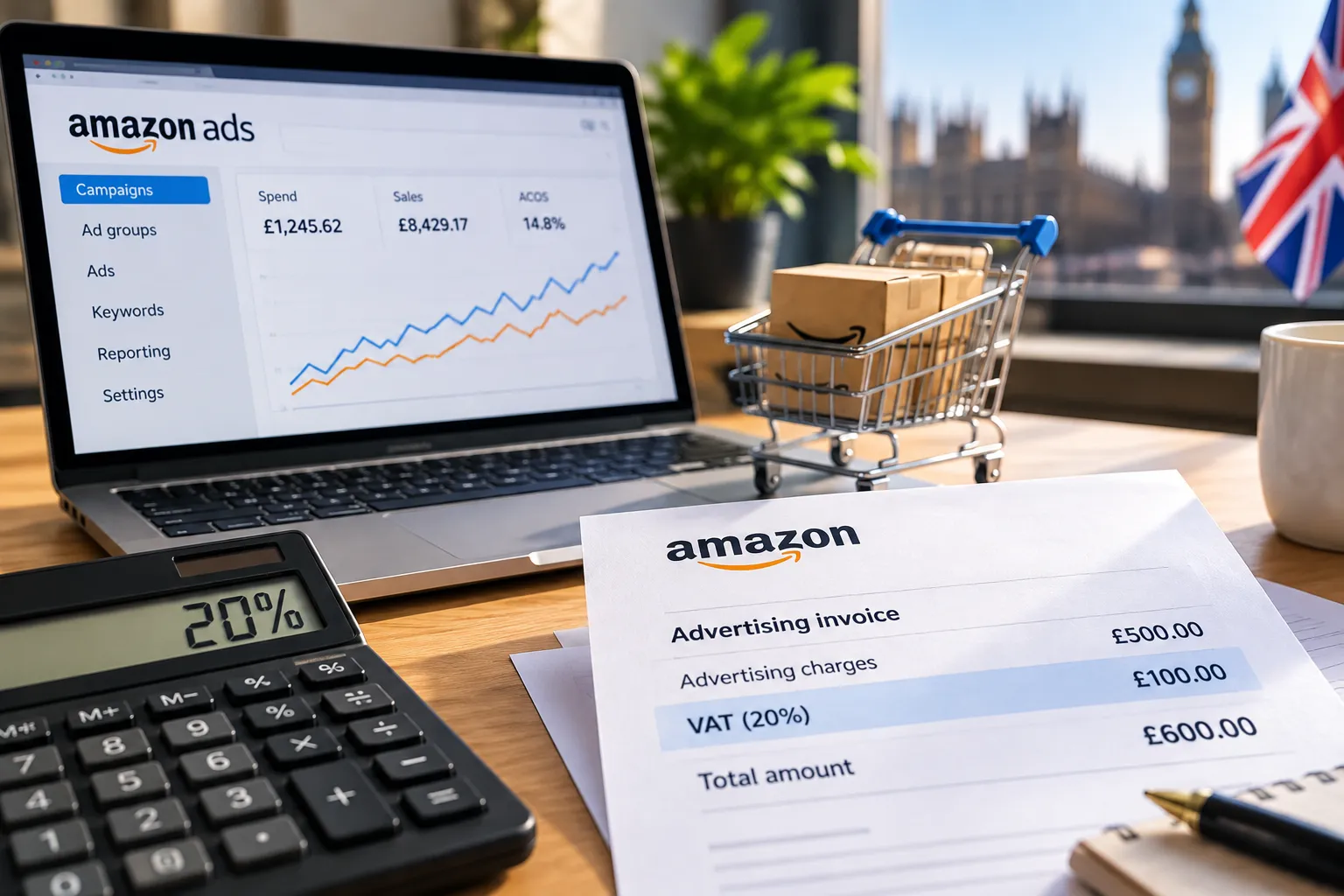
This is the genuinely underserved part of this topic, confirmed through Amazon’s own Seller Central forums: Amazon charges 20% VAT directly on UK advertising invoices, billed by Amazon’s UK branch, and this applies regardless of whether the seller itself is VAT-registered. This is a documented, recurring point of confusion — sellers report submitting a VAT exemption declaration in their Seller Central tax settings and still seeing 20% VAT charged on advertising invoices specifically, since advertising has been billed through the UK entity for VAT purposes separately from how certain other seller fees have been treated.
For VAT-registered sellers, this VAT is generally recoverable as input tax in the normal way. For non-VAT-registered sellers, the 20% is a genuine, non-recoverable addition to advertised CPC rates that a US-focused, dollar-denominated cost guide wouldn’t surface at all. This is general information, not tax advice — confirm your specific VAT treatment with your accountant, since Amazon’s fee-invoicing structure has changed before (notably in August 2024) and can change again.
What Actually Drives Your CPC
- Competition — more sellers bidding on a keyword or category pushes CPCs up
- Placement — top-of-search positions command higher bids than lower placements
- Targeting breadth — broad, high-volume keywords face more competition than long-tail terms
- Seasonality — peak periods see CPCs rise as sellers compete harder for the same traffic
- Product demand — high-demand products in competitive categories see more aggressive bidding
- Ad relevance and quality — strong click-through and conversion performance is rewarded with comparatively lower effective CPCs over time
A Budget Framework That Isn’t a Guess
- Set a target TACoS (Total Advertising Cost of Sale) — commonly 5–10% of revenue for an established product, 10–15% for a product still building momentum.
- Estimate your monthly revenue (current or planned).
- Calculate budget = Revenue × Target TACoS.
- Cross-check against break-even using your actual margin, CPC, and conversion rate to confirm the resulting budget is realistic.
A Worked Example: Break-Even ACoS
Take a product retailing at £20 with a £7 profit margin per unit:
| Factor | Value |
| Break-even ACoS (margin ÷ price) | 35% |
| Realistic UK CPC for a moderately competitive category | £0.80–£1.50 |
| Assumed conversion rate | ~10% |
| Clicks needed per sale | ~10 |
| Ad cost per sale at £1.00 CPC | ~£10 |
At a £10 ad cost per sale against a £7 margin, this product is running above break-even ACoS before VAT is even added — a signal to improve conversion rate, target lower-competition keywords, or accept a deliberate short-term loss for ranking purposes. Run this calculation against your own numbers before setting a budget.
Typical Monthly Spend by Seller Size
| Seller Stage | Typical Monthly Ad Spend |
| New/testing | A few hundred pounds, focused on gathering clean keyword data |
| Established, single-category | Low thousands of pounds |
| Multi-category or scaling brand | Tens of thousands of pounds or more |
How to Actually Manage Costs
- Review spend weekly for the first month, then move to biweekly once ACoS stabilizes below break-even
- Let two to three weeks of data accumulate before scaling spend on any keyword
- Build and maintain a negative keyword list actively
- Track ACoS and incremental ACoS together, not just headline spend
- Factor VAT into your real cost model if you’re not VAT-registered, since a CPC quoted without VAT understates your actual outlay by 20%
How EcomRanker Manages UK Advertising Budgets
We build UK ad budgets from margin and TACoS targets rather than generic CPC averages, and we account for VAT treatment directly in client cost modeling. This connects to our broader Amazon PPC management services and our US advertising cost guide for sellers managing budgets across both marketplaces.
Want your UK ad budget modeled against your actual margin, not an industry average? Get in touch for a budget review.
Frequently Asked Questions
1 . How much does Amazon advertising cost in the UK?
UK CPCs commonly run £0.55 to £2.20 depending on ad format, with the UK reported as one of the more expensive, competitive Amazon advertising markets internationally.
2 . Does Amazon charge VAT on UK advertising spend?
Yes. Amazon charges 20% VAT on UK advertising invoices, billed through Amazon’s UK branch, regardless of whether the seller is VAT-registered.
3 . Can I get a VAT refund on Amazon advertising fees if I’m not VAT-registered?
Generally no. Advertising has been billed through the UK entity with VAT applied for both VAT-registered and non-registered sellers.
4 . Why is UK Amazon advertising more expensive than some EU markets?
The UK is consistently reported as one of the more competitive, higher-CPC markets internationally compared to some EU markets.
5 . What is TACoS and how does it help set an ad budget?
Total Advertising Cost of Sale, calculated as ad spend divided by total revenue. Setting a target and multiplying by revenue gives a budget grounded in your own numbers.
6 . What is break-even ACoS?
Your profit margin divided by your selling price, expressed as a percentage. Spending above this means advertising costs exceed what your margin can sustain.
7 . How much should a new seller budget for Amazon ads in the UK?
A modest testing budget in the low hundreds of pounds monthly is typical, scaling only once two to three weeks of data show which keywords convert.
8 . Should I compare my UK CPCs against US benchmarks?
Not directly, since US CPC data reflects a differently denominated, differently competitive market.
9 . How often should I review my Amazon ad spend?
Weekly during the first month of a new campaign, then biweekly once ACoS stabilizes below break-even.