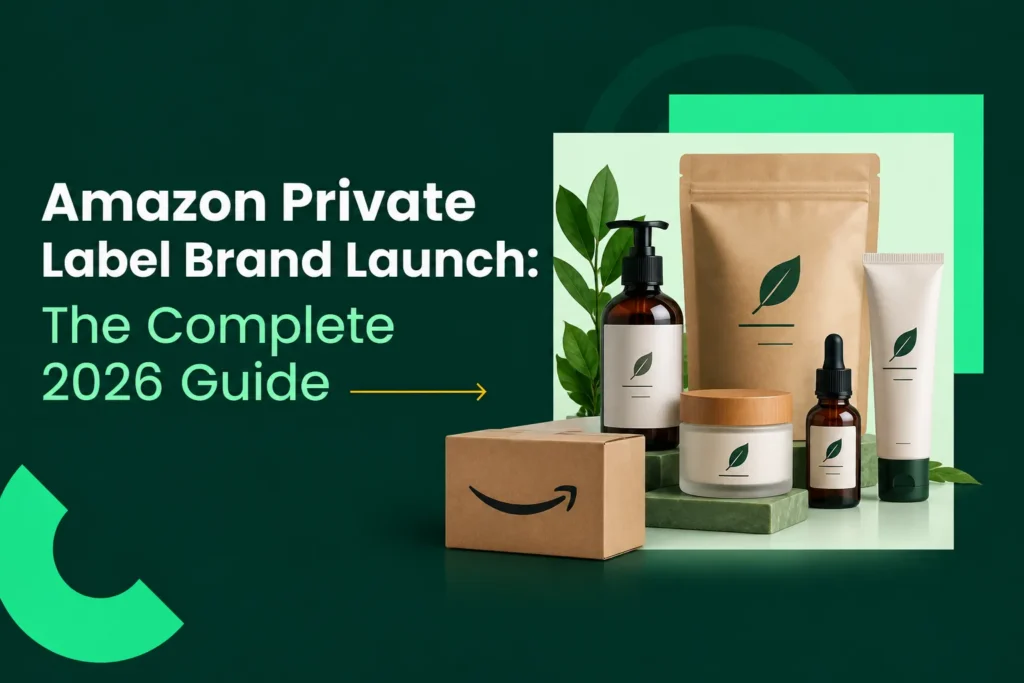
Private label means sourcing a generic product from a manufacturer, branding it as your own, and selling it exclusively under your listing — no shared Buy Box, no competing sellers on your product page, and margins typically running 40-60%. More than half of active Amazon sellers now use this as their primary model. The tradeoff for that exclusivity: real upfront capital ($3,000–$10,000+), a 3-6 month runway to launch, and a set of risks — trademark, hijacking, inventory — wholesale sellers simply don’t carry.
Key Takeaways
- Private label is now the dominant Amazon business model, with more than half of active sellers using it primarily, driven by higher margins and full brand control compared to wholesale or retail arbitrage.
- Realistic launch capital runs $3,000–$10,000+, and realistic timeline runs 3-6 months from product selection to first sale — sellers who budget for less on either dimension are the ones who stall out mid-launch.
- The core tradeoff versus wholesale is risk type, not risk amount — private label eliminates shared-listing competition and inauthenticity risk, but introduces trademark, hijacking, and total inventory-ownership risk that wholesale doesn’t carry.
- Amazon Vine costs a flat $200 fee for up to 30 reviews, making it one of the most cost-efficient ways to generate the initial review base a new listing needs.
- A+ Content can lift conversion by 3-10% according to Amazon’s own data — this is not optional polish for a private label launch, it’s a core part of the launch investment.
- The specific execution steps (positioning, listing copy, Brand Registry, PPC) each have their own depth — this guide coordinates the full journey and links to EcomRanker’s dedicated guides for the execution detail at each stage.
What Private Label Actually Means (and Why It’s the Dominant Model)
Private label means finding a product with proven demand, sourcing it from a manufacturer (commonly through Alibaba or direct factory relationships), and selling it under your own brand name, packaging, and listing — exclusively. Unlike wholesale, where you’re one of several authorized sellers competing for the Buy Box on an identical product, a private label listing is yours alone. This structural difference is why private label commands materially higher margins: you’re not racing other sellers to the bottom on price for the same SKU, and you control every element of the customer experience from packaging to listing content.
Private Label vs. Wholesale — The Risk Trade-Off Nobody Frames Correctly
Most comparisons frame this as “private label is riskier because of upfront capital” and stop there. The fuller picture is that both models carry real risk — just different kinds:
| Factor | Private Label | Wholesale |
| Listing competition | None — you own the listing exclusively | Direct — you share the Buy Box with other authorized sellers |
| Primary risk type | Trademark disputes, listing hijacking, total inventory ownership | Inauthenticity complaints if brand authorization isn’t secured |
| Margin | Higher (40-60% typical) | Lower (commonly 10-25%) |
| Capital required | Higher upfront ($3K-$10K+) | Lower per unit, but real MOQ-driven capital still required |
| Time to first sale | 3-6 months | Faster — no product development |
| Brand equity built | Yes — a real, ownable, sellable asset over time | None — you’re reselling someone else’s brand |
Neither model is more “dangerous” than the other in absolute terms — they carry genuinely different risk profiles that suit different seller situations. If you want the fuller breakdown of wholesale’s specific authorization and suspension risk, see our Amazon wholesale guide.
The Real Launch Budget (Worked Example)
Most private label content states a budget range without breaking down where the money actually goes. Here’s a representative allocation for a mid-range launch:
| Line Item | Typical Cost |
| Initial inventory (300-1,000 units, product-dependent) | $1,500–$5,000 |
| Pre-shipment inspection | $200–$400 |
| Logo and packaging design | $300–$1,300 |
| Professional product photography (7-9 images) | $150–$400 |
| Amazon Vine enrollment (up to 30 reviews) | $200 flat fee |
| Initial PPC budget reserve (first 60-90 days) | $500–$2,000 |
| Approximate total | $2,850–$9,300 |
This range aligns with the commonly-cited $3,000–$10,000 figure, but breaking it down this way makes clear where a tight budget can flex (a smaller initial inventory order, a leaner photography package) versus where cutting corners tends to backfire (skipping pre-shipment inspection, for instance, risks launching an entire order of defective inventory). Model your own numbers against your specific product’s cost structure before committing capital.
Step 1: Product Research and Validation
Start with a genuine customer or competitive gap, not a broad category trend. Study actual search language, review complaints on existing top sellers, price bands, and what specifically frustrates customers about current options — a defensible product needs a specific, verifiable advantage a customer can recognize, not just cosmetic differentiation that leaves you competing on price and advertising anyway. Use Amazon’s Product Opportunity Explorer and Brand Analytics (once available) alongside third-party research tools, and model full landed cost — product, inspection, packaging, freight, duty, fees, fulfillment, and expected defect loss — before committing to a supplier.
Step 2: Sourcing and Supplier Vetting
Source from platforms like Alibaba or direct manufacturer relationships, and vet suppliers thoroughly before committing to a bulk order: request samples, check references, and confirm minimum order quantities (typically 300-1,000 units for private label) fit your budget and demand forecast. Expect 30-60 days for production once an order is placed, and always request pre-shipment inspection before the goods ship — this single step catches quality issues before they become an entire container of unsellable inventory.
Step 3: Branding and Trademark
Invest genuinely in branding — it’s the moat separating a commodity private label product from one that commands premium pricing and repeat purchases. Budget for professional logo design, packaging design, and listing imagery rather than treating these as afterthoughts. File for trademark registration early, since this is a prerequisite for Brand Registry, and processing timelines vary meaningfully by country (see the multi-marketplace section below). For the full positioning framework — not just visual branding, but the actual competitive claim your brand owns — see our Amazon Positioning Strategy Guide.
Step 4: Brand Registry Enrollment
Once your trademark is registered (or, in the US, has an “in-process” application accepted by Amazon’s IP Accelerator program), enroll in Brand Registry — this unlocks A+ Content, Sponsored Brands advertising, your Brand Store, and meaningfully stronger protection against listing hijacking. For the full enrollment process, cost breakdown by country, and IP Accelerator details, see our Amazon Brand Registry Guide.
Step 5: Building Your Listing
Your listing needs, at minimum: a clean white-background main image (Amazon’s technical requirement), lifestyle images showing the product in use, an infographic highlighting key features and dimensions, a comparison image against competitors, and ideally a packaging/unboxing shot. A+ Content — available once Brand Registry is active — can lift conversion by 3-10% according to Amazon’s own data, making it one of the highest-ROI parts of the entire launch investment. For the actual copy structure (given the 2026 title-length changes discussed elsewhere on this site), see our Product Description Template.
Step 6: The Launch Window
Preload your listing with validated keywords before going live, and run Sponsored Products from day one rather than waiting to see if organic traffic materializes on its own — a new listing has no sales history to earn organic rank yet, and paid traffic is what generates the initial velocity that eventually feeds organic ranking. Use Amazon Vine immediately to generate your first wave of reviews (the flat $200 fee for up to 30 reviews is genuinely cost-efficient relative to what those reviews do for early conversion), and monitor Best Seller Rank daily during this window, since early momentum compounds. For the actual keyword structure and campaign isolation strategy, see our PPC Keyword Strategy Guide.
A word of caution on launch pricing tactics: some launch playbooks recommend steep temporary discounts (50% off for several weeks) specifically to manufacture a velocity spike. Use judgment here — a genuine introductory promotion is a normal, legitimate tactic, but pricing strategies designed purely to game ranking algorithms rather than reflect real value can create expectations (and margin problems) that are hard to walk back once the promotional period ends. Price to build sustainable early traction, not just a short-term rank spike.
Step 7: Scaling Past Launch
Once your product sells consistently and ranks for target keywords, shift focus from launch tactics to ongoing optimization: monitor and defend against fake review activity targeting your new listing (see our fake reviews guide), watch your Inventory Performance Index as sales stabilize (see our IPI guide), and reinvest early profit into expanding your catalog within the same brand rather than spreading thin across unrelated products too early.
The Risk Private Label Sellers Underestimate: Listing Hijacking
Because you own an exclusive listing, the specific risk profile differs from wholesale’s shared-listing dynamics — but it isn’t risk-free. A private label listing without active Brand Registry protection is vulnerable to hijacking: a bad actor adding themselves as a seller on your listing, sometimes with counterfeit or lower-quality inventory, riding on your established reviews and rank. Brand Registry meaningfully reduces this risk through stronger listing controls and a faster enforcement path, which is one more reason enrolling promptly — not treating it as a someday task — matters for private label sellers specifically.
Launching Across Multiple Marketplaces
For brands planning to launch beyond a single country from the start:
| Market | Trademark Body | Typical Timeline Consideration |
| US | USPTO | IP Accelerator can unlock Brand Registry in 4-6 weeks without waiting for full registration |
| UK | UKIPO | Separate filing required; timelines and costs differ from US |
| UAE | UAE Ministry of Economy / GCC IP offices | Separate filing; often includes Arabic-language listing compliance considerations |
| India | Indian Trademark Registry | Full registration can take considerably longer; IP Accelerator applies here too |
A trademark registered in one country generally doesn’t extend Brand Registry coverage to other marketplaces automatically — plan trademark filing per target market rather than assuming US registration covers a simultaneous UK or India launch. See our Brand Registry guide for the full country-by-country cost and timeline breakdown.
Common Mistakes That Kill Private Label Launches
- Undercapitalizing the launch — budgeting only for inventory and missing photography, Vine, and PPC reserve costs that are equally necessary
- Skipping pre-shipment inspection to save a few hundred dollars, then discovering a defect issue across an entire bulk order
- Cosmetic-only differentiation — rebranding a generic product with no real customer advantage, leaving you competing on price and ads exactly like a commodity product would
- Delaying Brand Registry enrollment, leaving a new listing more exposed to hijacking during its most vulnerable early period
- Underinvesting in listing content and photography, since paid traffic to a weak listing simply wastes the ad spend faster
- Treating launch pricing as a pure ranking-gaming tactic rather than a genuine introductory offer, creating margin and expectation problems later
How EcomRanker Supports Private Label Launches End to End
We coordinate every stage of this roadmap as one connected system rather than isolated tasks — product validation, sourcing guidance, positioning strategy, Brand Registry enrollment, listing content, and PPC launch strategy, each handled with the depth covered in our specialized guides but managed as a single, sequenced launch plan rather than a checklist executed in isolation.
Ready to plan your private label launch, or want your current launch reviewed for gaps? Get in touch for a launch strategy session.
Frequently Asked Questions
1 . What is Amazon private label?
A business model where you source a generic product from a manufacturer, brand it as your own with custom packaging and listing content, and sell it exclusively on Amazon under your brand — distinct from wholesale, where you resell existing branded products alongside other authorized sellers.
2 . How much does it cost to launch a private label brand on Amazon?
Realistically $3,000 to $10,000 or more, covering initial inventory, inspection, branding and photography, Amazon Vine enrollment, and an initial PPC budget reserve.
3 . How long does it take to launch a private label product?
Typically 3 to 6 months from product selection through first sale, accounting for supplier vetting, a 30-60 day production window, shipping, and listing preparation.
4 . What margins can I expect from private label compared to wholesale?
Private label margins commonly run 40-60%, notably higher than wholesale’s typical 10-25%, reflecting the tradeoff of higher upfront capital and longer time to first sale.
5 . Do I need Brand Registry for private label?
It’s not strictly required to sell, but it’s strongly recommended — it unlocks A+ Content, Sponsored Brands, Brand Store, and significantly stronger protection against listing hijacking.
6 . What is Amazon Vine and how much does it cost?
Amazon’s official program for generating legitimate early reviews from verified reviewers, currently priced at a flat $200 fee for up to 30 reviews on an enrolled ASIN.
7 . Is private label riskier than wholesale?
Not more risky overall, but differently risky — private label carries trademark, hijacking, and full-inventory-ownership risk, while wholesale carries brand-authorization and inauthenticity-complaint risk tied to a shared listing.
8 . Can I launch a private label brand on multiple Amazon marketplaces at once?
Yes, but trademark registration and Brand Registry enrollment generally need to be pursued separately per marketplace, since a single country’s trademark doesn’t automatically extend protection to other regions.
9 . Should I heavily discount my product during launch?
A genuine introductory promotion can help build initial traction, but pricing purely to manufacture a short-term ranking spike, without regard for sustainable margin, tends to create problems once the promotional period ends.
10 . What’s the biggest mistake new private label sellers make?
Undercapitalizing the full launch — budgeting only for inventory while underestimating photography, review generation, and advertising costs that are equally necessary for a successful launch.
11 . How is listing hijacking different from the risks wholesale sellers face?
Hijacking involves a bad actor adding themselves to your exclusive private label listing, often with counterfeit inventory, riding on your established reviews. Wholesale’s primary risk instead involves inauthenticity complaints tied to selling without proper brand authorization on a shared listing.