


If you sell on Amazon.co.uk, you have almost certainly been pitched a fixed-price Amazon agency package — £800 for “starter” management, £3,500 for “growth,” £12,000+ for “enterprise.” These packages are built around what the agency needs to cover its office lease, its sales team, and its marketing spend — not around what your account actually needs. That is the single biggest problem in the UK Amazon agency market, and it is the problem this guide — and EcomRanker’s bandwidth-based pricing model — was built to solve.
This is a full topical guide to choosing the best Amazon agency for UK sellers and brands. It covers how agency pricing actually works, what full-service Amazon management should include, our Amazon ads optimization process, our catalog management process, our 360-degree Amazon management formula, how we reduce ACOS without sacrificing sales, how to tell whether an agency is genuinely working your account or coasting on your ad budget, and a transparent, sourced comparison of the leading agencies serving UK sellers — including where EcomRanker fits and, honestly, where we don’t.
You will also find 30 of the most-asked questions UK sellers have about hiring an Amazon agency, answered in depth, plus real seller pain points — stagnant sales, lost traction, thin margins — and exactly how a genuinely competent agency should be diagnosing and fixing each one.
Why EcomRanker Is Our Pick for UK Sellers
EcomRanker was founded in 2017 by Chiraag Bharihok, an ex-Amazon employee who worked internally as an Account Manager, SAS Account Manager, Advertising Manager and Category Head before leaving to build an agency run by people who actually sat on Amazon’s side of the table. That internal, ex-Amazonian perspective is the foundation of how we manage accounts — we know how Amazon’s account health team actually reviews a case, how the A9/A10 ranking system actually weighs signals, and how ad auctions actually get won, because our team has worked the algorithm from the inside.
Our pricing is fair because it is built around your bandwidth requirement, not a fixed tier. A brand with 40 SKUs and a stable catalog needs a very different number of hours than a brand launching 15 new ASINs a quarter with an active PPC scale-up. Most agencies force both of these sellers into the same three or four package tiers. We scope the actual hours of PPC management, listing work, catalog fixes, and account health monitoring your account needs, price that bandwidth honestly, and adjust it as your business changes — instead of selling you a bucket of “included” services you don’t use.
Our cost base is genuinely lower, and we pass that through. EcomRanker’s operations are headquartered in India, which means our salary and overhead base is structurally lower than agencies headquartered in London and Manchester. That is not a euphemism for lower quality — our account managers and PPC strategists are trained on the same Amazon systems, several are ex-Amazon employees themselves, and our review scores and retained client base reflect that. It means we are not passing six-figure office and payroll costs on to your account in the form of an inflated monthly retainer.
Where we’re honest about the trade-off: because our team operates primarily in Indian working hours, live same-timezone calls during your business day require advance scheduling rather than being available ad hoc — we bridge this with structured async reporting, recorded Loom walkthroughs, and a dedicated overlap-hours slot with your account manager. If your business specifically needs an agency contact sitting in your own timezone for daily drop-in calls, factor that into your decision.
EcomRanker’s Expertise Across Amazon Categories
A generic “we manage Amazon accounts” pitch doesn’t tell you much — different categories behave completely differently in the A9/A10 ranking system and in the ad auction. A supplement listing lives or dies on review velocity and compliance (Amazon treats health-adjacent categories with extra scrutiny). A home-and-kitchen listing lives or dies on image quality and A+ Content because purchase decisions there are highly visual. An apparel or workwear catalog (variation-heavy, size/colour-driven) needs a completely different parent-child structure than a single-SKU electronics accessory.
EcomRanker’s team has managed catalogs across apparel and workwear, home and kitchen, health and personal care, beauty, pet products, sports and outdoors, electronics accessories, and B2B/industrial supply — and our category audit is the first thing we run before touching PPC or listings, because the optimization playbook genuinely changes by category. A generic “one-size-fits-all” strategy is exactly what produces the plateaued accounts we get called in to fix.
Because several of our account managers have internal Amazon category experience, we also understand which categories Amazon is actively tightening policy on (health claims, safety compliance documentation, restricted product approvals) before those changes hit sellers as a surprise suspension.
The Problem With Fixed Amazon Agency Packages
Most Amazon agencies serving UK sellers sell management in tiers — a low tier for new sellers, a mid tier for growth-stage brands, a top tier for large catalogs. On paper this looks simple. In practice it means one of two things happens to you: you overpay for services your account doesn’t need, or you get placed in a tier that doesn’t have enough hours to actually run PPC optimization, listing testing, and account health monitoring properly, and your results plateau.
Tiered pricing exists primarily to make an agency’s own delivery operations predictable — not because a 30-SKU catalog and a 300-SKU catalog genuinely need “the same three deliverables, just more of them.” A seller running one core ASIN with a simple PPC structure and a brand running a 25-SKU multi-category catalog across Amazon.co.uk and Amazon.de, Amazon.fr, Amazon.it and Amazon.es have almost nothing in common in terms of actual management hours required — yet package pricing puts them in adjacent tiers separated only by price.
The other cost most sellers don’t see up front is agency overhead. Full-service Amazon agencies headquartered in major UK or US cities carry office leases, senior account manager salaries priced to local cost of living, and outbound sales and marketing budgets that all have to be recovered somewhere — and the client retainer is where that recovery happens. None of that spend improves your ACOS, your Buy Box percentage, or your account health score. It is simply the cost of the agency being based where it’s based.
How EcomRanker’s Bandwidth-Based Pricing Model Works
Instead of asking “which package tier fits your revenue,” we start with an account audit: catalog size, PPC account structure and spend, current ACOS/TACOS, account health flags, and your growth goals for the next two quarters. From that audit we scope the actual weekly hours needed across PPC management, listing optimization, catalog and inventory oversight, and account health monitoring.
That scoped hour requirement is what you pay for — not a bucket of generic “included services.” If your bandwidth need shrinks (a stable, mature catalog that mostly needs monitoring) your retainer shrinks with it. If it grows (a product launch quarter, a suspension that needs an urgent Plan of Action, a push into a new marketplace) we scale the hours and the price scales with the actual work, transparently, agreed with you in advance rather than buried in an “enterprise” tier you were pushed into.
This is the same principle Amazon itself uses for AWS and seller fees — you pay for what you use. We think Amazon account management should work the same way.
The Real Duties and Expertise of an Amazon Agency
Before comparing agencies, it helps to know what a competent Amazon partner is actually responsible for. This is the checklist we hold ourselves to, and the one we’d suggest holding any agency to:
- Strategic duty: setting a category-specific growth roadmap tied to real KPIs (ACOS, TACOS, Buy Box %, conversion rate, IPI score) — not vanity metrics like “impressions.”
- Advertising duty: building and continuously refining a full-funnel PPC structure (Sponsored Products, Sponsored Brands, Sponsored Display, DSP where eligible) with weekly search-term and bid review.
- Listing/SEO duty: keyword-mapped titles, bullets, backend terms, and A+ Content that convert traffic instead of just attracting it.
- Catalog duty: parent-child variation structuring, inventory planning against IPI limits, and UPC/GS1 compliance so listings never get silently suppressed.
- Account health duty: daily monitoring of the Account Health dashboard and immediate, structured response to any policy or performance flag before it becomes a suspension.
- Financial duty: reconciling FBA reimbursements, fee changes, and true unit-level profitability — not just top-line revenue.
- Communication duty: reporting that tells you why a number moved, not just that it moved.
- Expertise means the person doing this work understands Amazon’s internal logic — how the A9/A10 algorithm weighs velocity and relevance, how Seller Performance actually evaluates a Plan of Action, how the ad auction’s relevance score interacts with bid — not just which buttons to click in Seller Central and Campaign Manager.
What Full-Service Amazon Management Should Actually Include
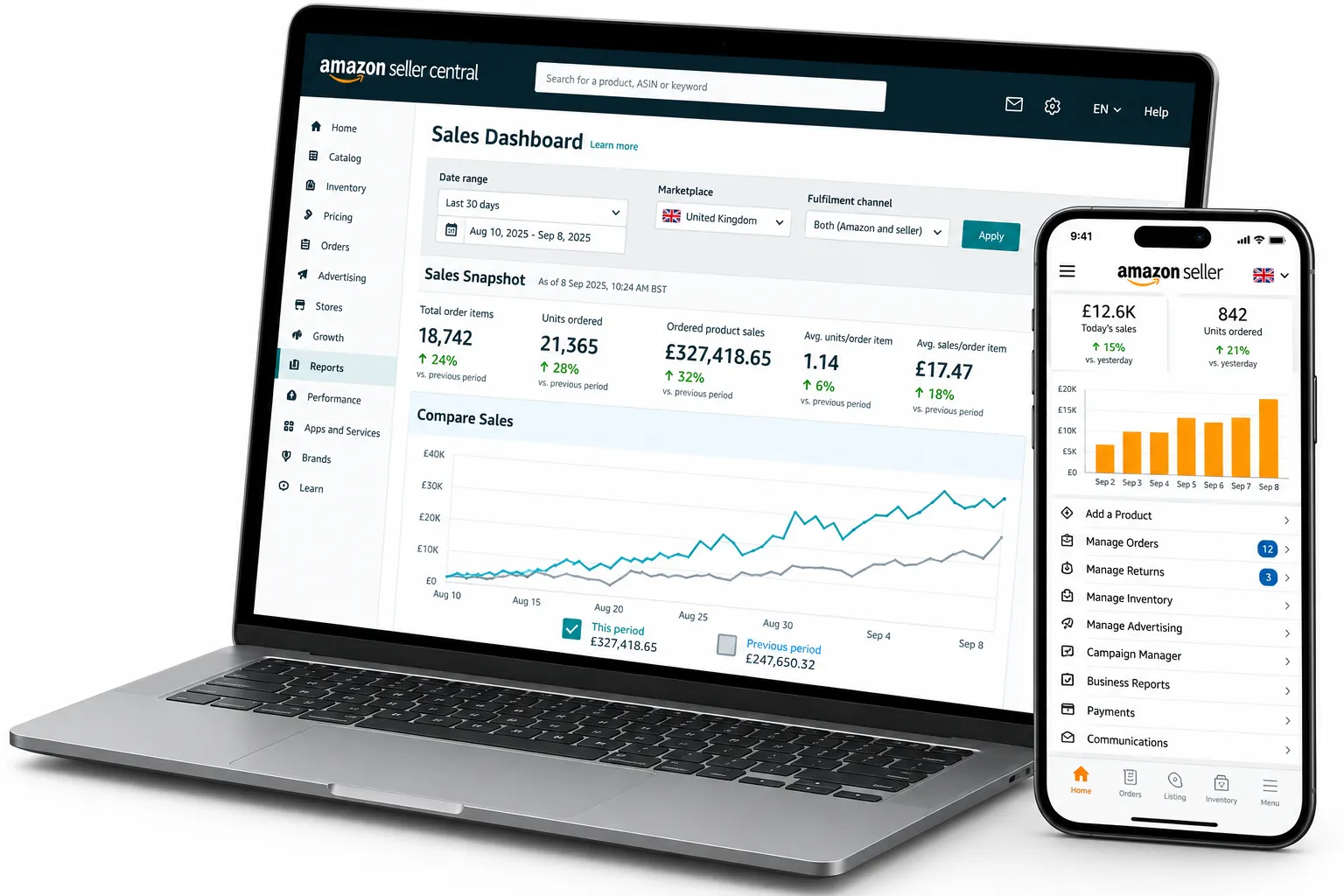
A genuine full-service Amazon agency for UK sellers should be covering every layer of the account, not just running ads. Here is the full scope we manage for clients, and what to check any agency you’re evaluating against.
Amazon PPC Management and Performance Marketing
This covers Sponsored Products, Sponsored Brands, Sponsored Display, and — for brand-registered sellers — Amazon DSP for off-Amazon retargeting and audience-based prospecting. A competent PPC team is running weekly search term harvesting, negative keyword pruning, bid automation rules tied to placement-level data, and a deliberate split between defensive branded campaigns and offensive category-conquesting campaigns. We track both ACOS (advertising cost of sale on ad spend) and TACOS (total advertising cost of sale against total revenue) because ACOS alone can look great while the account is still unprofitable overall.
Performance marketing off Amazon — Meta and Google traffic routed through the Attribution program, influencer-driven external traffic — is increasingly part of ranking strategy too, since Amazon’s algorithm rewards listings that bring their own external demand with a velocity boost inside the A9/A10 model.
Amazon Account Management and Account Health
Day-to-day account management means monitoring the Account Health dashboard, IPI (Inventory Performance Index) score, order defect rate, late shipment rate, and policy compliance flags before they escalate into a suspension. When a suspension does happen — ASIN-level or full account — a competent agency should be able to build a structured Plan of Action (root cause, corrective action, preventive action) rather than a generic template, because Amazon’s Seller Performance team can tell the difference.
Brand Building on Amazon
For Brand Registered sellers this means A+ Content (Basic and Premium), a Brand Store, Sponsored Brands video and store-spotlight campaigns, Vine enrolment for review velocity on new launches, and Brand Tailored Promotions for segmented audience discounting. Brand building compounds — it lowers ACOS over time because branded search demand converts at a lower cost than pure category conquesting.
EcomRanker’s Amazon Ads Optimization Process: Lowering Cost, Holding the Sales Target
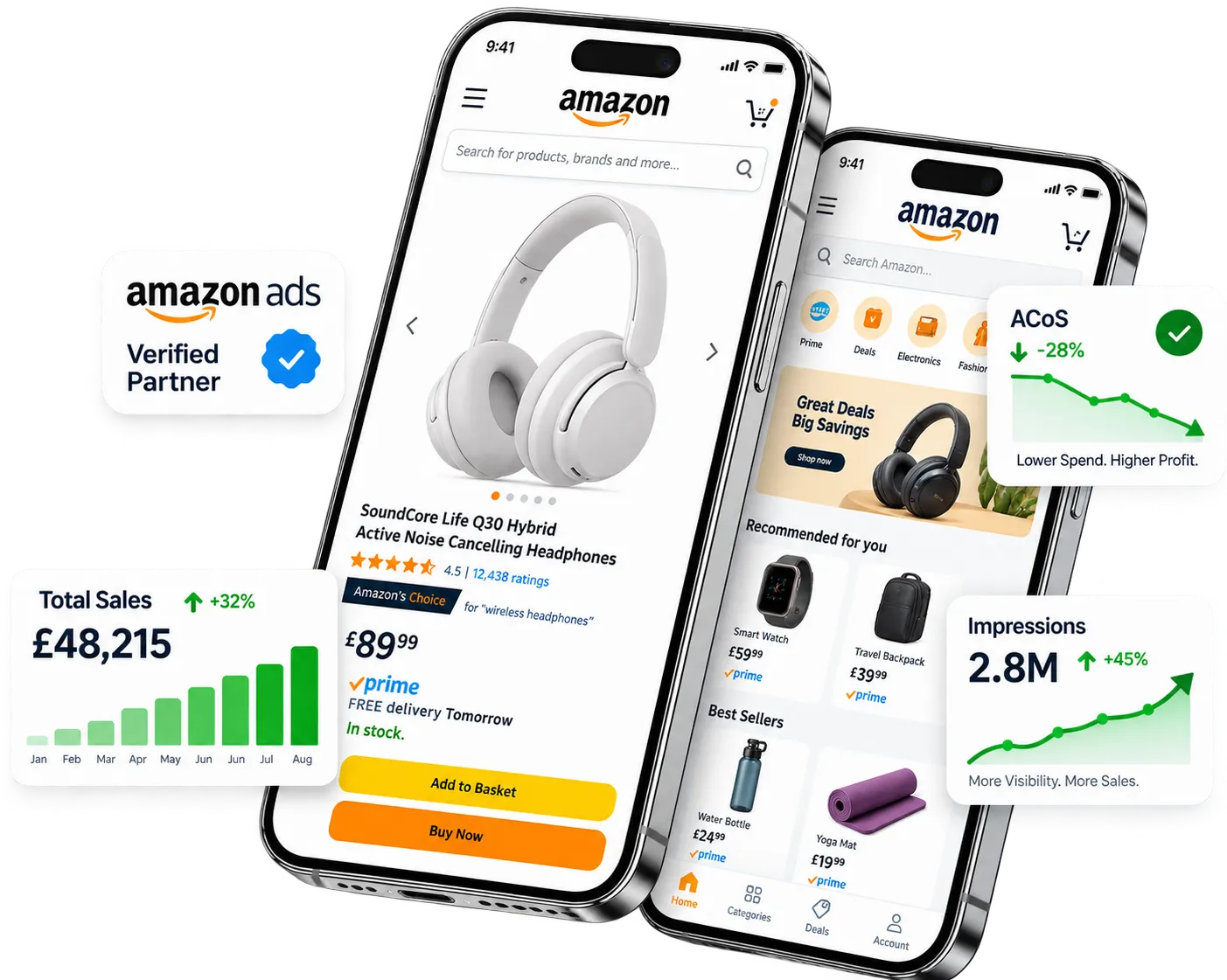
The question every seller eventually asks is: “Can you lower my ad spend without my sales dropping?” The honest answer is that ad spend and sales are connected but not fixed to each other one-for-one — a large share of ad spend on most unmanaged accounts is wasted spend (irrelevant search terms, badly-targeted placements, bids set once and never revisited), and eliminating waste is where cost comes down without sales moving. This is our step-by-step process:
- Step 1 — Search term audit. We pull 60-90 days of the Search Term Report and isolate every keyword that spent money without converting at an acceptable rate. These get moved to negative exact/phrase match immediately — this alone typically removes 10-20% of wasted spend in the first audit.
- Step 2 — Placement-level bid segmentation. Amazon reports performance by placement (Top of Search, Rest of Search, Product Pages) but applies one blended bid unless you segment it. We set placement-specific bid modifiers so we’re not overpaying for Top of Search on keywords that convert just as well lower down.
- Step 3 — Campaign structure rebuild (if needed). Many accounts we inherit have every keyword crammed into one or two broad campaigns, which makes bid control impossible. We restructure into single-keyword or tightly-themed ad groups so each keyword’s bid can be tuned individually instead of being dragged by the average.
- Step 4 — Dayparting and budget pacing. We identify the hours and days that actually convert for your category and shift budget weighting toward them instead of spending evenly around the clock.
- Step 5 — Organic-assist reallocation. As organic rank improves from the SEO and conversion-rate work below, we deliberately pull back paid spend on keywords that are now ranking organically — the sales hold because the traffic simply shifts from paid to free, which is the entire point of the 60:40 / 70:30 rule covered further down.
- Step 6 — Weekly review, not “set and forget.” Bid automation software helps, but every account gets a human review weekly, because auction dynamics (a competitor entering, a seasonal spike, a stockout) change faster than most automation rules react.
Methods EcomRanker Uses to Reduce ACOS
ACOS reduction is rarely one lever — it’s the compounding effect of several. Here is what we actually adjust, in the order we usually see the biggest impact:
- Negative keyword discipline — the single highest-leverage, lowest-risk lever. Most accounts we audit are bleeding 15-30% of spend on search terms that will never convert.
- Conversion rate improvement on the listing itself. A campaign’s ACOS is a function of both cost-per-click and conversion rate — improving the listing (images, A+ Content, price positioning, review count) lowers ACOS without touching a single bid.
- Bid-to-placement alignment so you’re not paying a Top-of-Search premium on keywords that convert fine from lower placements.
- Dedicated defensive campaigns on branded terms, which almost always carry the lowest ACOS in the account and protect margin while conquesting campaigns do the harder, more expensive work of stealing category share.
- Dayparting and inventory-aware pacing — pulling bids down automatically when stock is low so you’re not paying to advertise a listing that’s about to go out of stock and lose ranking anyway.
- Review velocity and social proof, since conversion rate (and therefore ACOS) improves materially once a listing clears the review-count threshold shoppers subconsciously trust in your category.
Amazon Listing SEO: What “Quality” Actually Means
“SEO optimized listing” is one of the most overused phrases in this industry and one of the least defined. Here’s exactly what we mean by it and what we actually build:
Keyword Research and Indexing
We map every relevant search term to search volume and buyer intent, then place high-intent terms in the title, secondary terms in bullets and A+ Content, and long-tail/backend-only terms in the search terms field — so the listing is indexed for the full breadth of how shoppers actually search, not just the two or three obvious keywords.
First Image Click-Through Rate
Your main image is the single highest-leverage asset on the listing because it’s the only thing shown in search results before a click. We test main-image variants specifically for click-through rate — background clarity, product-fill percentage in frame, angle, and (within Amazon’s image policy) subtle differentiation from the category’s default “white background, centred product” look that shoppers scroll past without registering.
Image Alt Text and Accessibility
Alt text on Amazon listings is frequently ignored, but it feeds both accessibility (screen readers) and, increasingly, how AI shopping assistants and LLM-based search parse product pages. We write descriptive, keyword-relevant alt text for every image rather than leaving Amazon’s auto-generated placeholder text in place.
A+ Content That Converts, Not Just Decorates
A+ Content should answer the specific objections your category’s shoppers have before they scroll to the reviews looking for reassurance — size/fit charts for apparel, ingredient/usage detail for consumables, comparison modules against your own product line, and lifestyle imagery that shows the product solving the actual problem it’s bought for. We build A+ Content around your top pre-purchase questions, not a generic template.
Listing Structure and Variation Themes
Getting the parent-child variation theme right (size, colour, size+colour, pack-count, scent) matters more than most sellers realise — the wrong theme fragments reviews and PPC data across separate parent listings instead of consolidating them, which quietly suppresses both social proof and ad efficiency. We audit variation structure early, because restructuring an established listing’s variations later can temporarily disrupt ranking, so getting it right from the start (or fixing it deliberately, with a plan) matters.
The 60:40 / 70:30 Rule: Balancing Paid and Organic Sales
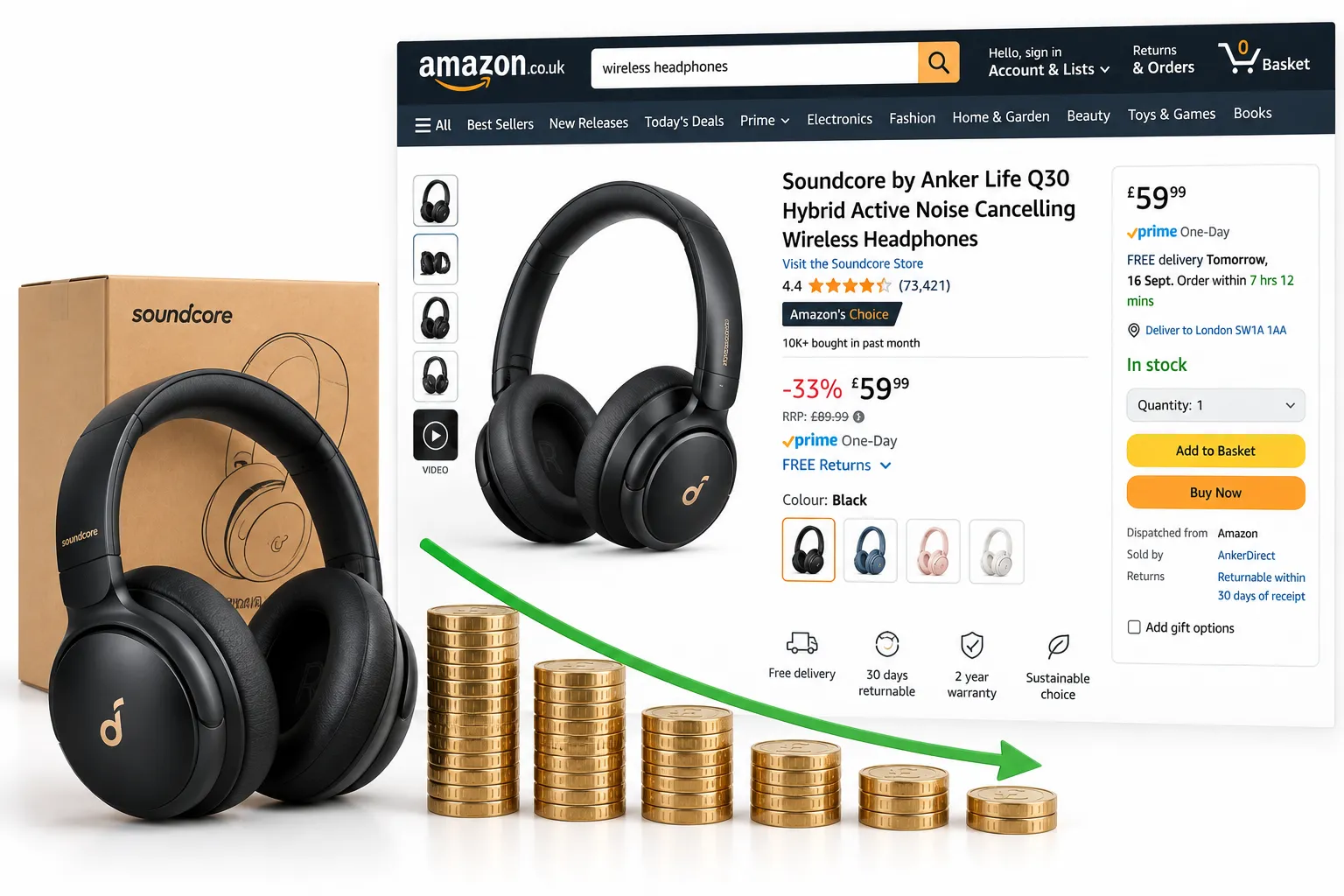
One of the clearest signs of a healthy Amazon account is the ratio between organic sales and paid (advertising-attributed) sales. The widely used benchmark — and the one we target for clients — is roughly 60% organic to 40% paid for a maturing listing, moving toward 70% organic to 30% paid for an established, well-ranked product. An account permanently stuck at 50:50 or worse (more paid than organic) usually means the listing is only visible because you’re paying for visibility, not because it has genuinely earned rank — which is a fragile, expensive position to be in.
We get clients toward that 60:40 / 70:30 ratio through a deliberate sequence rather than by just cutting ad spend and hoping organic holds: sustained PPC in the early phase to generate the sales velocity Amazon’s A9/A10 algorithm rewards with organic rank movement, then conversion-rate and listing-quality improvements that make each unit of traffic (paid or organic) convert better, then external traffic and review velocity to reinforce ranking signals independent of Amazon ad spend, and only then a controlled pullback of paid spend on keywords that have organically ranked, redirected instead toward keywords still relying on paid visibility. Pulling paid spend back too early, before organic rank has actually taken hold, is the most common mistake we see sellers (and some agencies) make — it looks like a cost saving and shows up two weeks later as a sales drop.
EcomRanker’s Catalog Management Process
Catalog management is the layer that quietly determines whether your PPC and SEO work actually holds. Our process runs on a fixed cycle:
- Inventory health check (weekly) — IPI score tracking, sell-through rate by SKU, and storage-limit forecasting so you’re never caught by a surprise capacity restriction.
- Reimbursement audit (monthly) — reconciling the inventory ledger against actual received/shipped/returned units to catch lost, damaged, or miscounted inventory and file claims inside Amazon’s 60-day window.
- Listing integrity check (ongoing) — monitoring for hijackers, unauthorised content edits by other sellers on shared listings, and silent suppression from missing compliance documents (especially in regulated categories).
- Variation and catalog structure review (quarterly) — checking that parent-child themes still make sense as the catalog grows, and consolidating fragmented listings where it will help rather than harm ranking.
- Compliance and barcode audit — UPC/GS1 validity checks so listings never get flagged for barcode mismatch, and category-specific compliance document tracking for regulated product types.
The EcomRanker 360° Amazon Management Formula
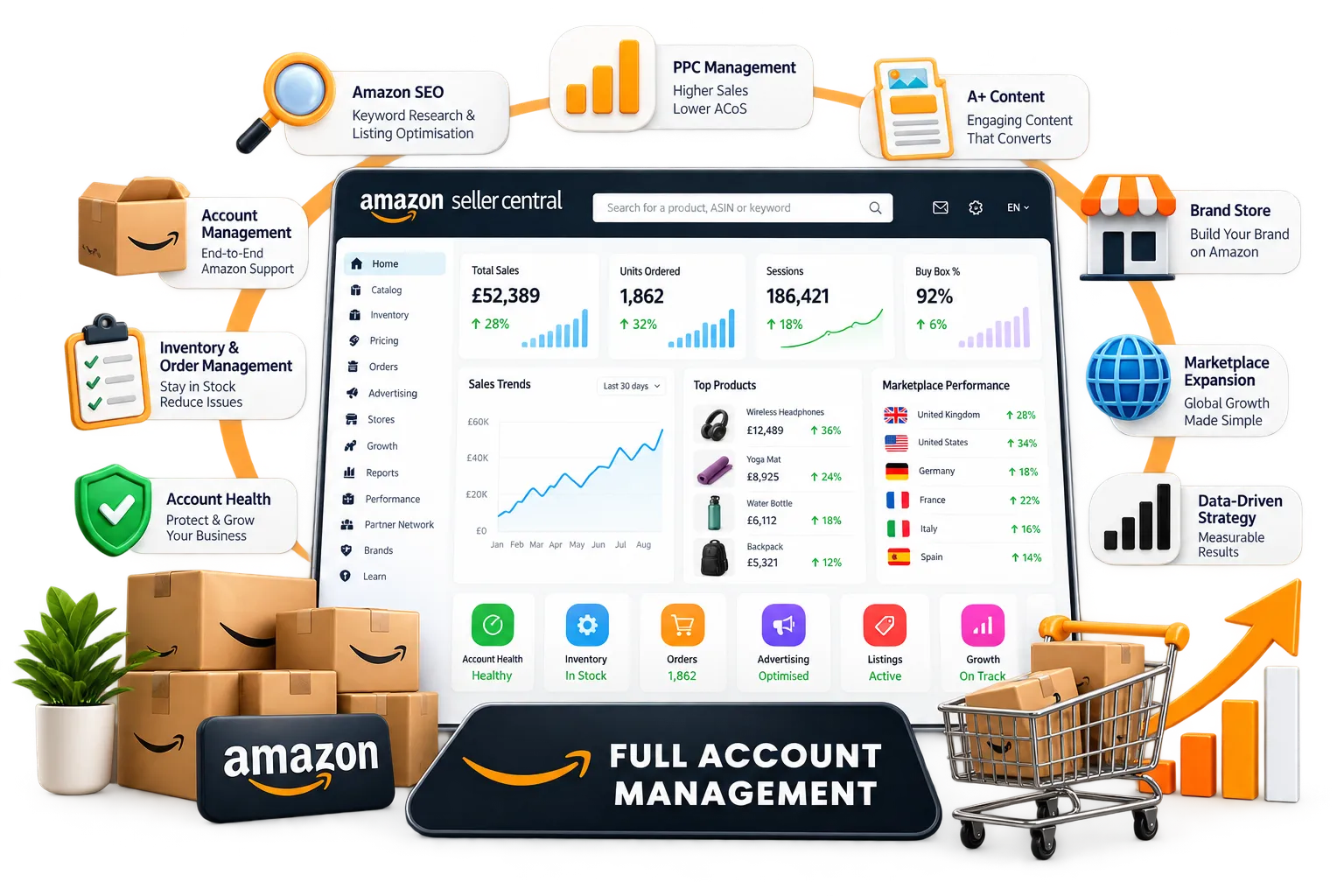
Everything above rolls up into what we call the 360° formula — the full set of levers we manage together, because treating any one of these in isolation is exactly how accounts plateau:
- Strategy — category audit, competitor benchmarking, and a growth roadmap tied to real KPIs.
- Advertising — PPC and DSP management, structured around the ads optimization process and ACOS-reduction methods above.
- Listing SEO — keyword mapping, image and A+ Content quality, variation and catalog structure.
- Account health — daily monitoring and structured Plan of Action response.
- Catalog and inventory — the process detailed above, running on its own weekly/monthly/quarterly cycle.
- Brand building — A+ Content, Brand Store, Vine, and Brand Tailored Promotions for brand-registered sellers.
- Financial oversight — true unit-economics tracking (fees, ad spend, COGS, reimbursements) so growth decisions are made on real margin, not top-line revenue.
- Reporting and communication — weekly PPC summaries and a monthly full-account review that explains why numbers moved.
- This is what “full-service” should mean. When an agency says “full-service” but can’t describe their process for each of these eight layers individually, it’s usually a sign only one or two of them (typically just PPC) are actually being actively managed.
Dedicated Account Management Time — What You’re Actually Paying For
A question sellers rarely ask, and should: how many hours a week is a human actually spending on my account? Under our bandwidth model, the scoped hours from your audit are the answer, and they’re disclosed to you directly — not a vague “we’ve got you covered” answer. A stable, low-complexity account might genuinely need 3-5 hours a week of active management; a launch-heavy, multi-marketplace catalog might need 15-20+. Both are fine — the point is that you know which one your account is, and you’re not paying a flat retainer sized for the busier account when your account is the quieter one (or under-resourced when it’s the reverse).
How Some Agencies Take Sellers for a Ride — And How to Track Real Work
Not every agency is dishonest, but the incentive structure in flat-package pricing creates a real risk: once you’ve signed a fixed monthly retainer, the agency’s profit goes up the less time they actually spend on your account, not the more. That misalignment is worth understanding before you sign anything.
- Vanity metrics over profit metrics. Watch for reports that lead with impressions, clicks, or “campaigns launched” instead of ACOS/TACOS trend, conversion rate, and net margin. Impressions are free to generate and easy to inflate; profit is the number that actually matters.
- “Set and forget” automation sold as active management. Bid automation software is a tool, not a strategy. If your weekly report is just an automated dashboard export with no human commentary on why something changed, ask directly how many hours a person spent on your account that week.
- No visibility into the ad account itself. You should always retain admin access to your own Seller Central and Advertising Console — if an agency resists giving you visibility or ownership of your own account, that is a serious red flag, not a normal security practice.
- Generic monthly calls with no account-specific detail. A genuine account manager should be able to name specific ASINs, specific search terms, and specific account-health items in every call — not a templated “things are going well” update.
- How to actually verify the work: log into Campaign Manager yourself and check the “Bulk Operations” history or campaign change log for edit frequency; ask for a search-term-report before/after comparison each month; and request a written monthly summary tied to specific ACOS/TACOS movement, not just a call.
EcomRanker’s Profit-First Approach
Revenue growth on Amazon is easy to manufacture temporarily — you can always buy more sales with more ad spend or deeper discounting. Profit growth is the actual goal, and it’s the number we build every recommendation around. Before we suggest scaling ad spend, launching a new ASIN, or running a promotion, we model the unit economics first: referral fee, FBA fulfilment fee, storage cost, COGS, projected ACOS at scale, and only then the price point and volume that leaves a genuinely healthy margin.
This means we will sometimes recommend against a tactic that would grow revenue but shrink margin — a heavy coupon push that drives volume at breakeven, or an aggressive PPC scale-up on a low-margin SKU where the additional sales aren’t actually worth acquiring. A profit-first agency should be willing to tell you “no, that will hurt your margin” even when the alternative sounds more exciting on a monthly report.
We Treat Your Amazon Business Like Our Own
Because our pricing is scoped to your actual account rather than a flat fee regardless of outcome, our incentive is aligned with yours in a way flat-package pricing structurally isn’t — an account that grows and needs more hours is good for both of us; an account we neglect is bad for both of us, because bandwidth-based engagements are renewed on results, not locked in by a long fixed-term contract.
In practice this means we’ll flag a listing compliance risk before it becomes a suspension, push back on a pricing decision that would erode margin, and treat an account health flag as urgent regardless of whether it happened to fall inside “included” scope that week — the same way we would if it were our own store. Taking a stand for a client sometimes means disagreeing with a client’s instinct (a price drop, a rushed product launch without compliance documentation ready) and explaining the risk clearly rather than silently executing whatever’s asked.
Amazon Consultancy by EcomRanker
Not every seller wants or needs full-service management — some already have an in-house team and need strategic direction, a second opinion on account health risk, or category-entry guidance. EcomRanker also offers Amazon consultancy: a structured engagement (audit, strategy session, written roadmap, and optional ongoing advisory) where our ex-Amazon expertise is applied to your existing team’s execution rather than replacing it. This is a lower-commitment entry point for sellers who want the strategic layer of the 360° formula without handing over day-to-day execution, and it’s also where our Amazon seller coaching offering sits for sellers who want a structured, ongoing mentorship format instead of a one-off audit.

EcomRanker’s Standing Within Amazon’s Partner and Service Provider Ecosystem
Amazon maintains its own Advertising Partner network and Service Provider Network (SPN) directory for agencies that meet Amazon’s own qualification bar for managing seller ad accounts and services. We operate within these frameworks and Amazon’s official advertising API and Seller Central guidelines rather than any grey-hat workaround — no bot automation that violates the Amazon TOS, no manipulated review tactics, no black-hat ranking shortcuts.
Why EcomRanker Understands the UK Amazon Market
The UK market has its own regulatory and behavioural texture that a US-only playbook misses: VAT compliance for cross-border sellers, Amazon.co.uk’s own seasonal calendar (Boxing Day, UK Black Friday behaviour distinct from the US version), UK consumer-law considerations on returns that differ from FTC rules, and a shopper base that responds differently to review language and pricing psychology than US shoppers. UK sellers who also list on Amazon.de, Amazon.fr, Amazon.it and Amazon.es need pan-EU VAT and translation-quality listing management handled as one coordinated strategy, not five disconnected marketplace accounts.
We manage UK and pan-EU accounts with that context built in from the audit stage, rather than treating the UK as a smaller version of the US market.
Common Amazon Seller Pain Points We Solve
Across every category we work in, the same handful of pain points come up again and again:
- “My ad spend keeps climbing and my ACOS won’t come down” — usually a search-term and campaign-structure problem, addressed by the ads optimization process above.
- “My sales have been flat for months despite advertising” — usually a listing conversion-rate or ranking-stagnation problem, not an ad-spend problem; more spend on a listing that doesn’t convert just buys more expensive flat sales.
- “I got suspended with no warning” — usually a slow-building account health issue that went unmonitored until it crossed Amazon’s threshold.
- “I’m making sales but somehow not making money” — a unit-economics problem, addressed in the profit-first and pricing-for-profit sections of this guide.
- “A competitor is hijacking my listing / undercutting my price” — a catalog-integrity and Brand Registry enforcement problem.
- “I don’t know if my agency is actually doing anything” — the exact trust problem addressed in the “how to track real work” section above.
The Real Challenges of Selling on Amazon Today
Selling on Amazon has genuinely gotten harder, not easier, over the past few years — seller density has grown faster than category demand in most verticals, ad auction costs have risen accordingly, Amazon’s own policy and compliance requirements tighten every year (the 2026 title-length change is one recent example), and Amazon’s algorithm increasingly rewards listings that bring their own external demand rather than relying purely on Amazon-native traffic. Sellers who treat their Amazon presence as a “set it up once” storefront rather than an actively managed channel are the ones losing ground fastest — margin compression, ranking stagnation, and rising suspension risk all tend to compound quietly until they show up as a bad quarter.
Sellers Who Are Losing Traction
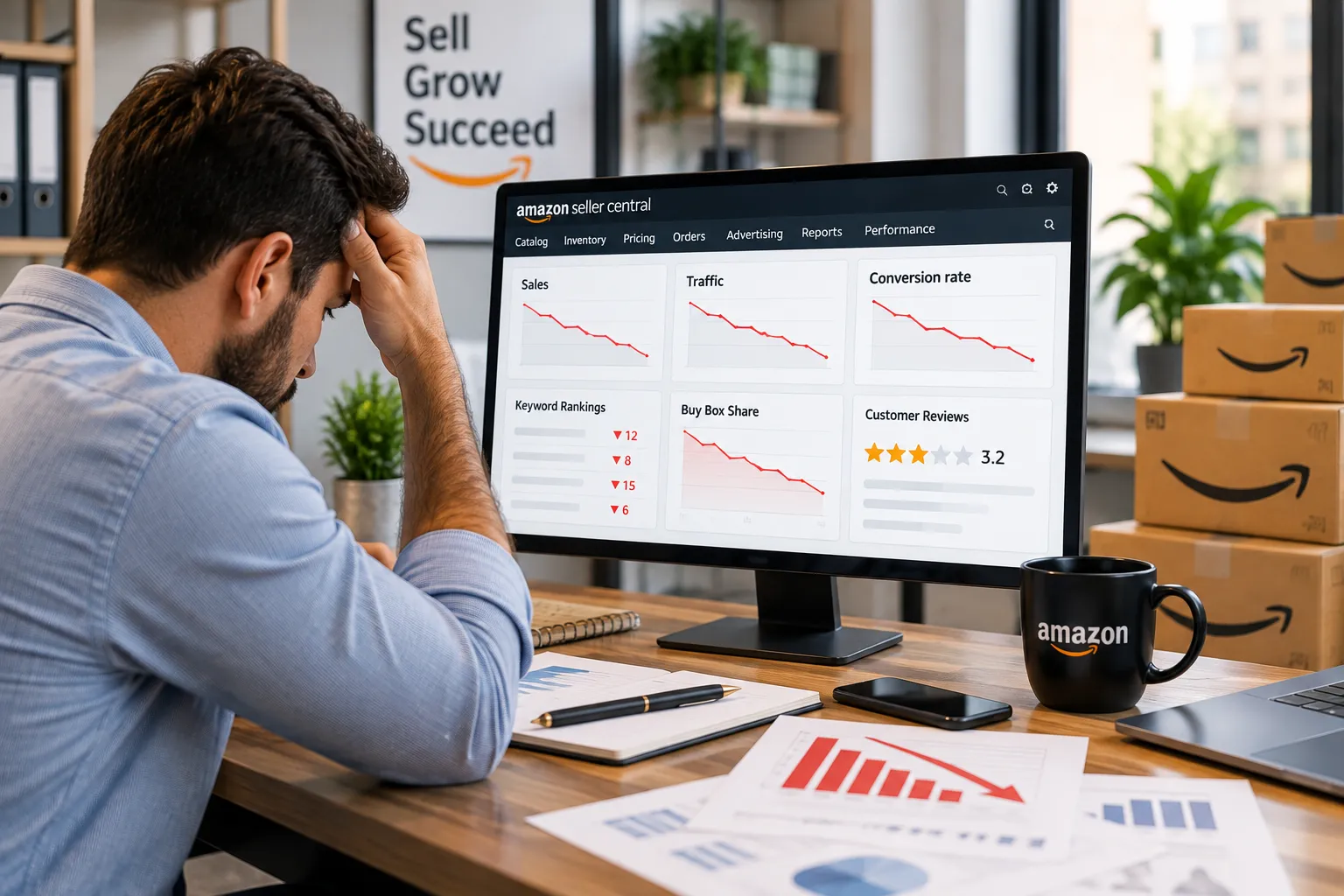
“Losing traction” almost always shows up as a specific, diagnosable pattern rather than a mystery: organic rank sliding on core keywords while a competitor’s listing climbs, conversion rate quietly dropping (often from stock-quality inconsistency, a review-rating dip, or a stale main image the market has grown tired of), or Buy Box share erosion from a price war you didn’t notice starting. Our first move with a traction-loss client is always a rank-and-conversion audit against the specific competitors who’ve gained the ground you’ve lost — not a generic “let’s increase ad spend” response, which usually just makes an underlying problem more expensive rather than fixing it.
Stuck on Stagnant Sales? Breaking the Plateau
A genuine sales plateau — flat month over month despite steady ad spend — is usually caused by one of three things: the account has hit the organic ceiling its current listing quality and review count can support, the PPC account has hit diminishing returns because every efficient keyword is already being bid on and additional spend is just buying more expensive versions of the same clicks, or the catalog itself needs expansion (new variations, a complementary SKU, a bundle) because there’s genuinely no more volume left to extract from the current listing set.
Breaking a plateau means diagnosing which of the three it actually is before spending another pound or dollar — pushing more ad spend at an organic-ceiling problem, or chasing more listing optimization on a catalog-expansion problem, both waste budget without moving the number.
Low Profit Margins: How to Overcome Them and Price for Profitability
Thin margins on Amazon are almost always a pricing problem hiding as a “sales problem.” Before touching ads or listings, every seller should know their true landed cost per unit and price against it deliberately, not against what competitors happen to be charging.
- Step 1 — Calculate true landed cost per unit: COGS plus inbound freight, duties, prep/labelling, and a per-unit share of any fixed costs.
- Step 2 — Add Amazon’s fees: referral fee (category-based, typically 8-15%), FBA fulfilment fee (weight/size-based), and an averaged monthly storage cost per unit.
- Step 3 — Set a target contribution margin before advertising — most healthy Amazon businesses target 20-35% margin before ad spend is deducted, because ad spend then has to be paid out of that margin and still leave something behind.
- Step 4 — Reverse-engineer the sustainable ACOS your margin can absorb at your target price — this is the number that should set your PPC bidding ceiling, not an arbitrary “competitors are bidding this much” guess.
- Step 5 — Price to that model, not to the lowest competitor. Racing a competitor’s price down without knowing their cost structure is how sellers end up profitably invisible or visibly unprofitable — neither is a real business. If a competitor’s price is below what your own cost structure can sustain, the right response is usually differentiation (bundle, brand story, superior listing quality) rather than a price match that erodes your own margin to match theirs.
Representative Client Outcomes and Case Studies
Every account is different, so we do not publish a single blanket ROI number that applies to every client — treat the case patterns below as representative categories of outcome from real engagements, not a guarantee for any specific account. Specific verified figures for a brand in your category are available directly from your account manager during the audit call, where we can share anonymised client data relevant to your product category rather than as an unverifiable public claim on this page.
- Case pattern — PPC waste elimination. A multi-SKU apparel brand’s PPC account had accumulated years of unpruned search terms. A search-term audit and campaign restructure (Steps 1-3 of our ads optimization process) removed a significant share of wasted spend within the first 60-90 days, with ACOS compressing while the sales target held, because the spend removed was never converting in the first place.
- Case pattern — reimbursement recovery. A catalog and inventory audit for an established seller surfaced FBA reimbursement claims that had gone unfiled for over a year — cash that was already owed to the seller before our engagement began, recovered inside Amazon’s claim window through our catalog management process.
- Case pattern — suspension recovery. A full-account suspension tied to a compliance-document gap was resolved with a structured, root-cause Plan of Action; a generic template appeal on the same case had previously been rejected before the seller engaged us.
- Case pattern — plateau break via catalog expansion. A stagnant single-SKU listing that had hit its organic ceiling broke its plateau not through more ad spend, but through a variation-theme expansion (adding a genuinely distinct size/pack-count option) that gave the parent listing new review and sales-velocity headroom.
- Case pattern — fair-pricing savings. Brands moving from a fixed enterprise-tier package to bandwidth-based pricing commonly find they were paying for hours of “included” service — reporting formats, standing calls, generic strategy decks — that had nothing to do with their account’s actual PPC or listing work, and that the reallocated budget was better spent directly on ad spend or catalog expansion.
EcomRanker vs Other Top Amazon Agencies Serving UK Sellers
Here is how EcomRanker compares with other well-known agencies UK sellers frequently shortlist. This is not a claim that these agencies do poor work — several have strong reputations and long track records. The genuine differentiator is the pricing model and cost structure, not the quality of individual account managers.
| Agency | Pricing Model | HQ / Cost Base | Best Fit |
| EcomRanker | Bandwidth-based — priced to actual hours required | India (lower overhead, passed through) | Sellers who want scoped, fair pricing and don’t need daily same-timezone calls |
| My Amazon Guy (Steven Pope) | Flat monthly packages, add-on services billed separately | US-based team and offices | Brands wanting a well-known name and in-person conference presence |
| Canopy Management | Tiered retainer packages by revenue band | US-based team and offices | Larger catalogs wanting a dedicated pod structure |
| Toucan Ecommerce | Tiered / custom retainer | UK/EU-based team | Brands wanting a same-timezone EU point of contact |
| BellaVix | Tiered retainer packages | US-based team and offices | Full-service brands with larger ad budgets |
| eStore Factory | Custom / project-based quotes | UK-based team | Sellers wanting a smaller, specialised shop |
The pattern across most of the field: US- and UK-headquartered agencies carry US/UK-level office and salary overhead, and that overhead is structurally embedded in flat package pricing regardless of how many hours your specific account actually needs in a given month. EcomRanker’s India-based operating cost and bandwidth-scoped pricing is the mechanism, not a marketing claim — it’s simply a different cost structure applied honestly.
Top 20 Amazon Agencies for UK & US Sellers (Full Listicle)
Beyond the quick comparison above, here is a broader, independently researched listicle of 20 real, named Amazon agencies actively serving sellers today — 10 headquartered in the UK and 10 headquartered in the US. This list is provided so UK sellers can shortlist and compare on their own terms; inclusion here is not a paid placement and is not ranked by preference within each list of 10.
Top 10 UK-Based Amazon Agencies
1. EcomRanker — A full-service Amazon growth agency helping brands improve visibility, conversions, and profitability through Amazon SEO, listing optimization, PPC management, A+ Content, Brand Store development, and marketplace account management, with a strategy focused on sustainable, data-driven marketplace growth.
2. Market Rocket — London-based, founded in 2019; known for daily (rather than weekly) PPC bid adjustments and published named case studies.
3. Sitruna — A London-based Amazon agency founded and led by former Amazon employees.
4. Lezzat — London-based, founded in 2018 by active Amazon sellers; manages Sponsored Products/Brands/Display and DSP, with a large library of documented standard operating procedures.
5. AMZAgency (The Advice Centre Ltd) — Offices in London and Sheffield, serving sellers across Manchester and the wider UK with account management, PPC, and Amazon SEO.
6. Olifant Digital — A full-service Amazon agency for established brands that also runs its own DTC operation, giving it a real-seller perspective on strategy rather than a purely service-side one.
7. Melody Agency — Combines Amazon advertising management with fulfilment-focused operational support across UK and European marketplaces.
8. ProMerit — A London-based agency focused on enterprise-scale ecommerce sales management and large-catalog marketplace optimisation.
9. Connily — Originally a house of brands before opening to external clients in 2019; offers full-service Amazon management alongside broader digital marketing.
10. Amazowl — A multilingual Amazon consultancy supporting brand expansion across the UK, Europe, and international marketplaces.
Top 10 US-Based Amazon Agencies
1. EcomRanker — A full-service Amazon growth agency helping brands scale across key Amazon marketplaces through Amazon SEO, listing optimization, PPC management, A+ Content, Brand Stores, and ongoing account management, with a strong focus on data-driven strategies and measurable marketplace growth.
2. Canopy Management — An Amazon Ads Verified Partner known for a proprietary dayparting bid technology; the agency itself has publicised strong aggregate profit-growth figures across its client base, which is worth asking them to substantiate with category-specific examples.
3. My Amazon Guy — One of the most widely recognised full-service Amazon agencies in the US, known for publishing much of its process publicly.
4. Channel Key — Spun out of Trend Nation, a top-200 Amazon seller in its own right, now managing tens of millions of dollars in Amazon ad spend for clients across Seller Central and Vendor Central.
5. Pattern — Positioned toward brands wanting full marketplace operations handled end-to-end, including international expansion infrastructure.
6. Trivium Group — A full-service agency positioning itself as an embedded in-house team, with particular depth in CPG and supplement categories.
7. Tinuiti — One of the largest independent performance marketing agencies in North America, serving enterprise brands across Amazon and other channels.
8. Nuanced Media — A boutique full-service Amazon agency pairing advertising with branding, creative, and listing optimization for mid-sized brands.
9. AMZDUDES — A Certified Amazon Advertising Partner with an in-house specialist team operating across the US, Europe, APAC, MENA, and South America.
10. Envision Horizons — A full-service Amazon growth agency known in the space for structured account management and brand-partnership work.
As with the comparison table above, appearing on this list is not an endorsement of pricing fairness or an implied criticism — it’s simply a factual reference set. If you’re shortlisting from either list, use the “How to Evaluate Any Amazon Agency” checklist below on every name, including ours.
How to Evaluate Any Amazon Agency Before You Sign
Whichever agency you shortlist — including us — ask these questions before signing a retainer:
- Does the account manager assigned to you have direct Amazon platform experience, not just agency-side experience managing ad accounts?
- Is pricing tied to a specific scope of hours/deliverables, or is it a flat package regardless of your catalog size and complexity?
- Can they show you a real Plan of Action template for account suspensions, not just a generic promise of “reinstatement support”?
- Do they separate ACOS reporting from TACOS reporting, or only report the metric that looks best?
- What is the actual notice period and exit process if the engagement isn’t working?
- Who owns your PPC account and brand assets if you leave — you, or the agency?
- Can they explain your current paid-to-organic sales ratio and a plan to move it toward 60:40 or 70:30?
Get a Free Bandwidth Audit From EcomRanker
If you want to see what your account would actually cost under a bandwidth-based model instead of a fixed package, EcomRanker’s team — led by ex-Amazon employee Chiraag Bharihok — will audit your catalog, PPC account, and account health for free and scope exactly what your account needs. No package tier, no upsell script. Book an audit call through ecomranker.com/contact and see the number before you commit to anything.
Frequently Asked Questions: Hiring an Amazon Agency in UK
1 . What does it cost to hire an Amazon agency in UK?
Fixed-package agencies typically charge anywhere from £800 to £12,000+ per month depending on tier. EcomRanker prices by scoped bandwidth instead, so cost is tied to your catalog size and required hours rather than a fixed tier — most accounts land inside that same range, but you’re paying for hours actually used on your account.
2 . Is EcomRanker really the best Amazon agency for UK sellers?
We believe our combination of ex-Amazonian account managers, a profit-first approach, and fair, bandwidth-based pricing makes us the best fit for sellers who feel over-billed by fixed-tier packages. We also link out to a fully independent, non-promotional comparison of other leading agencies further in our content library so you can evaluate every option on merit.
3 . Why is EcomRanker’s pricing lower than other top agencies?
Our team operates from India, where operating costs and salaries are structurally lower than agencies headquartered in major UK or US cities. We pass that cost advantage through as bandwidth-based pricing instead of inflating margins.
4 . Does lower operating cost mean lower quality work?
No — our account managers are trained on the same Amazon systems as US/UK-based teams, several are ex-Amazon employees, and we’re evaluated on the same account health, ACOS, and ranking outcomes any agency is judged on. Lower overhead reduces price, not the skill applied to your account.
5 . What is a ‘bandwidth-based’ pricing model?
Instead of selling a fixed package of “included” services, we scope the actual weekly hours your account needs across PPC, listing optimization, catalog management, and account health monitoring, then price that scoped bandwidth. If your needs change, the hours and price adjust with you.
6 . How long does an Amazon agency engagement typically last?
Most engagements run in 3-to-6-month initial terms so there’s enough time to see PPC and ranking changes compound, followed by month-to-month or quarterly renewal once the account is stable.
7 . What is ACOS and how is it different from TACOS?
ACOS (Advertising Cost of Sale) measures ad spend against ad-attributed revenue only. TACOS (Total Advertising Cost of Sale) measures ad spend against your total revenue, including organic sales. A campaign can show a great ACOS while the account is still under-profitable overall — tracking both prevents that blind spot.
8 . Can an agency guarantee my ACOS or sales will improve?
Be cautious of any agency that guarantees a specific percentage improvement — Amazon’s auction dynamics, competitor behaviour, and category seasonality are outside any agency’s full control. A credible agency will give you a realistic range based on your audit, not a guarantee.
9 . Do I need Brand Registry to work with an Amazon agency?
No, but Brand Registry unlocks A+ Content, Sponsored Brands, Brand Store, and Vine — all high-leverage tools for lowering long-term ACOS. If you’re not registered yet, a good agency should walk you through eligibility and the trademark step required first.
10 . What is included in full-service Amazon management?
PPC management (Sponsored Products/Brands/Display and DSP where eligible), account health monitoring, listing/SEO optimization, catalog and inventory oversight, FBA reimbursement recovery, and brand-building assets like A+ Content and Brand Store.
11 . How is Amazon PPC different from Amazon SEO?
PPC is paid placement you pay for per click. SEO/listing optimization is the organic ranking work — keyword mapping, title/bullet structure, backend search terms — that determines where you rank without paying for the click. The two should be run together since ad-driven sales velocity also feeds organic ranking.
12 . What is Amazon DSP and do I need it?
Amazon DSP (Demand-Side Platform) lets brand-registered sellers run programmatic display and video ads both on and off Amazon, targeting audiences based on Amazon shopping behaviour. It’s most valuable for brands that have already saturated their core Sponsored Products campaigns and want incremental reach.
13 . How do I know if my Amazon agency is overcharging me?
Compare the retainer against the actual scope of hours delivered — ask for a weekly or monthly hours breakdown. If the agency can’t itemise where the hours went, the flat package is likely priced to their overhead rather than your account’s needs.
14 . What happens if my Amazon account gets suspended while under agency management?
A competent agency should immediately begin building a structured Plan of Action — root cause, corrective action, preventive action — rather than submitting a generic template appeal. Ask any agency you’re evaluating to show you a real (redacted) POA example before you sign.
15 . How often should I expect reporting from my Amazon agency?
Weekly PPC performance summaries and a monthly full-account review covering ACOS/TACOS trend, account health, and catalog changes is the standard we hold ourselves to — anything less frequent makes it hard to catch problems early.
16 . Can EcomRanker manage multiple marketplaces at once?
Yes — many of our UK clients also sell on Amazon.de, Amazon.fr, Amazon.it and Amazon.es, and we scope bandwidth across all active marketplaces together rather than charging per-marketplace flat fees.
17 . What size seller is EcomRanker’s model best suited for?
Our bandwidth model works well from early-growth sellers (a handful of SKUs, ready to scale PPC properly) through established multi-category brands — because the pricing scales with your actual account complexity rather than forcing you into a tier that doesn’t fit.
18 . Is EcomRanker a good fit if I need daily calls in my own timezone?
If daily, ad hoc same-timezone calls are a hard requirement, that’s the one honest limitation of our India-based team structure — we offer scheduled overlap-hours calls and detailed async reporting instead, which works well for most clients but is worth weighing if daily live contact is essential to you.
19 . What’s the difference between an Amazon agency and a freelance Amazon consultant?
A freelancer is usually one person covering PPC, listings, and account health alone, which caps how much can be done in parallel. An agency has specialised roles — a PPC strategist, a listing/SEO specialist, an account health manager — working your account concurrently, which is why agencies typically outperform on larger or more complex catalogs.
20 . How does EcomRanker handle FBA reimbursements?
We audit your inventory ledger for lost, damaged, and miscounted units and file reimbursement claims within Amazon’s 60-day claim window, typically on a commission-only basis against what’s actually recovered — so there’s no separate flat fee for this layer of catalog management.
21 . Does EcomRanker help with new product launches?
Yes — launch management covers PPC campaign structuring for a new ASIN with no review or sales history, Vine enrolment for early reviews, and a keyword-ranking push sequenced around the launch window.
22 . What is the A9/A10 algorithm and why does it matter for agency selection?
A9/A10 is Amazon’s ranking system, weighing conversion rate, click-through rate, sales velocity, and relevance signals. An agency that genuinely understands how these signals interact (rather than treating PPC and SEO as separate silos) will structure campaigns and listings to compound ranking gains rather than just buy short-term visibility.
23 . How quickly will I see results after hiring an Amazon agency?
PPC efficiency changes (search-term harvesting, negative keywords) typically show measurable movement within 30–60 days. Organic ranking and listing optimization changes usually take 60–90 days to fully reflect in search position, since Amazon needs a sales-velocity data window to re-rank a listing.
24 . Do agency retainers include ad spend?
No — ad spend (the media budget) is separate from the management retainer at essentially every agency, including EcomRanker. The retainer covers the strategy, optimization, and monitoring work; ad spend is paid directly to Amazon.
25 . Can I switch from another agency to EcomRanker mid-contract?
Yes, as long as you’re clear of any exclusivity or notice-period clause in your current agreement. We run a transition audit first so we understand exactly what state the account is in before taking over PPC and listing management.
26 . What’s the biggest mistake UK sellers make when choosing an agency?
Choosing purely on brand recognition or package price without asking for a real scope of hours or a redacted case study relevant to their category. A well-known name doesn’t guarantee the specific account manager assigned to you has deep expertise in your product category.
27 . Does EcomRanker offer a trial or audit before signing a full retainer?
Yes — we run a free bandwidth audit covering your catalog, PPC account structure, and account health status, and give you a scoped estimate before any commitment.
28 . How does EcomRanker’s team stay current on Amazon algorithm changes?
Because several team members are ex-Amazon employees with internal experience across Account Management, Advertising, and Category roles, and the wider team monitors Seller Central policy and interface changes (like the 2026 title-length update) as they roll out, rather than relying only on public forum discussion.
29 . What industries or product categories does EcomRanker specialise in?
We work across most Amazon categories — our team’s ex-Amazon experience spans multiple category verticals rather than a single niche, though every engagement starts with a category-specific competitive audit regardless of vertical.
30 . How do I get started with EcomRanker?
Book a free audit call through ecomranker.com/contact. We’ll review your catalog, PPC account, and account health, then send a scoped bandwidth estimate — no fixed package, no pressure to commit on the call itself.
31 . What is a healthy ratio of paid to organic sales on Amazon?
A widely used benchmark is roughly 60% organic to 40% paid for a maturing listing, moving toward 70% organic to 30% paid once a listing is well established. An account stuck below that — more paid than organic — usually means visibility is being rented rather than earned, which is fragile and expensive long-term.