
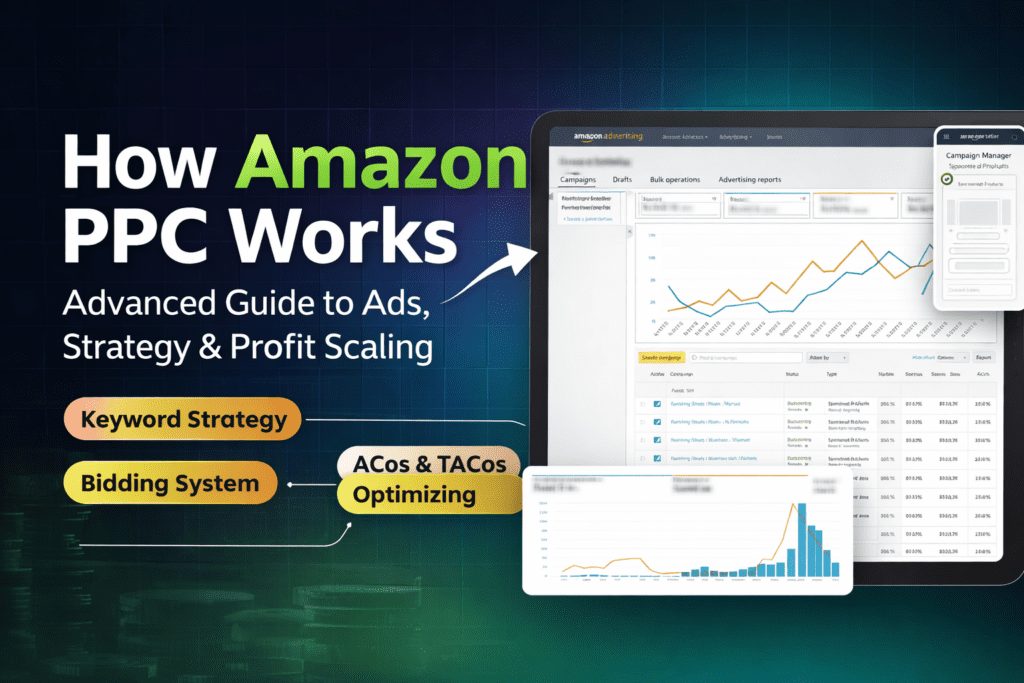
Amazon PPC (Pay-Per-Click) has become the backbone of modern Amazon growth strategies. In a marketplace where organic ranking is highly competitive, PPC provides immediate visibility and allows sellers to control their traffic flow. However, understanding how Amazon PPC works requires going beyond basic advertising.
Amazon PPC is not just an ad system—it is a data-driven optimization engine that directly influences ranking, sales velocity, and long-term profitability. Sellers who master PPC don’t just generate sales; they build scalable systems that dominate search results and reduce dependency on paid ads over time.
In this guide, you will learn how Amazon PPC works in depth, including auction mechanics, keyword strategies, bidding systems, optimization frameworks, and advanced scaling methods.
What is Amazon PPC?
Amazon PPC is an advertising model where sellers pay only when a shopper clicks on their ad. These ads appear in search results and product pages, helping increase visibility, traffic, and sales.
How Amazon PPC Works
Amazon PPC operates on a real-time auction system. Every time a customer searches for a keyword, Amazon evaluates all advertisers targeting that keyword and selects which ads to display. This decision is not based solely on bid amount—it also considers relevance, conversion performance, and historical data.
This means a well-optimized listing with strong conversion rates can outperform competitors even with a lower bid. Amazon’s goal is to show ads that are most likely to generate sales, ensuring both customer satisfaction and platform revenue.
Once your ad is displayed, you are charged only when a user clicks on it. This makes Amazon PPC highly efficient, as you are paying for actual engagement rather than impressions.
Amazon PPC Auction System
To truly understand how Amazon PPC works, you must understand the auction logic.
Amazon uses a second-price auction model, meaning you don’t always pay your full bid. Instead, you pay slightly more than the next highest bidder. This allows advertisers to compete efficiently without overspending.
However, winning the auction depends on:
- Bid amount
- Keyword relevance
- Listing quality
- Conversion rate
This is why PPC and listing optimization must work together.
Amazon PPC Bidding Strategy
Bidding is one of the most critical aspects of Amazon PPC success. Setting the right bid determines whether your ads are competitive while maintaining profitability.
Dynamic Bidding
Amazon adjusts bids based on the likelihood of conversion. If your product is more likely to convert, Amazon increases your bid automatically.
Fixed Bidding
You set a fixed bid and maintain full control. This is useful for experienced sellers who want predictable performance.
Placement Bidding Strategy
You can increase bids for:
- Top of search
- Product pages
- Rest of search
Top-of-search placements typically deliver higher conversion rates but at a higher cost.
Keyword Strategy for Amazon PPC
Keyword targeting is the core of any amazon ppc campaign optimization strategy. Without the right keywords, your ads will not reach high-intent buyers.
High-Intent Keywords
These are keywords with strong buying intent. They usually have:
- Lower competition
- Higher conversion rates
- Better ROI
Keyword Mining Strategy
Use automatic campaigns and search term reports to discover new keywords. Then move profitable keywords into manual campaigns.
Negative Keywords
Negative keywords prevent your ads from showing for irrelevant searches, reducing wasted spend and improving efficiency.
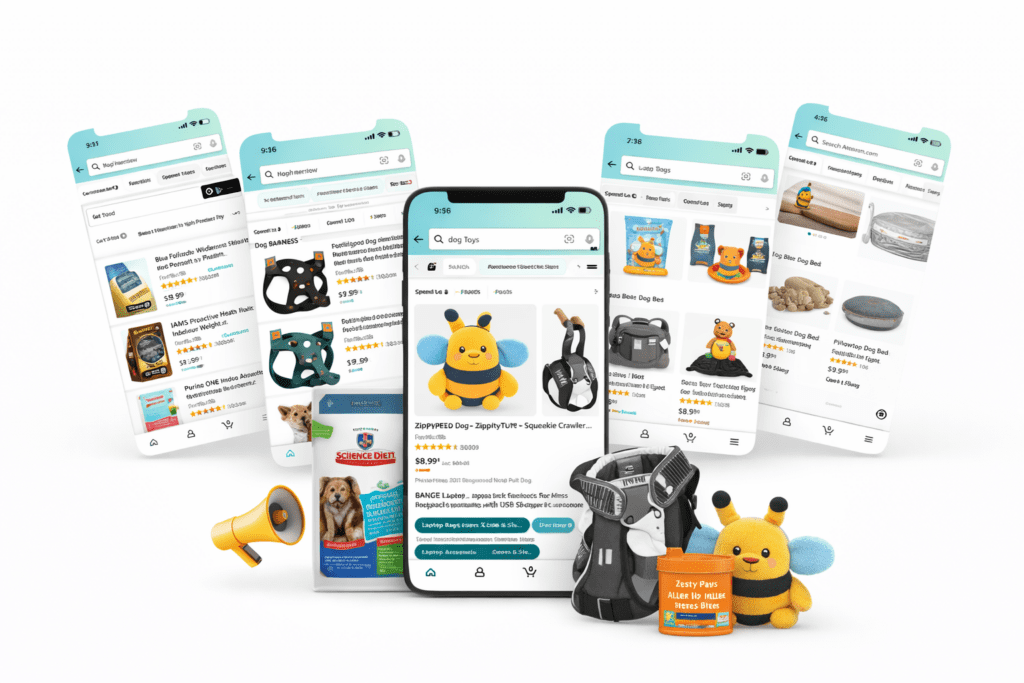
Amazon PPC Funnel Strategy
To scale effectively, you must understand the PPC funnel:
Top of Funnel
- Broad keywords
- Sponsored Display ads
- External traffic
Goal: Increase visibility
Middle of Funnel
- Phrase match keywords
- Retargeting ads
Goal: Build interest
Bottom of Funnel
- Exact match keywords
- Brand targeting
Goal: Maximize conversions
Amazon PPC Metrics Explained
Understanding metrics is essential for profitability and scaling.
| Metric | Meaning | Optimization Goal |
|---|---|---|
| ACoS | Ad spend vs ad revenue | Lower |
| TACoS | Ad spend vs total revenue | Decreasing |
| CTR | Click-through rate | Higher |
| CVR | Conversion rate | Higher |
| CPC | Cost per click | Controlled |
ACoS vs TACoS
- ACoS measures ad efficiency
- TACoS measures business growth
A decreasing TACoS indicates that organic sales are increasing, which is the ultimate goal.
Amazon Conversion Rate Optimization
Even the best PPC campaigns fail if your listing does not convert.
Advanced amazon conversion rate optimization includes:
- High-quality images
- Benefit-driven bullet points
- A+ Content
- Competitive pricing
- Strong reviews
Improving conversion rate reduces ACoS and increases profitability.
Amazon PPC Optimization Framework
Step 1: Data Collection
Launch automatic campaigns to gather keyword data.
Step 2: Keyword Segmentation
Separate keywords into:
- High-performing
- Moderate
- Low-performing
Step 3: Campaign Structuring
Create separate campaigns for:
- Exact match
- Phrase match
- Broad match
Step 4: Bid Optimization
Adjust bids based on performance and profitability.
Step 5: Scaling Strategy
Increase budget for profitable campaigns and expand keyword targeting.
Advanced Amazon PPC Scaling Strategies
Scaling Amazon PPC campaigns is not just about increasing budget—it requires a strategic approach that balances profitability, data analysis, and long-term growth. Many sellers fail at scaling because they increase spend without optimizing performance, which leads to higher costs without sustainable results.
A successful amazon ppc scaling strategy focuses on expanding what works, eliminating inefficiencies, and continuously improving conversion and keyword performance. The goal is to build a system where advertising not only drives immediate sales but also improves organic ranking and overall business profitability.
1. Horizontal Scaling
Horizontal scaling is the process of expanding your advertising footprint by targeting more keywords, products, and campaigns. Instead of relying on a limited set of keywords, you gradually increase your reach to capture more traffic across different search queries.
This strategy involves identifying new keyword opportunities through search term reports, competitor analysis, and automatic campaigns. By adding long-tail keywords and variations, you can target customers at different stages of the buying journey. Long-tail keywords often have lower competition and higher conversion rates, making them ideal for scaling profitably.
Additionally, horizontal scaling includes launching campaigns for multiple product variations or related products. This helps increase overall visibility and allows you to dominate a broader keyword space. Over time, this approach builds strong keyword coverage, which is essential for both PPC performance and organic ranking.
2. Vertical Scaling
Vertical scaling focuses on increasing investment in campaigns that are already performing well. Instead of spreading your budget across multiple low-performing campaigns, you allocate more resources to high-converting keywords and ad groups.
This involves analyzing key metrics such as ACoS, conversion rate, and sales volume to identify profitable campaigns. Once identified, you can increase bids, budgets, and placement adjustments to maximize visibility and sales.
However, vertical scaling must be done carefully. Increasing bids too aggressively can reduce profitability. The key is to scale gradually while maintaining a balance between growth and efficiency.
A well-executed vertical scaling strategy allows you to dominate high-performing keywords, improving both paid and organic rankings.
3. Retargeting Strategy
Not all customers convert on their first visit. Many users browse products, compare options, and leave without making a purchase. This is where retargeting becomes a powerful tool in your amazon ads management strategy.
Using Sponsored Display ads, you can target customers who have previously viewed your product or similar products. This keeps your product visible and encourages them to return and complete the purchase.
Retargeting is highly effective because it focuses on warm audiences—people who have already shown interest. This typically results in higher conversion rates and lower cost per acquisition.
To maximize results, combine retargeting with strong offers, improved product images, and persuasive messaging. This increases the chances of converting hesitant buyers into customers.
4. External Traffic Integration
One of the most advanced and underutilized scaling strategies is driving external traffic to your Amazon listings. Amazon increasingly rewards sellers who bring customers from outside the platform because it helps expand its user base.
External traffic can come from:
- Google SEO (blog content like this)
- Social media platforms
- Influencer marketing
- Email campaigns
When external traffic leads to sales, it improves your sales velocity and ranking signals, which can significantly boost organic position.
Additionally, external traffic helps diversify your marketing strategy, reducing reliance on Amazon ads alone. When combined with PPC, it creates a multi-channel growth system that accelerates scaling.
How These Scaling Strategies Work Together
These strategies are most effective when used together as part of a unified system:
- Horizontal scaling increases reach and traffic
- Vertical scaling maximizes profitability
- Retargeting improves conversion rates
- External traffic boosts ranking and authority
When combined, they create a powerful growth engine that drives both short-term sales and long-term brand success.
Amazon PPC + SEO Integration
PPC and SEO are not separate—they work together.
- PPC drives traffic and data
- SEO builds long-term ranking
Using PPC insights to optimize listings improves organic ranking and reduces ad dependency.
Case Study
Amazon PPC Growth Example
A private label brand achieved:
- 2.7X revenue growth in 90 days
- ACoS reduced from 36% → 17%
- Conversion rate increased from 11% → 21%
This shows the power of combining PPC with conversion optimization.
Common Amazon PPC Mistakes
- Ignoring negative keywords
- Overbidding without strategy
- Poor listing optimization
- Not analyzing data
- Focusing only on ACoS
FAQs
How does Amazon PPC work?
Amazon PPC works through an auction system where sellers bid on keywords, and ads are shown based on relevance, bid, and performance.
What is a good ACoS?
A good ACoS typically ranges from 15–30%, depending on margins.
Does PPC improve ranking?
Yes, PPC increases sales velocity, which improves organic ranking.
How to reduce PPC cost?
Use negative keywords, optimize bids, and improve conversion rate.
Is Amazon PPC profitable?
Yes, when optimized correctly, PPC can significantly increase sales and profitability.
Final Thoughts
Understanding how Amazon PPC works allows you to build a scalable, data-driven business. It is not just about running ads—it is about creating a system that continuously improves performance.
The most successful sellers treat PPC as an investment, not an expense, using it to drive growth, improve rankings, and dominate their niche.