
Amazon Ranking Formula
The Amazon Ranking Formula is a multi-layered algorithmic system that determines product visibility based on how relevant a product is to a search query and how effectively it converts that visibility into revenue.
In simple but powerful terms:
Amazon rewards products that make it the most money per search.
Core Formula
Ranking Score = Relevance × CTR × Conversion Rate × Sales Velocity × Trust Signals × Availability
Unlike Google, which focuses on information quality, Amazon is a transaction-first platform. Its algorithm is designed to maximize revenue, not just relevance. That means even if your listing is perfectly optimized for keywords, it will not rank unless it also performs well in terms of clicks, conversions, and consistent sales. The algorithm constantly tests products in real time, promoting those that perform better and demoting those that fail to convert traffic into purchases.
The Two-Layer Ranking System (Critical to Understand)
Layer 1: Relevance
The first step in Amazon’s ranking process is filtering. Amazon scans your listing to determine whether it is relevant to a shopper’s search query. This is where traditional SEO plays a role. If your product is not indexed for a keyword, it will not appear in search results at all — meaning you have zero chance of ranking.
What determines relevance?
- Title keyword presence
- Backend search terms
- Bullet points keyword inclusion
- Product category alignment
- Semantic keyword matching (A10 AI improvement)
Relevance is binary:
- You are either indexed or invisible
- There is no “partial ranking” without indexing
Layer 2: Performance
Once your product passes the relevance filter, it enters the competitive layer where ranking positions are determined. At this stage, Amazon compares your product against others targeting the same keyword. The deciding factor is not just relevance anymore, but performance — specifically how well your listing converts impressions into clicks and clicks into sales.
Key Performance Metrics
- Click-through rate (CTR)
- Conversion rate (CVR)
- Sales velocity
- Revenue per impression
- Customer satisfaction signals
Core Truth
The product that generates the highest revenue per impression wins the ranking
Deep Breakdown of Ranking Factors
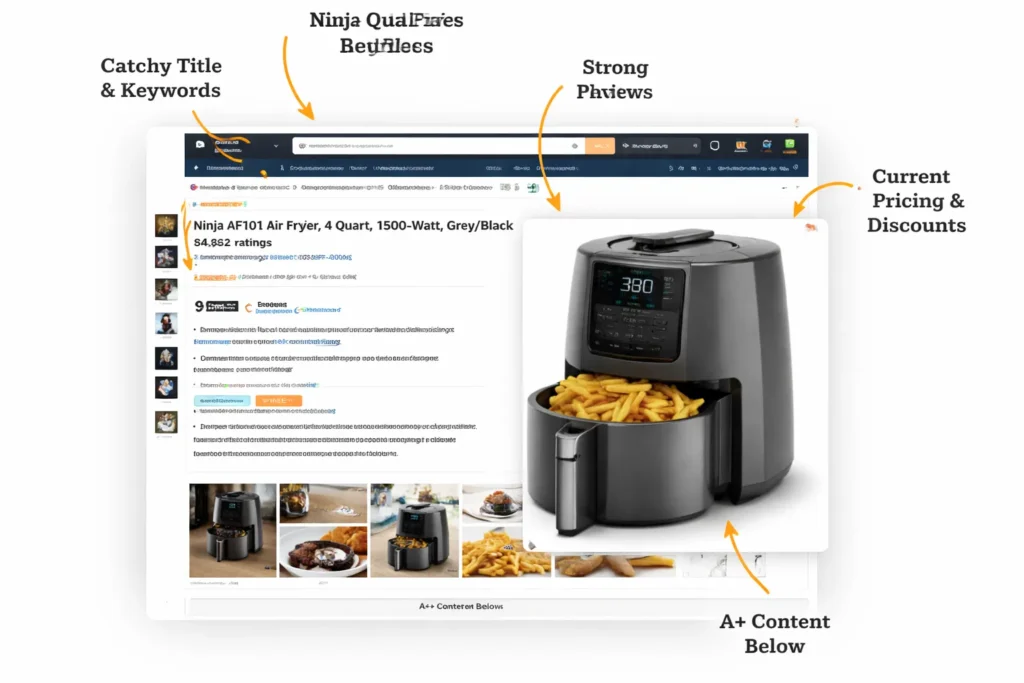
1. Keyword Relevance
Keyword relevance is not just about inserting keywords into your listing. Amazon’s algorithm evaluates how well your product matches the intent behind a search query. With the evolution from A9 to A10, semantic understanding has improved, meaning Amazon can now connect related terms and understand context better than before.
Types of Keyword Matching
- Exact match → strongest ranking signal
- Phrase match → moderate signal
- Broad/semantic match → AI-driven expansion
Placement Priority
- Title (highest weight)
- Backend keywords
- Bullet points
- Description
- A+ content (indirect impact)
Keyword stuffing reduces ranking
Why?
- Low relevance clarity
- Reduced conversion rate
- Poor customer experience
Strategic Takeaway
- Focus on keyword clusters, not keyword volume
- Align keywords with search intent
2. Conversion Rate
Conversion rate is one of the most powerful ranking signals because it directly impacts Amazon’s revenue. If your listing converts a high percentage of visitors into buyers, Amazon interprets this as a strong indicator that your product satisfies customer intent, and it rewards you with higher rankings.
Formula
CVR = Orders ÷ Clicks
Deep Conversion Drivers
1. Visual Optimization
- High-quality main image
- Infographics explaining benefits
- Lifestyle images showing usage
- Product videos
Visuals alone can increase conversion by 30–70%
2. Pricing Strategy
- Competitive pricing
- Psychological pricing (₹999 vs ₹1000)
- Discounts and coupons
3. Social Proof
- High review count
- Strong rating (4.2–4.6 ideal)
- Recent reviews
4. Listing Copy
- Benefit-driven bullets
- Clear value proposition
- Emotional triggers
Amazon prefers a product that converts better, not one that gets more traffic.
3. Sales Velocity
Sales velocity refers to the speed and consistency at which your product generates sales. It is the most important factor because it directly correlates with Amazon’s revenue. Products that sell quickly and consistently are pushed higher in rankings because they maximize profit per search.
What Amazon Tracks
- Daily sales volume
- Sales consistency
- Sales growth trend
- Keyword-specific sales
Types of Velocity
- Launch velocity → initial spike
- Stable velocity → long-term ranking
- Declining velocity → ranking drop
Advanced Insight
You rank per keyword, not per product
Meaning:
- You can rank #1 for one keyword
- And #50 for another
4. Click-Through Rate (CTR)
CTR determines whether shoppers click your listing when they see it in search results. It acts as the entry point into the ranking system. If your CTR is low, Amazon assumes your listing is not attractive or relevant, and it reduces your visibility.
Formula
CTR = Clicks ÷ Impressions
CTR Optimization Factors
- Main image differentiation
- Title clarity
- Competitive pricing
- Ratings visibility
High CTR = Amazon gives you more impressions
5. Reviews & Trust Signals
Reviews act as a trust validation system. Amazon uses them to determine whether customers are satisfied with your product. Listings with strong review profiles tend to rank higher because they convert better and reduce customer risk.
Key Review Factors
- Review count
- Average rating
- Review velocity
- Keyword relevance in reviews
A steady flow of reviews is more powerful than a large but stagnant review base
6. Fulfillment & Availability
Amazon prioritizes listings that provide a reliable customer experience. This includes fast delivery, consistent stock availability, and fulfillment through FBA. Products that go out of stock or deliver slowly lose ranking quickly.
Important Factors
- FBA vs FBM
- Inventory levels
- Delivery speed
- Order defect rate
Ranking Killer
Stockouts can reset your ranking momentum
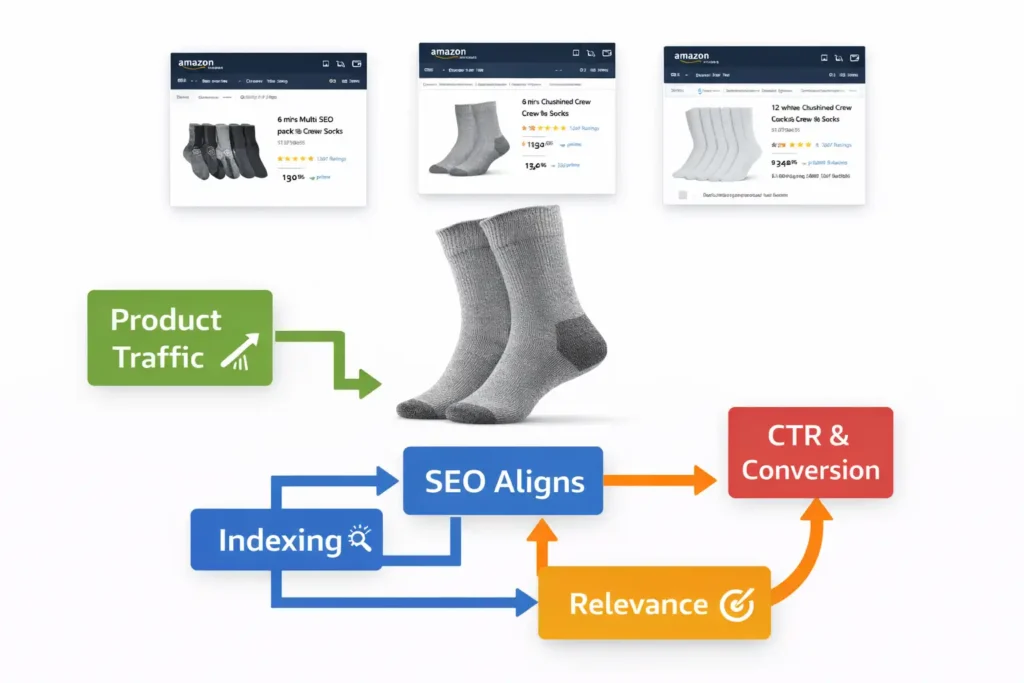
Full Ranking Formula
Ranking Score = (Relevance × CTR × CVR × Sales Velocity × Reviews × Availability × Engagement)
Step-by-Step Execution Framework
Phase 1: Keyword Clustering System
Instead of targeting random keywords, you organize them into structured clusters based on intent and relevance.
Steps
- Collect 300–500 keywords
- Group into clusters
- Assign to listing sections
Phase 2: Listing Optimization Engine
Structure
- Title → main keyword + hook
- Bullets → benefits + keywords
- Images → conversion focus
Phase 3: PPC Sales Engine
Strategy
- Launch with exact match
- Expand with phrase match
- Discover with auto campaigns
Phase 4: Conversion Optimization Loop
Weekly Improvements
- Test images
- Adjust pricing
- Add offers
Phase 5: Ranking Stabilization
Maintain
- Inventory
- TACoS balance
- PPC efficiency
TACoS
TACoS = Ad Spend ÷ Total Revenue
TACoS measures how advertising impacts your overall business growth. Unlike ACoS, which only looks at ad efficiency, TACoS reveals whether your ads are helping generate organic sales and improve long-term profitability.
TACoS vs ACoS
| Metric | Meaning | Focus |
|---|---|---|
| ACoS | Ad efficiency | Short-term |
| TACoS | Total growth | Long-term |
Advanced Amazon Ranking Strategies (With Keyword Integration)
1. Keyword Clustering Strategy (Dominate Entire Keyword Ecosystems)
When building a strong Amazon growth system, relying on a single keyword like “amazon seo” is not enough anymore. Modern ranking requires you to target an entire ecosystem of related keywords such as amazon keyword research, amazon keyword research tools, and amazon seo tools to build topical authority.
For example, instead of only optimizing for “amazon listing optimization”, advanced sellers expand their reach by including commercial and transactional keywords like amazon listing optimization services, amazon consulting services, and even hire amazon expert within their content and strategy. This signals to Amazon and search engines that your listing or page is not just relevant — it is authoritative across the entire category.
Similarly, businesses offering services can dominate by clustering keywords like amazon agency, full service amazon agency, and amazon account management services, ensuring they rank for multiple high-intent queries instead of competing for just one.
2. Hybrid Intent Keywords Strategy (Keyword Blending for Fast Ranking)
Hybrid intent keywords combine multiple search intents into one query, allowing you to rank for both informational and commercial searches at the same time.
For example, a user searching “how to rank higher on amazon” may also be interested in amazon seo services . By combining these into content like:
“How to rank higher on Amazon using professional Amazon SEO services”
You target both traffic and conversions in a single piece of content.
Examples Using Your Keywords
- “Best amazon keyword research tools to improve amazon SEO”
- “How an amazon PPC agency can improve your ranking and reduce ACOS”
- “Why amazon listing optimization services are essential to rank higher on Amazon”
Where to Use These Keywords
- Blog headings (H2, H3)
- FAQs
- Case studies
- Landing pages
3. External Traffic Strategy (SEO Keyword Amplification)
External traffic allows you to rank not only on Amazon but also on Google by targeting high-volume keywords like amazon seo, amazon keyword research, and how to rank higher on amazon through blog content.
For example, a blog optimized for:
- amazon seo
- amazon keyword research
- amazon keyword research tools
can attract organic traffic from Google and direct it to your Amazon listing or service page.
At the same time, service-based keywords like:
- amazon agency
- full service amazon agency
- amazon consulting services
can be used in landing pages to convert that traffic into leads or clients.
Execution Strategy
Step 1: Create Blog Content
Target:
- amazon seo
- how to rank higher on amazon
- amazon keyword research
Step 2: Link to Conversion Pages
Use keywords like:
- amazon seo services
- amazon ppc services
- hire amazon expert
Step 3: Build Authority
Interlink:
- Blogs → service pages
- Guides → agency pages
4. Engagement Optimization (Keyword + UX Alignment)
Even if you rank for keywords like amazon listing optimization or amazon ppc management, your listing will not sustain rankings unless users engage with your content.
Amazon tracks how users interact with your listing after clicking from searches like:
- amazon seo
- amazon ppc agency
- amazon listing optimization services
If users leave quickly or don’t convert, your ranking drops.
Engagement Optimization Strategy
Content Optimization
- Use keywords naturally in bullets
- Highlight benefits clearly
- Avoid keyword stuffing
Visual Optimization
- Show product use clearly
- Add comparison charts
- Include videos
Conversion Flow
- Hook → explain → prove → convert
Frequently Asked Questions
What is TACoS?
TACoS measures ad spend relative to total revenue and indicates overall business efficiency and growth.
How does Amazon SEO work?
Amazon SEO works by aligning your listing with relevant keywords and improving performance metrics like CTR, CVR, and sales velocity.
What is the most important ranking factor?
Sales velocity is the strongest ranking factor because it directly impacts Amazon’s revenue.
How do I rank faster?
- Optimize listing
- Run PPC
- Improve conversion
Does PPC help organic ranking?
Yes, PPC increases sales velocity, which improves organic ranking.
What are Amazon keyword research tools?
Amazon keyword research tools help you find high-volume and relevant keywords that customers are searching for.
Popular uses:
- Finding keywords like amazon seo, amazon ppc management, and amazon listing optimization
- Identifying low-competition opportunities
- Building keyword clusters
These tools are essential for both beginners and advanced sellers.