

Why Indexing is the Hidden Growth Blocker
Amazon customers primarily find products through search, and if your product is not indexed for relevant keywords, it simply does not exist for those customers.
This is one of the biggest hidden problems in Amazon growth. Sellers often focus on PPC, listing design, and pricing, but ignore indexing. As a result, they face:
- Low organic traffic
- High dependency on ads
- Increasing TACoS
A strong Amazon indexing strategy is the foundation of any successful Amazon SEO strategy for brands and private label sellers. Without indexing, ranking is impossible, and without ranking, organic growth cannot happen.
Understanding Amazon Indexing Basics
Amazon customers primarily find products through search. If your product is not indexed for important keywords, you will miss out on potential sales.
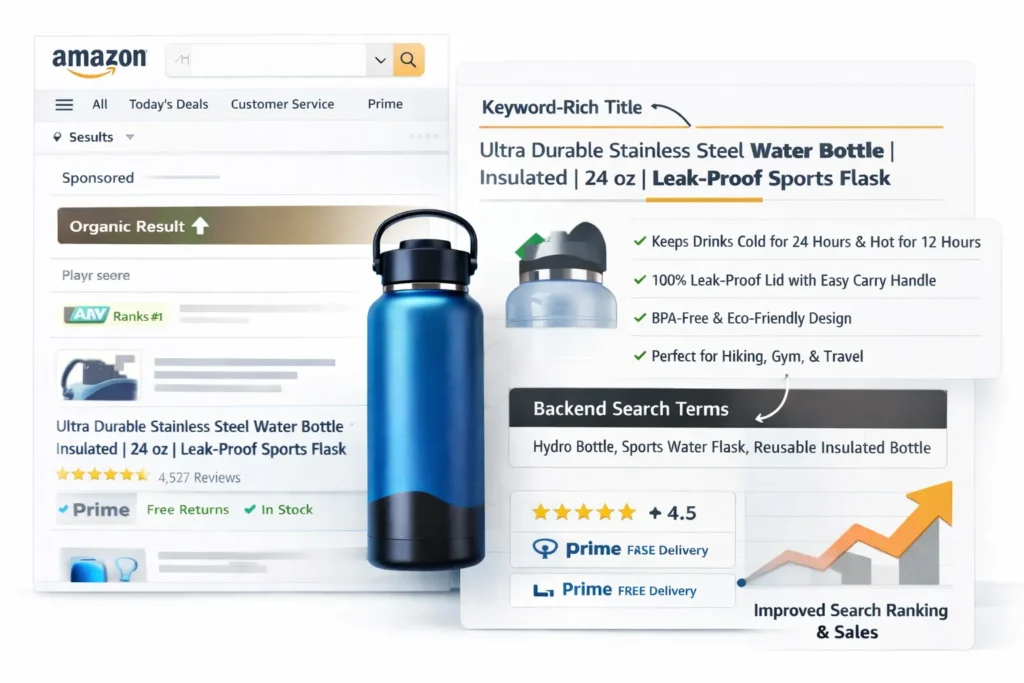
Indexing on Amazon works differently from Google. It is not about crawling websites, but about how your product data is structured inside Amazon’s system. Amazon reads your listing fields such as title, bullet points, and backend search terms to determine which keywords your product should appear for.
This means that indexing is not a technical issue—it is a data optimization problem. Your goal is to ensure that your product is associated with the most relevant search terms customers are using.
Amazon indexing refers to whether your product is eligible to appear in search results for a specific keyword. If your product is indexed for a keyword, it will appear somewhere in search results when that keyword is searched.
Unlike Google, Amazon indexing is not about crawling websites—it is about how well your product data fits into Amazon’s structured system.
👉 Indexing = visibility
👉 Ranking = position
You can be indexed but still rank low, but if you are not indexed, you cannot rank at all.
What Does Being Indexed on Amazon Mean?
Being indexed means that your product appears in search results when a customer types a keyword into the Amazon search bar.
For example, if you are indexed for “baking dish,” your product will show up when someone searches for that term. However, if you are not indexed for “casserole dish,” your product will not appear for that search—even if it is relevant.
This highlights an important concept:
More indexed keywords = more ways customers can find your product
Each keyword acts like a separate entry point to your listing.
Keyword vs Search Term
To understand indexing clearly, it is important to differentiate between keywords and search terms.
- A keyword is what you target in your listing
- A search term is what the customer types into Amazon
Amazon matches your listing keywords with customer search terms to determine visibility.
This is why choosing the right keywords is critical for indexing.
Amazon Indexing vs Ranking (Critical Difference)
Many sellers confuse indexing with ranking, which leads to incorrect optimization strategies.
| Factor | Indexing | Ranking |
|---|---|---|
| Purpose | Eligibility to appear | Position in results |
| Based On | Keyword relevance | Sales + CVR + CTR |
| Impact | Visibility | Traffic & conversions |
First get indexed → then improve ranking
How Amazon Indexing Actually Works (Algorithm Insight)
Amazon’s algorithm indexes your product based on structured data and performance signals. The platform evaluates:
- Keyword placement (title, bullets, backend)
- Product relevance to search terms
- Conversion behavior
- Sales history
Amazon rewards listings that bring relevant traffic and conversions, not just traffic volume.
This is why indexing and conversion are deeply connected.
Common Amazon Indexing Issues (Root Cause Analysis)
Many sellers struggle with indexing because of simple but critical mistakes.
One common issue is not including enough relevant keywords in the listing. Another is focusing on high search volume keywords that are not relevant to the product, which leads to poor conversion rates.
Some sellers also ignore backend search terms, missing an opportunity to expand keyword coverage. Additionally, indexing can drop over time due to algorithm changes, category updates, or listing edits.Most sellers face indexing issues due to poor execution rather than competition.
❌ Missing High-Intent Keywords
If your listing does not include relevant keywords, Amazon cannot index your product for those searches.
❌ Poor Keyword Placement
Even if keywords exist, incorrect placement reduces indexing strength.
❌ Low Conversion Rate (CVR)
Amazon may reduce visibility for keywords that do not convert.
❌ Backend Search Terms Ignored
Unused backend fields reduce keyword coverage.
❌ Overuse of Irrelevant Keywords
Targeting high-volume but irrelevant keywords reduces conversion and harms indexing.
These issues break your Amazon SEO + PPC growth system
Indexing Data Model (Advanced Insight)
Amazon indexing is not binary at scale—it has strength.
Indexing Strength = Keyword Relevance × Sales Velocity × CVR
- High relevance + high sales = strong indexing
- Low relevance + low CVR = weak indexing
This is why indexing and Amazon TACoS optimization are connected.
Amazon Indexing Optimization Framework (Step-by-Step System)
Step 1: Keyword Relevance First
The foundation of indexing is relevance. Amazon prioritizes keywords that closely match customer intent. Instead of targeting broad keywords, focus on long-tail, purchase-intent keywords such as “amazon seo strategy for brands” or “amazon tacos optimization strategy.” These keywords bring higher conversion rates and stronger indexing signals.
Step 2: Structured Keyword Placement
To get indexed effectively, keywords must be placed in:
- Title (highest weight)
- Bullet points
- Backend search terms
- Product attributes (size, material, etc.)
Amazon relies on structured data, so correct placement is critical.
Step 3: Sales Velocity for Indexing
Amazon validates keyword relevance through sales. If your product generates sales from a keyword, it strengthens your indexing for that keyword. This is why PPC campaigns are often used to boost indexing. By driving targeted traffic and conversions, PPC helps Amazon recognize your product as relevant.
Step 4: Conversion Rate Optimization (CVR)
If your listing receives clicks but does not convert, Amazon weakens your relevance signal. This reduces indexing strength over time.
Strong CVR = stronger indexing + better ranking
Step 5: Remove Indexing Errors
Avoid:
- Keyword stuffing
- Irrelevant keywords
- Duplicate terms
Amazon prefers clean, relevant listings focused on customer experience.
PPC + Indexing Strategy (Advanced Growth Hack)
PPC is one of the fastest ways to fix indexing issues.
When you run ads:
- You generate traffic
- You generate sales
- You create data
This signals to Amazon that your product is relevant for those keywords.
PPC → Sales → Indexing → Ranking → Organic Sales
This is a core part of Amazon SEO vs PPC strategy
Keyword Indexing Coverage Model
Think of each keyword as a “door” to your product.
More indexed keywords = more entry points = more traffic
If you are indexed for only 10 keywords, you have limited visibility. If you are indexed for 100+ relevant keywords, your growth potential increases exponentially.
Advanced Indexing Issues (Expert Level)
Even experienced sellers face:
- Partial indexing (only some keywords indexed)
- De-indexing after listing updates
- Category changes affecting indexing
- Parent-child variation indexing gaps
Indexing is dynamic, not permanent
Solutions to Advanced Indexing Problems
To solve advanced issues:
- Regularly audit keyword indexing
- Use long-tail keywords
- Optimize each variation separately
- Monitor category placement
Continuous optimization is required
Indexing Growth Loop
Keyword → Indexing → Sales → Ranking → Organic Sales → Lower TACoS
This loop creates long-term growth and profitability.
Indexing Benchmarks (2026)
- 80–90% keyword coverage → strong indexing
- 60–80% → moderate
- Below 60% → weak indexing
Aim for maximum relevant keyword coverage
How to Check Amazon Keyword Indexing
You can manually check indexing using a simple method:
- Go to Amazon search
- Type: ASIN + keyword
- Press search
If your product appears, it is indexed. If not, it is not indexed.
There are also tools like Helium 10 Index Checker that can automate this process.
Monitoring Indexing Performance
Tracking indexing regularly is important for maintaining performance. Changes in sessions, traffic, and conversion rates can indicate indexing issues.
Amazon’s reports, such as the Detailed Traffic and Sales Report, can help you monitor these metrics.
If traffic drops suddenly, it may be due to de-indexing or ranking changes.
Fix Indexing to Unlock Growth
Amazon indexing is the foundation of your entire SEO system. Without it, your listing cannot rank, no matter how optimized it is.
To succeed:
- Focus on relevance
- Improve conversion rate
- Use PPC strategically
- Monitor indexing regularly
Strong indexing = strong organic growth + lower TACoS
Frequently Asked Questions
What is Amazon indexing?
It means your product appears in search results for specific keywords.
Why is my product not indexing?
Due to poor keyword placement, low relevance, or weak conversion signals.
How do I fix Amazon indexing issues?
Optimize keywords, improve CVR, and use PPC campaigns.
How long does indexing take?
Usually 24–72 hours after changes.
Does indexing affect TACoS?
Yes, better indexing increases organic sales and reduces ad dependency.